Piling Rig and Drilling Equipment Hire in Kenya: Foundation Solutions [2027]
Bored Piles, CFA Piling & Rotary Drilling Rigs for High-Rise and Infrastructure Foundations
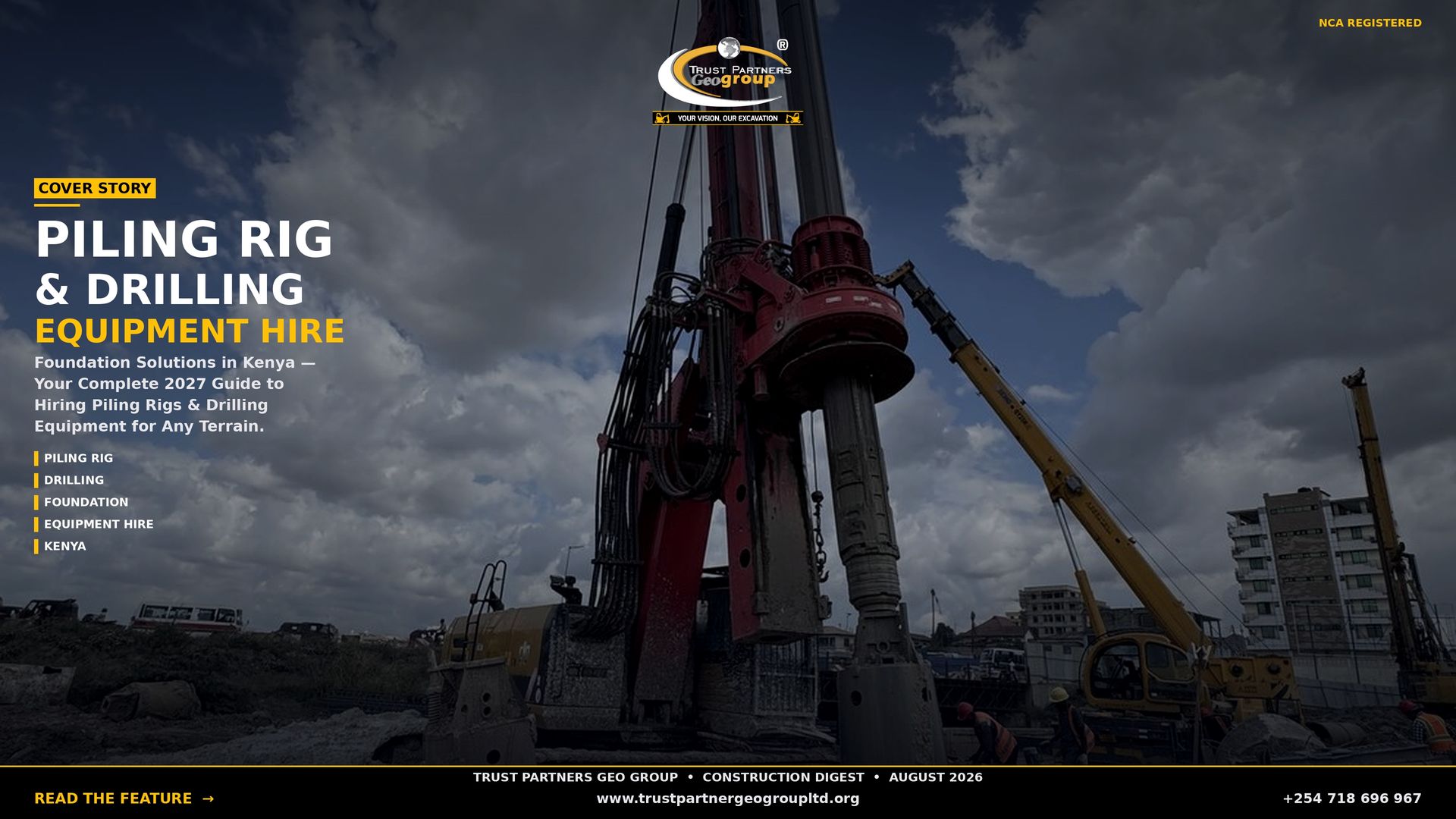
When surface soils cannot carry the load of a building, bridge or industrial facility, piled foundations are the only solution. Piling rigs drill deep into stable ground — past weak black cotton soil, loose coastal sand and high water tables — to anchor structures on bedrock or dense murram. This guide covers everything Kenyan developers, structural engineers and contractors need to know about piling rig and drilling equipment hire in Kenya for 2027: bored piles, CFA, driven piles, hire rates and how Trust Partners Geo-Group delivers foundation solutions across all 47 counties.

NCA-registered excavation and heavy equipment hire contractor with 15+ years operating across Kenya. Our piling fleet includes rotary drilling rigs, CFA rigs and hydraulic drill rigs for bored piles, driven piles and foundation drilling.
What Is a Piling Rig and When Do You Need One?
A piling rig is a heavy-duty drilling machine that creates deep foundation piles by boring or driving columns into the ground to transfer building loads to stable soil or rock layers. Unlike shallow foundations (strip footings, raft slabs) that spread load across surface soils, piles bypass weak upper layers and anchor in competent strata deep below.
In Kenya, piling rigs are essential when:
- Black cotton soil is present: Nairobi, Kiambu, Kajiado and parts of Nakuru sit on expansive clay that shrinks and swells — shallow foundations crack and settle differentially.
- Coastal sands are loose: Mombasa, Malindi and Diani have loose, saturated sands that liquefy under vibration and cannot support heavy loads.
- High water table exists: Areas near rivers, lakes and wetlands have groundwater within metres of the surface, making excavation impractical.
- High-rise loads exceed soil capacity: Buildings above 8 storeys, bridges, transmission towers and water tanks concentrate loads that shallow soils cannot bear.
- Steep slopes or hillside construction: Rift Valley escarpments and Aberdare foothills require deep anchoring to prevent sliding and overturning.
Types of Piling Rigs and Drilling Equipment in Kenya
Rotary Bored Piling Rigs
Rotary rigs use a Kelly bar or telescopic drill string with a rock auger or bucket to excavate pile holes. A temporary steel casing prevents collapse in loose soils. After drilling to design depth, a reinforcement cage is lowered and the hole is filled with tremie concrete. Rotary rigs are the most versatile piling solution in Kenya, handling everything from soft clay to hard Nairobi phonolite.
CFA (Continuous Flight Auger) Rigs
CFA rigs drill with a hollow-stem auger that carries soil to the surface continuously. At depth, concrete is pumped through the hollow stem while the auger is withdrawn — no soil is left in the hole and no temporary casing is needed. CFA is the fastest piling method, producing 15–25 piles per day with minimal vibration and noise — ideal for urban Nairobi where adjacent buildings are close.
Driven Pile Rigs (Hydraulic Hammers)
Driven pile rigs use a hydraulic hammer to force prefabricated concrete or steel piles into the ground. This is the fastest method overall but generates significant vibration and noise. In Kenya, driven piles are restricted in dense urban areas and are primarily used for bridge piers, marine structures and industrial foundations where vibration is not a concern.
Micropile and Anchoring Drill Rigs
Small hydraulic drill rigs (8–15 ton) install micropiles (100–300 mm diameter) and ground anchors for slope stabilization, underpinning existing buildings and restricted-access sites. These rigs are essential for retrofit foundations in Nairobi's CBD and hillside construction in Kiambu and Limuru.
Bored Piles vs Driven Piles vs CFA: Method Comparison
| Factor | Bored Piles (Rotary) | CFA Piles | Driven Piles |
|---|---|---|---|
| Best For | Hard rock, variable soils, high loads | Medium loads, urban sites, speed | Marine, bridges, uniform soils |
| Diameter Range | 400 – 2,500 mm | 300 – 1,200 mm | 250 – 600 mm (pre-cast) |
| Depth Range | 10 – 60+ metres | 8 – 30 metres | 8 – 40 metres |
| Daily Production | 4 – 8 piles/day | 15 – 25 piles/day | 10 – 20 piles/day |
| Vibration Level | Low | Very Low | High |
| Noise Level | Moderate | Low | High |
| Soil Removal | Yes (augured/spoiled) | No (auger conveys soil out) | No (displaces soil) |
| Concrete Volume | High (overbreak allowance) | Moderate | None (pre-cast element) |
| Typical Cost per Metre | KES 12,000 – 22,000 | KES 9,000 – 16,000 | KES 8,000 – 14,000 |
| Urban Suitability | Good | Excellent | Poor (vibration restrictions) |
Piling Rig Hire Rates in Kenya 2027
The following table reflects Trust Partners Geo-Group's 2027 rate structure for piling and drilling equipment:
| Hire Basis | Small Drill Rig (8–15 ton) | Medium Rotary Rig (40–60 ton) | Large CFA/Crawler Rig (80–120 ton) | Notes |
|---|---|---|---|---|
| Wet Hire (per hour) | KES 12,000 – 18,000 | KES 22,000 – 30,000 | KES 32,000 – 45,000 | Includes operator, fuel, lubricants |
| Daily Rate (8 hrs) | KES 85,000 – 125,000 | KES 160,000 – 220,000 | KES 240,000 – 340,000 | Standard shift; overtime 1.5x |
| Weekly Rate (6 days) | KES 450,000 – 650,000 | KES 850,000 – 1,200,000 | KES 1,300,000 – 1,850,000 | 48 hours included; excess hourly |
| Monthly Rate | KES 1.6 – 2.4 million | KES 3.8 – 5.2 million | KES 5.5 – 7.8 million | 200 hours/month; major maintenance by owner |
| Mobilization (Nairobi) | KES 35,000 – 55,000 | KES 65,000 – 95,000 | KES 120,000 – 180,000 | Low-bed trailer, permits, escort |
| Mobilization (Upcountry) | KES 85,000 – 140,000 | KES 150,000 – 220,000 | KES 280,000 – 400,000 | Nakuru, Kisumu, Mombasa, Nanyuki |
| Consumables Deposit | KES 150,000 – 250,000 | KES 300,000 – 500,000 | KES 450,000 – 700,000 | Auger teeth, casing, tremie pipes |
Interactive Cost Calculator
Use the calculator below to estimate your piling project costs based on your specific requirements. All rates are drawn directly from our 2027 pricing structure above.
Piling Rig Hire Cost Calculator — Kenya 2027
Cost Estimate
Foundation Applications in Kenyan Construction
High-Rise Buildings in Nairobi
Nairobi's skyline — from Upper Hill to Kilimani to Westlands — is built on piled foundations. Buildings above 8 storeys require piles to bypass black cotton soil and anchor in weathered rock or dense murram at 15–35 metres depth. CFA piles dominate urban sites due to low vibration, while rotary bored piles handle the heaviest loads for towers above 20 storeys.
Bridges and Flyovers
Bridge piers along the Nairobi–Nakuru highway, Mombasa–Nairobi Standard Gauge Railway (SGR) and county road networks rely on large-diameter bored piles (1,200–2,000 mm) drilled to 30–50 metres. These piles must resist lateral loads from traffic, wind and seismic forces — requiring full-length reinforcement cages and high-strength concrete.
Transmission Towers and Wind Turbines
Kenya Power transmission towers and Lake Turkana Wind Power turbines require deep pile foundations to resist uplift and overturning forces. Micropiles and small-diameter bored piles (300–450 mm) to 20–30 metres are the standard solution for these distributed infrastructure assets.
Water Tanks and Reservoirs
Elevated water tanks and ground reservoirs in Machakos, Kajiado and Laikipia use piled ring foundations to distribute hydrostatic loads evenly and prevent differential settlement on expansive soils. CFA piles are preferred for their speed and minimal spoil generation in environmentally sensitive water projects.
Industrial and Warehouse Foundations
Factories, warehouses and logistics parks in Athi River EPZ, Tatu City and Naivasha Industrial Park require heavy-duty foundations for crane rails, press machinery and rack storage systems. Driven piles or large rotary bored piles handle concentrated loads that raft foundations cannot support.
Trust Partners Geo-Group Piling & Drilling Fleet
Trust Partners Geo-Group maintains a dedicated piling and drilling fleet stationed in Nairobi with rapid mobilization to all 47 counties:
- Sany SR155 Rotary Piling Rig (55 ton): Medium-duty rotary rig for bored piles to 1,200 mm diameter and 35 metres depth. Primary deployment: high-rise buildings, commercial developments, bridge piers.
- Bauer BG 24 CFA Rig (75 ton): Continuous flight auger specialist for urban piling with minimal vibration. Primary deployment: residential towers, hospitals, schools in dense Nairobi neighbourhoods.
- Junttan PM20 Hydraulic Pile Driver (20 ton): Driven pile rig for pre-cast concrete and steel piles. Primary deployment: marine structures, bridge abutments, industrial foundations.
- Klemm KR 806 Micropile Rig (8 ton): Compact drill rig for micropiles, ground anchors and restricted-access underpinning. Primary deployment: CBD retrofit, hillside stabilization, foundation repair.
All piling operators hold NITA-certified plant operator cards, structural engineering inductions and first-aid certification. Every deployment includes a piling method statement, borehole logging protocol, concrete testing schedule and structural engineer sign-off.
Service coverage includes: Nairobi, Kiambu, Kajiado, Machakos, Mombasa, Nakuru, Kisumu, Naivasha, Nanyuki, Laikipia, Meru, Embu, Kericho and all 47 counties.
Book Your Piling Rig & Drilling Equipment for 2027
Foundation slots fill fast at the start of the dry season. Secure your rotary, CFA or driven pile rig with certified operator, full tooling and nationwide mobilization.
Call +254 718 686 967 Email for QuoteFrequently Asked Questions
What is a piling rig and when do you need one in Kenya?
A piling rig is a heavy-duty drilling machine that creates deep foundation piles by boring or driving columns into the ground to transfer building loads to stable soil or rock layers. In Kenya, piling rigs are essential when surface soils are too weak to support structures directly — common in Nairobi's black cotton soil zones, Mombasa's coastal sands, and areas with high water tables. High-rise buildings above 8 storeys, bridges, transmission towers, water tanks and industrial facilities on poor ground all require piled foundations.
How much does it cost to hire a piling rig in Kenya?
Piling rig hire rates in Kenya range from KES 22,000–35,000 per hour for wet hire of a medium-duty rotary piling rig (40–60 ton) with operator and fuel. Small hydraulic drilling rigs for light piling cost KES 12,000–18,000 per hour. Daily rates for a standard piling rig average KES 160,000–240,000 for an 8-hour shift. Monthly contracts for continuous foundation work start from KES 3.8–5.5 million depending on rig size, project duration and mobilization distance. CFA piling rigs command a 20–30% premium due to specialized auger and concrete pumping equipment.
What is the difference between bored piles, driven piles and CFA piles?
Bored piles are created by drilling a hole into the ground, placing a steel reinforcement cage, and filling with concrete — ideal for hard ground and minimal vibration requirements. Driven piles are prefabricated concrete or steel piles hammered into the ground using a pile driver — fastest method but generates high vibration and noise, restricted in urban Nairobi. CFA (Continuous Flight Auger) piles use a hollow-stem auger drilled to depth, then concrete is pumped through the auger as it is withdrawn — no soil removal, minimal vibration, and fastest production rate of 15–25 piles per day.
What diameter and depth can piling rigs achieve in Kenya?
Piling rig capabilities in Kenya vary by machine class and ground conditions. Small hydraulic rigs (8–15 ton) drill piles from 300–600 mm diameter to 12–18 metres depth for light commercial and residential buildings. Medium rotary rigs (40–60 ton) handle 600–1,200 mm diameter piles to 30–40 metres depth for mid-rise buildings and bridges. Large crawler rigs (80–120 ton) achieve 1,200–2,500 mm diameter piles to 60+ metres depth for high-rise towers, major bridges and heavy industrial foundations. In Nairobi's black cotton soil, depths of 15–25 metres typically reach competent murram or weathered rock.
Do piling rig hire rates include the operator and fuel in Kenya?
Most Kenyan contractors quote piling rig hire on a wet-hire basis, including a certified piling operator, fuel, lubricants and routine maintenance. Wet hire is mandatory for piling work because rig operation requires specialized knowledge of torque control, vertical alignment, spoil removal and concrete placement. Dry hire is rarely available for piling rigs due to the technical complexity. Trust Partners Geo-Group provides wet-hire piling rigs with operators experienced in bored piles, CFA and rotary drilling across Kenya's varied soil conditions.
What soil conditions in Kenya require piled foundations?
Several Kenyan soil conditions necessitate piled foundations: (1) Black cotton soil (expansive clay) in Nairobi, Kiambu and Kajiado — highly plastic, shrinks and swells, causing differential settlement. (2) Coastal sands in Mombasa, Malindi and Diani — loose, liquefiable under seismic or vibratory loads. (3) Marsh and wetland soils around Lake Victoria, Naivasha and parts of Kano Plains — low bearing capacity and high compressibility. (4) Fill and reclaimed land in industrial zones — variable density and contamination. (5) Steep slopes and hillside construction in Rift Valley and Aberdare foothills — shallow foundations are unstable.
How long does piling work take for a typical building in Kenya?
Piling duration depends on pile quantity, diameter, depth, method and ground conditions. A typical 10-storey commercial building in Nairobi requiring 80 bored piles (600 mm diameter, 18 metres deep) takes 10–14 working days with one medium rotary rig producing 6–8 piles per day. A 20-storey residential tower with 120 CFA piles (450 mm diameter, 15 metres deep) takes 6–8 working days at 15–20 piles per day. Bridge piers with large-diameter piles (1,200 mm, 35 metres) take 2–3 days per pile. Delays from hard rock, groundwater, NEMA inspections or rebar cage fabrication can extend timelines by 30–50%.
What permits are required for piling work in Kenya?
Piling projects in Kenya require NEMA environmental impact assessment (EIA) clearance for projects near water bodies, wetlands or residential areas. NCA contractor registration is mandatory for all structural foundation work. County building permits must specify pile type, depth and load capacity. For projects near existing buildings, structural engineer sign-off on vibration monitoring plans is required — particularly important for driven piles in Nairobi's dense urban core. Geotechnical investigation reports from registered firms are required by most structural engineers before piling design approval. Trust Partners Geo-Group coordinates with geotechnical consultants, structural engineers and county authorities to ensure full compliance.
Related Resources
Planning a Foundation Project in 2027?
Contact Trust Partners Geo-Group at +254 718 686 967 for a free geotechnical assessment and itemized piling rig quote. Serving Nairobi, Mombasa, Kisumu, Nakuru, Naivasha, Nanyuki and all 47 counties.
Call +254 718 686 967 Request QuotePiling Rig and Drilling Equipment Hire in Kenya: Foundation Solutions [2027]
Bored Piles, CFA Piling & Rotary Drilling Rigs for High-Rise and Infrastructure Foundations
When surface soils cannot carry the load of a building, bridge or industrial facility, piled foundations are the only solution. Piling rigs drill deep into stable ground — past weak black cotton soil, loose coastal sand and high water tables — to anchor structures on bedrock or dense murram. This guide covers everything Kenyan developers, structural engineers and contractors need to know about piling rig and drilling equipment hire in Kenya for 2027: bored piles, CFA, driven piles, hire rates and how Trust Partners Geo-Group delivers foundation solutions across all 47 counties.
NCA-registered excavation and heavy equipment hire contractor with 15+ years operating across Kenya. Our piling fleet includes rotary drilling rigs, CFA rigs and hydraulic drill rigs for bored piles, driven piles and foundation drilling.
What Is a Piling Rig and When Do You Need One?
A piling rig is a heavy-duty drilling machine that creates deep foundation piles by boring or driving columns into the ground to transfer building loads to stable soil or rock layers. Unlike shallow foundations (strip footings, raft slabs) that spread load across surface soils, piles bypass weak upper layers and anchor in competent strata deep below.
In Kenya, piling rigs are essential when:
- Black cotton soil is present: Nairobi, Kiambu, Kajiado and parts of Nakuru sit on expansive clay that shrinks and swells — shallow foundations crack and settle differentially.
- Coastal sands are loose: Mombasa, Malindi and Diani have loose, saturated sands that liquefy under vibration and cannot support heavy loads.
- High water table exists: Areas near rivers, lakes and wetlands have groundwater within metres of the surface, making excavation impractical.
- High-rise loads exceed soil capacity: Buildings above 8 storeys, bridges, transmission towers and water tanks concentrate loads that shallow soils cannot bear.
- Steep slopes or hillside construction: Rift Valley escarpments and Aberdare foothills require deep anchoring to prevent sliding and overturning.
Types of Piling Rigs and Drilling Equipment in Kenya
Rotary Bored Piling Rigs
Rotary rigs use a Kelly bar or telescopic drill string with a rock auger or bucket to excavate pile holes. A temporary steel casing prevents collapse in loose soils. After drilling to design depth, a reinforcement cage is lowered and the hole is filled with tremie concrete. Rotary rigs are the most versatile piling solution in Kenya, handling everything from soft clay to hard Nairobi phonolite.
CFA (Continuous Flight Auger) Rigs
CFA rigs drill with a hollow-stem auger that carries soil to the surface continuously. At depth, concrete is pumped through the hollow stem while the auger is withdrawn — no soil is left in the hole and no temporary casing is needed. CFA is the fastest piling method, producing 15–25 piles per day with minimal vibration and noise — ideal for urban Nairobi where adjacent buildings are close.
Driven Pile Rigs (Hydraulic Hammers)
Driven pile rigs use a hydraulic hammer to force prefabricated concrete or steel piles into the ground. This is the fastest method overall but generates significant vibration and noise. In Kenya, driven piles are restricted in dense urban areas and are primarily used for bridge piers, marine structures and industrial foundations where vibration is not a concern.
Micropile and Anchoring Drill Rigs
Small hydraulic drill rigs (8–15 ton) install micropiles (100–300 mm diameter) and ground anchors for slope stabilization, underpinning existing buildings and restricted-access sites. These rigs are essential for retrofit foundations in Nairobi's CBD and hillside construction in Kiambu and Limuru.
Bored Piles vs Driven Piles vs CFA: Method Comparison
| Factor | Bored Piles (Rotary) | CFA Piles | Driven Piles |
|---|---|---|---|
| Best For | Hard rock, variable soils, high loads | Medium loads, urban sites, speed | Marine, bridges, uniform soils |
| Diameter Range | 400 – 2,500 mm | 300 – 1,200 mm | 250 – 600 mm (pre-cast) |
| Depth Range | 10 – 60+ metres | 8 – 30 metres | 8 – 40 metres |
| Daily Production | 4 – 8 piles/day | 15 – 25 piles/day | 10 – 20 piles/day |
| Vibration Level | Low | Very Low | High |
| Noise Level | Moderate | Low | High |
| Soil Removal | Yes (augured/spoiled) | No (auger conveys soil out) | No (displaces soil) |
| Concrete Volume | High (overbreak allowance) | Moderate | None (pre-cast element) |
| Typical Cost per Metre | KES 12,000 – 22,000 | KES 9,000 – 16,000 | KES 8,000 – 14,000 |
| Urban Suitability | Good | Excellent | Poor (vibration restrictions) |
Piling Rig Hire Rates in Kenya 2027
The following table reflects Trust Partners Geo-Group's 2027 rate structure for piling and drilling equipment:
| Hire Basis | Small Drill Rig (8–15 ton) | Medium Rotary Rig (40–60 ton) | Large CFA/Crawler Rig (80–120 ton) | Notes |
|---|---|---|---|---|
| Wet Hire (per hour) | KES 12,000 – 18,000 | KES 22,000 – 30,000 | KES 32,000 – 45,000 | Includes operator, fuel, lubricants |
| Daily Rate (8 hrs) | KES 85,000 – 125,000 | KES 160,000 – 220,000 | KES 240,000 – 340,000 | Standard shift; overtime 1.5x |
| Weekly Rate (6 days) | KES 450,000 – 650,000 | KES 850,000 – 1,200,000 | KES 1,300,000 – 1,850,000 | 48 hours included; excess hourly |
| Monthly Rate | KES 1.6 – 2.4 million | KES 3.8 – 5.2 million | KES 5.5 – 7.8 million | 200 hours/month; major maintenance by owner |
| Mobilization (Nairobi) | KES 35,000 – 55,000 | KES 65,000 – 95,000 | KES 120,000 – 180,000 | Low-bed trailer, permits, escort |
| Mobilization (Upcountry) | KES 85,000 – 140,000 | KES 150,000 – 220,000 | KES 280,000 – 400,000 | Nakuru, Kisumu, Mombasa, Nanyuki |
| Consumables Deposit | KES 150,000 – 250,000 | KES 300,000 – 500,000 | KES 450,000 – 700,000 | Auger teeth, casing, tremie pipes |
Interactive Cost Calculator
Use the calculator below to estimate your piling project costs based on your specific requirements. All rates are drawn directly from our 2027 pricing structure above.
Piling Rig Hire Cost Calculator — Kenya 2027
Cost Estimate
Foundation Applications in Kenyan Construction
High-Rise Buildings in Nairobi
Nairobi's skyline — from Upper Hill to Kilimani to Westlands — is built on piled foundations. Buildings above 8 storeys require piles to bypass black cotton soil and anchor in weathered rock or dense murram at 15–35 metres depth. CFA piles dominate urban sites due to low vibration, while rotary bored piles handle the heaviest loads for towers above 20 storeys.
Bridges and Flyovers
Bridge piers along the Nairobi–Nakuru highway, Mombasa–Nairobi Standard Gauge Railway (SGR) and county road networks rely on large-diameter bored piles (1,200–2,000 mm) drilled to 30–50 metres. These piles must resist lateral loads from traffic, wind and seismic forces — requiring full-length reinforcement cages and high-strength concrete.
Transmission Towers and Wind Turbines
Kenya Power transmission towers and Lake Turkana Wind Power turbines require deep pile foundations to resist uplift and overturning forces. Micropiles and small-diameter bored piles (300–450 mm) to 20–30 metres are the standard solution for these distributed infrastructure assets.
Water Tanks and Reservoirs
Elevated water tanks and ground reservoirs in Machakos, Kajiado and Laikipia use piled ring foundations to distribute hydrostatic loads evenly and prevent differential settlement on expansive soils. CFA piles are preferred for their speed and minimal spoil generation in environmentally sensitive water projects.
Industrial and Warehouse Foundations
Factories, warehouses and logistics parks in Athi River EPZ, Tatu City and Naivasha Industrial Park require heavy-duty foundations for crane rails, press machinery and rack storage systems. Driven piles or large rotary bored piles handle concentrated loads that raft foundations cannot support.
Trust Partners Geo-Group Piling & Drilling Fleet
Trust Partners Geo-Group maintains a dedicated piling and drilling fleet stationed in Nairobi with rapid mobilization to all 47 counties:
- Sany SR155 Rotary Piling Rig (55 ton): Medium-duty rotary rig for bored piles to 1,200 mm diameter and 35 metres depth. Primary deployment: high-rise buildings, commercial developments, bridge piers.
- Bauer BG 24 CFA Rig (75 ton): Continuous flight auger specialist for urban piling with minimal vibration. Primary deployment: residential towers, hospitals, schools in dense Nairobi neighbourhoods.
- Junttan PM20 Hydraulic Pile Driver (20 ton): Driven pile rig for pre-cast concrete and steel piles. Primary deployment: marine structures, bridge abutments, industrial foundations.
- Klemm KR 806 Micropile Rig (8 ton): Compact drill rig for micropiles, ground anchors and restricted-access underpinning. Primary deployment: CBD retrofit, hillside stabilization, foundation repair.
All piling operators hold NITA-certified plant operator cards, structural engineering inductions and first-aid certification. Every deployment includes a piling method statement, borehole logging protocol, concrete testing schedule and structural engineer sign-off.
Service coverage includes: Nairobi, Kiambu, Kajiado, Machakos, Mombasa, Nakuru, Kisumu, Naivasha, Nanyuki, Laikipia, Meru, Embu, Kericho and all 47 counties.
Book Your Piling Rig & Drilling Equipment for 2027
Foundation slots fill fast at the start of the dry season. Secure your rotary, CFA or driven pile rig with certified operator, full tooling and nationwide mobilization.
Call +254 718 686 967 Email for QuoteFrequently Asked Questions
What is a piling rig and when do you need one in Kenya?
A piling rig is a heavy-duty drilling machine that creates deep foundation piles by boring or driving columns into the ground to transfer building loads to stable soil or rock layers. In Kenya, piling rigs are essential when surface soils are too weak to support structures directly — common in Nairobi's black cotton soil zones, Mombasa's coastal sands, and areas with high water tables. High-rise buildings above 8 storeys, bridges, transmission towers, water tanks and industrial facilities on poor ground all require piled foundations.
How much does it cost to hire a piling rig in Kenya?
Piling rig hire rates in Kenya range from KES 22,000–35,000 per hour for wet hire of a medium-duty rotary piling rig (40–60 ton) with operator and fuel. Small hydraulic drilling rigs for light piling cost KES 12,000–18,000 per hour. Daily rates for a standard piling rig average KES 160,000–240,000 for an 8-hour shift. Monthly contracts for continuous foundation work start from KES 3.8–5.5 million depending on rig size, project duration and mobilization distance. CFA piling rigs command a 20–30% premium due to specialized auger and concrete pumping equipment.
What is the difference between bored piles, driven piles and CFA piles?
Bored piles are created by drilling a hole into the ground, placing a steel reinforcement cage, and filling with concrete — ideal for hard ground and minimal vibration requirements. Driven piles are prefabricated concrete or steel piles hammered into the ground using a pile driver — fastest method but generates high vibration and noise, restricted in urban Nairobi. CFA (Continuous Flight Auger) piles use a hollow-stem auger drilled to depth, then concrete is pumped through the auger as it is withdrawn — no soil removal, minimal vibration, and fastest production rate of 15–25 piles per day.
What diameter and depth can piling rigs achieve in Kenya?
Piling rig capabilities in Kenya vary by machine class and ground conditions. Small hydraulic rigs (8–15 ton) drill piles from 300–600 mm diameter to 12–18 metres depth for light commercial and residential buildings. Medium rotary rigs (40–60 ton) handle 600–1,200 mm diameter piles to 30–40 metres depth for mid-rise buildings and bridges. Large crawler rigs (80–120 ton) achieve 1,200–2,500 mm diameter piles to 60+ metres depth for high-rise towers, major bridges and heavy industrial foundations. In Nairobi's black cotton soil, depths of 15–25 metres typically reach competent murram or weathered rock.
Do piling rig hire rates include the operator and fuel in Kenya?
Most Kenyan contractors quote piling rig hire on a wet-hire basis, including a certified piling operator, fuel, lubricants and routine maintenance. Wet hire is mandatory for piling work because rig operation requires specialized knowledge of torque control, vertical alignment, spoil removal and concrete placement. Dry hire is rarely available for piling rigs due to the technical complexity. Trust Partners Geo-Group provides wet-hire piling rigs with operators experienced in bored piles, CFA and rotary drilling across Kenya's varied soil conditions.
What soil conditions in Kenya require piled foundations?
Several Kenyan soil conditions necessitate piled foundations: (1) Black cotton soil (expansive clay) in Nairobi, Kiambu and Kajiado — highly plastic, shrinks and swells, causing differential settlement. (2) Coastal sands in Mombasa, Malindi and Diani — loose, liquefiable under seismic or vibratory loads. (3) Marsh and wetland soils around Lake Victoria, Naivasha and parts of Kano Plains — low bearing capacity and high compressibility. (4) Fill and reclaimed land in industrial zones — variable density and contamination. (5) Steep slopes and hillside construction in Rift Valley and Aberdare foothills — shallow foundations are unstable.
How long does piling work take for a typical building in Kenya?
Piling duration depends on pile quantity, diameter, depth, method and ground conditions. A typical 10-storey commercial building in Nairobi requiring 80 bored piles (600 mm diameter, 18 metres deep) takes 10–14 working days with one medium rotary rig producing 6–8 piles per day. A 20-storey residential tower with 120 CFA piles (450 mm diameter, 15 metres deep) takes 6–8 working days at 15–20 piles per day. Bridge piers with large-diameter piles (1,200 mm, 35 metres) take 2–3 days per pile. Delays from hard rock, groundwater, NEMA inspections or rebar cage fabrication can extend timelines by 30–50%.
What permits are required for piling work in Kenya?
Piling projects in Kenya require NEMA environmental impact assessment (EIA) clearance for projects near water bodies, wetlands or residential areas. NCA contractor registration is mandatory for all structural foundation work. County building permits must specify pile type, depth and load capacity. For projects near existing buildings, structural engineer sign-off on vibration monitoring plans is required — particularly important for driven piles in Nairobi's dense urban core. Geotechnical investigation reports from registered firms are required by most structural engineers before piling design approval. Trust Partners Geo-Group coordinates with geotechnical consultants, structural engineers and county authorities to ensure full compliance.
Related Resources
Planning a Foundation Project in 2027?
Contact Trust Partners Geo-Group at +254 718 686 967 for a free geotechnical assessment and itemized piling rig quote. Serving Nairobi, Mombasa, Kisumu, Nakuru, Naivasha, Nanyuki and all 47 counties.
Call +254 718 686 967 Request Quote