Telehandler and Forklift Hire for Construction Sites in Kenya: Lifting Capacity Guide [2027]
Material Handling Equipment Hire — From Warehouses to Multi-Storey Building Sites
Moving materials efficiently on a construction site is the difference between hitting programme and bleeding budget. Telehandlers and forklifts are the workhorses of material handling — lifting cement, steel, roofing and formwork from ground level to height, across muddy yards and into tight warehouse aisles. This 2027 guide covers everything Kenyan contractors, developers and warehouse managers need to know about telehandler and forklift hire in Kenya: lifting capacities, machine types, hire rates and how Trust Partners Geo-Group delivers certified operators and maintained equipment across all 47 counties.

NCA-registered excavation and heavy equipment hire contractor with 15+ years operating across Kenya. Our material handling fleet includes telehandlers, rough-terrain forklifts and warehouse forklifts for construction, logistics and industrial projects.
What Is a Telehandler and When Do You Need One?
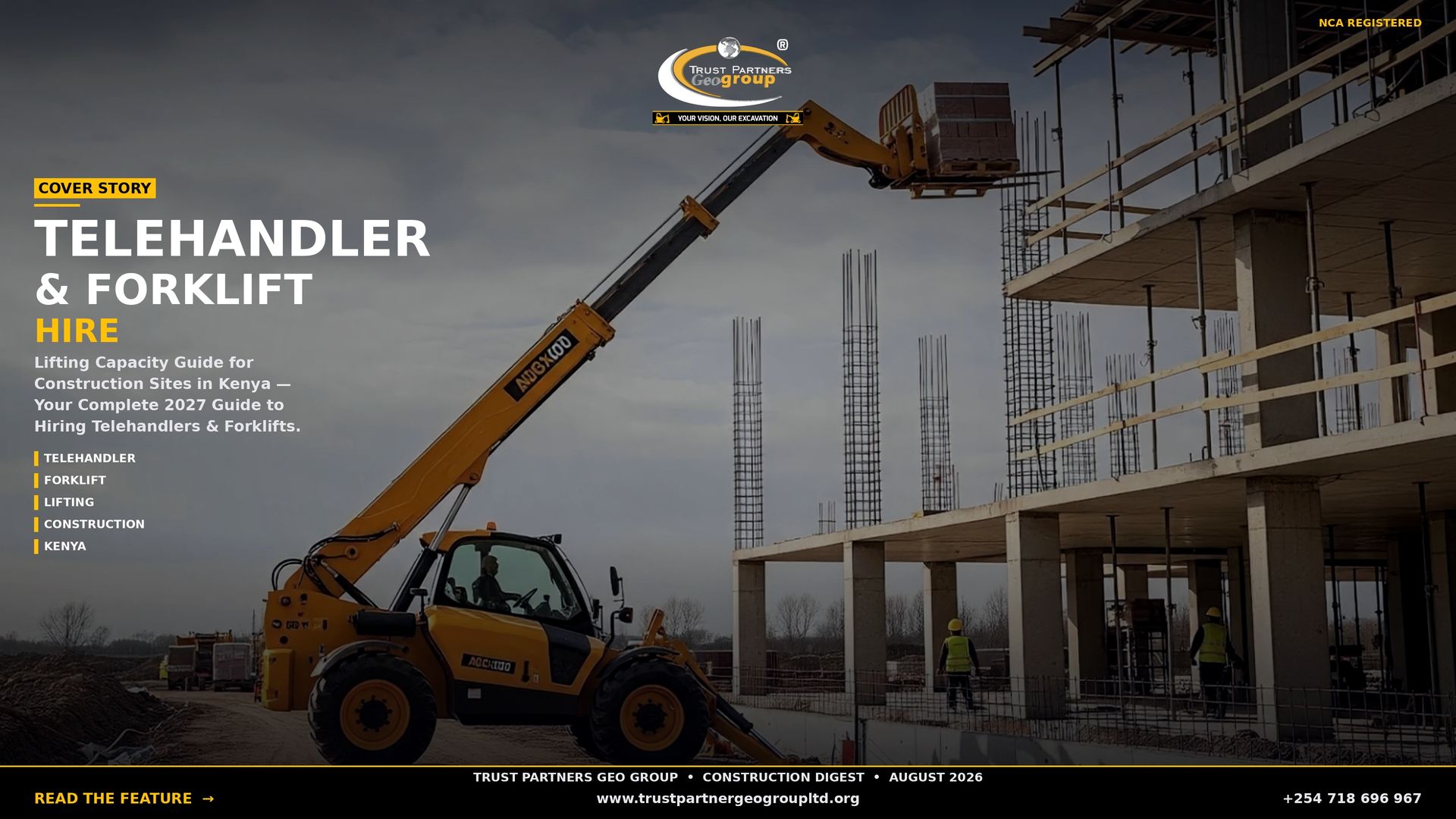
A telehandler (telescopic handler) is a versatile material handling machine that combines the vertical lifting capability of a forklift with the forward reach of a crane boom. Unlike standard forklifts that lift loads straight up, telehandlers extend a telescopic boom forward and upward — allowing them to place loads over obstacles, across trenches and onto upper floors of buildings under construction.
In Kenya, telehandlers and forklifts are essential when:
- Multi-storey construction requires material placement at height: Telehandlers lift cement, blocks, reinforcement and roofing materials to scaffolding and slab levels — eliminating manual carrying up staircases.
- Rough terrain makes standard forklifts unsafe: Construction sites in Nairobi, Kajiado and Ngong have mud, loose murram and uneven grading that warehouse forklifts cannot navigate.
- Steel erection and roofing truss installation: Telehandlers with 10–17 metre reach position structural steel and roofing components precisely without rigging a mobile crane.
- Warehouse and factory operations need palletized load movement: Standard forklifts handle fast, repetitive loading and stacking in EPZ factories, distribution centres and retail logistics hubs.
- Precast concrete panel installation: Heavy panels require both lifting capacity and reach that only large telehandlers or cranes can provide.
Types of Telehandlers and Forklifts for Kenyan Construction
Rough-Terrain Telehandlers (4x4)
Rough-terrain telehandlers are the standard for Kenyan construction sites. With four-wheel drive, large off-road tyres and articulated steering, they traverse muddy conditions, loose aggregate and sloped ground. Reach options range from 6 metres (single-storey buildings) to 17 metres (four-storey structures and steel erection). Load capacities span 3–5 tons. Trust Partners Geo-Group stocks Manitou and JCB rough-terrain telehandlers — the most reliable brands for East African conditions.
Rotating Telehandlers (Merlo, Magni)
Rotating telehandlers feature a cab and boom that rotate 360 degrees on a turret, combining telehandler reach with rough-terrain crane manoeuvrability. These are ideal for confined sites in Nairobi's CBD, Karen and Runda where space is limited and the machine must work from a single position. Capacities range from 4–5 tons with 18–25 metre reach.
Warehouse Forklifts (Counterbalance)
Standard counterbalance forklifts are designed for flat, hard surfaces — concrete warehouse floors, paved yards and loading docks. Diesel and LPG models are common in Kenya. Capacities range from 1.5 tons (light retail) to 10 tons (heavy industrial and container handling). Trust Partners Geo-Group provides Toyota, Linde and TCM forklifts for EPZ factories and distribution centres in Athi River, Mombasa and Nairobi.
Rough-Terrain Forklifts (Masted 4x4)
Rough-terrain forklifts bridge the gap between warehouse forklifts and telehandlers. They have masted vertical lift (no telescopic boom) but ride on large 4x4 tyres for uneven ground. Best for construction yards, brick factories and agricultural sites where loads are palletized but surfaces are unpaved. Capacities range from 2.5–5 tons.
Lifting Capacity Guide: Matching Machine to Load
| Machine Type | Capacity | Max Reach / Height | Best For | Typical Load Examples |
|---|---|---|---|---|
| Compact Telehandler | 2.5 – 3.0 ton | 6 – 7 metres | Single-storey, tight sites | Cement bags, timber, small steel sections |
| Standard Telehandler | 3.5 – 4.0 ton | 10 – 12 metres | 2–3 storey buildings, roofing | Block pallets, roofing sheets, reinforcement coils |
| Heavy Telehandler | 4.5 – 5.0 ton | 14 – 17 metres | Steel erection, precast, multi-storey | Steel trusses, precast panels, heavy formwork |
| Rotating Telehandler | 4.0 – 5.5 ton | 18 – 25 metres | Confined sites, high reach | Structural steel, glazing units, HVAC modules |
| Warehouse Forklift (3–5 ton) | 3.0 – 5.0 ton | 3 – 4.5 metres (mast) | Warehouses, yards, loading | Palletized goods, container stuffing |
| Heavy Forklift (7–10 ton) | 7.0 – 10.0 ton | 4 – 5 metres (mast) | Industrial, container yards | Machinery, generator sets, steel bundles |
| Rough-Terrain Forklift | 2.5 – 5.0 ton | 4 – 5 metres (mast) | Unpaved yards, farms, brick sites | Bricks, blocks, bagged cement on mud |
Telehandler & Forklift Hire Rates in Kenya 2027
The following table reflects Trust Partners Geo-Group's 2027 rate structure for material handling equipment:
| Machine | Daily Rate (8 hrs) | Weekly Rate (6 days) | Monthly Rate | Notes |
|---|---|---|---|---|
| Warehouse Forklift 3–5 ton | KES 8,000 – 15,000 | KES 42,000 – 72,000 | KES 180,000 – 320,000 | Wet hire; diesel or LPG |
| Heavy Forklift 7–10 ton | KES 15,000 – 25,000 | KES 78,000 – 120,000 | KES 320,000 – 520,000 | Wet hire; container-capable |
| Rough-Terrain Forklift 3–5 ton | KES 20,000 – 35,000 | KES 100,000 – 160,000 | KES 420,000 – 680,000 | 4x4; muddy site capable |
| Telehandler 6m reach (3–4 ton) | KES 25,000 – 40,000 | KES 130,000 – 200,000 | KES 550,000 – 850,000 | Rough-terrain; forks + bucket |
| Telehandler 10–12m reach (4 ton) | KES 35,000 – 50,000 | KES 180,000 – 260,000 | KES 750,000 – 1,100,000 | Multi-storey material placement |
| Telehandler 14–17m reach (5 ton) | KES 45,000 – 65,000 | KES 230,000 – 340,000 | KES 950,000 – 1,450,000 | Steel erection; precast handling |
| Rotating Telehandler 18–25m | KES 65,000 – 95,000 | KES 340,000 – 480,000 | KES 1,400,000 – 2,000,000 | 360° rotation; confined sites |
| Mobilization (Nairobi) | KES 8,000 – 18,000 depending on machine size and trailer type | |||
| Mobilization (Upcountry) | KES 25,000 – 65,000 depending on distance (Nakuru, Kisumu, Mombasa, Nanyuki) | |||
Material Handling Applications on Kenyan Sites
Multi-Storey Residential and Commercial Buildings
Nairobi's high-rise construction in Upper Hill, Kilimani and Westlands relies on telehandlers to lift block pallets, cement bags, reinforcement bars and formwork to upper floors. A 10–12 metre reach telehandler serves buildings up to 4 storeys from ground level, eliminating the need for tower cranes during the substructure and shell phases.
Warehouse and Logistics Parks
EPZ factories in Athi River, Tatu City logistics hubs and Naivasha industrial parks use warehouse forklifts for container unloading, pallet racking and production line feeding. Heavy 7–10 ton forklifts handle machinery installation and container stuffing for export cargo.
Steel Frame Construction and Roofing
Telehandlers with 14–17 metre reach are the preferred tool for steel frame erection and roofing installation. They position trusses, purlins and metal sheeting precisely without the setup time and cost of a mobile crane. This is especially valuable on church, school and warehouse projects across Kenya.
Precast Concrete and Modular Construction
Precast wall panels, floor slabs and beam units require both lifting capacity and reach. Heavy telehandlers (5 ton, 14m+ reach) handle panels up to 3 tons, while rotating telehandlers manoeuvre in tight factory and site conditions where crane access is limited.
Agriculture and Farm Construction
Rough-terrain forklifts and compact telehandlers serve Kenya's agricultural sector — loading fertiliser, moving produce, and constructing dairy housing, greenhouse frames and irrigation infrastructure. Their 4x4 capability handles the muddy conditions common on farms during rainy seasons.
Safety Standards and Operator Requirements
Telehandler and forklift operations in Kenya must comply with OSHA workplace safety standards, NCA construction site regulations and factory inspectorate requirements. Key safety protocols include:
- Certified Operators: All telehandler and forklift operators must hold NITA Plant Operator certification with specific endorsements for telescopic handlers or counterbalance forklifts. Trust Partners Geo-Group operators undergo additional site-safety inductions for every project.
- Daily Pre-Start Inspections: Brakes, hydraulics, tyres, boom pins, fork heels and load hooks are inspected and logged before every shift. Defective equipment is immediately withdrawn from service.
- Load Chart Compliance: Telehandler load charts are displayed in every cab. Operators are trained to calculate safe working loads at the exact boom angle, extension and attachment configuration before every lift.
- Exclusion Zones: A minimum 3-metre exclusion zone is maintained around the telehandler operating radius. Banksmen use standard hand signals and two-way radios to guide operators in congested sites.
- Outrigger Deployment: Telehandlers working at full extension on soft or sloped ground must deploy outriggers and use load-moment indicators to prevent tip-over.
- PPE: All personnel in the lifting zone wear hard hats, high-visibility vests, safety boots and eye protection. Overhead lifting zones are barrier-taped during active operations.
Trust Partners Geo-Group Material Handling Fleet
Trust Partners Geo-Group maintains a dedicated material handling fleet stationed in Nairobi with rapid mobilization to all 47 counties:
- Manitou MT 732 Rough-Terrain Telehandler (3.2 ton, 7m reach): Compact telehandler for single-storey construction, farm work and tight urban sites. Primary deployment: residential projects, schools, churches in Nairobi, Kiambu and Kajiado.
- JCB 540-140 Telehandler (4 ton, 14m reach): Standard heavy telehandler for multi-storey material placement and steel erection. Primary deployment: commercial buildings, warehouses, precast installation.
- Merlo Roto 45.21 Rotating Telehandler (4.5 ton, 21m reach): 360-degree rotating telehandler for confined sites and high-reach work. Primary deployment: CBD projects, industrial retrofits, glazing and HVAC installation.
- Toyota 8FD 3.5-ton Diesel Forklift: Reliable warehouse forklift for EPZ factories, distribution centres and retail logistics. Primary deployment: Athi River, Mombasa, Nairobi industrial zones.
- TCM 10-ton Heavy Forklift: Heavy-duty forklift for container handling, machinery installation and steel yard operations. Primary deployment: ports, logistics parks, industrial construction.
- Ausa C200 Rough-Terrain Forklift (2 ton, 4x4): Compact rough-terrain forklift for muddy construction yards, brick factories and agricultural sites. Primary deployment: rural construction, farm infrastructure, county projects.
All machines are maintained to manufacturer schedules with full hydraulic, engine and brake service records. Every deployment includes a method statement, risk assessment, operator certification and site-specific safety briefing.
Service coverage includes: Nairobi, Kiambu, Kajiado, Machakos, Mombasa, Nakuru, Kisumu, Naivasha, Nanyuki, Laikipia, Meru, Embu, Kericho and all 47 counties.
Book Your Telehandler or Forklift for 2027
Material handling equipment fills fast during peak construction season. Secure your telehandler or forklift with certified operator, full attachments and nationwide mobilization.
Call +254 718 686 967 Email for QuoteFrequently Asked Questions
What is the difference between a telehandler and a forklift?
A forklift is a material handling machine with vertical lifting forks designed for moving palletized loads on flat, hard surfaces like warehouses and yards. A telehandler (telescopic handler) combines forklift capability with a telescopic boom that extends forward and upward, allowing it to lift loads to height and reach over obstacles. Telehandlers are essential on uneven construction sites where rough terrain, mud and slopes make standard forklifts unsafe. Forklifts excel at fast, repetitive indoor and yard loading; telehandlers dominate outdoor construction, roofing, steel erection and multi-storey building material placement.
How much does it cost to hire a telehandler in Kenya?
Telehandler hire rates in Kenya range from KES 25,000–40,000 per day for a 6-metre reach rough-terrain telehandler (3–4 ton capacity) with operator. Large telehandlers with 14–17 metre reach and 5-ton capacity cost KES 45,000–65,000 per day. Weekly hire reduces the daily rate by 15–20%, with 6-day packages from KES 130,000–220,000 depending on reach and capacity. Monthly contracts for continuous construction projects start from KES 550,000–950,000. All rates are wet hire including certified operator, fuel and routine maintenance.
How much does it cost to hire a forklift in Kenya?
Forklift hire rates in Kenya vary by capacity and terrain type. Standard warehouse forklifts (3–5 ton) cost KES 8,000–15,000 per day wet hire. Heavy-duty forklifts (7–10 ton) for industrial and construction yard use cost KES 15,000–25,000 per day. Rough-terrain forklifts with 4x4 capability for muddy and uneven sites cost KES 20,000–35,000 per day. Weekly packages offer 15–20% savings, and monthly contracts for factory and warehouse operations start from KES 180,000–450,000 depending on machine size and shift pattern.
What lifting capacity do I need for my construction site?
Lifting capacity depends on your heaviest typical load plus a safety margin. For standard construction material pallets (cement, tiles, reinforcement bars), a 3–4 ton telehandler or forklift is sufficient. Steel frame construction and roofing trusses typically require 4–5 ton capacity with 10–14 metre reach. Precast concrete panels and heavy machinery placement need 5–7 ton telehandlers with 14–17 metre reach. Always check the load chart at full extension — a telehandler rated for 4 tons at 6 metres may only lift 1.5 tons at 14 metres. Trust Partners Geo-Group provides load chart briefings with every telehandler deployment.
Do telehandler and forklift hire rates include the operator in Kenya?
Yes, Trust Partners Geo-Group quotes telehandler and forklift hire on a wet-hire basis, including a NITA-certified operator, fuel, lubricants and routine maintenance. Operating a telehandler requires specialized training in load management, boom extension stability, rough-terrain manoeuvring and site safety — wet hire is mandatory for all deployments. Forklift operators also require NITA certification and site-specific inductions. Dry hire is available only for long-term warehouse contracts where the client employs certified in-house operators.
What are the main applications of telehandlers on Kenyan construction sites?
Telehandlers serve multiple roles on Kenyan construction sites: (1) Material placement — lifting cement, blocks, reinforcement and roofing materials to upper floors and scaffolding. (2) Steel erection — positioning trusses, purlins and structural steel at height. (3) Formwork support — placing and removing shuttering panels for concrete slabs and columns. (4) Precast installation — handling concrete wall panels and beam units. (5) Roofing and cladding — lifting metal sheets, tiles and insulation to roof level. (6) Multi-storey building work — extending over obstacles to place loads on balconies and intermediate floors. (7) Agriculture and warehousing — loading and stacking in EPZ factories and distribution centres.
What safety requirements apply to telehandler and forklift operations in Kenya?
Telehandler and forklift operations in Kenya must comply with OSHA workplace safety standards and NCA construction site regulations. Key requirements include: (1) NITA-certified operators with telehandler-specific endorsements. (2) Daily pre-start inspections of brakes, hydraulics, tyres, boom pins and load hooks. (3) Load capacity charts displayed in the cab and adhered to at all boom angles and extensions. (4) Exclusion zones around the operating radius to protect workers from falling loads and tip-over hazards. (5) Level ground or outrigger deployment for telehandlers working at full extension. (6) Proper signalling and banksman communication in congested sites. (7) PPE for all personnel in the lifting zone — hard hats, high-visibility vests and safety boots. Trust Partners Geo-Group provides method statements and risk assessments with every material handling deployment.
Which is better for a construction site — a telehandler or a mobile crane?
Telehandlers and mobile cranes serve different material handling roles. Telehandlers are faster, more manoeuvrable and cost-effective for loads under 5 tons at heights under 17 metres — ideal for routine material placement, roofing and steel erection on building sites. They can drive across rough terrain and position loads precisely without rigging. Mobile cranes are necessary for loads above 5 tons, heights above 20 metres, or where the load must be lifted over large obstacles or across site boundaries. Cranes also handle suspended loads with slings and hooks rather than forks. Many Kenyan construction sites use both: telehandlers for daily material movement and mobile cranes for heavy lifts during structural framing and precast installation.
Related Resources
Need Material Handling Equipment for Your 2027 Project?
Contact Trust Partners Geo-Group at +254 718 686 967 for a free site assessment and itemized telehandler or forklift quote. Serving Nairobi, Mombasa, Kisumu, Nakuru, Naivasha, Nanyuki and all 47 counties.
Call +254 718 686 967 Request QuoteTelehandler and Forklift Hire for Construction Sites in Kenya: Lifting Capacity Guide [2027]
Material Handling Equipment Hire — From Warehouses to Multi-Storey Building Sites
Moving materials efficiently on a construction site is the difference between hitting programme and bleeding budget. Telehandlers and forklifts are the workhorses of material handling — lifting cement, steel, roofing and formwork from ground level to height, across muddy yards and into tight warehouse aisles. This 2027 guide covers everything Kenyan contractors, developers and warehouse managers need to know about telehandler and forklift hire in Kenya: lifting capacities, machine types, hire rates and how Trust Partners Geo-Group delivers certified operators and maintained equipment across all 47 counties.
NCA-registered excavation and heavy equipment hire contractor with 15+ years operating across Kenya. Our material handling fleet includes telehandlers, rough-terrain forklifts and warehouse forklifts for construction, logistics and industrial projects.
What Is a Telehandler and When Do You Need One?
A telehandler (telescopic handler) is a versatile material handling machine that combines the vertical lifting capability of a forklift with the forward reach of a crane boom. Unlike standard forklifts that lift loads straight up, telehandlers extend a telescopic boom forward and upward — allowing them to place loads over obstacles, across trenches and onto upper floors of buildings under construction.
In Kenya, telehandlers and forklifts are essential when:
- Multi-storey construction requires material placement at height: Telehandlers lift cement, blocks, reinforcement and roofing materials to scaffolding and slab levels — eliminating manual carrying up staircases.
- Rough terrain makes standard forklifts unsafe: Construction sites in Nairobi, Kajiado and Ngong have mud, loose murram and uneven grading that warehouse forklifts cannot navigate.
- Steel erection and roofing truss installation: Telehandlers with 10–17 metre reach position structural steel and roofing components precisely without rigging a mobile crane.
- Warehouse and factory operations need palletized load movement: Standard forklifts handle fast, repetitive loading and stacking in EPZ factories, distribution centres and retail logistics hubs.
- Precast concrete panel installation: Heavy panels require both lifting capacity and reach that only large telehandlers or cranes can provide.
Types of Telehandlers and Forklifts for Kenyan Construction
Rough-Terrain Telehandlers (4x4)
Rough-terrain telehandlers are the standard for Kenyan construction sites. With four-wheel drive, large off-road tyres and articulated steering, they traverse muddy conditions, loose aggregate and sloped ground. Reach options range from 6 metres (single-storey buildings) to 17 metres (four-storey structures and steel erection). Load capacities span 3–5 tons. Trust Partners Geo-Group stocks Manitou and JCB rough-terrain telehandlers — the most reliable brands for East African conditions.
Rotating Telehandlers (Merlo, Magni)
Rotating telehandlers feature a cab and boom that rotate 360 degrees on a turret, combining telehandler reach with rough-terrain crane manoeuvrability. These are ideal for confined sites in Nairobi's CBD, Karen and Runda where space is limited and the machine must work from a single position. Capacities range from 4–5 tons with 18–25 metre reach.
Warehouse Forklifts (Counterbalance)
Standard counterbalance forklifts are designed for flat, hard surfaces — concrete warehouse floors, paved yards and loading docks. Diesel and LPG models are common in Kenya. Capacities range from 1.5 tons (light retail) to 10 tons (heavy industrial and container handling). Trust Partners Geo-Group provides Toyota, Linde and TCM forklifts for EPZ factories and distribution centres in Athi River, Mombasa and Nairobi.
Rough-Terrain Forklifts (Masted 4x4)
Rough-terrain forklifts bridge the gap between warehouse forklifts and telehandlers. They have masted vertical lift (no telescopic boom) but ride on large 4x4 tyres for uneven ground. Best for construction yards, brick factories and agricultural sites where loads are palletized but surfaces are unpaved. Capacities range from 2.5–5 tons.
Lifting Capacity Guide: Matching Machine to Load
| Machine Type | Capacity | Max Reach / Height | Best For | Typical Load Examples |
|---|---|---|---|---|
| Compact Telehandler | 2.5 – 3.0 ton | 6 – 7 metres | Single-storey, tight sites | Cement bags, timber, small steel sections |
| Standard Telehandler | 3.5 – 4.0 ton | 10 – 12 metres | 2–3 storey buildings, roofing | Block pallets, roofing sheets, reinforcement coils |
| Heavy Telehandler | 4.5 – 5.0 ton | 14 – 17 metres | Steel erection, precast, multi-storey | Steel trusses, precast panels, heavy formwork |
| Rotating Telehandler | 4.0 – 5.5 ton | 18 – 25 metres | Confined sites, high reach | Structural steel, glazing units, HVAC modules |
| Warehouse Forklift (3–5 ton) | 3.0 – 5.0 ton | 3 – 4.5 metres (mast) | Warehouses, yards, loading | Palletized goods, container stuffing |
| Heavy Forklift (7–10 ton) | 7.0 – 10.0 ton | 4 – 5 metres (mast) | Industrial, container yards | Machinery, generator sets, steel bundles |
| Rough-Terrain Forklift | 2.5 – 5.0 ton | 4 – 5 metres (mast) | Unpaved yards, farms, brick sites | Bricks, blocks, bagged cement on mud |
Telehandler & Forklift Hire Rates in Kenya 2027
The following table reflects Trust Partners Geo-Group's 2027 rate structure for material handling equipment:
| Machine | Daily Rate (8 hrs) | Weekly Rate (6 days) | Monthly Rate | Notes |
|---|---|---|---|---|
| Warehouse Forklift 3–5 ton | KES 8,000 – 15,000 | KES 42,000 – 72,000 | KES 180,000 – 320,000 | Wet hire; diesel or LPG |
| Heavy Forklift 7–10 ton | KES 15,000 – 25,000 | KES 78,000 – 120,000 | KES 320,000 – 520,000 | Wet hire; container-capable |
| Rough-Terrain Forklift 3–5 ton | KES 20,000 – 35,000 | KES 100,000 – 160,000 | KES 420,000 – 680,000 | 4x4; muddy site capable |
| Telehandler 6m reach (3–4 ton) | KES 25,000 – 40,000 | KES 130,000 – 200,000 | KES 550,000 – 850,000 | Rough-terrain; forks + bucket |
| Telehandler 10–12m reach (4 ton) | KES 35,000 – 50,000 | KES 180,000 – 260,000 | KES 750,000 – 1,100,000 | Multi-storey material placement |
| Telehandler 14–17m reach (5 ton) | KES 45,000 – 65,000 | KES 230,000 – 340,000 | KES 950,000 – 1,450,000 | Steel erection; precast handling |
| Rotating Telehandler 18–25m | KES 65,000 – 95,000 | KES 340,000 – 480,000 | KES 1,400,000 – 2,000,000 | 360° rotation; confined sites |
| Mobilization (Nairobi) | KES 8,000 – 18,000 depending on machine size and trailer type | |||
| Mobilization (Upcountry) | KES 25,000 – 65,000 depending on distance (Nakuru, Kisumu, Mombasa, Nanyuki) | |||
Material Handling Applications on Kenyan Sites
Multi-Storey Residential and Commercial Buildings
Nairobi's high-rise construction in Upper Hill, Kilimani and Westlands relies on telehandlers to lift block pallets, cement bags, reinforcement bars and formwork to upper floors. A 10–12 metre reach telehandler serves buildings up to 4 storeys from ground level, eliminating the need for tower cranes during the substructure and shell phases.
Warehouse and Logistics Parks
EPZ factories in Athi River, Tatu City logistics hubs and Naivasha industrial parks use warehouse forklifts for container unloading, pallet racking and production line feeding. Heavy 7–10 ton forklifts handle machinery installation and container stuffing for export cargo.
Steel Frame Construction and Roofing
Telehandlers with 14–17 metre reach are the preferred tool for steel frame erection and roofing installation. They position trusses, purlins and metal sheeting precisely without the setup time and cost of a mobile crane. This is especially valuable on church, school and warehouse projects across Kenya.
Precast Concrete and Modular Construction
Precast wall panels, floor slabs and beam units require both lifting capacity and reach. Heavy telehandlers (5 ton, 14m+ reach) handle panels up to 3 tons, while rotating telehandlers manoeuvre in tight factory and site conditions where crane access is limited.
Agriculture and Farm Construction
Rough-terrain forklifts and compact telehandlers serve Kenya's agricultural sector — loading fertiliser, moving produce, and constructing dairy housing, greenhouse frames and irrigation infrastructure. Their 4x4 capability handles the muddy conditions common on farms during rainy seasons.
Safety Standards and Operator Requirements
Telehandler and forklift operations in Kenya must comply with OSHA workplace safety standards, NCA construction site regulations and factory inspectorate requirements. Key safety protocols include:
- Certified Operators: All telehandler and forklift operators must hold NITA Plant Operator certification with specific endorsements for telescopic handlers or counterbalance forklifts. Trust Partners Geo-Group operators undergo additional site-safety inductions for every project.
- Daily Pre-Start Inspections: Brakes, hydraulics, tyres, boom pins, fork heels and load hooks are inspected and logged before every shift. Defective equipment is immediately withdrawn from service.
- Load Chart Compliance: Telehandler load charts are displayed in every cab. Operators are trained to calculate safe working loads at the exact boom angle, extension and attachment configuration before every lift.
- Exclusion Zones: A minimum 3-metre exclusion zone is maintained around the telehandler operating radius. Banksmen use standard hand signals and two-way radios to guide operators in congested sites.
- Outrigger Deployment: Telehandlers working at full extension on soft or sloped ground must deploy outriggers and use load-moment indicators to prevent tip-over.
- PPE: All personnel in the lifting zone wear hard hats, high-visibility vests, safety boots and eye protection. Overhead lifting zones are barrier-taped during active operations.
Trust Partners Geo-Group Material Handling Fleet
Trust Partners Geo-Group maintains a dedicated material handling fleet stationed in Nairobi with rapid mobilization to all 47 counties:
- Manitou MT 732 Rough-Terrain Telehandler (3.2 ton, 7m reach): Compact telehandler for single-storey construction, farm work and tight urban sites. Primary deployment: residential projects, schools, churches in Nairobi, Kiambu and Kajiado.
- JCB 540-140 Telehandler (4 ton, 14m reach): Standard heavy telehandler for multi-storey material placement and steel erection. Primary deployment: commercial buildings, warehouses, precast installation.
- Merlo Roto 45.21 Rotating Telehandler (4.5 ton, 21m reach): 360-degree rotating telehandler for confined sites and high-reach work. Primary deployment: CBD projects, industrial retrofits, glazing and HVAC installation.
- Toyota 8FD 3.5-ton Diesel Forklift: Reliable warehouse forklift for EPZ factories, distribution centres and retail logistics. Primary deployment: Athi River, Mombasa, Nairobi industrial zones.
- TCM 10-ton Heavy Forklift: Heavy-duty forklift for container handling, machinery installation and steel yard operations. Primary deployment: ports, logistics parks, industrial construction.
- Ausa C200 Rough-Terrain Forklift (2 ton, 4x4): Compact rough-terrain forklift for muddy construction yards, brick factories and agricultural sites. Primary deployment: rural construction, farm infrastructure, county projects.
All machines are maintained to manufacturer schedules with full hydraulic, engine and brake service records. Every deployment includes a method statement, risk assessment, operator certification and site-specific safety briefing.
Service coverage includes: Nairobi, Kiambu, Kajiado, Machakos, Mombasa, Nakuru, Kisumu, Naivasha, Nanyuki, Laikipia, Meru, Embu, Kericho and all 47 counties.
Book Your Telehandler or Forklift for 2027
Material handling equipment fills fast during peak construction season. Secure your telehandler or forklift with certified operator, full attachments and nationwide mobilization.
Call +254 718 686 967 Email for QuoteFrequently Asked Questions
What is the difference between a telehandler and a forklift?
A forklift is a material handling machine with vertical lifting forks designed for moving palletized loads on flat, hard surfaces like warehouses and yards. A telehandler (telescopic handler) combines forklift capability with a telescopic boom that extends forward and upward, allowing it to lift loads to height and reach over obstacles. Telehandlers are essential on uneven construction sites where rough terrain, mud and slopes make standard forklifts unsafe. Forklifts excel at fast, repetitive indoor and yard loading; telehandlers dominate outdoor construction, roofing, steel erection and multi-storey building material placement.
How much does it cost to hire a telehandler in Kenya?
Telehandler hire rates in Kenya range from KES 25,000–40,000 per day for a 6-metre reach rough-terrain telehandler (3–4 ton capacity) with operator. Large telehandlers with 14–17 metre reach and 5-ton capacity cost KES 45,000–65,000 per day. Weekly hire reduces the daily rate by 15–20%, with 6-day packages from KES 130,000–220,000 depending on reach and capacity. Monthly contracts for continuous construction projects start from KES 550,000–950,000. All rates are wet hire including certified operator, fuel and routine maintenance.
How much does it cost to hire a forklift in Kenya?
Forklift hire rates in Kenya vary by capacity and terrain type. Standard warehouse forklifts (3–5 ton) cost KES 8,000–15,000 per day wet hire. Heavy-duty forklifts (7–10 ton) for industrial and construction yard use cost KES 15,000–25,000 per day. Rough-terrain forklifts with 4x4 capability for muddy and uneven sites cost KES 20,000–35,000 per day. Weekly packages offer 15–20% savings, and monthly contracts for factory and warehouse operations start from KES 180,000–450,000 depending on machine size and shift pattern.
What lifting capacity do I need for my construction site?
Lifting capacity depends on your heaviest typical load plus a safety margin. For standard construction material pallets (cement, tiles, reinforcement bars), a 3–4 ton telehandler or forklift is sufficient. Steel frame construction and roofing trusses typically require 4–5 ton capacity with 10–14 metre reach. Precast concrete panels and heavy machinery placement need 5–7 ton telehandlers with 14–17 metre reach. Always check the load chart at full extension — a telehandler rated for 4 tons at 6 metres may only lift 1.5 tons at 14 metres. Trust Partners Geo-Group provides load chart briefings with every telehandler deployment.
Do telehandler and forklift hire rates include the operator in Kenya?
Yes, Trust Partners Geo-Group quotes telehandler and forklift hire on a wet-hire basis, including a NITA-certified operator, fuel, lubricants and routine maintenance. Operating a telehandler requires specialized training in load management, boom extension stability, rough-terrain manoeuvring and site safety — wet hire is mandatory for all deployments. Forklift operators also require NITA certification and site-specific inductions. Dry hire is available only for long-term warehouse contracts where the client employs certified in-house operators.
What are the main applications of telehandlers on Kenyan construction sites?
Telehandlers serve multiple roles on Kenyan construction sites: (1) Material placement — lifting cement, blocks, reinforcement and roofing materials to upper floors and scaffolding. (2) Steel erection — positioning trusses, purlins and structural steel at height. (3) Formwork support — placing and removing shuttering panels for concrete slabs and columns. (4) Precast installation — handling concrete wall panels and beam units. (5) Roofing and cladding — lifting metal sheets, tiles and insulation to roof level. (6) Multi-storey building work — extending over obstacles to place loads on balconies and intermediate floors. (7) Agriculture and warehousing — loading and stacking in EPZ factories and distribution centres.
What safety requirements apply to telehandler and forklift operations in Kenya?
Telehandler and forklift operations in Kenya must comply with OSHA workplace safety standards and NCA construction site regulations. Key requirements include: (1) NITA-certified operators with telehandler-specific endorsements. (2) Daily pre-start inspections of brakes, hydraulics, tyres, boom pins and load hooks. (3) Load capacity charts displayed in the cab and adhered to at all boom angles and extensions. (4) Exclusion zones around the operating radius to protect workers from falling loads and tip-over hazards. (5) Level ground or outrigger deployment for telehandlers working at full extension. (6) Proper signalling and banksman communication in congested sites. (7) PPE for all personnel in the lifting zone — hard hats, high-visibility vests and safety boots. Trust Partners Geo-Group provides method statements and risk assessments with every material handling deployment.
Which is better for a construction site — a telehandler or a mobile crane?
Telehandlers and mobile cranes serve different material handling roles. Telehandlers are faster, more manoeuvrable and cost-effective for loads under 5 tons at heights under 17 metres — ideal for routine material placement, roofing and steel erection on building sites. They can drive across rough terrain and position loads precisely without rigging. Mobile cranes are necessary for loads above 5 tons, heights above 20 metres, or where the load must be lifted over large obstacles or across site boundaries. Cranes also handle suspended loads with slings and hooks rather than forks. Many Kenyan construction sites use both: telehandlers for daily material movement and mobile cranes for heavy lifts during structural framing and precast installation.
Related Resources
Need Material Handling Equipment for Your 2027 Project?
Contact Trust Partners Geo-Group at +254 718 686 967 for a free site assessment and itemized telehandler or forklift quote. Serving Nairobi, Mombasa, Kisumu, Nakuru, Naivasha, Nanyuki and all 47 counties.
Call +254 718 686 967 Request Quote