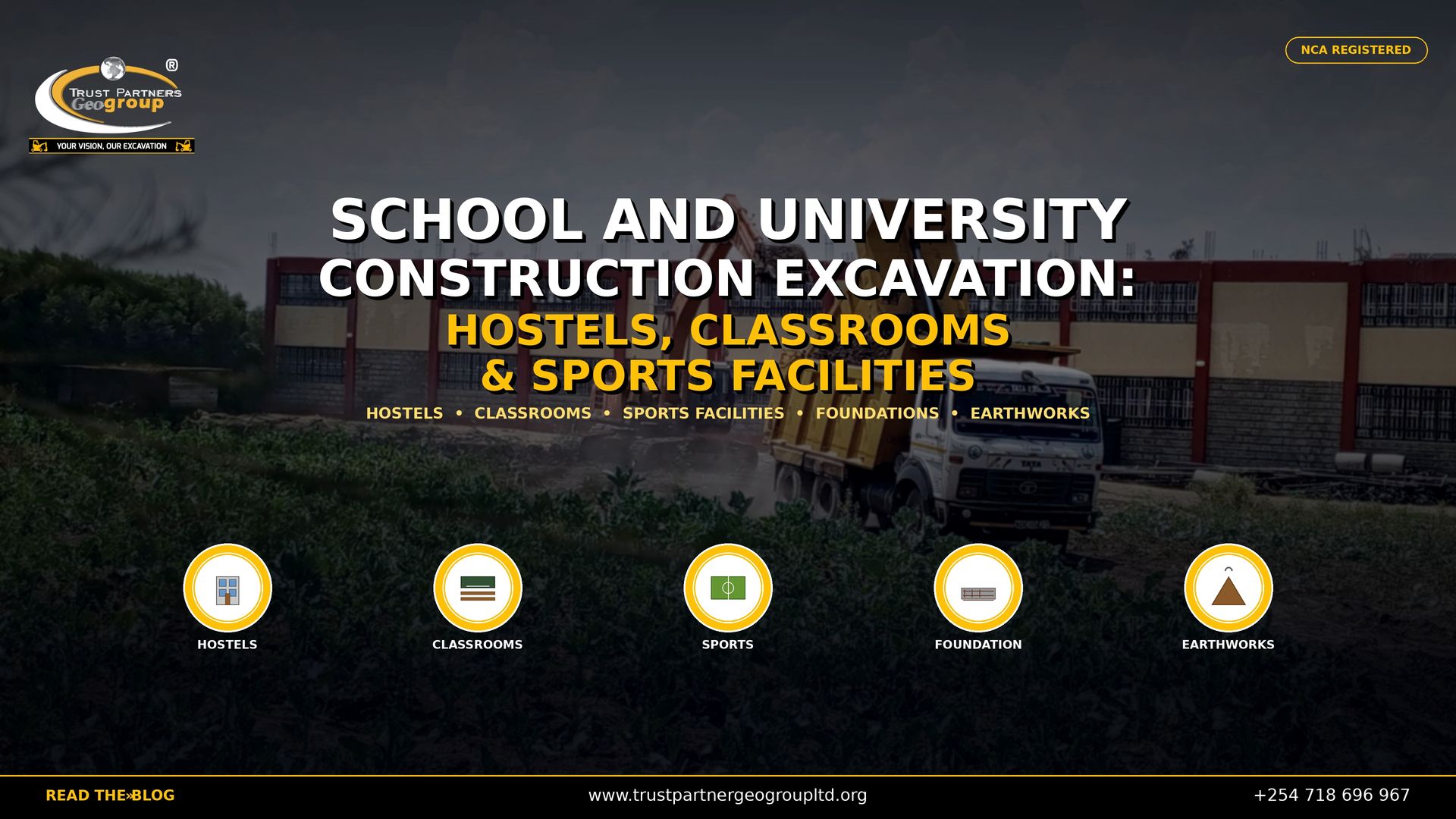
School and University Construction Excavation: Hostels, Classrooms and Sports Facilities in Kenya [2026]
Sector guide to institutional earthworks for Kenya's education infrastructure: foundations, sports facilities and phased construction
Table of Contents
- 1. The Education Infrastructure Imperative
- 2. What is Institutional Construction Excavation?
- 3. Classroom Block Foundation Excavation
- 4. Hostel and Dormitory Foundation Excavation
- 5. Sports Facility Earthworks and Grading
- 6. Laboratory and Library Foundation Requirements
- 7. Phased Construction and Academic Calendar Constraints
- 8. Equipment Selection for Institutional Sites
- 9. Cost Analysis and Budget Benchmarks [2026]
- 10. Regulatory Compliance for Education Sector Construction
- 11. Frequently Asked Questions
- 12. Conclusion
The bell rings at 7:30 AM. Two thousand students stream into classrooms that did not exist eighteen months ago. They sit at desks in buildings founded on earthworks executed during three compressed holiday periods, when excavators worked through April rains and August heat to deliver foundations before term reopened. This is the reality of school construction excavation in Kenya: not the leisurely programmes of commercial development, but intense, calendar-driven earthworks that must complete before the first student returns. Kenya's education sector is expanding at unprecedented scale. The Competency-Based Curriculum (CBC) requires new junior secondary school infrastructure. University enrolment growth demands hostel blocks, lecture halls, and sports facilities. And county governments are constructing technical institutes and vocational centres in every constituency. Each project requires classroom block foundation excavation, hostel building excavation for multi-storey dormitories, and sports facility earthworks that transform uneven ground into FIFA-standard football pitches and IAAF-compliant running tracks. Unlike residential or commercial excavation, institutional earthworks operate under unique constraints: academic calendars that prohibit construction during term time; safety requirements that protect students from construction hazards; repetitive foundation layouts that reward manufacturing-style efficiency; and county education boards that demand value-for-money scrutiny on every shilling spent. This sector guide provides a comprehensive methodology for university foundation construction in Nairobi and across Kenya. We cover classroom block foundations, hostel basement excavation, sports facility grading, laboratory requirements, phased construction strategies, and regulatory compliance for the education sector. Whether you are building a CBC junior secondary in Kiambu, expanding a university hostel in Juja, or constructing a county technical institute in Nakuru, Trust Partners Geo-Group Ltd provides the heavy equipment for hire and excavation in Kenya expertise that delivers institutional projects on time, on budget, and ready for the academic term.
Trust Partners Geo-Group Ltd - Institutional Construction & Education Sector Earthworks Team
NCA-registered contractor with 15+ years in school construction excavation, university foundation construction, hostel building excavation, sports facility earthworks and institutional construction across Nairobi, Kiambu, Kajiado, Machakos, Nakuru and all Kenyan counties.
1. The Education Infrastructure Imperative
Kenya's education system is undergoing structural transformation. The CBC implementation has created demand for over 10,000 new junior secondary school classrooms nationwide. University enrolment has grown by 8% annually, straining existing hostel and lecture hall capacity. And the government's TVET (Technical and Vocational Education and Training) expansion programme targets 200 new technical institutes by 2030. This construction boom represents one of the largest institutional earthworks markets in East Africa.
The Scale of Institutional Earthworks
A typical secondary school expansion requires: foundation excavation for 8-12 classroom blocks (120m x 10m total footprint); hostel foundation excavation for 2-4 dormitory blocks (3-4 storeys); administration and laboratory block foundations; sports field grading for football, athletics, and basketball; sanitation excavation for septic systems or sewer connections; and access road formation and drainage. A university hostel complex of 1,000 beds requires: basement excavation for parking and plant rooms; multi-storey foundation systems for 5-6 hostel blocks; dining hall and common room foundations; and sports and recreation facility earthworks. These are not small projects. A single secondary school expansion generates 2,000-4,000m3 of earthworks. A university hostel complex generates 8,000-15,000m3. The contractor who treats institutional excavation as scaled-up residential work will fail on programme and budget. The contractor who understands the manufacturing efficiency of repetitive foundations, the safety imperatives of student proximity, and the calendar rigidity of academic schedules will dominate this market.
2. What is Institutional Construction Excavation?
Institutional construction excavation for schools and universities encompasses all earthworks required to create foundations, platforms, sports surfaces, and infrastructure for educational facilities. It differs from commercial excavation in three critical dimensions: scale (hundreds of repetitive foundations rather than unique individual units); scheduling (academic calendar constraints that compress programmes into holiday periods); and safety (student protection requirements that govern site access, noise, dust, and vibration).
Scope of Education Sector Earthworks
A complete institutional earthworks package includes: bulk site clearance and mass grading for the entire campus or expansion area; topsoil stripping and conservation for landscape reinstatement; cut-and-fill earthworks to achieve platform levels for all building types; foundation excavation for classroom blocks, hostels, laboratories, libraries, and administration buildings; sports facility grading including football pitches, running tracks, basketball courts, and grandstands; drainage excavation for stormwater, sewerage, and surface water management; access road formation and compaction; and utility trenching for water, power, and communication reticulation. Trust Partners Geo-Group delivers all these elements as integrated packages, coordinating earthworks to align with academic calendars and student safety requirements.
Repetitive Foundation Advantage
Institutional construction offers a unique economic advantage: repetition. A secondary school may have 10 identical classroom blocks with identical foundation layouts. A university may have 6 identical hostel blocks. This repetition allows: template-based setting out that reduces survey time by 60%; standardized excavation depths and widths that optimize bucket selection; consistent compaction testing protocols that streamline quality control; and crew learning curves that improve productivity from block 1 to block 10. Trust Partners Geo-Group leverages repetitive foundation layouts to achieve production rates 25-35% higher than non-repetitive commercial projects of equivalent scale.
3. Classroom Block Foundation Excavation
Classroom blocks are the fundamental unit of educational construction. Their foundation excavation must be efficient, cost-controlled, and tolerant of the moderate structural loads imposed by 1-2 storey construction.
Foundation Types for Classrooms
Standard 1-2 storey classroom blocks in Kenya typically use strip foundations: 600-900mm deep, 400-600mm wide continuous concrete strips under load-bearing walls; column bases at 1.5-2.0m centres for veranda and covered walkway supports; and ground beam connections where blocks are linked by covered circulation. For 3-4 storey classroom blocks or laboratory buildings with heavy equipment, pad foundations or short bored piles may be required. In black cotton soil areas, complete soil replacement to 1.2-1.5m depth with select fill is standard, with raft foundations where replacement depth is excessive. Trust Partners Geo-Group has excavated classroom foundations for over 200 school blocks across Kenya, optimizing foundation depths for local soil conditions while maintaining the cost discipline that education budgets demand.
Excavation Methodology
Classroom foundation excavation uses 20-tonne excavators with trenching buckets in continuous runs. For a standard 10m x 60m classroom block, foundation trenches total 140-180 linear metres. Production rate is 40-60 linear metres per day per excavator on stable soils. Key controls: maintain ±25mm level tolerance; ensure vertical sides where formwork will be placed; remove all organic material and loose soil from trench bottoms; and protect excavations from rainwater infiltration before blinding. For repetitive blocks, GPS machine control or laser-guided buckets maintain consistent depth across all trenches without constant survey checks. Trust Partners Geo-Group programmes classroom foundation excavation in sequences of 2-3 blocks per week, allowing concrete teams to follow immediately and preventing trench collapse from weather exposure.
4. Hostel and Dormitory Foundation Excavation
Hostel blocks impose greater structural demands than classrooms. Multi-storey construction, concentrated live loads, and basement requirements for parking or plant rooms drive foundation complexity.
Multi-Storey Foundation Requirements
University hostels of 4-6 storeys require foundations capable of supporting 300-500 kN per column. Foundation options include: reinforced pad foundations (2.0m x 2.0m x 1.2m deep) on stable soils with bearing capacity exceeding 200 kPa; raft or mat foundations where soil is variable or expansive; and bored pile foundations where rock is shallow or bearing capacity is inadequate. Basement excavation for hostel plant rooms, storage, or parking adds 2.5-3.5m depth and requires retaining walls, dewatering, and shoring near boundaries. In Nairobi's university zones (Juja, Kahawa Sukari, Karen, Rongai), hostel basement excavation often encounters high water tables requiring continuous dewatering. Trust Partners Geo-Group has delivered hostel foundation excavations for universities and colleges across Kenya, from 3-storey dormitories on stable red soils to 6-storey blocks with basement parking on expansive clay.
Sanitation and Utility Integration
Hostel blocks require intensive utility infrastructure: sewerage connections at 1.5-2.5m depth for every block; water supply trenches with 1.0-1.5m separation from sewer lines; electrical trenches for block distribution; and communication ducts for internet and security systems. These trenches must be excavated and backfilled before road formation to prevent damage from construction traffic. For boarding schools without central sewerage, septic tank and soak pit excavation is required per block or cluster. Standard septic tank excavation is 3.0m x 2.0m x 2.5m deep for 200-student hostel blocks. Soak pits require 1.5m diameter x 3.0-4.0m depth with percolation testing before construction. Trust Partners Geo-Group integrates sanitation excavation with foundation work, preventing the programme delays that occur when utilities are treated as afterthoughts.
5. Sports Facility Earthworks and Grading
Sports facilities are the most precision-demanding earthworks in institutional construction. A football pitch with a 1% incorrect fall becomes a swimming pool in the rains. A running track with ±50mm level variation instead of ±10mm destroys athlete performance and voids synthetic surface warranties.
Football Pitch Grading
A standard FIFA-compliant football pitch is 90m x 60m with additional runoff zones, requiring earthworks across 7,000-8,000m2. Grading specifications: platform level within ±20mm across the entire pitch; 1-2% fall to perimeter drainage to prevent ponding; 300-400mm of engineered soil profile (subgrade, drainage layer, rootzone) for natural turf; and 250-350mm of engineered profile for synthetic surfaces. Natural turf pitches require: subgrade compacted to 85% MDD (softer than building foundations to allow root penetration); 100-150mm drainage gravel layer with perforated pipes at 5-10m centres; and 200-300mm rootzone mix (sand-soil blend) graded to final level. Synthetic turf requires: concrete or asphalt base (institutional standard) with ±10mm tolerance; or compacted stone base with shock pad layer. Trust Partners Geo-Group grades football pitches using laser-controlled motor graders and total station verification, achieving the tolerances required by both natural turf and synthetic surface contractors.
Running Track and Athletics Facilities
IAAF-compliant running tracks require extraordinary precision: subgrade tolerance of ±10mm across the entire 400m oval; consistent 1-2% crossfall for drainage; and radius accuracy within ±20mm for curved sections. The earthworks profile includes: subgrade excavation and compaction to 95% MDD; 150-200mm crushed stone base course; and asphalt or concrete wearing course placed by specialized contractors. Long jump and triple jump pits require 2.5m x 3.0m x 0.5m deep excavation with sand fill. High jump and pole vault landing areas require 5m x 5m x 0.6m deep foam pit excavations. Throwing sectors (discus, javelin, shot put) require fan-shaped graded areas with safety netting foundations. Trust Partners Geo-Group has graded athletics facilities for secondary schools and universities, coordinating earthworks with specialized track contractors to ensure subgrade tolerances meet international standards.
Grandstand and Spectator Foundations
Grandstands require stepped foundation excavation following spectator sight-line geometry. Each row riser is typically 400-450mm high with 600-700mm tread depth. Foundation excavation follows the stepped profile, with retaining walls at the front and rear. Drainage must be integrated to prevent water accumulation under seating areas. Trust Partners Geo-Group excavates grandstand foundations using total station-controlled profiles, ensuring that structural steel or precast seating contractors receive subgrades that match their fabrication tolerances.
6. Laboratory and Library Foundation Requirements
Laboratories and libraries impose foundation demands that exceed standard classrooms due to equipment loads, vibration sensitivity, and moisture control requirements.
Science Laboratory Foundations
Science laboratories house heavy equipment: fume hoods (200-400kg); autoclaves and sterilizers (300-600kg); and preparation room storage. Foundation requirements include: pad foundations at 1.5-2.0m centres capable of 250-350 kPa bearing capacity; vibration-isolated floors for sensitive microscopy and analytical equipment; and chemical-resistant drainage systems with acid-proof piping. Chemistry laboratories require spill containment trenches integrated into floor slabs, requiring precise subgrade excavation with falls to collection points. Biology laboratories requiring sterile conditions need floor subgrades with moisture barriers preventing groundwater vapour transmission. Trust Partners Geo-Group has excavated laboratory foundations for secondary schools and universities, coordinating with M&E engineers to ensure utility trenches align with equipment layouts.
Library Foundations
Library buildings impose concentrated floor loads from book storage: 5-10 kN/m2 for general reading areas; 10-15 kN/m2 for compact storage and archive areas; and 8-12 kN/m2 for server rooms and digital infrastructure. Foundations must prevent differential settlement that would jam shelving systems and crack plaster. Where libraries include basement storage, excavation extends to 2.5-3.0m depth with waterproofing and climate control subgrade preparation. Trust Partners Geo-Group prepares library subgrades with enhanced compaction (98% MDD) and plate load testing to verify bearing capacity exceeds 250 kPa under storage areas.
7. Phased Construction and Academic Calendar Constraints
The defining constraint of institutional construction is the academic calendar. Excavation must complete during holiday periods, or proceed without disrupting classes during term time.
Holiday Period Construction
Kenyan schools operate three-term calendars with holidays in April (2-3 weeks), August (3-4 weeks), and December-January (5-6 weeks). University calendars vary but typically include long breaks in April-August and December-February. The most intensive earthworks must occur during long holidays when sites are vacant. Trust Partners Geo-Group programmes institutional excavation in holiday sprints: December-January for major bulk earthworks and foundation excavation; April for drainage, utilities, and sports facility grading; and August for final grading, compaction, and handover before September opening. This phasing requires meticulous pre-holiday preparation: materials ordered, equipment mobilised, and crews briefed before the last student departs.
Term-Time Construction Protocols
Where programmes cannot be completed in holidays, term-time construction requires: 3-metre safety hoarding between construction zones and student areas; dust suppression with continuous misting during dry periods; noise control maintaining <65dB at classroom boundaries; restricted haul routes avoiding assembly areas, dining halls, and dormitories; and emergency evacuation route maintenance at all times. Construction hours are typically restricted to 08:00-16:00 to avoid early morning and evening student movements. Trust Partners Geo-Group has executed term-time expansions at operating schools and universities, maintaining zero safety incidents and minimal academic disruption through rigorous site management protocols.
8. Equipment Selection for Institutional Sites
Institutional sites require equipment fleets that balance production with safety, noise control, and spatial constraints.
| Operation | Primary Equipment | Support Equipment | Notes |
|---|---|---|---|
| Bulk clearing & grading | 20-tonne excavator, motor grader | Dump trucks | Holiday period priority |
| Classroom foundation trenches | 20-tonne excavator (trench bucket) | Dump trucks, plate compactor | 40-60m/day production |
| Hostel basement excavation | 20/30-tonne excavator | Dump trucks, dewatering pumps | Shoring near boundaries |
| Sports field grading | Motor grader (laser/GPS) | 10-tonne roller | ±20mm pitch tolerance |
| Running track subgrade | Motor grader (laser) | 10-tonne roller | ±10mm track tolerance |
| Utility trenching | 5-tonne compact excavator | Dump trucks, plate compactor | Confined between buildings |
| Sanitation excavation | 20-tonne excavator | Dump trucks | Deep, shored pits |
| Compaction | 10-tonne roller | Plate compactors | 95% MDD standard |
Safety and Noise Modifications
For institutional sites near occupied buildings, Trust Partners Geo-Group modifies equipment: excavators fitted with muffler systems maintaining <75dB at 10 metres; generators enclosed in acoustic containers; reverse alarms replaced with white-noise or broadband alerts that localize better than tonal beeps; and dust suppression via water bowser misting at all active excavation faces. These modifications cost 5-10% more in equipment hire but prevent the programme stoppages and community complaints that unmodified equipment generates.
9. Cost Analysis and Budget Benchmarks [2026]
Institutional construction costs must satisfy county education boards, university councils, and Ministry of Education auditors who scrutinize every shilling.
| Cost Element | Unit | 2026 Rate (KES) | Notes |
|---|---|---|---|
| Bulk site clearing | m2 | 35-65 | Light to dense vegetation |
| Topsoil strip and stockpile | m3 | 140-200 | Conservation for landscaping |
| Mass cut-and-fill (balanced) | m3 | 180-320 | Institutional scale efficiency |
| Classroom strip foundation | linear m | 850-1,400 | 600-900mm deep, red soil |
| Hostel pad foundation | m3 | 550-850 | 1.2-1.8m deep, reinforced |
| Hostel basement excavation | m3 | 650-1,100 | With retaining walls |
| Football pitch grading | m2 | 280-450 | Platform ±20mm |
| Running track subgrade | m2 | 350-550 | Platform ±10mm |
| Grandstand stepped foundation | m3 | 650-950 | Precision profile |
| Utility trenching | linear m | 250-420 | 600-1,200mm deep |
| Septic tank excavation | m3 | 650-950 | Deep, shored, dewatered |
| Compaction testing | test | 8,500-15,000 | Sand replacement or nuclear |
| Black cotton soil removal | m3 | 450-750 | Excavation + replacement |
Typical project costs: A secondary school expansion with 8 classrooms, 2 dormitories, and sports facilities costs KES 2.5-4.5 million for complete earthworks on stable red soil. A university hostel complex (500 beds, 4 storeys, basement parking) costs KES 6-10 million. A county technical institute with workshops, classrooms, and sports facilities costs KES 3.5-6 million. Programme: secondary school = 4-6 weeks; university hostel = 8-12 weeks; technical institute = 5-8 weeks. Trust Partners Geo-Group provides fixed-price institutional packages with academic calendar guarantees and phased payment terms.
10. Regulatory Compliance for Education Sector Construction
Institutional construction operates under a multi-layered regulatory framework that includes education-specific requirements beyond standard building codes.
National Construction Authority (NCA)
All institutional contractors must be NCA-registered. School projects typically fall under Class NCA 2 (KES 100-500 million) or Class NCA 3 (KES 20-100 million), while university projects require Class NCA 1. The contractor must register the project, employ registered site supervisors, and maintain safety records. For excavation, NCA requires geotechnical reports, structural engineer sign-off on foundations, and compliance with the National Building Code.
Ministry of Education and County Education Boards
The Ministry of Education (MOE) and county education boards regulate school construction through: project approval for all public school construction; standards compliance for classroom sizes, sanitation ratios, and safety requirements; and inspection at foundation, wall plate, and completion stages. Boarding schools require additional approval for dormitory construction from the MOE's school inspectorate. Universities regulate construction through their respective councils, with project committees overseeing contractor selection and progress. Trust Partners Geo-Group coordinates with MOE inspectors and university project committees to ensure excavation milestones align with inspection schedules.
NEMA and Public Health Requirements
Institutional projects exceeding 5 acres or 500 students require NEMA Environmental Impact Assessment. All projects require: sediment control preventing construction runoff from contaminating school water sources; dust suppression protecting student respiratory health; noise control during term time; and proper disposal of excavation spoil. Public health approval is required for sanitation designs, ensuring septic systems or sewer connections meet student population requirements (minimum 1 toilet per 25 girls, 1 per 30 boys, plus urinals). Trust Partners Geo-Group implements NEMA-compliant environmental management and coordinates with public health officers on sanitation excavation.
11. Frequently Asked Questions: School and University Construction Excavation in Kenya
How much does school and university construction excavation cost in Kenya in 2026?
School and university construction excavation in Kenya in 2026 costs KES 380-650 per m3 for institutional foundations depending on soil conditions, building type and scale. A standard classroom block (20m x 10m footprint) costs KES 180,000-320,000 for foundation excavation. A 5-storey university hostel with 2,000m2 footprint costs KES 850,000-1.5 million for basement and foundation excavation. A sports facility with running track, football pitch and grandstand costs KES 2.5-5 million for complete earthworks including grading, drainage and foundation excavation. Bulk institutional earthworks achieve 20-30% cost savings through repetitive foundation layouts and coordinated fleet deployment. Trust Partners Geo-Group provides volume-based pricing for institutional developers with phased payment terms aligned to academic calendars.
What foundation type is best for school classroom blocks in Kenya?
Strip foundations are the standard and most cost-effective solution for 1-2 storey classroom blocks in Kenya, costing KES 45,000-75,000 per classroom and providing adequate support on stable red coffee soils with bearing capacity exceeding 150 kPa. For 3-4 storey classroom blocks or laboratory buildings with heavy equipment loads, reinforced strip foundations or pad foundations at 800-1,200mm depth are required, costing KES 85,000-140,000 per bay. In black cotton soil areas, raft foundations or complete soil replacement with select fill are necessary, increasing costs to KES 120,000-200,000 per classroom. For multi-storey hostels exceeding 5 floors, pile foundations may be required where bearing capacity is inadequate. Trust Partners Geo-Group recommends geotechnical investigation for all institutional projects to optimize foundation selection and minimize long-term maintenance.
How long does foundation excavation take for a school construction project in Kenya?
Foundation excavation for a standard primary school with 8 classroom blocks, administration block and sanitation facilities takes 4-6 weeks in Nairobi's red soil conditions. A secondary school with 16 classrooms, 2 laboratories, library and dormitory blocks requires 8-12 weeks. A university hostel complex with 5-storey blocks, basement parking and sports facilities requires 12-18 weeks. The programme breaks down as: bulk site clearance and mass grading (1-2 weeks); foundation trench excavation for classroom blocks (2-3 weeks); hostel and multi-storey foundation excavation (3-5 weeks); sports facility grading and drainage (2-3 weeks); and compaction testing and certification (1 week). Academic calendar constraints often require completion during holiday periods (April, August, December), compressing programmes by 30%. Trust Partners Geo-Group programmes institutional excavation to align with school holiday schedules, ensuring zero disruption to academic activities.
What equipment is used for school and university construction excavation in Kenya?
School and university construction excavation in Kenya typically uses: 20-tonne excavators with trenching buckets for bulk earthworks, classroom foundation trenches and hostel basement excavation; 5-tonne compact excavators for confined areas between existing buildings, utility trenches and sanitation facilities; motor graders for sports field grading, access road formation and site leveling; 10-tonne smooth drum rollers for subgrade and fill compaction; 20-tonne dump trucks for spoil removal and imported fill delivery; and plate compactors for trench backfill and foundation pad edge compaction. For sports facilities, laser-controlled graders achieve the ±20mm tolerance required for synthetic track and football pitch surfaces. Trust Partners Geo-Group provides complete institutional construction fleets with NCA-certified operators trained in school site safety, dust suppression, and noise control during term time.
Do school construction projects in Kenya require NEMA and NCA approval for excavation?
Yes. All school and university construction projects require NCA contractor registration and project registration under the National Construction Authority Act. NEMA Environmental Impact Assessment is required for institutional projects exceeding 5 acres or 500 students under the Environmental Management and Coordination Act. Smaller projects require a simplified Environmental Audit. The Ministry of Education must approve all school construction projects through county education boards or university councils. County government approval is required for building plans, subdivision layouts and infrastructure designs. Boarding schools and university hostels additionally require public health approval for sanitation and water supply designs. Trust Partners Geo-Group is an NCA-registered contractor (Class NCA 1) with NEMA compliance capability, providing institutional developers with complete regulatory documentation for education sector earthworks.
How does soil type affect school foundation costs in Nairobi and Kenyan counties?
Soil type significantly affects school foundation costs across Kenya. In Nairobi and Kiambu red coffee soil zones, classroom strip foundations cost KES 45,000-65,000 per unit with straightforward 600-900mm excavation. In black cotton soil zones (Kajiado, parts of Machakos, Nyandarua), expansive clay requires removal to 1.2-1.5m depth and replacement with select fill, increasing costs to KES 120,000-200,000 per classroom for raft foundations. In rocky areas (Nyeri, Meru, parts of Nakuru), rock breaking adds KES 30,000-60,000 per classroom block. In wetland or high-water-table areas (Kisumu, Busia, parts of Mombasa), dewatering and specialized foundations add KES 40,000-80,000 per unit. Trust Partners Geo-Group conducts geotechnical investigation before institutional excavation to classify soils and optimize foundation design, typically saving school developers 15-25% through soil-specific solutions.
Where can I hire heavy equipment for school and university construction excavation in Kenya?
Trust Partners Geo-Group Ltd provides heavy equipment for hire for school and university construction excavation across Nairobi, Kiambu, Kajiado, Machakos, Nakuru, Mombasa, Kisumu, Eldoret and all Kenyan counties. Our institutional construction fleet includes: 20-tonne excavators for bulk earthworks, classroom foundations and hostel basements; 5-tonne compact excavators for confined access between existing school buildings; motor graders with laser control for sports field precision grading; 10-tonne rollers for compaction to 95% MDD; 20-tonne dump trucks for spoil haulage and fill delivery; and plate compactors for utility trench backfill. We offer academic calendar-sensitive scheduling, completing excavation during school holidays to prevent disruption. All equipment includes NCA-certified operators trained in institutional site safety, dust suppression, and student protection protocols. Contact +254 718 68 69 67 for institutional construction excavation quotations.
12. Conclusion: Excavating the Future of Kenyan Education
Every classroom, every hostel room, every sports field, and every laboratory in Kenya begins as raw earth. The transformation from bush to build-ready platform is not merely a construction preliminary—it is the physical foundation upon which the nation's education system stands. A poorly excavated classroom foundation cracks in the first dry season, disrupting learning and wasting scarce education funds. An inadequately graded football pitch floods in April, rendering it unusable for the term. A hostel basement that leaks or settles creates maintenance liabilities that drain university budgets for decades.
The education sector demands excavation contractors who understand that institutional construction is different. The academic calendar is non-negotiable. Student safety is paramount. Repetitive foundations reward efficiency. And every shilling saved on earthworks is a shilling available for books, equipment, and teachers. The contractor who treats a school as merely another construction site will fail on programme, budget, and community trust. The contractor who respects the academic calendar, protects student welfare, and delivers precision earthworks at institutional scale will build lasting partnerships with county education boards, university councils, and Ministry of Education project teams.
Trust Partners Geo-Group Ltd has excavated foundations for schools, colleges, and universities across Kenya—from single classroom blocks in rural constituencies to multi-storey university hostels in Nairobi's academic corridors. We understand the unique demands of education sector construction: the holiday-period sprints that compress programmes into weeks; the term-time protocols that protect students from construction hazards; the repetitive efficiency that reduces per-unit foundation costs; and the regulatory landscape that involves NCA, NEMA, Ministry of Education, county boards, and public health departments. Our heavy equipment for hire fleet is configured for institutional production. Our operators are trained in school site safety and noise control. And our project managers coordinate earthworks to align with academic calendars, ensuring that foundations are ready before the first student arrives.
For county education departments, school boards of management, university project committees, and private education investors planning institutional construction in Nairobi, Kiambu, Kajiado, Machakos, Nakuru, or any Kenyan county, we provide the school construction excavation partnership that delivers education infrastructure on time, on budget, and ready for learning. Contact Trust Partners Geo-Group Ltd for a site-specific geotechnical assessment, academic calendar-aligned programme, and fixed-price quotation for your institutional earthworks project.
School & University Construction Excavation in Kenya
Institutional earthworks for classrooms, hostels, sports facilities and laboratories across Nairobi, Kiambu, Kajiado, Machakos, Nakuru, Mombasa, Kisumu and Eldoret.
Free lead magnet: ask for our Institutional Construction Earthworks Cost Calculator (PDF) - classroom, hostel and sports facility cost estimators, academic calendar planner, and 2026 rate benchmarks for Kenyan education projects.
Related Resources
Hospital Foundation Excavation in Kenya: Vibration Control and Precision Requirements
Technical whitepaper on vibration management, precision tolerances and regulatory compliance for medical facility construction earthworks.
READ MOREFoundation Excavation Cost Comparison Between Strip, Raft and Pile 2026
Detailed cost breakdown and selection guide for foundation types across Kenyan soil conditions, with per-unit pricing and programme comparisons.
READ MORESite Grading for Residential Construction: Slope Management, Drainage and Foundation Prep
Comprehensive guide to residential site grading, cut-and-fill balance, drainage design and foundation pad preparation for Kenyan homeowners and developers.
READ MOREAffordable Housing Project Excavation: Foundation Solutions for Kenya's Mass Housing Program
Government guide to mass housing foundation excavation, bulk earthworks, and cost optimization for Kenya's housing programme.
READ MOREBulk Basement Excavation in Kenya
Comprehensive guide to bulk basement excavation methods, equipment selection and cost control for Kenyan construction projects.
READ MORENCA Contractor Registration Requirements for Excavation Works in Kenya 2026
Compliance guide for NCA registration, project registration, site supervision requirements and regulatory documentation for construction contractors.
READ MORETRUST PARTNERS GEO-GROUP LTD | YOUR EXCAVATION IS OUR FUTURE
WEBSITE: WWW.TRUSTPARTNERGEOGROUPLTD.ORG | EMAIL: INFO@TRUSTPARTNERGEOGROUPLTD.ORG | PHONE: +254 718 68 69 67
FOLLOW US: FACEBOOK | TIKTOK | INSTAGRAM | LINKEDIN
© 2026 TRUST PARTNERS GEO-GROUP LTD. ALL RIGHTS RESERVED.
School and University Construction Excavation: Hostels, Classrooms and Sports Facilities in Kenya [2026]
Sector guide to institutional earthworks for Kenya's education infrastructure: foundations, sports facilities and phased construction
Table of Contents
- 1. The Education Infrastructure Imperative
- 2. What is Institutional Construction Excavation?
- 3. Classroom Block Foundation Excavation
- 4. Hostel and Dormitory Foundation Excavation
- 5. Sports Facility Earthworks and Grading
- 6. Laboratory and Library Foundation Requirements
- 7. Phased Construction and Academic Calendar Constraints
- 8. Equipment Selection for Institutional Sites
- 9. Cost Analysis and Budget Benchmarks [2026]
- 10. Regulatory Compliance for Education Sector Construction
- 11. Frequently Asked Questions
- 12. Conclusion
The bell rings at 7:30 AM. Two thousand students stream into classrooms that did not exist eighteen months ago. They sit at desks in buildings founded on earthworks executed during three compressed holiday periods, when excavators worked through April rains and August heat to deliver foundations before term reopened. This is the reality of school construction excavation in Kenya: not the leisurely programmes of commercial development, but intense, calendar-driven earthworks that must complete before the first student returns. Kenya's education sector is expanding at unprecedented scale. The Competency-Based Curriculum (CBC) requires new junior secondary school infrastructure. University enrolment growth demands hostel blocks, lecture halls, and sports facilities. And county governments are constructing technical institutes and vocational centres in every constituency. Each project requires classroom block foundation excavation, hostel building excavation for multi-storey dormitories, and sports facility earthworks that transform uneven ground into FIFA-standard football pitches and IAAF-compliant running tracks. Unlike residential or commercial excavation, institutional earthworks operate under unique constraints: academic calendars that prohibit construction during term time; safety requirements that protect students from construction hazards; repetitive foundation layouts that reward manufacturing-style efficiency; and county education boards that demand value-for-money scrutiny on every shilling spent. This sector guide provides a comprehensive methodology for university foundation construction in Nairobi and across Kenya. We cover classroom block foundations, hostel basement excavation, sports facility grading, laboratory requirements, phased construction strategies, and regulatory compliance for the education sector. Whether you are building a CBC junior secondary in Kiambu, expanding a university hostel in Juja, or constructing a county technical institute in Nakuru, Trust Partners Geo-Group Ltd provides the heavy equipment for hire and excavation in Kenya expertise that delivers institutional projects on time, on budget, and ready for the academic term.
Trust Partners Geo-Group Ltd - Institutional Construction & Education Sector Earthworks Team
NCA-registered contractor with 15+ years in school construction excavation, university foundation construction, hostel building excavation, sports facility earthworks and institutional construction across Nairobi, Kiambu, Kajiado, Machakos, Nakuru and all Kenyan counties.
1. The Education Infrastructure Imperative
Kenya's education system is undergoing structural transformation. The CBC implementation has created demand for over 10,000 new junior secondary school classrooms nationwide. University enrolment has grown by 8% annually, straining existing hostel and lecture hall capacity. And the government's TVET (Technical and Vocational Education and Training) expansion programme targets 200 new technical institutes by 2030. This construction boom represents one of the largest institutional earthworks markets in East Africa.
The Scale of Institutional Earthworks
A typical secondary school expansion requires: foundation excavation for 8-12 classroom blocks (120m x 10m total footprint); hostel foundation excavation for 2-4 dormitory blocks (3-4 storeys); administration and laboratory block foundations; sports field grading for football, athletics, and basketball; sanitation excavation for septic systems or sewer connections; and access road formation and drainage. A university hostel complex of 1,000 beds requires: basement excavation for parking and plant rooms; multi-storey foundation systems for 5-6 hostel blocks; dining hall and common room foundations; and sports and recreation facility earthworks. These are not small projects. A single secondary school expansion generates 2,000-4,000m3 of earthworks. A university hostel complex generates 8,000-15,000m3. The contractor who treats institutional excavation as scaled-up residential work will fail on programme and budget. The contractor who understands the manufacturing efficiency of repetitive foundations, the safety imperatives of student proximity, and the calendar rigidity of academic schedules will dominate this market.
2. What is Institutional Construction Excavation?
Institutional construction excavation for schools and universities encompasses all earthworks required to create foundations, platforms, sports surfaces, and infrastructure for educational facilities. It differs from commercial excavation in three critical dimensions: scale (hundreds of repetitive foundations rather than unique individual units); scheduling (academic calendar constraints that compress programmes into holiday periods); and safety (student protection requirements that govern site access, noise, dust, and vibration).
Scope of Education Sector Earthworks
A complete institutional earthworks package includes: bulk site clearance and mass grading for the entire campus or expansion area; topsoil stripping and conservation for landscape reinstatement; cut-and-fill earthworks to achieve platform levels for all building types; foundation excavation for classroom blocks, hostels, laboratories, libraries, and administration buildings; sports facility grading including football pitches, running tracks, basketball courts, and grandstands; drainage excavation for stormwater, sewerage, and surface water management; access road formation and compaction; and utility trenching for water, power, and communication reticulation. Trust Partners Geo-Group delivers all these elements as integrated packages, coordinating earthworks to align with academic calendars and student safety requirements.
Repetitive Foundation Advantage
Institutional construction offers a unique economic advantage: repetition. A secondary school may have 10 identical classroom blocks with identical foundation layouts. A university may have 6 identical hostel blocks. This repetition allows: template-based setting out that reduces survey time by 60%; standardized excavation depths and widths that optimize bucket selection; consistent compaction testing protocols that streamline quality control; and crew learning curves that improve productivity from block 1 to block 10. Trust Partners Geo-Group leverages repetitive foundation layouts to achieve production rates 25-35% higher than non-repetitive commercial projects of equivalent scale.
3. Classroom Block Foundation Excavation
Classroom blocks are the fundamental unit of educational construction. Their foundation excavation must be efficient, cost-controlled, and tolerant of the moderate structural loads imposed by 1-2 storey construction.
Foundation Types for Classrooms
Standard 1-2 storey classroom blocks in Kenya typically use strip foundations: 600-900mm deep, 400-600mm wide continuous concrete strips under load-bearing walls; column bases at 1.5-2.0m centres for veranda and covered walkway supports; and ground beam connections where blocks are linked by covered circulation. For 3-4 storey classroom blocks or laboratory buildings with heavy equipment, pad foundations or short bored piles may be required. In black cotton soil areas, complete soil replacement to 1.2-1.5m depth with select fill is standard, with raft foundations where replacement depth is excessive. Trust Partners Geo-Group has excavated classroom foundations for over 200 school blocks across Kenya, optimizing foundation depths for local soil conditions while maintaining the cost discipline that education budgets demand.
Excavation Methodology
Classroom foundation excavation uses 20-tonne excavators with trenching buckets in continuous runs. For a standard 10m x 60m classroom block, foundation trenches total 140-180 linear metres. Production rate is 40-60 linear metres per day per excavator on stable soils. Key controls: maintain ±25mm level tolerance; ensure vertical sides where formwork will be placed; remove all organic material and loose soil from trench bottoms; and protect excavations from rainwater infiltration before blinding. For repetitive blocks, GPS machine control or laser-guided buckets maintain consistent depth across all trenches without constant survey checks. Trust Partners Geo-Group programmes classroom foundation excavation in sequences of 2-3 blocks per week, allowing concrete teams to follow immediately and preventing trench collapse from weather exposure.
4. Hostel and Dormitory Foundation Excavation
Hostel blocks impose greater structural demands than classrooms. Multi-storey construction, concentrated live loads, and basement requirements for parking or plant rooms drive foundation complexity.
Multi-Storey Foundation Requirements
University hostels of 4-6 storeys require foundations capable of supporting 300-500 kN per column. Foundation options include: reinforced pad foundations (2.0m x 2.0m x 1.2m deep) on stable soils with bearing capacity exceeding 200 kPa; raft or mat foundations where soil is variable or expansive; and bored pile foundations where rock is shallow or bearing capacity is inadequate. Basement excavation for hostel plant rooms, storage, or parking adds 2.5-3.5m depth and requires retaining walls, dewatering, and shoring near boundaries. In Nairobi's university zones (Juja, Kahawa Sukari, Karen, Rongai), hostel basement excavation often encounters high water tables requiring continuous dewatering. Trust Partners Geo-Group has delivered hostel foundation excavations for universities and colleges across Kenya, from 3-storey dormitories on stable red soils to 6-storey blocks with basement parking on expansive clay.
Sanitation and Utility Integration
Hostel blocks require intensive utility infrastructure: sewerage connections at 1.5-2.5m depth for every block; water supply trenches with 1.0-1.5m separation from sewer lines; electrical trenches for block distribution; and communication ducts for internet and security systems. These trenches must be excavated and backfilled before road formation to prevent damage from construction traffic. For boarding schools without central sewerage, septic tank and soak pit excavation is required per block or cluster. Standard septic tank excavation is 3.0m x 2.0m x 2.5m deep for 200-student hostel blocks. Soak pits require 1.5m diameter x 3.0-4.0m depth with percolation testing before construction. Trust Partners Geo-Group integrates sanitation excavation with foundation work, preventing the programme delays that occur when utilities are treated as afterthoughts.
5. Sports Facility Earthworks and Grading
Sports facilities are the most precision-demanding earthworks in institutional construction. A football pitch with a 1% incorrect fall becomes a swimming pool in the rains. A running track with ±50mm level variation instead of ±10mm destroys athlete performance and voids synthetic surface warranties.
Football Pitch Grading
A standard FIFA-compliant football pitch is 90m x 60m with additional runoff zones, requiring earthworks across 7,000-8,000m2. Grading specifications: platform level within ±20mm across the entire pitch; 1-2% fall to perimeter drainage to prevent ponding; 300-400mm of engineered soil profile (subgrade, drainage layer, rootzone) for natural turf; and 250-350mm of engineered profile for synthetic surfaces. Natural turf pitches require: subgrade compacted to 85% MDD (softer than building foundations to allow root penetration); 100-150mm drainage gravel layer with perforated pipes at 5-10m centres; and 200-300mm rootzone mix (sand-soil blend) graded to final level. Synthetic turf requires: concrete or asphalt base (institutional standard) with ±10mm tolerance; or compacted stone base with shock pad layer. Trust Partners Geo-Group grades football pitches using laser-controlled motor graders and total station verification, achieving the tolerances required by both natural turf and synthetic surface contractors.
Running Track and Athletics Facilities
IAAF-compliant running tracks require extraordinary precision: subgrade tolerance of ±10mm across the entire 400m oval; consistent 1-2% crossfall for drainage; and radius accuracy within ±20mm for curved sections. The earthworks profile includes: subgrade excavation and compaction to 95% MDD; 150-200mm crushed stone base course; and asphalt or concrete wearing course placed by specialized contractors. Long jump and triple jump pits require 2.5m x 3.0m x 0.5m deep excavation with sand fill. High jump and pole vault landing areas require 5m x 5m x 0.6m deep foam pit excavations. Throwing sectors (discus, javelin, shot put) require fan-shaped graded areas with safety netting foundations. Trust Partners Geo-Group has graded athletics facilities for secondary schools and universities, coordinating earthworks with specialized track contractors to ensure subgrade tolerances meet international standards.
Grandstand and Spectator Foundations
Grandstands require stepped foundation excavation following spectator sight-line geometry. Each row riser is typically 400-450mm high with 600-700mm tread depth. Foundation excavation follows the stepped profile, with retaining walls at the front and rear. Drainage must be integrated to prevent water accumulation under seating areas. Trust Partners Geo-Group excavates grandstand foundations using total station-controlled profiles, ensuring that structural steel or precast seating contractors receive subgrades that match their fabrication tolerances.
6. Laboratory and Library Foundation Requirements
Laboratories and libraries impose foundation demands that exceed standard classrooms due to equipment loads, vibration sensitivity, and moisture control requirements.
Science Laboratory Foundations
Science laboratories house heavy equipment: fume hoods (200-400kg); autoclaves and sterilizers (300-600kg); and preparation room storage. Foundation requirements include: pad foundations at 1.5-2.0m centres capable of 250-350 kPa bearing capacity; vibration-isolated floors for sensitive microscopy and analytical equipment; and chemical-resistant drainage systems with acid-proof piping. Chemistry laboratories require spill containment trenches integrated into floor slabs, requiring precise subgrade excavation with falls to collection points. Biology laboratories requiring sterile conditions need floor subgrades with moisture barriers preventing groundwater vapour transmission. Trust Partners Geo-Group has excavated laboratory foundations for secondary schools and universities, coordinating with M&E engineers to ensure utility trenches align with equipment layouts.
Library Foundations
Library buildings impose concentrated floor loads from book storage: 5-10 kN/m2 for general reading areas; 10-15 kN/m2 for compact storage and archive areas; and 8-12 kN/m2 for server rooms and digital infrastructure. Foundations must prevent differential settlement that would jam shelving systems and crack plaster. Where libraries include basement storage, excavation extends to 2.5-3.0m depth with waterproofing and climate control subgrade preparation. Trust Partners Geo-Group prepares library subgrades with enhanced compaction (98% MDD) and plate load testing to verify bearing capacity exceeds 250 kPa under storage areas.
7. Phased Construction and Academic Calendar Constraints
The defining constraint of institutional construction is the academic calendar. Excavation must complete during holiday periods, or proceed without disrupting classes during term time.
Holiday Period Construction
Kenyan schools operate three-term calendars with holidays in April (2-3 weeks), August (3-4 weeks), and December-January (5-6 weeks). University calendars vary but typically include long breaks in April-August and December-February. The most intensive earthworks must occur during long holidays when sites are vacant. Trust Partners Geo-Group programmes institutional excavation in holiday sprints: December-January for major bulk earthworks and foundation excavation; April for drainage, utilities, and sports facility grading; and August for final grading, compaction, and handover before September opening. This phasing requires meticulous pre-holiday preparation: materials ordered, equipment mobilised, and crews briefed before the last student departs.
Term-Time Construction Protocols
Where programmes cannot be completed in holidays, term-time construction requires: 3-metre safety hoarding between construction zones and student areas; dust suppression with continuous misting during dry periods; noise control maintaining <65dB at classroom boundaries; restricted haul routes avoiding assembly areas, dining halls, and dormitories; and emergency evacuation route maintenance at all times. Construction hours are typically restricted to 08:00-16:00 to avoid early morning and evening student movements. Trust Partners Geo-Group has executed term-time expansions at operating schools and universities, maintaining zero safety incidents and minimal academic disruption through rigorous site management protocols.
8. Equipment Selection for Institutional Sites
Institutional sites require equipment fleets that balance production with safety, noise control, and spatial constraints.
| Operation | Primary Equipment | Support Equipment | Notes |
|---|---|---|---|
| Bulk clearing & grading | 20-tonne excavator, motor grader | Dump trucks | Holiday period priority |
| Classroom foundation trenches | 20-tonne excavator (trench bucket) | Dump trucks, plate compactor | 40-60m/day production |
| Hostel basement excavation | 20/30-tonne excavator | Dump trucks, dewatering pumps | Shoring near boundaries |
| Sports field grading | Motor grader (laser/GPS) | 10-tonne roller | ±20mm pitch tolerance |
| Running track subgrade | Motor grader (laser) | 10-tonne roller | ±10mm track tolerance |
| Utility trenching | 5-tonne compact excavator | Dump trucks, plate compactor | Confined between buildings |
| Sanitation excavation | 20-tonne excavator | Dump trucks | Deep, shored pits |
| Compaction | 10-tonne roller | Plate compactors | 95% MDD standard |
Safety and Noise Modifications
For institutional sites near occupied buildings, Trust Partners Geo-Group modifies equipment: excavators fitted with muffler systems maintaining <75dB at 10 metres; generators enclosed in acoustic containers; reverse alarms replaced with white-noise or broadband alerts that localize better than tonal beeps; and dust suppression via water bowser misting at all active excavation faces. These modifications cost 5-10% more in equipment hire but prevent the programme stoppages and community complaints that unmodified equipment generates.
9. Cost Analysis and Budget Benchmarks [2026]
Institutional construction costs must satisfy county education boards, university councils, and Ministry of Education auditors who scrutinize every shilling.
| Cost Element | Unit | 2026 Rate (KES) | Notes |
|---|---|---|---|
| Bulk site clearing | m2 | 35-65 | Light to dense vegetation |
| Topsoil strip and stockpile | m3 | 140-200 | Conservation for landscaping |
| Mass cut-and-fill (balanced) | m3 | 180-320 | Institutional scale efficiency |
| Classroom strip foundation | linear m | 850-1,400 | 600-900mm deep, red soil |
| Hostel pad foundation | m3 | 550-850 | 1.2-1.8m deep, reinforced |
| Hostel basement excavation | m3 | 650-1,100 | With retaining walls |
| Football pitch grading | m2 | 280-450 | Platform ±20mm |
| Running track subgrade | m2 | 350-550 | Platform ±10mm |
| Grandstand stepped foundation | m3 | 650-950 | Precision profile |
| Utility trenching | linear m | 250-420 | 600-1,200mm deep |
| Septic tank excavation | m3 | 650-950 | Deep, shored, dewatered |
| Compaction testing | test | 8,500-15,000 | Sand replacement or nuclear |
| Black cotton soil removal | m3 | 450-750 | Excavation + replacement |
Typical project costs: A secondary school expansion with 8 classrooms, 2 dormitories, and sports facilities costs KES 2.5-4.5 million for complete earthworks on stable red soil. A university hostel complex (500 beds, 4 storeys, basement parking) costs KES 6-10 million. A county technical institute with workshops, classrooms, and sports facilities costs KES 3.5-6 million. Programme: secondary school = 4-6 weeks; university hostel = 8-12 weeks; technical institute = 5-8 weeks. Trust Partners Geo-Group provides fixed-price institutional packages with academic calendar guarantees and phased payment terms.
10. Regulatory Compliance for Education Sector Construction
Institutional construction operates under a multi-layered regulatory framework that includes education-specific requirements beyond standard building codes.
National Construction Authority (NCA)
All institutional contractors must be NCA-registered. School projects typically fall under Class NCA 2 (KES 100-500 million) or Class NCA 3 (KES 20-100 million), while university projects require Class NCA 1. The contractor must register the project, employ registered site supervisors, and maintain safety records. For excavation, NCA requires geotechnical reports, structural engineer sign-off on foundations, and compliance with the National Building Code.
Ministry of Education and County Education Boards
The Ministry of Education (MOE) and county education boards regulate school construction through: project approval for all public school construction; standards compliance for classroom sizes, sanitation ratios, and safety requirements; and inspection at foundation, wall plate, and completion stages. Boarding schools require additional approval for dormitory construction from the MOE's school inspectorate. Universities regulate construction through their respective councils, with project committees overseeing contractor selection and progress. Trust Partners Geo-Group coordinates with MOE inspectors and university project committees to ensure excavation milestones align with inspection schedules.
NEMA and Public Health Requirements
Institutional projects exceeding 5 acres or 500 students require NEMA Environmental Impact Assessment. All projects require: sediment control preventing construction runoff from contaminating school water sources; dust suppression protecting student respiratory health; noise control during term time; and proper disposal of excavation spoil. Public health approval is required for sanitation designs, ensuring septic systems or sewer connections meet student population requirements (minimum 1 toilet per 25 girls, 1 per 30 boys, plus urinals). Trust Partners Geo-Group implements NEMA-compliant environmental management and coordinates with public health officers on sanitation excavation.
11. Frequently Asked Questions: School and University Construction Excavation in Kenya
How much does school and university construction excavation cost in Kenya in 2026?
School and university construction excavation in Kenya in 2026 costs KES 380-650 per m3 for institutional foundations depending on soil conditions, building type and scale. A standard classroom block (20m x 10m footprint) costs KES 180,000-320,000 for foundation excavation. A 5-storey university hostel with 2,000m2 footprint costs KES 850,000-1.5 million for basement and foundation excavation. A sports facility with running track, football pitch and grandstand costs KES 2.5-5 million for complete earthworks including grading, drainage and foundation excavation. Bulk institutional earthworks achieve 20-30% cost savings through repetitive foundation layouts and coordinated fleet deployment. Trust Partners Geo-Group provides volume-based pricing for institutional developers with phased payment terms aligned to academic calendars.
What foundation type is best for school classroom blocks in Kenya?
Strip foundations are the standard and most cost-effective solution for 1-2 storey classroom blocks in Kenya, costing KES 45,000-75,000 per classroom and providing adequate support on stable red coffee soils with bearing capacity exceeding 150 kPa. For 3-4 storey classroom blocks or laboratory buildings with heavy equipment loads, reinforced strip foundations or pad foundations at 800-1,200mm depth are required, costing KES 85,000-140,000 per bay. In black cotton soil areas, raft foundations or complete soil replacement with select fill are necessary, increasing costs to KES 120,000-200,000 per classroom. For multi-storey hostels exceeding 5 floors, pile foundations may be required where bearing capacity is inadequate. Trust Partners Geo-Group recommends geotechnical investigation for all institutional projects to optimize foundation selection and minimize long-term maintenance.
How long does foundation excavation take for a school construction project in Kenya?
Foundation excavation for a standard primary school with 8 classroom blocks, administration block and sanitation facilities takes 4-6 weeks in Nairobi's red soil conditions. A secondary school with 16 classrooms, 2 laboratories, library and dormitory blocks requires 8-12 weeks. A university hostel complex with 5-storey blocks, basement parking and sports facilities requires 12-18 weeks. The programme breaks down as: bulk site clearance and mass grading (1-2 weeks); foundation trench excavation for classroom blocks (2-3 weeks); hostel and multi-storey foundation excavation (3-5 weeks); sports facility grading and drainage (2-3 weeks); and compaction testing and certification (1 week). Academic calendar constraints often require completion during holiday periods (April, August, December), compressing programmes by 30%. Trust Partners Geo-Group programmes institutional excavation to align with school holiday schedules, ensuring zero disruption to academic activities.
What equipment is used for school and university construction excavation in Kenya?
School and university construction excavation in Kenya typically uses: 20-tonne excavators with trenching buckets for bulk earthworks, classroom foundation trenches and hostel basement excavation; 5-tonne compact excavators for confined areas between existing buildings, utility trenches and sanitation facilities; motor graders for sports field grading, access road formation and site leveling; 10-tonne smooth drum rollers for subgrade and fill compaction; 20-tonne dump trucks for spoil removal and imported fill delivery; and plate compactors for trench backfill and foundation pad edge compaction. For sports facilities, laser-controlled graders achieve the ±20mm tolerance required for synthetic track and football pitch surfaces. Trust Partners Geo-Group provides complete institutional construction fleets with NCA-certified operators trained in school site safety, dust suppression, and noise control during term time.
Do school construction projects in Kenya require NEMA and NCA approval for excavation?
Yes. All school and university construction projects require NCA contractor registration and project registration under the National Construction Authority Act. NEMA Environmental Impact Assessment is required for institutional projects exceeding 5 acres or 500 students under the Environmental Management and Coordination Act. Smaller projects require a simplified Environmental Audit. The Ministry of Education must approve all school construction projects through county education boards or university councils. County government approval is required for building plans, subdivision layouts and infrastructure designs. Boarding schools and university hostels additionally require public health approval for sanitation and water supply designs. Trust Partners Geo-Group is an NCA-registered contractor (Class NCA 1) with NEMA compliance capability, providing institutional developers with complete regulatory documentation for education sector earthworks.
How does soil type affect school foundation costs in Nairobi and Kenyan counties?
Soil type significantly affects school foundation costs across Kenya. In Nairobi and Kiambu red coffee soil zones, classroom strip foundations cost KES 45,000-65,000 per unit with straightforward 600-900mm excavation. In black cotton soil zones (Kajiado, parts of Machakos, Nyandarua), expansive clay requires removal to 1.2-1.5m depth and replacement with select fill, increasing costs to KES 120,000-200,000 per classroom for raft foundations. In rocky areas (Nyeri, Meru, parts of Nakuru), rock breaking adds KES 30,000-60,000 per classroom block. In wetland or high-water-table areas (Kisumu, Busia, parts of Mombasa), dewatering and specialized foundations add KES 40,000-80,000 per unit. Trust Partners Geo-Group conducts geotechnical investigation before institutional excavation to classify soils and optimize foundation design, typically saving school developers 15-25% through soil-specific solutions.
Where can I hire heavy equipment for school and university construction excavation in Kenya?
Trust Partners Geo-Group Ltd provides heavy equipment for hire for school and university construction excavation across Nairobi, Kiambu, Kajiado, Machakos, Nakuru, Mombasa, Kisumu, Eldoret and all Kenyan counties. Our institutional construction fleet includes: 20-tonne excavators for bulk earthworks, classroom foundations and hostel basements; 5-tonne compact excavators for confined access between existing school buildings; motor graders with laser control for sports field precision grading; 10-tonne rollers for compaction to 95% MDD; 20-tonne dump trucks for spoil haulage and fill delivery; and plate compactors for utility trench backfill. We offer academic calendar-sensitive scheduling, completing excavation during school holidays to prevent disruption. All equipment includes NCA-certified operators trained in institutional site safety, dust suppression, and student protection protocols. Contact +254 718 68 69 67 for institutional construction excavation quotations.
12. Conclusion: Excavating the Future of Kenyan Education
Every classroom, every hostel room, every sports field, and every laboratory in Kenya begins as raw earth. The transformation from bush to build-ready platform is not merely a construction preliminary—it is the physical foundation upon which the nation's education system stands. A poorly excavated classroom foundation cracks in the first dry season, disrupting learning and wasting scarce education funds. An inadequately graded football pitch floods in April, rendering it unusable for the term. A hostel basement that leaks or settles creates maintenance liabilities that drain university budgets for decades.
The education sector demands excavation contractors who understand that institutional construction is different. The academic calendar is non-negotiable. Student safety is paramount. Repetitive foundations reward efficiency. And every shilling saved on earthworks is a shilling available for books, equipment, and teachers. The contractor who treats a school as merely another construction site will fail on programme, budget, and community trust. The contractor who respects the academic calendar, protects student welfare, and delivers precision earthworks at institutional scale will build lasting partnerships with county education boards, university councils, and Ministry of Education project teams.
Trust Partners Geo-Group Ltd has excavated foundations for schools, colleges, and universities across Kenya—from single classroom blocks in rural constituencies to multi-storey university hostels in Nairobi's academic corridors. We understand the unique demands of education sector construction: the holiday-period sprints that compress programmes into weeks; the term-time protocols that protect students from construction hazards; the repetitive efficiency that reduces per-unit foundation costs; and the regulatory landscape that involves NCA, NEMA, Ministry of Education, county boards, and public health departments. Our heavy equipment for hire fleet is configured for institutional production. Our operators are trained in school site safety and noise control. And our project managers coordinate earthworks to align with academic calendars, ensuring that foundations are ready before the first student arrives.
For county education departments, school boards of management, university project committees, and private education investors planning institutional construction in Nairobi, Kiambu, Kajiado, Machakos, Nakuru, or any Kenyan county, we provide the school construction excavation partnership that delivers education infrastructure on time, on budget, and ready for learning. Contact Trust Partners Geo-Group Ltd for a site-specific geotechnical assessment, academic calendar-aligned programme, and fixed-price quotation for your institutional earthworks project.
School & University Construction Excavation in Kenya
Institutional earthworks for classrooms, hostels, sports facilities and laboratories across Nairobi, Kiambu, Kajiado, Machakos, Nakuru, Mombasa, Kisumu and Eldoret.
Free lead magnet: ask for our Institutional Construction Earthworks Cost Calculator (PDF) - classroom, hostel and sports facility cost estimators, academic calendar planner, and 2026 rate benchmarks for Kenyan education projects.
Related Resources
Hospital Foundation Excavation in Kenya: Vibration Control and Precision Requirements
Technical whitepaper on vibration management, precision tolerances and regulatory compliance for medical facility construction earthworks.
READ MOREFoundation Excavation Cost Comparison Between Strip, Raft and Pile 2026
Detailed cost breakdown and selection guide for foundation types across Kenyan soil conditions, with per-unit pricing and programme comparisons.
READ MORESite Grading for Residential Construction: Slope Management, Drainage and Foundation Prep
Comprehensive guide to residential site grading, cut-and-fill balance, drainage design and foundation pad preparation for Kenyan homeowners and developers.
READ MOREAffordable Housing Project Excavation: Foundation Solutions for Kenya's Mass Housing Program
Government guide to mass housing foundation excavation, bulk earthworks, and cost optimization for Kenya's housing programme.
READ MOREBulk Basement Excavation in Kenya
Comprehensive guide to bulk basement excavation methods, equipment selection and cost control for Kenyan construction projects.
READ MORENCA Contractor Registration Requirements for Excavation Works in Kenya 2026
Compliance guide for NCA registration, project registration, site supervision requirements and regulatory documentation for construction contractors.
READ MORETRUST PARTNERS GEO-GROUP LTD | YOUR EXCAVATION IS OUR FUTURE
WEBSITE: WWW.TRUSTPARTNERGEOGROUPLTD.ORG | EMAIL: INFO@TRUSTPARTNERGEOGROUPLTD.ORG | PHONE: +254 718 68 69 67
FOLLOW US: FACEBOOK | TIKTOK | INSTAGRAM | LINKEDIN
© 2026 TRUST PARTNERS GEO-GROUP LTD. ALL RIGHTS RESERVED.