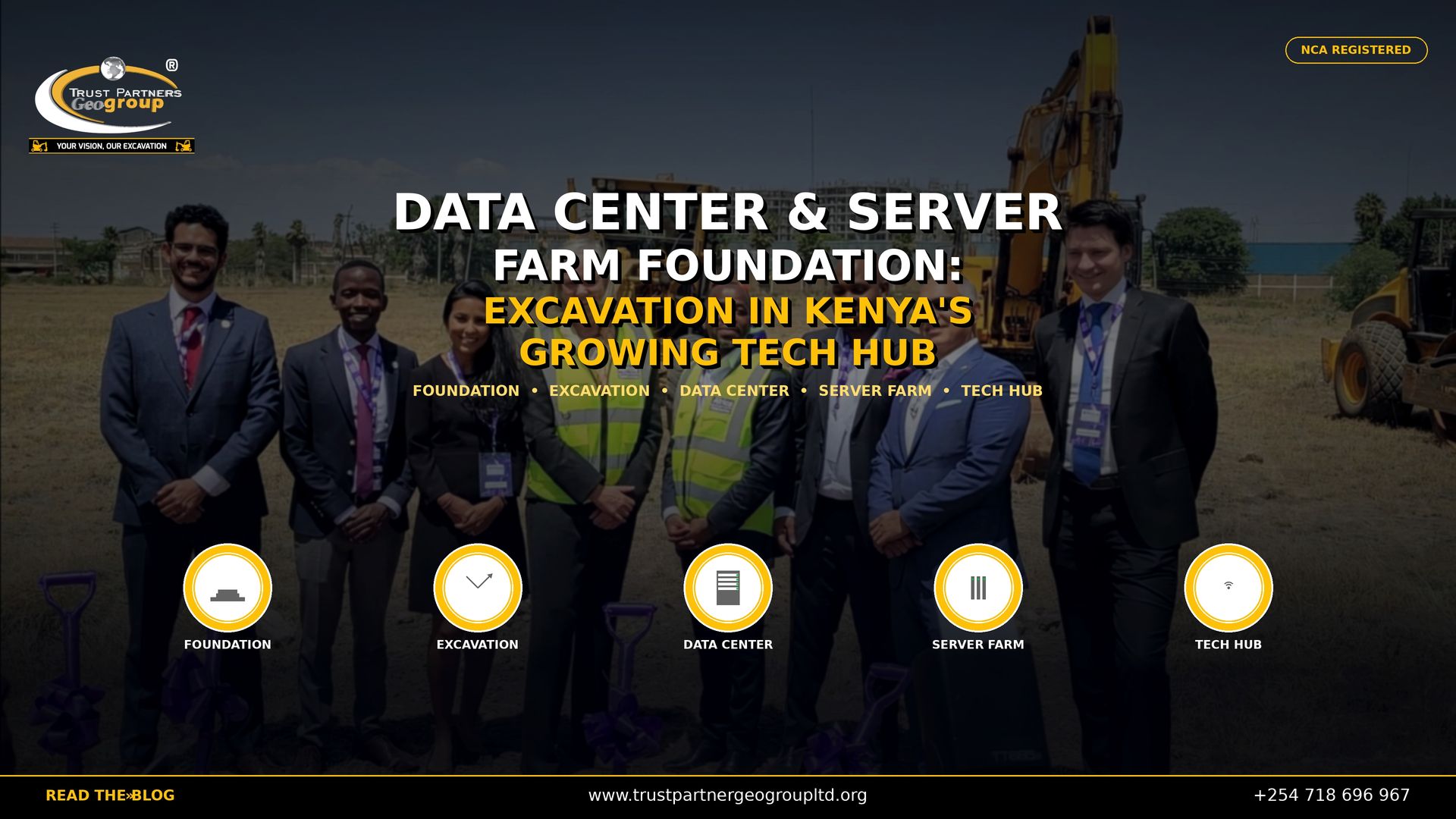
Data Center and Server Farm Foundation Excavation in Kenya's Growing Tech Hub [2026]
The Tech Sector Guide to Precision Groundworks — Konza, Tatu City, Nairobi & Beyond
Kenya is becoming East Africa's digital backbone. Hyperscale cloud providers, fintech campuses and colocation facilities are breaking ground from Konza Technopolis to Tatu City — and every server rack, cooling unit and fiber duct depends on one invisible discipline: foundation excavation executed to millimetre tolerance. This 2026 tech sector guide covers data center foundation excavation in Kenya, server farm excavation in Nairobi, tech facility construction groundworks and cloud infrastructure excavation — the foundation types, precision controls, soil challenges and cost benchmarks that determine whether a facility hums for twenty years or cracks in two. With 15+ years of foundation excavation experience across Kenya, Trust Partners Geo-Group delivers the tight-tolerance groundworks that tech infrastructure demands.

From hyperscale mat foundations to vibration-controlled urban excavation, our teams deliver tech-sector groundworks with GPS precision, documented QA and the settlement discipline that server farms cannot compromise on.
1. Kenya's Data Center Boom: Where the Tech Hub Actually Stands in 2026
East Africa's internet economy is converging on Kenya. The result is a construction vertical that barely existed five years ago — and now commands some of the most technically demanding foundation work in the country:
- Hyperscale cloud campuses: global providers and local consortiums building 5,000–20,000 m² facilities with load concentrations that dwarf standard commercial buildings.
- Fintech and banking server farms: Nairobi's financial district and peripheral campuses requiring 24/7 uptime, which begins with zero-settlement foundation discipline.
- Konza Technopolis: Kenya's flagship smart city attracting data center, BPO and R&D facilities — large platforms in a greenfield geotechnical environment that must be characterised before a single bucket breaks ground.
- Tatu City and special economic zones: master-planned tech and logistics parks where infrastructure excavation is bundled with building foundations from day one.
- Edge and colocation nodes: smaller but rapidly multiplying facilities in Mombasa, Nakuru and Kisumu, each requiring the same precision on tighter footprints.

2. Foundation Types: What Data Centers and Server Farms Actually Need Below Ground
Tech facilities in Kenya use foundation systems selected for load distribution, settlement control and future flexibility. The excavation scope changes with each:
Raft (Mat) Foundations
The default for hyperscale data centers. A continuous reinforced concrete slab — often 1,000–3,000 m² per pour — spreads rack loads across the entire footprint. Excavation must deliver:
- Uniform formation level across the entire mat area — typically ±25mm tolerance.
- Zero organic material, loose pockets or soft spots that create differential settlement.
- Clean, dry formation capable of receiving blinding concrete directly.
Where expansive black cotton soils exist — common in Nairobi's Athi River corridor and parts of Konza — the mat may sit on a engineered fill replacement layer or compacted granular sub-base up to 1.5m deep. That multiplies excavation volume and demands strict compaction testing.
Pile-Supported Rafts
Where bearing capacity is insufficient or where groundwater is encountered, piles carry the mat. Excavation includes:
- Bulk excavation to pile cap level, often 2–4m below natural ground.
- Precision trimming around pile caps and ground beams.
- Dewatering and side stability during open-cut work.
Isolated Pad Foundations
Smaller server farms or edge nodes may use pad and strip foundations. Excavation is simpler but still demands tight tolerance at each pad — out-of-level pads induce frame stress that telegraphs through the superstructure to sensitive equipment.
Utility Corridors and Trenches
Data centers are as much underground infrastructure as above-ground building. Excavation scope routinely includes:
- Power trenches: deep, wide routes for medium-voltage cables from substations to facility.
- Cooling trenches: routes for chilled water pipes, often insulated and laid to precise gradient.
- Fiber ducts: multiple parallel trenches for redundant fiber entry paths.
- Stormwater and drainage: including oil-water separators and containment systems.
3. The Excavation Sequence: From Site Strip to Build-Ready Tech Pad
Data center foundation excavation follows a stricter sequence than general commercial work. The standard delivery — mapped in our post-excavation handover discipline — runs as follows:
| Phase | Activity | Tolerance / Standard |
|---|---|---|
| 1. Site strip | Remove topsoil, vegetation and organics across footprint + 5m working margin | Clear to natural ground; stockpile topsoil for reinstatement |
| 2. Bulk excavation | Machine cut to 100–150mm above final formation | GPS machine control; monitor vibration near live infrastructure |
| 3. Precision trim | Final grade with laser-guided bucket or motor grader | ±25mm at formation level; 5m grid survey |
| 4. Proof rolling | Heavy roller pass to identify soft spots or voids | Visual + penetrometer check; mark and replace soft areas |
| 5. Utility trenching | Power, cooling, fiber and drainage trenches | Gradient ±10mm; bedding compacted to 95% MDD |
| 6. Compaction testing | Density tests, plate load tests where specified | 95–98% MDD; documented per layer |
| 7. Handover | Survey as-builts, geotagged photos, test certificates | Structural engineer sign-off before blinding |
Each phase is a gate: the structural engineer will not release the formation for blinding until survey records prove the tolerance, compaction tests meet specification and utility trenches are clean and aligned. On tech facilities, this discipline is contractual, not optional.

4. Vibration, Settlement and Precision: Excavation Controls for Sensitive Tech Infrastructure
Data center excavation is governed by tolerances that general contractors rarely encounter:
Tolerance Standards
- Formation level: ±25mm across the entire mat footprint. Some hyperscale specifications demand ±15mm.
- Utility trench gradients: ±10mm over trench length — critical for gravity drainage and cooling pipe slope.
- Pad levels: ±10mm at each isolated pad. Out-of-level pads induce column moment that cracks the frame.
Vibration Control
Many data center sites in Nairobi are built adjacent to existing live facilities. Vibration from excavation, rock breaking or piling can degrade running equipment. Controls include:
- Real-time monitoring: seismographs logging peak particle velocity (PPV) continuously, with alarm thresholds typically set at 5 mm/s for sensitive equipment.
- Low-impact breaking: hydraulic breakers under 20 kg class instead of blasting — see our vibration-controlled factory excavation methods.
- Staged excavation: maintaining buffer zones and excavating in bays rather than full-width cuts to reduce ground disturbance propagation.
- Equipment routing: heavy haulage kept outside the structural influence zone of adjacent foundations.
Settlement Prevention
Post-construction settlement is the silent killer of data center uptime. Excavation practices that prevent it:
- Over-excavation and replacement: where black cotton or organic soils are found, remove to firm stratum and backfill with engineered granular material in controlled layers.
- Dynamic compaction: on loose volcanic soils or fill, impact compaction densifies the stratum before the mat is poured.
- Dewatering discipline: groundwater left in the formation softens bearing strata. Well-point or sump dewatering maintains dry excavation until blinding is complete.
5. Konza, Tatu City and Nairobi: Kenya's Data Center Geography
Each tech corridor location presents distinct excavation conditions:
Konza Technopolis (Machakos County)
Konza is Kenya's most ambitious tech city — and a greenfield geotechnical puzzle. Excavation contractors face:
- Variable stratigraphy: volcanic tuff, murram and black cotton patches within single large footprints. Borehole density must be high enough to catch transitions.
- Large platform areas: master-planned blocks require bulk earthworks and precision grading at campus scale — 10,000–50,000 m² pads are normal.
- Infrastructure bundling: roads, power corridors, water and fiber are excavated concurrently with building foundations, demanding coordinated traffic management and sequencing.
Tatu City (Kiambu County)
Tatu City's mixed-use tech and logistics zone sits on rolling red-soil terrain north of Nairobi:
- Cut-to-fill balance: sloping sites require significant cut-to-fill to create level pads, with the balance carefully managed to avoid import or export.
- Red murram and clay: generally good bearing but prone to erosion during the rainy season — excavation programmes must be weather-windowed.
Nairobi CBD and Peripheral Tech Campuses
Urban data center excavation in Nairobi — Parklands, Upper Hill, Mombasa Road and Industrial Area — is constrained by:
- Tight footprints: zero working space, requiring shored excavations or retaining wall systems to protect adjacent buildings.
- Live utilities: fiber, power and water mains crisscross urban sites; service location and hand-dug verification are mandatory before machine work.
- Vibration limits: adjacent banks, hospitals and offices impose strict PPV thresholds.
Mombasa and Coastal Nodes
Coastal data centers face saline groundwater, coral-derived soils and the same marine earthworks discipline as our coastal protection projects — dewatering, corrosion-resistant reinforcement and sulfate-resistant concrete bedding.

6. Equipment, QA and Tolerance: Delivering the Grade Servers Demand
Standard excavation plant does not deliver ±25mm tolerance without augmentation. The tech-sector spread includes:
| Machine / System | Role on Data Center Projects |
|---|---|
| 30–45 t excavators with GPS machine control | Bulk cut and precision trim — GPS grade control eliminates string lines and delivers real-time ±20mm accuracy |
| Laser-guided motor graders | Final formation trimming across large mats; laser receivers maintain constant grade |
| Vibratory rollers (trench and pad) | Compaction of utility bedding and replacement fill to 95–98% MDD |
| Low-impact hydraulic breakers | Rock breaking within 5 mm/s PPV limits near live facilities |
| Total stations / RTK GPS rovers | 5m grid survey verification before handover |
| Seismographs | Continuous vibration monitoring when working adjacent to operating data centers |
| Water bowsers and pumps | Dust suppression and dewatering — dry formation is non-negotiable for blinding |
QA/QC Protocol
Tech facility clients audit earthworks QA as closely as structural concrete. Our standard protocol:
- Pre-works survey: existing levels, utility locations and benchmark establishment.
- Daily grade checks: GPS machine control is verified against total station spot checks every 50m.
- Compaction testing: sand replacement or nuclear density tests every 500 m² or per lift, whichever is more frequent.
- Plate load testing: where specified, to confirm bearing capacity at formation level.
- Geotagged documentation: photo records of formation, trenches and tests, uploaded to shared project folders before handover.

7. Data Center Foundation Costs: 2026 Kenya Benchmarks
| Work Item | Typical 2026 Range (KES) | Notes |
|---|---|---|
| Bulk excavation (general soils) | 450–1,200 per m³ | Depth, haul distance and ground conditions drive variance |
| Precision grading and tolerance verification | 350–900 per m² | Laser/GPS control; includes survey and proof rolling |
| Black cotton soil removal & replacement | 1,800–3,500 per m³ | Excavation, haul away, engineered fill supply and compaction |
| Utility trenching (power/cooling/fiber) | 2,500–6,500 per metre | Depth, bedding, backfill and compaction |
| Rock excavation (controlled breaking) | 3,500–8,000 per m³ | Low-impact methods; higher where vibration limits apply |
| Mat foundation pad (all-in) | 8M–45M per pad | Size 1,000–5,000 m²; includes excavation, replacement, compaction |
| Compaction testing and QA | 15,000–45,000 per test | Sand replacement, nuclear density, plate load |
| Vibration monitoring (rental) | 8,000–18,000 per day | Seismograph with technician and reporting |
8. Frequently Asked Questions
What type of foundation do data centers in Kenya require?
Most use large raft or mat foundations to distribute rack loads and minimize differential settlement. Hyperscale facilities may need pile-supported rafts where black cotton soils or expansive clays are present. Excavation must achieve ±25mm tolerance and include deep utility corridors for power, cooling and fiber.
How precise must data center foundation excavation be?
Typically ±25mm at formation level, with some hyperscale specifications demanding ±15mm. Utility trench gradients require ±10mm. GPS machine control and laser grading are standard. Over-excavation requires engineered backfill with controlled compaction.
What are the main soil challenges for tech facility construction in Kenya?
Black cotton soils with high shrink-swell potential in Nairobi and Konza, volcanic tuff, loose murram and high groundwater. Each requires selective removal and replacement, dewatering, or ground improvement before foundation construction.
How do you control vibration during excavation near existing data centers?
Low-impact hydraulic breakers under 20 kg, real-time seismograph monitoring with alarm thresholds at 5 mm/s PPV, staged excavation maintaining buffer zones, and equipment routing that avoids sensitive foundation influence zones.
What is the typical timeline for data center foundation excavation?
A 2,000–5,000 m² pad typically requires 4–8 weeks from site strip to handover. Bulk excavation 1–2 weeks, precision grading 1 week, utility trenching 1–2 weeks, and testing/documentation 1 week. Poor soils or rain can extend by 30–50%.
How much does data center foundation excavation cost in Kenya?
Bulk earthworks KES 450–1,200 per m³; precision grading KES 350–900 per m²; mat foundation pads KES 8M–45M all-in. Black cotton soil replacement adds KES 1,800–3,500 per m³. The precision premium is typically under 0.5% of total facility cost.
Who provides data center foundation excavation services in Kenya?
NCA-registered contractors with GPS machine control, vibration management and precision grading capability. Trust Partners Geo-Group delivers data center and server farm foundation excavation across Nairobi, Konza, Tatu City and Mombasa with documented QA and tight-tolerance handover. Call +254 718 686 967.
9. Conclusion: The Foundation Determines the Uptime
Data centers are not buildings with computers inside — they are precision machines with a building wrapped around them. The excavation and foundation work is the first mechanical layer: if the pad is out of level, if a soft spot settles 10mm after rack installation, if a cooling trench drains the wrong way, the facility fails before it goes live.
Kenya's tech hub growth — Konza, Tatu City, Nairobi's fintech corridor, Mombasa's edge nodes — demands earthworks contractors who understand server loads, fiber redundancy and cooling continuity as well as they understand cut and fill. The tolerance is tighter, the QA is stricter, and the cost of error is measured in millions of shillings of downtime.
Trust Partners Geo-Group delivers tech-sector foundation excavation end-to-end: geotechnical coordination, GPS precision grading, vibration-controlled breaking, utility trenching, compaction testing and documented handover — with the QA discipline that structural engineers and tech clients both demand. From Konza's greenfield platforms to Nairobi's constrained urban sites, we build the ground that Kenya's digital economy stands on.

Building a Data Center? Start With a Foundation That Meets Tech Standards.
Trust Partners Geo-Group delivers precision data center foundation excavation — GPS grading, vibration control, documented QA and tight-tolerance handover — across Nairobi, Konza, Tatu City and Mombasa.
Call +254 718 686 967 — 24/7 Request a Tech Sector QuoteData Center and Server Farm Foundation Excavation in Kenya's Growing Tech Hub [2026]
The Tech Sector Guide to Precision Groundworks — Konza, Tatu City, Nairobi & Beyond
Kenya is becoming East Africa's digital backbone. Hyperscale cloud providers, fintech campuses and colocation facilities are breaking ground from Konza Technopolis to Tatu City — and every server rack, cooling unit and fiber duct depends on one invisible discipline: foundation excavation executed to millimetre tolerance. This 2026 tech sector guide covers data center foundation excavation in Kenya, server farm excavation in Nairobi, tech facility construction groundworks and cloud infrastructure excavation — the foundation types, precision controls, soil challenges and cost benchmarks that determine whether a facility hums for twenty years or cracks in two. With 15+ years of foundation excavation experience across Kenya, Trust Partners Geo-Group delivers the tight-tolerance groundworks that tech infrastructure demands.
From hyperscale mat foundations to vibration-controlled urban excavation, our teams deliver tech-sector groundworks with GPS precision, documented QA and the settlement discipline that server farms cannot compromise on.
1. Kenya's Data Center Boom: Where the Tech Hub Actually Stands in 2026
East Africa's internet economy is converging on Kenya. The result is a construction vertical that barely existed five years ago — and now commands some of the most technically demanding foundation work in the country:
- Hyperscale cloud campuses: global providers and local consortiums building 5,000–20,000 m² facilities with load concentrations that dwarf standard commercial buildings.
- Fintech and banking server farms: Nairobi's financial district and peripheral campuses requiring 24/7 uptime, which begins with zero-settlement foundation discipline.
- Konza Technopolis: Kenya's flagship smart city attracting data center, BPO and R&D facilities — large platforms in a greenfield geotechnical environment that must be characterised before a single bucket breaks ground.
- Tatu City and special economic zones: master-planned tech and logistics parks where infrastructure excavation is bundled with building foundations from day one.
- Edge and colocation nodes: smaller but rapidly multiplying facilities in Mombasa, Nakuru and Kisumu, each requiring the same precision on tighter footprints.
2. Foundation Types: What Data Centers and Server Farms Actually Need Below Ground
Tech facilities in Kenya use foundation systems selected for load distribution, settlement control and future flexibility. The excavation scope changes with each:
Raft (Mat) Foundations
The default for hyperscale data centers. A continuous reinforced concrete slab — often 1,000–3,000 m² per pour — spreads rack loads across the entire footprint. Excavation must deliver:
- Uniform formation level across the entire mat area — typically ±25mm tolerance.
- Zero organic material, loose pockets or soft spots that create differential settlement.
- Clean, dry formation capable of receiving blinding concrete directly.
Where expansive black cotton soils exist — common in Nairobi's Athi River corridor and parts of Konza — the mat may sit on a engineered fill replacement layer or compacted granular sub-base up to 1.5m deep. That multiplies excavation volume and demands strict compaction testing.
Pile-Supported Rafts
Where bearing capacity is insufficient or where groundwater is encountered, piles carry the mat. Excavation includes:
- Bulk excavation to pile cap level, often 2–4m below natural ground.
- Precision trimming around pile caps and ground beams.
- Dewatering and side stability during open-cut work.
Isolated Pad Foundations
Smaller server farms or edge nodes may use pad and strip foundations. Excavation is simpler but still demands tight tolerance at each pad — out-of-level pads induce frame stress that telegraphs through the superstructure to sensitive equipment.
Utility Corridors and Trenches
Data centers are as much underground infrastructure as above-ground building. Excavation scope routinely includes:
- Power trenches: deep, wide routes for medium-voltage cables from substations to facility.
- Cooling trenches: routes for chilled water pipes, often insulated and laid to precise gradient.
- Fiber ducts: multiple parallel trenches for redundant fiber entry paths.
- Stormwater and drainage: including oil-water separators and containment systems.
3. The Excavation Sequence: From Site Strip to Build-Ready Tech Pad
Data center foundation excavation follows a stricter sequence than general commercial work. The standard delivery — mapped in our post-excavation handover discipline — runs as follows:
| Phase | Activity | Tolerance / Standard |
|---|---|---|
| 1. Site strip | Remove topsoil, vegetation and organics across footprint + 5m working margin | Clear to natural ground; stockpile topsoil for reinstatement |
| 2. Bulk excavation | Machine cut to 100–150mm above final formation | GPS machine control; monitor vibration near live infrastructure |
| 3. Precision trim | Final grade with laser-guided bucket or motor grader | ±25mm at formation level; 5m grid survey |
| 4. Proof rolling | Heavy roller pass to identify soft spots or voids | Visual + penetrometer check; mark and replace soft areas |
| 5. Utility trenching | Power, cooling, fiber and drainage trenches | Gradient ±10mm; bedding compacted to 95% MDD |
| 6. Compaction testing | Density tests, plate load tests where specified | 95–98% MDD; documented per layer |
| 7. Handover | Survey as-builts, geotagged photos, test certificates | Structural engineer sign-off before blinding |
Each phase is a gate: the structural engineer will not release the formation for blinding until survey records prove the tolerance, compaction tests meet specification and utility trenches are clean and aligned. On tech facilities, this discipline is contractual, not optional.
4. Vibration, Settlement and Precision: Excavation Controls for Sensitive Tech Infrastructure
Data center excavation is governed by tolerances that general contractors rarely encounter:
Tolerance Standards
- Formation level: ±25mm across the entire mat footprint. Some hyperscale specifications demand ±15mm.
- Utility trench gradients: ±10mm over trench length — critical for gravity drainage and cooling pipe slope.
- Pad levels: ±10mm at each isolated pad. Out-of-level pads induce column moment that cracks the frame.
Vibration Control
Many data center sites in Nairobi are built adjacent to existing live facilities. Vibration from excavation, rock breaking or piling can degrade running equipment. Controls include:
- Real-time monitoring: seismographs logging peak particle velocity (PPV) continuously, with alarm thresholds typically set at 5 mm/s for sensitive equipment.
- Low-impact breaking: hydraulic breakers under 20 kg class instead of blasting — see our vibration-controlled factory excavation methods.
- Staged excavation: maintaining buffer zones and excavating in bays rather than full-width cuts to reduce ground disturbance propagation.
- Equipment routing: heavy haulage kept outside the structural influence zone of adjacent foundations.
Settlement Prevention
Post-construction settlement is the silent killer of data center uptime. Excavation practices that prevent it:
- Over-excavation and replacement: where black cotton or organic soils are found, remove to firm stratum and backfill with engineered granular material in controlled layers.
- Dynamic compaction: on loose volcanic soils or fill, impact compaction densifies the stratum before the mat is poured.
- Dewatering discipline: groundwater left in the formation softens bearing strata. Well-point or sump dewatering maintains dry excavation until blinding is complete.
5. Konza, Tatu City and Nairobi: Kenya's Data Center Geography
Each tech corridor location presents distinct excavation conditions:
Konza Technopolis (Machakos County)
Konza is Kenya's most ambitious tech city — and a greenfield geotechnical puzzle. Excavation contractors face:
- Variable stratigraphy: volcanic tuff, murram and black cotton patches within single large footprints. Borehole density must be high enough to catch transitions.
- Large platform areas: master-planned blocks require bulk earthworks and precision grading at campus scale — 10,000–50,000 m² pads are normal.
- Infrastructure bundling: roads, power corridors, water and fiber are excavated concurrently with building foundations, demanding coordinated traffic management and sequencing.
Tatu City (Kiambu County)
Tatu City's mixed-use tech and logistics zone sits on rolling red-soil terrain north of Nairobi:
- Cut-to-fill balance: sloping sites require significant cut-to-fill to create level pads, with the balance carefully managed to avoid import or export.
- Red murram and clay: generally good bearing but prone to erosion during the rainy season — excavation programmes must be weather-windowed.
Nairobi CBD and Peripheral Tech Campuses
Urban data center excavation in Nairobi — Parklands, Upper Hill, Mombasa Road and Industrial Area — is constrained by:
- Tight footprints: zero working space, requiring shored excavations or retaining wall systems to protect adjacent buildings.
- Live utilities: fiber, power and water mains crisscross urban sites; service location and hand-dug verification are mandatory before machine work.
- Vibration limits: adjacent banks, hospitals and offices impose strict PPV thresholds.
Mombasa and Coastal Nodes
Coastal data centers face saline groundwater, coral-derived soils and the same marine earthworks discipline as our coastal protection projects — dewatering, corrosion-resistant reinforcement and sulfate-resistant concrete bedding.
6. Equipment, QA and Tolerance: Delivering the Grade Servers Demand
Standard excavation plant does not deliver ±25mm tolerance without augmentation. The tech-sector spread includes:
| Machine / System | Role on Data Center Projects |
|---|---|
| 30–45 t excavators with GPS machine control | Bulk cut and precision trim — GPS grade control eliminates string lines and delivers real-time ±20mm accuracy |
| Laser-guided motor graders | Final formation trimming across large mats; laser receivers maintain constant grade |
| Vibratory rollers (trench and pad) | Compaction of utility bedding and replacement fill to 95–98% MDD |
| Low-impact hydraulic breakers | Rock breaking within 5 mm/s PPV limits near live facilities |
| Total stations / RTK GPS rovers | 5m grid survey verification before handover |
| Seismographs | Continuous vibration monitoring when working adjacent to operating data centers |
| Water bowsers and pumps | Dust suppression and dewatering — dry formation is non-negotiable for blinding |
QA/QC Protocol
Tech facility clients audit earthworks QA as closely as structural concrete. Our standard protocol:
- Pre-works survey: existing levels, utility locations and benchmark establishment.
- Daily grade checks: GPS machine control is verified against total station spot checks every 50m.
- Compaction testing: sand replacement or nuclear density tests every 500 m² or per lift, whichever is more frequent.
- Plate load testing: where specified, to confirm bearing capacity at formation level.
- Geotagged documentation: photo records of formation, trenches and tests, uploaded to shared project folders before handover.
7. Data Center Foundation Costs: 2026 Kenya Benchmarks
| Work Item | Typical 2026 Range (KES) | Notes |
|---|---|---|
| Bulk excavation (general soils) | 450–1,200 per m³ | Depth, haul distance and ground conditions drive variance |
| Precision grading and tolerance verification | 350–900 per m² | Laser/GPS control; includes survey and proof rolling |
| Black cotton soil removal & replacement | 1,800–3,500 per m³ | Excavation, haul away, engineered fill supply and compaction |
| Utility trenching (power/cooling/fiber) | 2,500–6,500 per metre | Depth, bedding, backfill and compaction |
| Rock excavation (controlled breaking) | 3,500–8,000 per m³ | Low-impact methods; higher where vibration limits apply |
| Mat foundation pad (all-in) | 8M–45M per pad | Size 1,000–5,000 m²; includes excavation, replacement, compaction |
| Compaction testing and QA | 15,000–45,000 per test | Sand replacement, nuclear density, plate load |
| Vibration monitoring (rental) | 8,000–18,000 per day | Seismograph with technician and reporting |
8. Frequently Asked Questions
What type of foundation do data centers in Kenya require?
Most use large raft or mat foundations to distribute rack loads and minimize differential settlement. Hyperscale facilities may need pile-supported rafts where black cotton soils or expansive clays are present. Excavation must achieve ±25mm tolerance and include deep utility corridors for power, cooling and fiber.
How precise must data center foundation excavation be?
Typically ±25mm at formation level, with some hyperscale specifications demanding ±15mm. Utility trench gradients require ±10mm. GPS machine control and laser grading are standard. Over-excavation requires engineered backfill with controlled compaction.
What are the main soil challenges for tech facility construction in Kenya?
Black cotton soils with high shrink-swell potential in Nairobi and Konza, volcanic tuff, loose murram and high groundwater. Each requires selective removal and replacement, dewatering, or ground improvement before foundation construction.
How do you control vibration during excavation near existing data centers?
Low-impact hydraulic breakers under 20 kg, real-time seismograph monitoring with alarm thresholds at 5 mm/s PPV, staged excavation maintaining buffer zones, and equipment routing that avoids sensitive foundation influence zones.
What is the typical timeline for data center foundation excavation?
A 2,000–5,000 m² pad typically requires 4–8 weeks from site strip to handover. Bulk excavation 1–2 weeks, precision grading 1 week, utility trenching 1–2 weeks, and testing/documentation 1 week. Poor soils or rain can extend by 30–50%.
How much does data center foundation excavation cost in Kenya?
Bulk earthworks KES 450–1,200 per m³; precision grading KES 350–900 per m²; mat foundation pads KES 8M–45M all-in. Black cotton soil replacement adds KES 1,800–3,500 per m³. The precision premium is typically under 0.5% of total facility cost.
Who provides data center foundation excavation services in Kenya?
NCA-registered contractors with GPS machine control, vibration management and precision grading capability. Trust Partners Geo-Group delivers data center and server farm foundation excavation across Nairobi, Konza, Tatu City and Mombasa with documented QA and tight-tolerance handover. Call +254 718 686 967.
9. Conclusion: The Foundation Determines the Uptime
Data centers are not buildings with computers inside — they are precision machines with a building wrapped around them. The excavation and foundation work is the first mechanical layer: if the pad is out of level, if a soft spot settles 10mm after rack installation, if a cooling trench drains the wrong way, the facility fails before it goes live.
Kenya's tech hub growth — Konza, Tatu City, Nairobi's fintech corridor, Mombasa's edge nodes — demands earthworks contractors who understand server loads, fiber redundancy and cooling continuity as well as they understand cut and fill. The tolerance is tighter, the QA is stricter, and the cost of error is measured in millions of shillings of downtime.
Trust Partners Geo-Group delivers tech-sector foundation excavation end-to-end: geotechnical coordination, GPS precision grading, vibration-controlled breaking, utility trenching, compaction testing and documented handover — with the QA discipline that structural engineers and tech clients both demand. From Konza's greenfield platforms to Nairobi's constrained urban sites, we build the ground that Kenya's digital economy stands on.
Building a Data Center? Start With a Foundation That Meets Tech Standards.
Trust Partners Geo-Group delivers precision data center foundation excavation — GPS grading, vibration control, documented QA and tight-tolerance handover — across Nairobi, Konza, Tatu City and Mombasa.
Call +254 718 686 967 — 24/7 Request a Tech Sector Quote