Lining Materials for Water Pans in Kenya: Clay, Geomembrane and Concrete Compared by Cost and Lifespan
The liner is the thin line between a pan that stores water and a pan that irrigates the water table. Five systems compared on cost, lifespan and the installation details that decide both.

1. Why Pans Leak — and When That's OK
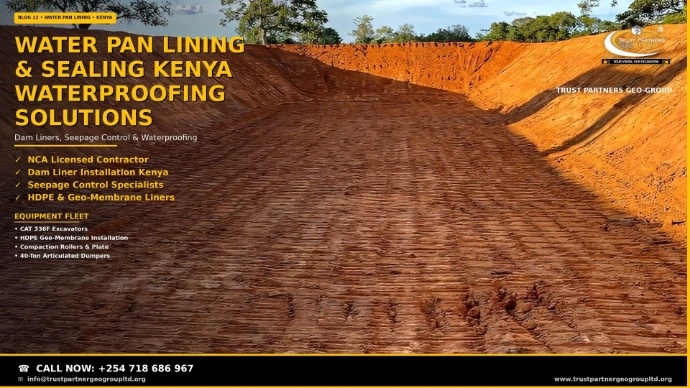
Every pan leaks; the engineering question is whether it leaks slowly enough to store water through the dry season. The decision tool is the percolation test — dig a one-metre test hole, fill it, watch: drawdown beyond 24 hours signals meaningful seepage, under 6 hours means the pan will lose its storage faster than it fills without treatment. Where the floor passes, a compacted clay floor treatment may be all that is needed; where it fails, a liner system earns its cost back in a single dry season by doubling effective storage. The liner work sits within the dam and water portfolio of our services, delivered by Trust Partners Geo-Group under our dam and water pan service — with sizing and costing covered in this cluster's excavation cost guide.
2. Compacted Clay Blankets
The traditional answer and still the right one where material cooperates. A blanket of 150–300mm of suitable clay — low permeability, free of stones and organics — placed in compacted lifts and finished smooth, costs KES 80–150 per m² where clay exists within economic haul of the site. Service life runs 10–30 years where the blanket stays wet and maintained, but cracked-clay floors are its undoing: seasonal drying opens fissures that route water straight past the treatment. Clay's verdict: unbeatable on cost and longevity where the soil profile supplies the material; the wrong tool on sands, gravels and self-cracking clays.
3. HDPE Geomembranes
The assured barrier. High-density polyethylene sheets of 0.5–1.0mm, factory-welded on site into a continuous skin, deliver 15–25 years of impermeability on any subgrade that can be prepared — including the cracked clays and stony floors that defeat clay. Installed pricing for 2026: 0.5mm at KES 180–300 per m², 0.75mm — the farm-pan standard — at KES 250–450, and 1.0mm at KES 350–600. The sheet is only half the system: subgrade trimming, geotextile underlay, perimeter anchor trenches, welded and air-tested seams, and UV protection where water levels fluctuate. Quotes that price the roll without the system are selling a leak scheduled for the second season.
4. Bentonite GCLs
The self-healing middle path. Geosynthetic clay liners — a thin layer of bentonite sandwiched between geotextiles — install fast at KES 180–300 per m², tolerate imperfect subgrades better than sheet membranes, and reseal around minor punctures as the bentonite hydrates and swells. Service life runs 15–25 years. The trade-offs against HDPE: slightly higher permeability, less tolerance of severe subgrade irregularity, and care needed keeping the product dry before installation — hydrated GCLs cannot be repositioned. For mid-size pans on reasonable ground, GCLs increasingly win the engineer's nod.
5. Soil-Cement & Concrete Systems
The cement family serves where traffic, animals or abrasion threaten sheet liners. Soil-cement — 8–12% cement blended into the excavated floor material, compacted in layers — runs KES 250–500 per m² and 10–20 years, the county-pan workhorse. Concrete — 75–150mm on a prepared subgrade at KES 800–1,500 per m² — is the generational answer for small high-value pans, troughs and sumps: animal-proof and 30–50 year life. Two rules decide whether cement lives or cracks: cure wet for at least seven days, and joint larger slabs — pan floors move with temperature and moisture whether the drawing allows it or not.
6. The Comparison Table
| System | Cost (KES/m²) | Lifespan | Best For | Watch Out |
|---|---|---|---|---|
| Compacted clay | 80–150 | 10–30 y | Clay-rich sites, big pans | Cracked-clay floors; haul |
| HDPE 0.75mm | 250–450 | 15–25 y | Assured sealing, any floor | UV exposure; seam quality |
| Bentonite GCL | 180–300 | 15–25 y | Mid pans, forgiving install | Keep dry until placed |
| Soil-cement | 250–500 | 10–20 y | Large pans, county works | Mix control; curing |
| Concrete | 800–1,500 | 30–50 y | Small premium pans, troughs | Cost; joints & curing |
7. Installation Quality: The Deciding Details
- Subgrade first: trimmed, stone-free, compacted — every liner inherits what the dig leaves.
- Underlay under membranes: 200–300gsm geotextile, the cheapest insurance in pan construction.
- Anchor trenches around the perimeter, sealing the liner into the ground line.
- Welded, tested seams on sheet systems — air-channel tested, not eyeballed.
- Water as protection: every liner lives longest under water — freeboard and level discipline are design-life decisions.
The defensive engineering around the whole pan — filters, seepage paths, toe drains — completes the picture in our seepage control and embankment stability guide, and the dam-side counterpart in earth dam design and construction.
8. Frequently Asked Questions
There is no universal best — only the best match between soil, water chemistry, budget and lifespan ambitions. Compacted clay wins where suitable clay exists within economic haul: cheapest per square metre (KES 80–150), decades of service if the blanket is thick and maintained, but it fails on sandy or cracked-clay floors and demands real clay volumes. HDPE geomembrane (0.5–1.0mm) wins where assured impermeability matters: KES 250–450 per m² installed buys a 15–25 year barrier that survives cracked clays and rocky floors the clay blanket cannot, but it demands a prepared subgrade, geotextile underlay and welded seams done by competent crews. Bentonite GCL — clay sandwiched in geotextiles — splits the difference at KES 180–300 per m²: self-healing against minor punctures, faster to install than loose clay, forgiving of imperfect subgrades. Concrete and soil-cement win on small, high-value or trafficked pans — animal-proof, erosion-proof, KES 250–1,500 per m² depending on system, with service lives measured in generations. The decision tool: the percolation test result first, then the material table in this article, then the installation quality rules — because every lining system fails at installation, not in the datasheet.
Installed HDPE geomembrane pricing for 2026, by thickness: 0.5mm at roughly KES 180–300 per m² installed; 0.75mm — the common farm-pan standard — at KES 250–450 per m²; and 1.0mm at KES 350–600 per m², the heavy-duty band for rocky subgrades, high water tables or long design lives. The material is only half the price: proper installation adds subgrade trimming and compaction, a 200–300gsm geotextile underlay (non-negotiable puncture insurance), anchor trenches around the perimeter, welded seams with air-channel testing, and a protective layer or water cover against UV where levels fluctuate. Beware quotes that price the roll and not the system — a liner laid over an untrimmed floor, without underlay, is a leak scheduled for its second season. For a 1,500 m² pan floor at 0.75mm, a fully installed system typically lands KES 450K–800K — the single largest line in pan construction after the dig itself, and the one that decides whether the pan stores water or loses it.
Service life is decided as much by installation and water level management as by material. Compacted clay blankets — 150–300mm thick, well maintained and kept wet: 10–30 years, but cracked-clay floors or maintenance laps can halve that, and a dry-season crack network can ruin a season's storage in weeks. HDPE geomembranes — 15–25 years for quality resin at 0.75–1.0mm, with UV being the main enemy: pans that drop below the liner's exposure line age fast, which is why freeboard and water-level discipline matter as much as the sheet. GCLs — 15–25 years, with the self-healing property buying extra tolerance. Soil-cement — 10–20 years depending on mix and curing. Reinforced concrete — 30–50 years, the generational answer where budgets allow. The universal rule across every system: whatever the liner, it lives longest under water and shortest under sun, wind and hooves — the pan's operating discipline is part of its lining's design life.
Yes — cement-based linings are a legitimate and durable family, with three systems in common Kenyan use. Soil-cement — roughly 8–12% cement mixed into the excavated floor material, moisture-conditioned and compacted in layers — costs KES 250–500 per m², suits larger pans where sheet liners would be costly, and delivers 10–20 years if mixed and cured properly; it is the workhorse of county and group-ranch pans. Plain or reinforced concrete — 75–150mm thick on a prepared subgrade, at KES 800–1,500 per m² — is the premium answer: animal-proof, machinery-proof, 30–50 year life, justified on small high-value pans, dipping troughs and tank sumps rather than large storage bowls. Cement-mortar rendering over masonry or keyed surfaces serves small structures. Two installation rules decide whether cement systems live or crack: cure them wet for at least seven days — cement that dries cracks — and cut expansion joints on larger slabs, because a pan floor moves with temperature and moisture whether the drawing allows it or not.
Yes — almost always, and the exceptions are so rare they are not worth gambling on. The geotextile underlay (typically 200–300gsm non-woven) exists because the membrane beneath it is only half a millimetre thick, while the world above it is full of angular stones, later root penetration, and the boots and hooves of maintenance traffic. A single rock point puncture, invisible at installation, becomes a jet of seeping water within seasons; the underlay is the cheap insurance — roughly 15–20% added to material cost — against a failure mode that costs the entire liner to fix. The exceptions: very smooth, fine-grained prepared subgrades (uniform sand or silt floors, stone-free and trimmed) on static, non-trafficked pans — and even there, most engineers specify underlay because excavation surprises are normal and hindsight is expensive. The wider installation quality set that decides liner life: trimmed and compacted subgrade, underlay, perimeter anchor trenches, welded and tested seams, and a water cover or protective layer where levels fluctuate — detail by detail in our seepage control guide.
Line It Once. Line It Right.
Trust Partners Geo-Group Ltd installs every pan lining system across Kenya — subgrade preparation, underlay, clay blankets, welded geomembranes, GCLs and cement systems — with tested seams, anchor trenches and the details that decide decades of service.
Estimate Your Pan Lining Cost✉️ Contact Us
📞 +254 718 68 69 67
Lining Materials for Water Pans in Kenya: Clay, Geomembrane and Concrete Compared by Cost and Lifespan
The liner is the thin line between a pan that stores water and a pan that irrigates the water table. Five systems compared on cost, lifespan and the installation details that decide both.
1. Why Pans Leak — and When That's OK
Every pan leaks; the engineering question is whether it leaks slowly enough to store water through the dry season. The decision tool is the percolation test — dig a one-metre test hole, fill it, watch: drawdown beyond 24 hours signals meaningful seepage, under 6 hours means the pan will lose its storage faster than it fills without treatment. Where the floor passes, a compacted clay floor treatment may be all that is needed; where it fails, a liner system earns its cost back in a single dry season by doubling effective storage. The liner work sits within the dam and water portfolio of our services, delivered by Trust Partners Geo-Group under our dam and water pan service — with sizing and costing covered in this cluster's excavation cost guide.
2. Compacted Clay Blankets
The traditional answer and still the right one where material cooperates. A blanket of 150–300mm of suitable clay — low permeability, free of stones and organics — placed in compacted lifts and finished smooth, costs KES 80–150 per m² where clay exists within economic haul of the site. Service life runs 10–30 years where the blanket stays wet and maintained, but cracked-clay floors are its undoing: seasonal drying opens fissures that route water straight past the treatment. Clay's verdict: unbeatable on cost and longevity where the soil profile supplies the material; the wrong tool on sands, gravels and self-cracking clays.
3. HDPE Geomembranes
The assured barrier. High-density polyethylene sheets of 0.5–1.0mm, factory-welded on site into a continuous skin, deliver 15–25 years of impermeability on any subgrade that can be prepared — including the cracked clays and stony floors that defeat clay. Installed pricing for 2026: 0.5mm at KES 180–300 per m², 0.75mm — the farm-pan standard — at KES 250–450, and 1.0mm at KES 350–600. The sheet is only half the system: subgrade trimming, geotextile underlay, perimeter anchor trenches, welded and air-tested seams, and UV protection where water levels fluctuate. Quotes that price the roll without the system are selling a leak scheduled for the second season.
4. Bentonite GCLs
The self-healing middle path. Geosynthetic clay liners — a thin layer of bentonite sandwiched between geotextiles — install fast at KES 180–300 per m², tolerate imperfect subgrades better than sheet membranes, and reseal around minor punctures as the bentonite hydrates and swells. Service life runs 15–25 years. The trade-offs against HDPE: slightly higher permeability, less tolerance of severe subgrade irregularity, and care needed keeping the product dry before installation — hydrated GCLs cannot be repositioned. For mid-size pans on reasonable ground, GCLs increasingly win the engineer's nod.
5. Soil-Cement & Concrete Systems
The cement family serves where traffic, animals or abrasion threaten sheet liners. Soil-cement — 8–12% cement blended into the excavated floor material, compacted in layers — runs KES 250–500 per m² and 10–20 years, the county-pan workhorse. Concrete — 75–150mm on a prepared subgrade at KES 800–1,500 per m² — is the generational answer for small high-value pans, troughs and sumps: animal-proof and 30–50 year life. Two rules decide whether cement lives or cracks: cure wet for at least seven days, and joint larger slabs — pan floors move with temperature and moisture whether the drawing allows it or not.
6. The Comparison Table
| System | Cost (KES/m²) | Lifespan | Best For | Watch Out |
|---|---|---|---|---|
| Compacted clay | 80–150 | 10–30 y | Clay-rich sites, big pans | Cracked-clay floors; haul |
| HDPE 0.75mm | 250–450 | 15–25 y | Assured sealing, any floor | UV exposure; seam quality |
| Bentonite GCL | 180–300 | 15–25 y | Mid pans, forgiving install | Keep dry until placed |
| Soil-cement | 250–500 | 10–20 y | Large pans, county works | Mix control; curing |
| Concrete | 800–1,500 | 30–50 y | Small premium pans, troughs | Cost; joints & curing |
7. Installation Quality: The Deciding Details
- Subgrade first: trimmed, stone-free, compacted — every liner inherits what the dig leaves.
- Underlay under membranes: 200–300gsm geotextile, the cheapest insurance in pan construction.
- Anchor trenches around the perimeter, sealing the liner into the ground line.
- Welded, tested seams on sheet systems — air-channel tested, not eyeballed.
- Water as protection: every liner lives longest under water — freeboard and level discipline are design-life decisions.
The defensive engineering around the whole pan — filters, seepage paths, toe drains — completes the picture in our seepage control and embankment stability guide, and the dam-side counterpart in earth dam design and construction.
8. Frequently Asked Questions
There is no universal best — only the best match between soil, water chemistry, budget and lifespan ambitions. Compacted clay wins where suitable clay exists within economic haul: cheapest per square metre (KES 80–150), decades of service if the blanket is thick and maintained, but it fails on sandy or cracked-clay floors and demands real clay volumes. HDPE geomembrane (0.5–1.0mm) wins where assured impermeability matters: KES 250–450 per m² installed buys a 15–25 year barrier that survives cracked clays and rocky floors the clay blanket cannot, but it demands a prepared subgrade, geotextile underlay and welded seams done by competent crews. Bentonite GCL — clay sandwiched in geotextiles — splits the difference at KES 180–300 per m²: self-healing against minor punctures, faster to install than loose clay, forgiving of imperfect subgrades. Concrete and soil-cement win on small, high-value or trafficked pans — animal-proof, erosion-proof, KES 250–1,500 per m² depending on system, with service lives measured in generations. The decision tool: the percolation test result first, then the material table in this article, then the installation quality rules — because every lining system fails at installation, not in the datasheet.
Installed HDPE geomembrane pricing for 2026, by thickness: 0.5mm at roughly KES 180–300 per m² installed; 0.75mm — the common farm-pan standard — at KES 250–450 per m²; and 1.0mm at KES 350–600 per m², the heavy-duty band for rocky subgrades, high water tables or long design lives. The material is only half the price: proper installation adds subgrade trimming and compaction, a 200–300gsm geotextile underlay (non-negotiable puncture insurance), anchor trenches around the perimeter, welded seams with air-channel testing, and a protective layer or water cover against UV where levels fluctuate. Beware quotes that price the roll and not the system — a liner laid over an untrimmed floor, without underlay, is a leak scheduled for its second season. For a 1,500 m² pan floor at 0.75mm, a fully installed system typically lands KES 450K–800K — the single largest line in pan construction after the dig itself, and the one that decides whether the pan stores water or loses it.
Service life is decided as much by installation and water level management as by material. Compacted clay blankets — 150–300mm thick, well maintained and kept wet: 10–30 years, but cracked-clay floors or maintenance laps can halve that, and a dry-season crack network can ruin a season's storage in weeks. HDPE geomembranes — 15–25 years for quality resin at 0.75–1.0mm, with UV being the main enemy: pans that drop below the liner's exposure line age fast, which is why freeboard and water-level discipline matter as much as the sheet. GCLs — 15–25 years, with the self-healing property buying extra tolerance. Soil-cement — 10–20 years depending on mix and curing. Reinforced concrete — 30–50 years, the generational answer where budgets allow. The universal rule across every system: whatever the liner, it lives longest under water and shortest under sun, wind and hooves — the pan's operating discipline is part of its lining's design life.
Yes — cement-based linings are a legitimate and durable family, with three systems in common Kenyan use. Soil-cement — roughly 8–12% cement mixed into the excavated floor material, moisture-conditioned and compacted in layers — costs KES 250–500 per m², suits larger pans where sheet liners would be costly, and delivers 10–20 years if mixed and cured properly; it is the workhorse of county and group-ranch pans. Plain or reinforced concrete — 75–150mm thick on a prepared subgrade, at KES 800–1,500 per m² — is the premium answer: animal-proof, machinery-proof, 30–50 year life, justified on small high-value pans, dipping troughs and tank sumps rather than large storage bowls. Cement-mortar rendering over masonry or keyed surfaces serves small structures. Two installation rules decide whether cement systems live or crack: cure them wet for at least seven days — cement that dries cracks — and cut expansion joints on larger slabs, because a pan floor moves with temperature and moisture whether the drawing allows it or not.
Yes — almost always, and the exceptions are so rare they are not worth gambling on. The geotextile underlay (typically 200–300gsm non-woven) exists because the membrane beneath it is only half a millimetre thick, while the world above it is full of angular stones, later root penetration, and the boots and hooves of maintenance traffic. A single rock point puncture, invisible at installation, becomes a jet of seeping water within seasons; the underlay is the cheap insurance — roughly 15–20% added to material cost — against a failure mode that costs the entire liner to fix. The exceptions: very smooth, fine-grained prepared subgrades (uniform sand or silt floors, stone-free and trimmed) on static, non-trafficked pans — and even there, most engineers specify underlay because excavation surprises are normal and hindsight is expensive. The wider installation quality set that decides liner life: trimmed and compacted subgrade, underlay, perimeter anchor trenches, welded and tested seams, and a water cover or protective layer where levels fluctuate — detail by detail in our seepage control guide.
Line It Once. Line It Right.
Trust Partners Geo-Group Ltd installs every pan lining system across Kenya — subgrade preparation, underlay, clay blankets, welded geomembranes, GCLs and cement systems — with tested seams, anchor trenches and the details that decide decades of service.
Estimate Your Pan Lining Cost✉️ Contact Us
📞 +254 718 68 69 67