Dam and Water Pan Excavation Costs in Kenya 2026: Per m³ Rates by County and Dam Size
The rate guide for Kenya's water storage build-out: per-m³ bands by ground type, the county table that explains them, sizing geometry, and the fleet power that turns surveys into storage.

1. The Per-m³ Answer First
Pan and dam rates reward the same discipline as every earthwork in our services portfolio — surveys before machines — practised across all 47 counties by Trust Partners Geo-Group under our dam and water pan excavation service. The bands below are the honest national picture; the county table that follows explains them.
| Ground & Scope | 2026 Rate (KES/m³) | Note |
|---|---|---|
| Soil excavation & carting within site | 350–800 | Haul, access, moisture |
| Rippable ground | 500–1,000 | Dozer ripping first |
| Rock requiring breaking | 1,200–2,500 | The risk line — survey first |
| Embankment placement (unbalanced) | +150–400 | Where cut exceeds rim need |
| Spillway (designed & armoured) | 150K–500K per structure | Non-negotiable |
| Liner where floor leaks | Clay 80–150/m²; HDPE 250–450/m² | Percolation test decides |
Working totals: 5,000 m³ farm pan KES 300K–700K on good ground; 20,000 m³ community pan KES 1M–2.5M. The rates sit within the wider earthworks picture priced in our per-m³ earthworks breakdown, and the engineering that follows the dig is covered in earth dam design and construction.
2. Rates by County & Region
| Region | Rate Band (KES/m³) | What Moves It |
|---|---|---|
| Nairobi metro & Central highlands | 350–700 | Competitive fleets; city logistics levy |
| Rift Valley (Nakuru–Eldoret–Kitale) | 300–650 | Fast red soils; long hauls |
| Western Kenya | 350–750 | Black cotton handling; drainage design |
| Eastern / semi-arid (Machakos–Kitui–Makueni) | 400–900 | Rock band; remote mobilisation |
| Kajiado & southern Rift | 400–1,000 | Volcanic tuff breaking |
| Coast | 400–900 | Fast sand, poor compaction, coral surprises |
The pattern worth memorising: machine day rates barely change county to county — ground, haul and mobilisation move the per-m³ number, which is why the survey precedes the quote on professional work.
3. Rates by Size: The Scale Effect
Per-m³ rates fall as pans grow. The 1,000–3,000 m³ homestead pan pays mobilisation against a small volume — the highest per-m³ tier, and the reason neighbours pool into group pans. The 5,000–20,000 m³ band reaches efficiency: fleets stage once, cut-and-fill balances within the bowl, and the per-m³ rate lands mid-band. Above 20,000 m³, programme economics take over: multi-week engagements discount machine rates 10–20%, and the cost conversation shifts from per-m³ to per-season of water delivered — where storage earns its keep.
4. What's Inside the Per-m³ Rate
An honest per-m³ rate carries: the dig itself to formation; loading and short haul within the site; embankment rim shaping in compacted lifts where the cut balances; formation trimming for the liner or clay floor; and the water management that keeps a dry dig dry. What it rarely carries — and must be quoted separately: the engineered spillway, liner materials, fencing, inlet works, and mobilisation to remote wards. Cross-check quotes against these lines; a rate that includes everything is usually a rate that includes nothing after signing. The full construction sequence is documented in this cluster's complete dam and pan excavation guide.
5. Sizing & Shaping: Geometry Sets Volume
The bowl's shape decides its cost before the fleet arrives. Side slopes of 1:2 balance stability against excavation volume; steeper saves earthwork but slumps in weak ground. Depth concentrates storage cheaply — a pan twice as deep holds roughly twice the water for far less than twice the perimeter — but push depth past the water table or into rock and the rate band jumps. Freeboard of one metre above the spillway crest costs a ring of earthwork and buys the storm margin that protects everything below it. The inlet end settles silt before water reaches storage; the deepest point sits at the draw-off so the last litre is the cleanest. None of this is exotic — it is the geometry line on the survey drawing, and it is worth more per shilling than any machine.
6. Fleet Power: Machines That Move a Pan
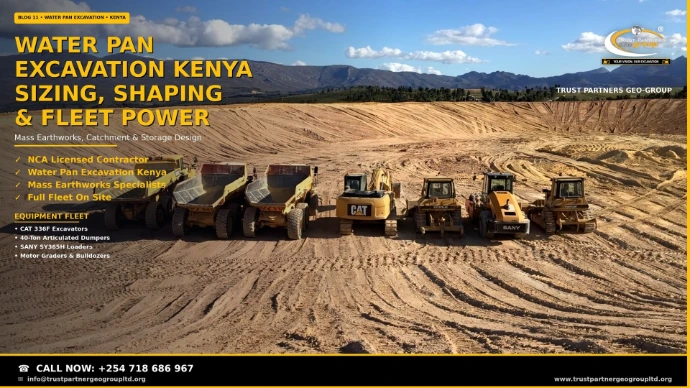
The production chain: 30-ton excavators dig, shape and trim — 50-ton units where rock bites; 30–40 tonne articulated dumpers move the cut 3–6 passes to the bucket; dozers rip, push and build the haul routes first; graders trim crests and access to falls; smooth-drum and sheepsfoot rollers compact rim fill in specification lifts; breakers ride the excavators where the floor fights back. Hire bands hold at KES 15,000–25,000 per day for the 30-ton class and KES 18,000–30,000 for the dumpers — and the fleet that wins is the one sized to the pan, not the one nearest the yard.
7. Worked Example: The 20-Cattle Pan
| Item | Figure |
|---|---|
| Storage target (20 cattle × 5-month dry gap + household + margin) | ≈ 500 m³ |
| Bowl geometry (30 × 20 m, 1.5 m avg depth, 1:2 slopes, 1 m freeboard) | ≈ 700 m³ excavation incl. rim |
| Excavation @ 400–700/m³ (soil, short haul) | KES 280K–490K |
| Spillway (simple armoured channel) | KES 150K–250K |
| Liner (clay floor, if percolation test fails) | KES 60K–150K |
| Indicative total | KES 500K–900K |
A season of water security for a herd and a homestead, at the price of two drought-driven herd losses — which is the arithmetic driving Kenya's pan build-out.
8. Frequently Asked Questions
The national bands for 2026: soil excavation and carting within site — KES 350–800 per m³, the spread driven by haul distance, ground and access. Rippable ground where dozers must open material before loading — KES 500–1,000 per m³. Rock requiring breaking — KES 1,200–2,500 per m³, the defining risk line on Machakos, Kitui, Kajiado and parts of Rift sites. Embankment placement from the cut — usually included where the pan balances, add KES 150–400 per m³ placed if material must move beyond the immediate rim. Two lines ride on top: the spillway, KES 150,000–500,000 designed and armoured, and the liner where the floor fails a percolation test — clay at KES 80–150 per m², geomembrane at KES 250–450 per m² installed. As working figures: a 5,000 m³ farm pan lands KES 300K–700K all-in on good ground; a 20,000 m³ community pan KES 1M–2.5M; larger county dams scale from there — always contingent on the siting survey that prices rock and haul before design.
The regional picture behind the national bands. Nairobi metro, Kiambu and the Central highlands: KES 350–700 per m³ — competitive fleets, short hauls, but disposal and county logistics price higher near the city. The Rift Valley (Nakuru, Eldoret, Kitale belts): KES 300–650 — excellent red soils that dig fast, long regional hauls the only levy. Western Kenya (Kisumu, Kakamega, Busia): KES 350–750 — black cotton handling slows production and drainage design adds work. Eastern and semi-arid counties (Machakos, Makueni, Kitui): KES 400–900 — the rock band bites hardest here, and mobilisation to remote wards adds a standing charge smaller budgets forget. Kajiado and the southern rift: KES 400–1,000 where volcanic tuff demands breaking. The Coast: KES 400–900 — sand digs fast but compacts poorly, and coral rock appears with little warning. The pattern: the machine day rate barely changes county to county — what moves the per-m³ number is ground, haul and mobilisation, which is why the survey precedes the quote.
Size it from demand across the dry gap, then check the catchment can fill it. Demand: a beef or dairy animal drinks 40–60 litres daily in cool weather and 60–100 in heat; twenty cattle therefore need roughly 1,200–2,000 litres daily, and across a five-month (150-day) dry gap that accumulates 180–300 m³ — call it 250 m³ with cleaning and evaporation margin. Add the household and any small irrigation, and a practical 20-cattle pan targets 400–600 m³ of storage. Geometry: a pan 30 by 20 metres at 1.5 metres average depth delivers roughly that, with 1:2 side slopes and a one-metre freeboard above the spillway crest. The catchment check: at a 15% runoff coefficient — typical rangeland — filling 500 m³ requires about 3,300 m² of effective catchment for a 600mm season, so either a generous catchment ratio (ten times the pan area is the traditional rule) or a diversion channel from uphill. Sizing surveys cost a fraction of a mis-sized pan; the full demand tables for livestock and irrigation sit in the sizing guide, and this cluster's complete construction guide carries the worked examples.
Production math from the fleet: a 30-ton excavator with matched articulated dumpers moves 600–1,200 m³ per day in free soil; a heavy dozer-and-scraper spread pushes more on long balance cuts. Against those rates: a 1,000–3,000 m³ farm pan is a 2–5 day dig; a 5,000–10,000 m³ pan runs 1–3 weeks including embankment shaping and compaction; a 20,000–50,000 m³ community or county dam is a 1–3 month programme with survey-controlled sequencing. The calendar modifiers: rock drops production to 80–250 m³ per day wherever breaking starts; the rains both slow production and punish open faces — dry-season digging is the default plan; and mobilisation to remote wards adds days that vanish from small budgets. Programme honestly and the dig finishes inside the month you said; programme from hope and the pan meets its first rains half-built, which is the most expensive way to store nothing.
The pan fleet follows the production chain. Excavators — 30-ton units as the backbone, 50-ton machines on heavy rock — dig, shape and trim the bowl to formation. Articulated dumpers — 30–40 tonne payloads matched 3–6 passes to the bucket — move the cut to the embankment rim, or cart to spoil where the pan overflows its balance. Dozers rip and push on balance cuts, and build the haul routes before the fleet needs them. Graders trim the embankment crest and access road to falls. Rollers — smooth drum on granular rim fill, sheepsfoot on clay — compact the embankment in specification lifts. And breakers on the excavators where rock interrupts the floor. Hire rates run the standard bands — 30-ton excavators KES 15,000–25,000 per day, dumpers KES 18,000–30,000 — and the fleet that wins is the one sized to the pan, not the one nearest the yard: the full selection logic sits in this cluster's construction guides.
Survey First. Dig Once. Store for Decades.
Trust Partners Geo-Group Ltd delivers water pan and dam excavation across all 47 counties — siting surveys, per-m³ itemised rates, matched fleets and the spillway and lining works that make storage permanent.
Estimate Your Pan on the Calculator✉️ Contact Us
📞 +254 718 68 69 67
Dam and Water Pan Excavation Costs in Kenya 2026: Per m³ Rates by County and Dam Size
The rate guide for Kenya's water storage build-out: per-m³ bands by ground type, the county table that explains them, sizing geometry, and the fleet power that turns surveys into storage.
1. The Per-m³ Answer First
Pan and dam rates reward the same discipline as every earthwork in our services portfolio — surveys before machines — practised across all 47 counties by Trust Partners Geo-Group under our dam and water pan excavation service. The bands below are the honest national picture; the county table that follows explains them.
| Ground & Scope | 2026 Rate (KES/m³) | Note |
|---|---|---|
| Soil excavation & carting within site | 350–800 | Haul, access, moisture |
| Rippable ground | 500–1,000 | Dozer ripping first |
| Rock requiring breaking | 1,200–2,500 | The risk line — survey first |
| Embankment placement (unbalanced) | +150–400 | Where cut exceeds rim need |
| Spillway (designed & armoured) | 150K–500K per structure | Non-negotiable |
| Liner where floor leaks | Clay 80–150/m²; HDPE 250–450/m² | Percolation test decides |
Working totals: 5,000 m³ farm pan KES 300K–700K on good ground; 20,000 m³ community pan KES 1M–2.5M. The rates sit within the wider earthworks picture priced in our per-m³ earthworks breakdown, and the engineering that follows the dig is covered in earth dam design and construction.
2. Rates by County & Region
| Region | Rate Band (KES/m³) | What Moves It |
|---|---|---|
| Nairobi metro & Central highlands | 350–700 | Competitive fleets; city logistics levy |
| Rift Valley (Nakuru–Eldoret–Kitale) | 300–650 | Fast red soils; long hauls |
| Western Kenya | 350–750 | Black cotton handling; drainage design |
| Eastern / semi-arid (Machakos–Kitui–Makueni) | 400–900 | Rock band; remote mobilisation |
| Kajiado & southern Rift | 400–1,000 | Volcanic tuff breaking |
| Coast | 400–900 | Fast sand, poor compaction, coral surprises |
The pattern worth memorising: machine day rates barely change county to county — ground, haul and mobilisation move the per-m³ number, which is why the survey precedes the quote on professional work.
3. Rates by Size: The Scale Effect
Per-m³ rates fall as pans grow. The 1,000–3,000 m³ homestead pan pays mobilisation against a small volume — the highest per-m³ tier, and the reason neighbours pool into group pans. The 5,000–20,000 m³ band reaches efficiency: fleets stage once, cut-and-fill balances within the bowl, and the per-m³ rate lands mid-band. Above 20,000 m³, programme economics take over: multi-week engagements discount machine rates 10–20%, and the cost conversation shifts from per-m³ to per-season of water delivered — where storage earns its keep.
4. What's Inside the Per-m³ Rate
An honest per-m³ rate carries: the dig itself to formation; loading and short haul within the site; embankment rim shaping in compacted lifts where the cut balances; formation trimming for the liner or clay floor; and the water management that keeps a dry dig dry. What it rarely carries — and must be quoted separately: the engineered spillway, liner materials, fencing, inlet works, and mobilisation to remote wards. Cross-check quotes against these lines; a rate that includes everything is usually a rate that includes nothing after signing. The full construction sequence is documented in this cluster's complete dam and pan excavation guide.
5. Sizing & Shaping: Geometry Sets Volume
The bowl's shape decides its cost before the fleet arrives. Side slopes of 1:2 balance stability against excavation volume; steeper saves earthwork but slumps in weak ground. Depth concentrates storage cheaply — a pan twice as deep holds roughly twice the water for far less than twice the perimeter — but push depth past the water table or into rock and the rate band jumps. Freeboard of one metre above the spillway crest costs a ring of earthwork and buys the storm margin that protects everything below it. The inlet end settles silt before water reaches storage; the deepest point sits at the draw-off so the last litre is the cleanest. None of this is exotic — it is the geometry line on the survey drawing, and it is worth more per shilling than any machine.
6. Fleet Power: Machines That Move a Pan
The production chain: 30-ton excavators dig, shape and trim — 50-ton units where rock bites; 30–40 tonne articulated dumpers move the cut 3–6 passes to the bucket; dozers rip, push and build the haul routes first; graders trim crests and access to falls; smooth-drum and sheepsfoot rollers compact rim fill in specification lifts; breakers ride the excavators where the floor fights back. Hire bands hold at KES 15,000–25,000 per day for the 30-ton class and KES 18,000–30,000 for the dumpers — and the fleet that wins is the one sized to the pan, not the one nearest the yard.
7. Worked Example: The 20-Cattle Pan
| Item | Figure |
|---|---|
| Storage target (20 cattle × 5-month dry gap + household + margin) | ≈ 500 m³ |
| Bowl geometry (30 × 20 m, 1.5 m avg depth, 1:2 slopes, 1 m freeboard) | ≈ 700 m³ excavation incl. rim |
| Excavation @ 400–700/m³ (soil, short haul) | KES 280K–490K |
| Spillway (simple armoured channel) | KES 150K–250K |
| Liner (clay floor, if percolation test fails) | KES 60K–150K |
| Indicative total | KES 500K–900K |
A season of water security for a herd and a homestead, at the price of two drought-driven herd losses — which is the arithmetic driving Kenya's pan build-out.
8. Frequently Asked Questions
The national bands for 2026: soil excavation and carting within site — KES 350–800 per m³, the spread driven by haul distance, ground and access. Rippable ground where dozers must open material before loading — KES 500–1,000 per m³. Rock requiring breaking — KES 1,200–2,500 per m³, the defining risk line on Machakos, Kitui, Kajiado and parts of Rift sites. Embankment placement from the cut — usually included where the pan balances, add KES 150–400 per m³ placed if material must move beyond the immediate rim. Two lines ride on top: the spillway, KES 150,000–500,000 designed and armoured, and the liner where the floor fails a percolation test — clay at KES 80–150 per m², geomembrane at KES 250–450 per m² installed. As working figures: a 5,000 m³ farm pan lands KES 300K–700K all-in on good ground; a 20,000 m³ community pan KES 1M–2.5M; larger county dams scale from there — always contingent on the siting survey that prices rock and haul before design.
The regional picture behind the national bands. Nairobi metro, Kiambu and the Central highlands: KES 350–700 per m³ — competitive fleets, short hauls, but disposal and county logistics price higher near the city. The Rift Valley (Nakuru, Eldoret, Kitale belts): KES 300–650 — excellent red soils that dig fast, long regional hauls the only levy. Western Kenya (Kisumu, Kakamega, Busia): KES 350–750 — black cotton handling slows production and drainage design adds work. Eastern and semi-arid counties (Machakos, Makueni, Kitui): KES 400–900 — the rock band bites hardest here, and mobilisation to remote wards adds a standing charge smaller budgets forget. Kajiado and the southern rift: KES 400–1,000 where volcanic tuff demands breaking. The Coast: KES 400–900 — sand digs fast but compacts poorly, and coral rock appears with little warning. The pattern: the machine day rate barely changes county to county — what moves the per-m³ number is ground, haul and mobilisation, which is why the survey precedes the quote.
Size it from demand across the dry gap, then check the catchment can fill it. Demand: a beef or dairy animal drinks 40–60 litres daily in cool weather and 60–100 in heat; twenty cattle therefore need roughly 1,200–2,000 litres daily, and across a five-month (150-day) dry gap that accumulates 180–300 m³ — call it 250 m³ with cleaning and evaporation margin. Add the household and any small irrigation, and a practical 20-cattle pan targets 400–600 m³ of storage. Geometry: a pan 30 by 20 metres at 1.5 metres average depth delivers roughly that, with 1:2 side slopes and a one-metre freeboard above the spillway crest. The catchment check: at a 15% runoff coefficient — typical rangeland — filling 500 m³ requires about 3,300 m² of effective catchment for a 600mm season, so either a generous catchment ratio (ten times the pan area is the traditional rule) or a diversion channel from uphill. Sizing surveys cost a fraction of a mis-sized pan; the full demand tables for livestock and irrigation sit in the sizing guide, and this cluster's complete construction guide carries the worked examples.
Production math from the fleet: a 30-ton excavator with matched articulated dumpers moves 600–1,200 m³ per day in free soil; a heavy dozer-and-scraper spread pushes more on long balance cuts. Against those rates: a 1,000–3,000 m³ farm pan is a 2–5 day dig; a 5,000–10,000 m³ pan runs 1–3 weeks including embankment shaping and compaction; a 20,000–50,000 m³ community or county dam is a 1–3 month programme with survey-controlled sequencing. The calendar modifiers: rock drops production to 80–250 m³ per day wherever breaking starts; the rains both slow production and punish open faces — dry-season digging is the default plan; and mobilisation to remote wards adds days that vanish from small budgets. Programme honestly and the dig finishes inside the month you said; programme from hope and the pan meets its first rains half-built, which is the most expensive way to store nothing.
The pan fleet follows the production chain. Excavators — 30-ton units as the backbone, 50-ton machines on heavy rock — dig, shape and trim the bowl to formation. Articulated dumpers — 30–40 tonne payloads matched 3–6 passes to the bucket — move the cut to the embankment rim, or cart to spoil where the pan overflows its balance. Dozers rip and push on balance cuts, and build the haul routes before the fleet needs them. Graders trim the embankment crest and access road to falls. Rollers — smooth drum on granular rim fill, sheepsfoot on clay — compact the embankment in specification lifts. And breakers on the excavators where rock interrupts the floor. Hire rates run the standard bands — 30-ton excavators KES 15,000–25,000 per day, dumpers KES 18,000–30,000 — and the fleet that wins is the one sized to the pan, not the one nearest the yard: the full selection logic sits in this cluster's construction guides.
Survey First. Dig Once. Store for Decades.
Trust Partners Geo-Group Ltd delivers water pan and dam excavation across all 47 counties — siting surveys, per-m³ itemised rates, matched fleets and the spillway and lining works that make storage permanent.
Estimate Your Pan on the Calculator✉️ Contact Us
📞 +254 718 68 69 67