
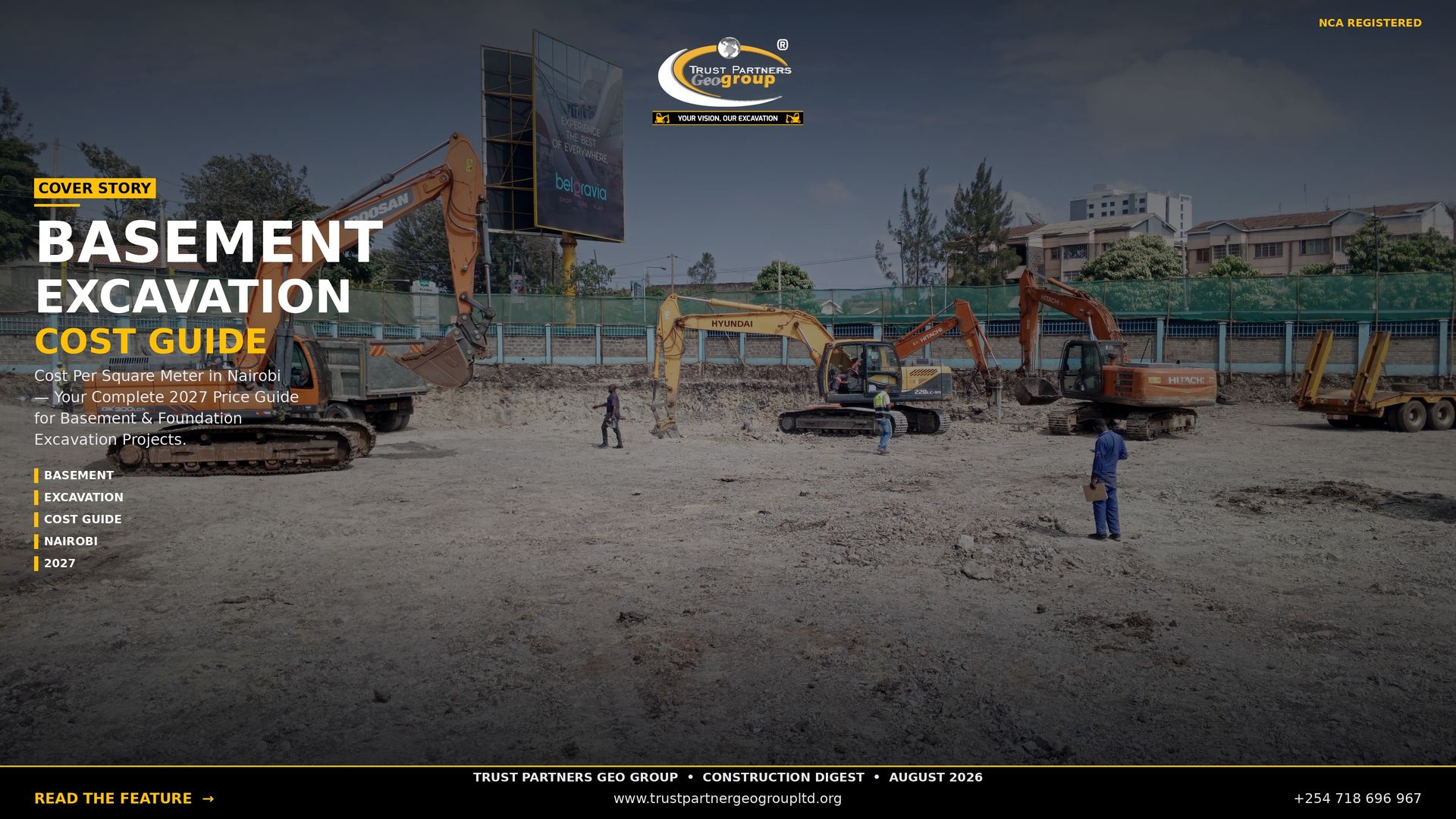
Basement Excavation Cost Per Square Meter in Nairobi [2027 Price Guide]
The Definitive Cost Reference for Developers, Architects & Quantity Surveyors
Every developer planning a 2027 project in Nairobi starts with the same question: what does basement excavation cost per square meter? The answer is not a single number — it is a matrix of depth, soil, access and location. This guide gives you the complete 2027 price table for basement excavation cost per m² in Nairobi, Kiambu, Kajiado and Machakos, with the ancillary costs that separate an accurate budget from a surprise variation. With 15+ years of basement excavation across Kenya, Trust Partners Geo-Group publishes these rates as a benchmark for the industry — and as the starting point for your itemized quote.

NCA-registered excavation contractors serving Nairobi, Kiambu, Kajiado, Machakos and all 47 counties. 15+ years of basement excavation, bulk earthworks and heavy equipment hire across Kenya and East Africa.
Basement Excavation Cost Per m²: 2027 at a Glance
The 2027 Nairobi construction market enters the year with stabilized diesel pricing, a recovering shilling, and increased competition for deep basement contracts in Upper Hill, Kilimani and the expanding satellite corridors. Trust Partners Geo-Group has structured the following cost per square meter rates based on active project data from Q3–Q4 2026, adjusted for 2027 equipment, fuel and labour indices. All rates include spoil disposal — a critical distinction, because many competitors quote net excavation then add spoil cartaway as a 15–25% variation.
| Depth Range | Soil Type | Cost per m² (KES) | Typical Application |
|---|---|---|---|
| Up to 4 meters | Loose Material | 3,200 | Residential basements, parking podiums, light commercial |
| Up to 4 meters | Weathered Rock | 3,600 | Shallow rock sites in Kajiado, Ngong, parts of Karen |
| 4 – 8 meters | Loose Material | 4,000 | Mid-rise parking, retail basements, institutional substructures |
| 4 – 8 meters | Weathered Rock | 4,800 | Medium-depth rock excavation with hydraulic hammer support |
| 8 – 15 meters | Loose Material | 8,400 | High-rise podium parking, hospital bunkers, deep commercial |
| 8 – 15 meters | Weathered Rock | 10,500 | Deep rock cuts requiring staged shoring and muck hoisting |
| 15 – 25 meters | Loose Material | 18,000 | Metro-style parking, deep plant rooms, high-rise foundations |
| 15 – 25 meters | Weathered Rock | 22,000 | Specialist deep rock excavation with multi-stage support |
Cost by Depth: Up to 4m vs 4–8m vs 8–15m vs 15–25m
Basement depth is the single largest cost driver in earthworks pricing. Each successive depth band triggers different equipment, safety, shoring and production constraints. The 2027 Trust Partners Geo-Group rate card reflects these engineering realities.
Shallow Basements: Up to 4 Meters Deep
Most residential and light commercial basements fall into this band. A 20-ton hydraulic excavator with a 0.8 m³ bucket can achieve production rates of 40–60 m² per day in loose material, assuming straightforward site access. Weathered rock at this depth is typically decomposed enough that a hydraulic ripper or medium breaker attachment suffices, adding only KES 400 per m² to the base rate. Review our complete depth guide for engineering constraints at each level.
Medium Basements: 4 – 8 Meters Deep
Once excavation passes 4 meters, lateral earth pressure becomes a design consideration. Simple 1:1.5 battered slopes are often no longer feasible on confined urban sites, meaning sheet piles, soldier piles or contiguous bored piles enter the temporary works scope. Production rates drop by 25–35% because material must be lifted rather than simply pushed to a stockpile. The 2027 rate of KES 4,000 per m² for loose material and KES 4,800 per m² for weathered rock reflects this slowdown plus the beginning of shoring interface costs.
Deep Basements: 8 – 15 Meters Deep
This is the domain of high-rise apartment podiums, hospital service floors and large retail basements in Westlands and Upper Hill. Excavation at this depth requires long-reach excavators or crane-and-skip mucking systems. Dewatering becomes a near-certainty in Nairobi's high-water-table zones such as Parklands and parts of Kilimani. The rate jumps to KES 8,400 per m² for loose material and KES 10,500 per m² for weathered rock — roughly double the 4–8 meter band — because every cubic meter must be hoisted vertically, and every bench cut requires re-positioning of heavy equipment.
Very Deep Basements: 15 – 25 Meters Deep
Very few Kenyan contractors price this category from standard schedules. These projects — typically found in mixed-use high-rise developments along Mombasa Road, Ngong Road and the emerging EPZ corridors — require diaphragm walls or top-down construction methods. The 2027 rate of KES 18,000 per m² for loose material and KES 22,000 per m² for weathered rock covers bulk excavation only; permanent retaining walls, dewatering plants and structural top-down slabs are priced as separate civil works packages. Mega basement projects over 30 meters require bespoke feasibility studies before unit rates can be fixed.
How Soil Conditions Change the Price
The difference between loose material and weathered rock is not merely geological — it is mechanical. Loose material includes murram, engineered fill, black cotton soil (with appropriate moisture management), and sandy deposits common in Athi River and parts of Ruaka. These materials yield to standard bucket excavation with minimal auxiliary equipment.
Weathered rock, by contrast, is partially decomposed rock that still retains structural strength. It cannot be ripped by a standard excavator bucket. It requires:
- Hydraulic rippers on 30-ton excavators for lightly weathered zones
- Hydraulic hammer attachments for medium weathering
- Chemical or controlled breaking where vibration restrictions apply near adjacent buildings
The production penalty is 30–50% compared to loose material, which explains the KES 400–4,000 per m² premium across depth bands. In 2027, fuel and breaker wear-part costs have stabilised, but the productivity gap remains. Rock-breaking alternatives in Nairobi are covered in our dedicated equipment guide.
Hard rock beyond the weathered classification is not included in the table above. If your geotechnical investigation reveals fresh basalt, phonolite or granite, expect standalone rock-breaking rates of KES 5,000–12,000 per m³, depending on fracture spacing and blasting permit requirements.
Location Adjustments: CBD vs. Satellite Towns
Nairobi's construction geography is no longer limited to the traditional CBD ring. The 2027 rate card applies standard pricing to the greater Nairobi metropolitan area, with the following location modifiers:
| Location Zone | Adjustment | Reasoning |
|---|---|---|
| Nairobi CBD (Upper Hill, Kilimani, Parklands, Westlands) | +15% | Traffic management, night-work permits, confined haulage routes, noise restrictions |
| Kiambu Corridor (Ruiru, Thika, Juja, Ruaka) | -10% | Better site access, lower haulage distances, fewer traffic constraints |
| Kajiado Corridor (Kitengela, Athi River, Ngong, Kiserian) | -15% | Excellent access, large working areas; offset by occasional hard rock surprises |
| Machakos / Mombasa Road Corridor | -10% | Good logistics, expanding infrastructure, competitive subcontractor market |
| Coastal Region (Mombasa, Malindi, Diani) | +5 to +20% | High water table, sandy soils requiring dewatering, longer equipment mobilisation |
Developers in Parklands, Kilimani and Upper Hill should budget at the upper end of each depth band due to vibration sensitivity and restricted working hours. Satellite-town projects in Kiambu County benefit from faster cycle times but may encounter black cotton soil in low-lying pockets near Ruiru and Juja.
Ancillary Costs: What the m² Rate Does and Does Not Include
The 2027 per-square-meter rates are comprehensive for bulk excavation, but they are not all-inclusive. Professional quantity surveyors separate the following items to avoid contract variations:
| Item | Typical Cost (KES) | Included in Base Rate? |
|---|---|---|
| Spoil disposal (within 15 km) | Included | Yes |
| Site clearance and topsoil strip | Included | Yes |
| Compaction of formation level | Included | Yes |
| Shoring / temporary retaining walls | 3,500 – 8,000 per m² of wall face | No |
| Dewatering (pump hire, fuel, discharge) | 150,000 – 600,000 per project | No |
| Rock breaking beyond weathered rock | 5,000 – 12,000 per m³ | No |
| Underpinning adjacent foundations | 8,000 – 15,000 per linear meter | No |
| Compaction testing (CBR, density) | 18,000 – 50,000 per test | No |
| Haulage beyond 15 km radius | 800 – 1,200 per m³ per 10 km | No |
How to Calculate Total Basement Excavation Cost
Follow this seven-step method to arrive at a defensible budget figure for your 2027 project:
- Measure the basement footprint. Calculate length × width in meters. Include all zones — parking bays, storage, plant rooms, circulation corridors and ramps. Do not deduct columns or small voids from the gross area; the excavator works the full envelope.
- Determine formation depth. Measure from natural ground level to the underside of blinding. Typical Nairobi residential basements sit at 2.5–4.5 m. Commercial podiums range 6–12 m. High-rise service basements can exceed 15 m.
- Identify the soil class. Review your geotechnical investigation. If the report classifies material as "loose to medium dense" or "fill / murram," use the loose-material column. If it references "highly weathered rock," "completely weathered rock," or SPT values above 50, use the weathered-rock column.
- Select the base rate. Use the 2027 price table above. Match your depth band and soil type precisely.
- Apply location adjustment. Add 15% for CBD sites. Deduct 10% for Kiambu and 15% for Kajiado standard sites.
- Add ancillary line items. Price shoring, dewatering, testing and rock breaking as separate BoQ lines. Do not bury them in the excavation rate.
- Request three itemized quotes. Obtain quotes from NCA-registered contractors. Compare unit rates, not just lump-sum totals. Verify spoil disposal is included — many low bids exclude it. Read our full planning and execution guide for tender-stage checklist templates.
Comparing Quotes: Unit Rate vs. Lump Sum vs. Daywork
Kenyan excavation contracts are let on three main commercial structures. Each suits a different risk profile:
Unit Rate Contracts
The contractor quotes a fixed rate per m² (or per m³) for each item in the BoQ. The client pays for the actual measured quantity after excavation. This is the fairest structure for basement work because final quantities often differ from design estimates once test pits reveal true soil profiles. The 2027 rates in this guide are structured for unit-rate comparison.
Lump Sum Contracts
The contractor quotes a single fixed price for the entire excavation scope. This works only when the geotechnical report is comprehensive, the site boundaries are fixed, and no rock is anticipated. Warning: Lump-sum bids that exclude spoil disposal, dewatering or rock breaking are the leading cause of disputes on Nairobi basement projects.
Daywork (Time & Materials)
Rarely used for bulk excavation, but appropriate for contingency rock breaking, emergency dewatering, or adjoining foundation underpinning. Daywork rates in 2027 average KES 18,000–28,000 per hour for a 30-ton excavator with operator and fuel, plus KES 4,500–7,000 per hour for a hydraulic breaker attachment.
Interactive Cost Calculator [2027]
Use the calculator below to estimate your project cost in seconds. Select your depth band, soil type and location to see a total based on the 2027 Trust Partners Geo-Group rate card. For a formal itemized quote, call +254 718 686 967 or request a site assessment.
2027 Basement Excavation Cost Calculator
Estimated Project Cost:
Rate applied: per m². Includes spoil disposal within 15 km. Excludes shoring, dewatering, and rock breaking beyond weathered classification.
Frequently Asked Questions
How much does basement excavation cost per square meter in Nairobi in 2027?
In 2027, basement excavation in Nairobi costs KES 3,200–22,000 per square meter depending on depth and soil type. Loose material up to 4 meters deep averages KES 3,200 per m², while weathered rock at 15–25 meters depth reaches KES 22,000 per m². All published rates include spoil disposal.
What factors affect basement excavation cost per m² in Kenya?
Key cost drivers include excavation depth, soil type (loose material or weathered rock), site access and working space, groundwater level requiring dewatering, proximity to existing buildings needing underpinning, haulage distance for spoil disposal, and the need for shoring or retaining walls. Deeper basements and rock excavation increase costs significantly.
Is basement excavation cheaper in Kiambu or Kajiado than in Nairobi CBD?
Generally yes. Basement excavation in Kiambu, Kajiado and Machakos satellite areas costs 10–20% less than Nairobi CBD due to better site access, fewer space constraints and lower spoil haulage distances. However, rocky volcanic soils in some Kajiado areas can offset savings if harder rock is encountered beyond the weathered layer.
How do I calculate total basement excavation cost for my project?
Multiply the basement footprint area (length × width) by the cost per square meter for your depth and soil conditions. Add allowances for shoring (KES 3,500–8,000 per m² of wall), dewatering (KES 150,000–600,000), compaction testing (KES 18,000–50,000 per test), and rock breaking beyond weathered rock if encountered.
Does basement depth significantly affect cost per square meter?
Yes. Excavation at 15–25 meters deep costs five to six times more per m² than shallow work up to 4 meters. Each additional depth band requires slower production rates, larger or specialized equipment, increased shoring requirements, longer material hoisting cycles, and higher safety and supervision overhead.
What is included in the 2027 basement excavation quote per square meter?
The 2027 rates include site clearance and topsoil strip, bulk excavation to formation level, precision trimming and tolerance verification, compaction of formation and access routes, spoil disposal off-site, and basic dewatering during excavation. They typically exclude permanent shoring systems, ongoing dewatering, rock breaking beyond weathered rock classification, underpinning of adjacent buildings, and backfilling.
Who offers the best basement excavation rates per m² in Nairobi?
NCA-registered contractors with transparent unit pricing, documented site assessments and no hidden extras. Trust Partners Geo-Group provides itemized per-m² basement excavation quotes for Nairobi, Kiambu, Kajiado and Machakos — with depth-based pricing, soil assessment, spoil disposal included, and guaranteed tolerance handover. Call +254 718 686 967 for a 2027 rate card.
Why does weathered rock cost more than loose material per square meter?
Weathered rock requires ripping, hydraulic hammering or blasting alternatives, slowing production by 30–50% and increasing equipment wear. The 2027 rates reflect this premium, ranging from KES 3,600 per m² for shallow weathered rock to KES 22,000 per m² for deep weathered rock excavation, compared to KES 3,200–18,000 per m² for loose material at equivalent depths.
Get Your 2027 Basement Excavation Quote Today
Planning a 2027 project? Contact Trust Partners Geo-Group at +254 718 686 967 for a free site assessment and itemized quote. Serving Nairobi, Kitengela, Athi River, Ruaka, Ngong, Naivasha, Nanyuki and all 47 counties.
Call +254 718 686 967 Email Our Estimating TeamBasement Excavation Cost Per Square Meter in Nairobi [2027 Price Guide]
The Definitive Cost Reference for Developers, Architects & Quantity Surveyors
Every developer planning a 2027 project in Nairobi starts with the same question: what does basement excavation cost per square meter? The answer is not a single number — it is a matrix of depth, soil, access and location. This guide gives you the complete 2027 price table for basement excavation cost per m² in Nairobi, Kiambu, Kajiado and Machakos, with the ancillary costs that separate an accurate budget from a surprise variation. With 15+ years of basement excavation across Kenya, Trust Partners Geo-Group publishes these rates as a benchmark for the industry — and as the starting point for your itemized quote.
NCA-registered excavation contractors serving Nairobi, Kiambu, Kajiado, Machakos and all 47 counties. 15+ years of basement excavation, bulk earthworks and heavy equipment hire across Kenya and East Africa.
Basement Excavation Cost Per m²: 2027 at a Glance
The 2027 Nairobi construction market enters the year with stabilized diesel pricing, a recovering shilling, and increased competition for deep basement contracts in Upper Hill, Kilimani and the expanding satellite corridors. Trust Partners Geo-Group has structured the following cost per square meter rates based on active project data from Q3–Q4 2026, adjusted for 2027 equipment, fuel and labour indices. All rates include spoil disposal — a critical distinction, because many competitors quote net excavation then add spoil cartaway as a 15–25% variation.
| Depth Range | Soil Type | Cost per m² (KES) | Typical Application |
|---|---|---|---|
| Up to 4 meters | Loose Material | 3,200 | Residential basements, parking podiums, light commercial |
| Up to 4 meters | Weathered Rock | 3,600 | Shallow rock sites in Kajiado, Ngong, parts of Karen |
| 4 – 8 meters | Loose Material | 4,000 | Mid-rise parking, retail basements, institutional substructures |
| 4 – 8 meters | Weathered Rock | 4,800 | Medium-depth rock excavation with hydraulic hammer support |
| 8 – 15 meters | Loose Material | 8,400 | High-rise podium parking, hospital bunkers, deep commercial |
| 8 – 15 meters | Weathered Rock | 10,500 | Deep rock cuts requiring staged shoring and muck hoisting |
| 15 – 25 meters | Loose Material | 18,000 | Metro-style parking, deep plant rooms, high-rise foundations |
| 15 – 25 meters | Weathered Rock | 22,000 | Specialist deep rock excavation with multi-stage support |
Cost by Depth: Up to 4m vs 4–8m vs 8–15m vs 15–25m
Basement depth is the single largest cost driver in earthworks pricing. Each successive depth band triggers different equipment, safety, shoring and production constraints. The 2027 Trust Partners Geo-Group rate card reflects these engineering realities.
Shallow Basements: Up to 4 Meters Deep
Most residential and light commercial basements fall into this band. A 20-ton hydraulic excavator with a 0.8 m³ bucket can achieve production rates of 40–60 m² per day in loose material, assuming straightforward site access. Weathered rock at this depth is typically decomposed enough that a hydraulic ripper or medium breaker attachment suffices, adding only KES 400 per m² to the base rate. Review our complete depth guide for engineering constraints at each level.
Medium Basements: 4 – 8 Meters Deep
Once excavation passes 4 meters, lateral earth pressure becomes a design consideration. Simple 1:1.5 battered slopes are often no longer feasible on confined urban sites, meaning sheet piles, soldier piles or contiguous bored piles enter the temporary works scope. Production rates drop by 25–35% because material must be lifted rather than simply pushed to a stockpile. The 2027 rate of KES 4,000 per m² for loose material and KES 4,800 per m² for weathered rock reflects this slowdown plus the beginning of shoring interface costs.
Deep Basements: 8 – 15 Meters Deep
This is the domain of high-rise apartment podiums, hospital service floors and large retail basements in Westlands and Upper Hill. Excavation at this depth requires long-reach excavators or crane-and-skip mucking systems. Dewatering becomes a near-certainty in Nairobi's high-water-table zones such as Parklands and parts of Kilimani. The rate jumps to KES 8,400 per m² for loose material and KES 10,500 per m² for weathered rock — roughly double the 4–8 meter band — because every cubic meter must be hoisted vertically, and every bench cut requires re-positioning of heavy equipment.
Very Deep Basements: 15 – 25 Meters Deep
Very few Kenyan contractors price this category from standard schedules. These projects — typically found in mixed-use high-rise developments along Mombasa Road, Ngong Road and the emerging EPZ corridors — require diaphragm walls or top-down construction methods. The 2027 rate of KES 18,000 per m² for loose material and KES 22,000 per m² for weathered rock covers bulk excavation only; permanent retaining walls, dewatering plants and structural top-down slabs are priced as separate civil works packages. Mega basement projects over 30 meters require bespoke feasibility studies before unit rates can be fixed.
How Soil Conditions Change the Price
The difference between loose material and weathered rock is not merely geological — it is mechanical. Loose material includes murram, engineered fill, black cotton soil (with appropriate moisture management), and sandy deposits common in Athi River and parts of Ruaka. These materials yield to standard bucket excavation with minimal auxiliary equipment.
Weathered rock, by contrast, is partially decomposed rock that still retains structural strength. It cannot be ripped by a standard excavator bucket. It requires:
- Hydraulic rippers on 30-ton excavators for lightly weathered zones
- Hydraulic hammer attachments for medium weathering
- Chemical or controlled breaking where vibration restrictions apply near adjacent buildings
The production penalty is 30–50% compared to loose material, which explains the KES 400–4,000 per m² premium across depth bands. In 2027, fuel and breaker wear-part costs have stabilised, but the productivity gap remains. Rock-breaking alternatives in Nairobi are covered in our dedicated equipment guide.
Hard rock beyond the weathered classification is not included in the table above. If your geotechnical investigation reveals fresh basalt, phonolite or granite, expect standalone rock-breaking rates of KES 5,000–12,000 per m³, depending on fracture spacing and blasting permit requirements.
Location Adjustments: CBD vs. Satellite Towns
Nairobi's construction geography is no longer limited to the traditional CBD ring. The 2027 rate card applies standard pricing to the greater Nairobi metropolitan area, with the following location modifiers:
| Location Zone | Adjustment | Reasoning |
|---|---|---|
| Nairobi CBD (Upper Hill, Kilimani, Parklands, Westlands) | +15% | Traffic management, night-work permits, confined haulage routes, noise restrictions |
| Kiambu Corridor (Ruiru, Thika, Juja, Ruaka) | -10% | Better site access, lower haulage distances, fewer traffic constraints |
| Kajiado Corridor (Kitengela, Athi River, Ngong, Kiserian) | -15% | Excellent access, large working areas; offset by occasional hard rock surprises |
| Machakos / Mombasa Road Corridor | -10% | Good logistics, expanding infrastructure, competitive subcontractor market |
| Coastal Region (Mombasa, Malindi, Diani) | +5 to +20% | High water table, sandy soils requiring dewatering, longer equipment mobilisation |
Developers in Parklands, Kilimani and Upper Hill should budget at the upper end of each depth band due to vibration sensitivity and restricted working hours. Satellite-town projects in Kiambu County benefit from faster cycle times but may encounter black cotton soil in low-lying pockets near Ruiru and Juja.
Ancillary Costs: What the m² Rate Does and Does Not Include
The 2027 per-square-meter rates are comprehensive for bulk excavation, but they are not all-inclusive. Professional quantity surveyors separate the following items to avoid contract variations:
| Item | Typical Cost (KES) | Included in Base Rate? |
|---|---|---|
| Spoil disposal (within 15 km) | Included | Yes |
| Site clearance and topsoil strip | Included | Yes |
| Compaction of formation level | Included | Yes |
| Shoring / temporary retaining walls | 3,500 – 8,000 per m² of wall face | No |
| Dewatering (pump hire, fuel, discharge) | 150,000 – 600,000 per project | No |
| Rock breaking beyond weathered rock | 5,000 – 12,000 per m³ | No |
| Underpinning adjacent foundations | 8,000 – 15,000 per linear meter | No |
| Compaction testing (CBR, density) | 18,000 – 50,000 per test | No |
| Haulage beyond 15 km radius | 800 – 1,200 per m³ per 10 km | No |
How to Calculate Total Basement Excavation Cost
Follow this seven-step method to arrive at a defensible budget figure for your 2027 project:
- Measure the basement footprint. Calculate length × width in meters. Include all zones — parking bays, storage, plant rooms, circulation corridors and ramps. Do not deduct columns or small voids from the gross area; the excavator works the full envelope.
- Determine formation depth. Measure from natural ground level to the underside of blinding. Typical Nairobi residential basements sit at 2.5–4.5 m. Commercial podiums range 6–12 m. High-rise service basements can exceed 15 m.
- Identify the soil class. Review your geotechnical investigation. If the report classifies material as "loose to medium dense" or "fill / murram," use the loose-material column. If it references "highly weathered rock," "completely weathered rock," or SPT values above 50, use the weathered-rock column.
- Select the base rate. Use the 2027 price table above. Match your depth band and soil type precisely.
- Apply location adjustment. Add 15% for CBD sites. Deduct 10% for Kiambu and 15% for Kajiado standard sites.
- Add ancillary line items. Price shoring, dewatering, testing and rock breaking as separate BoQ lines. Do not bury them in the excavation rate.
- Request three itemized quotes. Obtain quotes from NCA-registered contractors. Compare unit rates, not just lump-sum totals. Verify spoil disposal is included — many low bids exclude it. Read our full planning and execution guide for tender-stage checklist templates.
Comparing Quotes: Unit Rate vs. Lump Sum vs. Daywork
Kenyan excavation contracts are let on three main commercial structures. Each suits a different risk profile:
Unit Rate Contracts
The contractor quotes a fixed rate per m² (or per m³) for each item in the BoQ. The client pays for the actual measured quantity after excavation. This is the fairest structure for basement work because final quantities often differ from design estimates once test pits reveal true soil profiles. The 2027 rates in this guide are structured for unit-rate comparison.
Lump Sum Contracts
The contractor quotes a single fixed price for the entire excavation scope. This works only when the geotechnical report is comprehensive, the site boundaries are fixed, and no rock is anticipated. Warning: Lump-sum bids that exclude spoil disposal, dewatering or rock breaking are the leading cause of disputes on Nairobi basement projects.
Daywork (Time & Materials)
Rarely used for bulk excavation, but appropriate for contingency rock breaking, emergency dewatering, or adjoining foundation underpinning. Daywork rates in 2027 average KES 18,000–28,000 per hour for a 30-ton excavator with operator and fuel, plus KES 4,500–7,000 per hour for a hydraulic breaker attachment.
Interactive Cost Calculator [2027]
Use the calculator below to estimate your project cost in seconds. Select your depth band, soil type and location to see a total based on the 2027 Trust Partners Geo-Group rate card. For a formal itemized quote, call +254 718 686 967 or request a site assessment.
2027 Basement Excavation Cost Calculator
Estimated Project Cost:
Rate applied: per m². Includes spoil disposal within 15 km. Excludes shoring, dewatering, and rock breaking beyond weathered classification.
Frequently Asked Questions
How much does basement excavation cost per square meter in Nairobi in 2027?
In 2027, basement excavation in Nairobi costs KES 3,200–22,000 per square meter depending on depth and soil type. Loose material up to 4 meters deep averages KES 3,200 per m², while weathered rock at 15–25 meters depth reaches KES 22,000 per m². All published rates include spoil disposal.
What factors affect basement excavation cost per m² in Kenya?
Key cost drivers include excavation depth, soil type (loose material or weathered rock), site access and working space, groundwater level requiring dewatering, proximity to existing buildings needing underpinning, haulage distance for spoil disposal, and the need for shoring or retaining walls. Deeper basements and rock excavation increase costs significantly.
Is basement excavation cheaper in Kiambu or Kajiado than in Nairobi CBD?
Generally yes. Basement excavation in Kiambu, Kajiado and Machakos satellite areas costs 10–20% less than Nairobi CBD due to better site access, fewer space constraints and lower spoil haulage distances. However, rocky volcanic soils in some Kajiado areas can offset savings if harder rock is encountered beyond the weathered layer.
How do I calculate total basement excavation cost for my project?
Multiply the basement footprint area (length × width) by the cost per square meter for your depth and soil conditions. Add allowances for shoring (KES 3,500–8,000 per m² of wall), dewatering (KES 150,000–600,000), compaction testing (KES 18,000–50,000 per test), and rock breaking beyond weathered rock if encountered.
Does basement depth significantly affect cost per square meter?
Yes. Excavation at 15–25 meters deep costs five to six times more per m² than shallow work up to 4 meters. Each additional depth band requires slower production rates, larger or specialized equipment, increased shoring requirements, longer material hoisting cycles, and higher safety and supervision overhead.
What is included in the 2027 basement excavation quote per square meter?
The 2027 rates include site clearance and topsoil strip, bulk excavation to formation level, precision trimming and tolerance verification, compaction of formation and access routes, spoil disposal off-site, and basic dewatering during excavation. They typically exclude permanent shoring systems, ongoing dewatering, rock breaking beyond weathered rock classification, underpinning of adjacent buildings, and backfilling.
Who offers the best basement excavation rates per m² in Nairobi?
NCA-registered contractors with transparent unit pricing, documented site assessments and no hidden extras. Trust Partners Geo-Group provides itemized per-m² basement excavation quotes for Nairobi, Kiambu, Kajiado and Machakos — with depth-based pricing, soil assessment, spoil disposal included, and guaranteed tolerance handover. Call +254 718 686 967 for a 2027 rate card.
Why does weathered rock cost more than loose material per square meter?
Weathered rock requires ripping, hydraulic hammering or blasting alternatives, slowing production by 30–50% and increasing equipment wear. The 2027 rates reflect this premium, ranging from KES 3,600 per m² for shallow weathered rock to KES 22,000 per m² for deep weathered rock excavation, compared to KES 3,200–18,000 per m² for loose material at equivalent depths.
Get Your 2027 Basement Excavation Quote Today
Planning a 2027 project? Contact Trust Partners Geo-Group at +254 718 686 967 for a free site assessment and itemized quote. Serving Nairobi, Kitengela, Athi River, Ruaka, Ngong, Naivasha, Nanyuki and all 47 counties.
Call +254 718 686 967 Email Our Estimating Team