
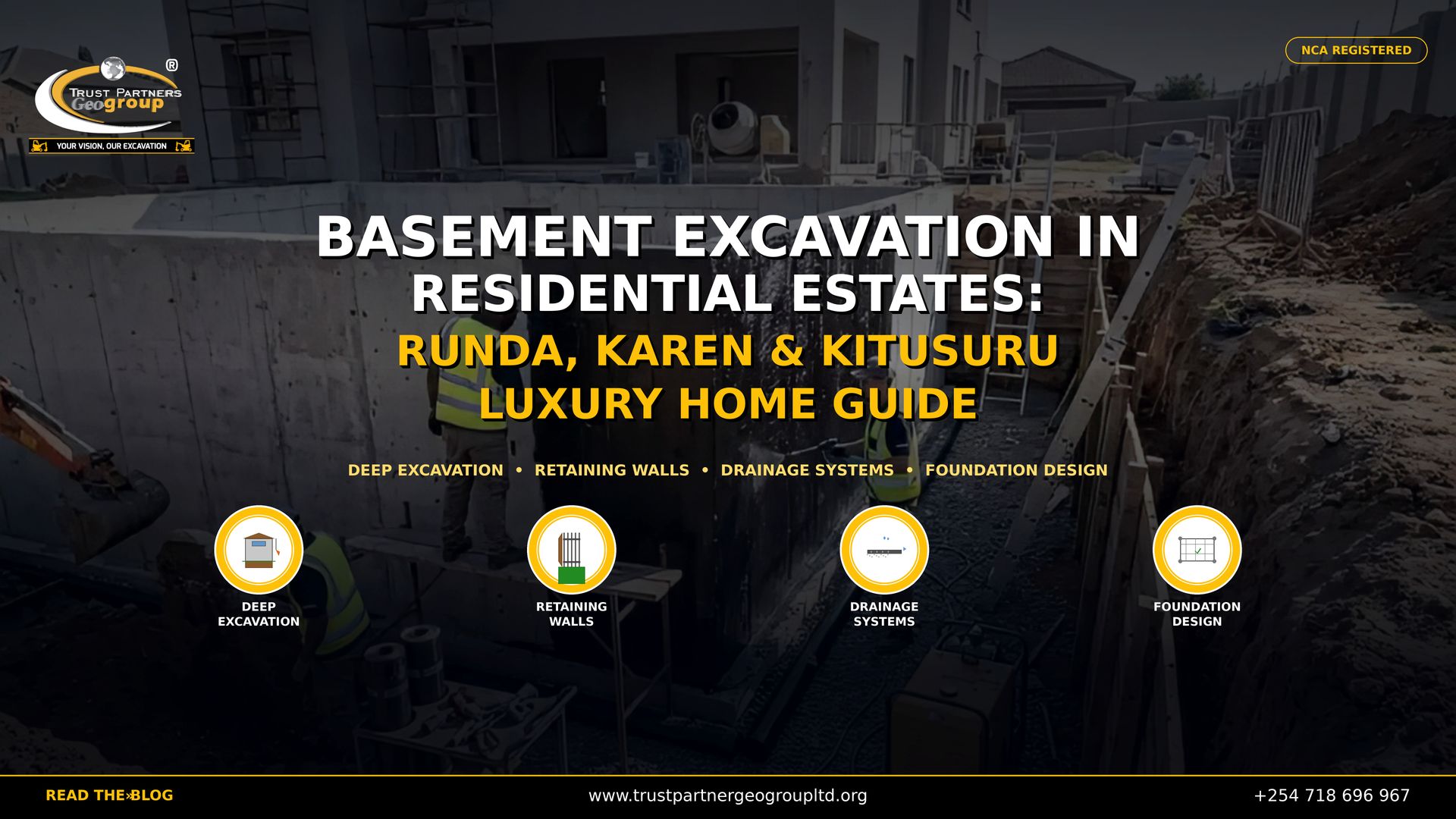
Basement Excavation for Residential Estates: Runda, Karen & Kitisuru Luxury Home Guide [2026]
Wine cellars, home cinemas, swimming pools, gyms and staff quarters for luxury homes in Nairobi's premium estates with heavy equipment for hire
Table of Contents
- 1. Why Luxury Home Basements are Nairobi's Most Exclusive Construction Niche
- 2. Geology of Runda, Karen and Kitisuru: Red Soil, Tuff and Estate Topography
- 3. Wine Cellar Excavation: Depth, Temperature and Humidity Engineering
- 4. Home Cinema and Entertainment Basement: Acoustics, Seating and AV Integration
- 5. Indoor Swimming Pool Basin Excavation: Precision, Waterproofing and Plant Rooms
- 6. Gym, Spa and Wellness Basement: Vibration Control and Climate Management
- 7. Staff Quarters, Parking and Utility Basement Layouts
- 8. Waterproofing and Climate Control for Residential Basements
- 9. Estate Compliance, Neighbour Relations and Access Constraints
- 10. Construction Costs and Programme [2026]
- 11. Frequently Asked Questions
- 12. Conclusion
Beneath the manicured lawns of a Kitisuru estate, where the Ngong Hills provide a backdrop visible through the light well, a 3.5-metre deep basement excavation reveals not a parking garage but a climate-controlled wine cellar holding 2,000 bottles at a constant 14°C, a home cinema with tiered seating for twelve guests, and a glass-walled gym overlooking an indoor lap pool. This is not construction. This is lifestyle engineering. And it is transforming Nairobi's most exclusive residential addresses - Runda, Karen, Kitisuru, Spring Valley, Loresho and Muthaiga - from single-level bungalows into vertically integrated luxury compounds where the basement is not an afterthought but the architectural centrepiece. In a city where land prices in premium estates have doubled every five years, the basement has become the ultimate expression of spatial luxury. It adds 200-400 square metres of climate-controlled, secure, private space without consuming a single additional square metre of the plot's ground-level footprint. It houses wine collections worth millions of shillings, cinema systems that rival commercial theatres, and wellness facilities that eliminate the need for gym memberships. But luxury residential basement excavation is a discipline distinct from commercial or high-rise basement work. The tolerances are tighter - a wine cellar floor must be level to ±5mm for racking installation. The finishes are more delicate - a home cinema cannot tolerate the damp that destroys acoustic panels. And the constraints are more personal - estate bylaws, neighbour sensitivity, and the expectation that construction should be invisible to the streetscape. Trust Partners Geo-Group Ltd provides heavy equipment for hire and luxury residential basement excavation services specifically for Nairobi's premium estates. From wine cellar precision grading to swimming pool basin waterproofing, from estate-compliant access protocols to landscape restoration that leaves no trace of construction, we deliver the excavation in Kenya expertise that turns architectural vision into subterranean luxury. Whether you are planning a climate-controlled cellar in Runda, a wellness basement in Karen, or an entertainment complex in Kitisuru, this guide provides the technical depth, cost transparency and estate-specific compliance clarity your project demands.
Trust Partners Geo-Group Ltd - Luxury Residential Basement & Estate Earthworks Team
NCA-registered excavation contractor with 15+ years in luxury home basement construction, wine cellar excavation, pool basins and premium estate earthworks across Runda, Karen, Kitisuru and Nairobi's most exclusive addresses.
1. Why Luxury Home Basements are Nairobi's Most Exclusive Construction Niche
Nairobi's premium residential estates have evolved from suburban retreats to vertically integrated luxury compounds. A decade ago, a 5-bedroom home on a 0.5-acre plot in Runda or Karen was considered generous. Today, the same plot supports a 7-bedroom main house, a 2-bedroom guest wing, a basement entertainment complex, an underground garage for six vehicles, and a staff quarter block - all within the estate's height and coverage restrictions. The basement is the enabling technology that makes this density possible without compromising the ground-level aesthetic that estate bylaws enforce.
The luxury basement market in Nairobi is driven by three factors. First, land scarcity: premium estate plots in Runda and Kitisuru now exceed KES 80-150 million per 0.5 acre, making vertical expansion economically essential. Second, security: high-net-worth homeowners increasingly prefer basement parking, panic rooms and secure storage that is invisible from the street and inaccessible to intruders. Third, lifestyle: the post-pandemic shift toward home-centric entertainment has created demand for cinema basements, home spas, wine cellars and private bars that match or exceed commercial venues in quality.
But luxury residential basement excavation is not simply commercial basement work at a smaller scale. The engineering requirements are different. A commercial basement tolerates ±50mm floor variation; a wine cellar racking system requires ±5mm. A commercial cinema has standard ceiling heights; a home cinema with tiered seating requires 3.5-4.5 metre clear spans. A commercial gym has industrial flooring; a residential spa basement requires vibration isolation to prevent noise transmission to bedrooms above. And the regulatory environment is more complex - estate management committees, neighbour consent protocols, and strict working-hour restrictions that do not apply to commercial sites. Trust Partners Geo-Group Ltd has completed luxury basements in over 40 Nairobi premium estates, giving us the empirical knowledge of how to deliver high-end residential earthworks within the constraints of exclusive community living.
2. Geology of Runda, Karen and Kitisuru: Red Soil, Tuff and Estate Topography
Nairobi's premium estates sit on the volcanic highlands that define the city's geography, but each estate has distinct geological characteristics that affect basement excavation design and cost.
Runda: Flat Ridge-Top Stability
Runda sits on a broad ridge top between the Nairobi and Mathare River valleys, with relatively flat topography and deep red coffee soil profiles. The red soil extends 3-5 metres before volcanic tuff appears, making standard 3-metre basements straightforward excavations in stable soil. However, Runda's former wetland pockets (particularly in the older sections near the United Nations Avenue) contain black cotton soil lenses that require stabilization if encountered. The flat terrain means basements can be excavated with simple ramp access, and spoil can be stockpiled on-site temporarily. Runda's estate bylaws require that no basement structure is visible above natural ground level, meaning all roof levels and light wells must be screened by landscaping.
Karen: Deep Red Soil and Gentle Slopes
Karen occupies the southern slopes of the Ngong Road forest, with gentle topography sloping toward the Mbagathi River. The red coffee soil is exceptionally deep here - 4-6 metres across much of the estate - providing stable excavation conditions for basements up to 4 metres depth. Below this, volcanic tuff and agglomerate appear, requiring breaker work for deeper wine cellars or pool basins. Karen's higher rainfall (1,000-1,200mm annually compared to 800-900mm in central Nairobi) and deeper soils mean that perched water tables are more common during the long rains, particularly in lower Karen near the river. Dewatering is sometimes required even for shallow basements. Karen's larger plot sizes (typically 1-2 acres) provide more working space than Runda, allowing larger equipment and more efficient spoil management.
Kitisuru: Sloping Terrain and Spring Lines
Kitisuru sits on the western escarpment of the Nairobi highlands, with significant slope gradients and spectacular views toward the Ngong Hills. The geology is more complex: thin red soil cover (1.5-3.0 metres) over volcanic tuff and basalt that appears quickly at depth. Kitisuru's springs - natural groundwater discharge points along the escarpment - create localized high water table conditions that can flood excavations unexpectedly. Basement excavation in Kitisuru requires careful groundwater assessment and often permanent sump pump systems even for residential basements. The sloping terrain means that hillside cut-and-fill is frequently required to create level basement platforms, generating 30-50% more earthworks volume than flat sites. Retaining walls on the downhill side are standard, adding structural cost but enabling the dramatic glass-walled basement designs that Kitisuru's views demand.
| Estate | Red Soil Depth | Rock Depth | Water Table Risk | Topography |
|---|---|---|---|---|
| Runda | 3-5 metres | 4-6 metres | Low (wetland pockets) | Flat ridge-top |
| Karen | 4-6 metres | 5-8 metres | Moderate (perched) | Gentle slopes |
| Kitisuru | 1.5-3.0 metres | 2.5-4.0 metres | High (spring lines) | Steep escarpment |
3. Wine Cellar Excavation: Depth, Temperature and Humidity Engineering
The wine cellar is the most technically demanding small-scale excavation in residential construction. It is not merely a cool room; it is a precision environment where temperature, humidity, light, vibration and air quality must be controlled to protect investments that can exceed KES 10 million in a single collection.
Depth and Thermal Stability
In Nairobi's climate, soil temperature at 2.5-3.5 metres depth remains stable at 14-18°C year-round - the ideal range for wine storage. Above 2 metres, seasonal temperature swings reach 8-12°C, which accelerates wine aging and damages corks. Below 4 metres, temperature continues to drop marginally but excavation costs increase disproportionately. The optimal wine cellar depth is therefore 2.5-3.5 metres below natural ground level, with the floor slab at 2.0-3.0 metres depth. For a standard 3m x 4m cellar with 2.8m clear height, this requires excavation of 50-70 m3 - a compact but precise operation. Trust Partners Geo-Group Ltd excavates wine cellars with ±25mm level accuracy to ensure that modular racking systems install without cutting or shimming.
Humidity and Vapour Control
Nairobi's relative humidity ranges from 30% in the dry season to 90% during the long rains. Wine requires 50-70% humidity: below 50% dries corks and causes oxidation; above 80% promotes mould that destroys labels and wooden racks. The cellar excavation must therefore include a vapour barrier system: external waterproofing membrane to prevent liquid water ingress; 0.2mm polyethylene vapour barrier beneath the floor slab; and 50mm rigid insulation (XPS or polyurethane) on walls and ceiling to prevent condensation on cool surfaces. A mechanical humidity control system (dehumidifier in wet season, humidifier in dry season) maintains the target range. The excavation must create space for these systems - typically a 200mm ceiling void for ducting and a 1.0m x 1.0m plant room corner for equipment.
Vibration and Light Isolation
Wine is sensitive to vibration, which disturbs sediment and accelerates chemical reactions. The cellar must be structurally isolated from vibration sources: generators, pool pumps, and gym equipment. In basement designs where the wine cellar shares a basement with a gym or cinema, Trust Partners Geo-Group Ltd excavates the wine cellar as a separate pocket with 200mm reinforced concrete walls on independent footings, creating a vibration-isolated box within the larger basement. Light is equally critical - wine degrades under UV exposure, so the cellar must have no windows and light-tight door seals. The excavation must accommodate a light-lock entry (a small vestibule with two doors) that prevents light infiltration when the main door is opened.
4. Home Cinema and Entertainment Basement: Acoustics, Seating and AV Integration
The home cinema basement has evolved from a TV room with a large screen to a fully engineered entertainment environment with tiered seating, acoustic treatment, and audio-visual systems that rival commercial multiplexes.
Ceiling Height and Tiered Seating
The defining spatial requirement of a home cinema basement is ceiling height. Tiered seating requires 300-400mm riser height per row to maintain sightlines to the screen. For three rows of seating, the rear row sits 900-1,200mm above the front row floor. With a 2.4m ceiling height above the front row, the rear row has only 1.2-1.5m clearance - insufficient for comfortable seating. Luxury cinema basements therefore require 3.5-4.5 metre clear heights, which in turn requires excavation depths of 4.0-5.0 metres below ground level. This depth often encounters volcanic tuff in Runda and Kitisuru, requiring breaker work that adds cost and programme time. Trust Partners Geo-Group Ltd uses laser-guided excavators to achieve the precise floor levels required for tiered seating, ensuring that riser heights are uniform to ±10mm for seamless joinery installation.
Acoustic Isolation
A cinema basement generates sound pressure levels of 85-100 dB during action sequences - equivalent to a motorcycle passing through the living room. Without acoustic isolation, this noise transmits through the floor slab to bedrooms and neighbouring properties. The excavation must accommodate acoustic mass-spring systems: a floating floor slab on rubber isolation pads or steel springs; acoustic ceiling voids with mineral wool absorption; and decoupled wall constructions that do not transmit vibration to the structural shell. The excavation depth must include space for these systems - typically 150-200mm for the floating floor buildup and 300-400mm for the acoustic ceiling void. Trust Partners Geo-Group Ltd excavates cinema basements with the additional depth and structural pockets required for acoustic isolation, working with acoustic engineers to ensure that the earthworks support the finished acoustic performance.
AV Integration and MEP Routing
Modern cinema basements include 4K projection systems, Dolby Atmos audio with 16+ speakers, climate control, and automated lighting. These systems require extensive MEP infrastructure: projector mounting beams cast into the ceiling slab; speaker conduit routes in walls and ceiling voids; HVAC ducting that delivers 6-8 air changes per hour without fan noise; and data cabling for streaming and gaming. The excavation must create service corridors and ceiling voids that accommodate this infrastructure without compromising headroom. Trust Partners Geo-Group Ltd marks all MEP routes on the excavation subgrade before blinding concrete is poured, ensuring that conduits and ducts can be installed without cutting into the structural slab.
5. Indoor Swimming Pool Basin Excavation: Precision, Waterproofing and Plant Rooms
The indoor swimming pool is the ultimate luxury basement feature - and the most technically demanding excavation element in residential construction.
Two-Level Excavation
An indoor pool basement requires a two-level excavation: the general basement floor at 3.0-3.5 metres depth, and the pool basin excavated an additional 1.5-2.0 metres below this floor to achieve standard water depth (1.2-1.8 metres). For a 10m x 5m residential pool, the basin excavation is 75-100 m3 of additional spoil, typically requiring a compact 5-tonne excavator working within the already-excavated basement space. The basin walls must be vertical and precise (±25mm) to accommodate either a prefabricated stainless steel or GRP pool shell, or a rendered and tiled concrete pool. In Kitisuru and lower Karen, where the water table is high, the basin excavation often requires dewatering during construction and a permanent sump pump in the plant room. Trust Partners Geo-Group Ltd excavates pool basins with total station guidance to ensure that the finished water level aligns perfectly with the surrounding basement floor, creating the flush-deck or infinity-edge effect that luxury designs demand.
Waterproofing and Tanking
Pool basins are the most waterproofing-critical element in residential construction. The basin is a permanent water container holding 50-100 tonnes of water (50-100 m3 at 1 tonne/m3) that exerts hydrostatic pressure on all surfaces. The standard waterproofing system is: structural concrete with crystalline waterproofing admixture (3-5% by cement weight) for integral capillary blocking; external SBS-modified bituminous membrane on the basin exterior; and an internal epoxy or tile finish that provides the final water barrier. Construction joints must include waterstop bars (PVC or hydrophilic rubber) centrally placed. The excavation must be clean and dry before concrete placement - any mud or water in the formwork compromises the waterproofing. Trust Partners Geo-Group Ltd insists on 48-hour dewatering and subgrade cleaning before pool basin concrete is poured, and conducts flood testing for 72 hours before handover.
Plant Room and MEP
The pool plant room houses the filtration system, heater, circulation pump, chemical dosing equipment and control panel. It requires 8-12 m2 of floor area with 2.2m ceiling height, positioned adjacent to the pool for short pipe runs. The plant room floor must be sloped to a drain (1:50) to manage backwash and splashing, and the excavation must include a sump pit for the plant room pump. Trust Partners Geo-Group Ltd excavates plant rooms with the falls, drainage connections and electrical conduit routes specified by the pool engineer, ensuring that the MEP rough-in is complete before the structural slab is poured.
6. Gym, Spa and Wellness Basement: Vibration Control and Climate Management
The wellness basement combines fitness, relaxation and therapy spaces within a single below-ground environment. The excavation challenge is not depth but isolation - creating a space that is physically and acoustically separated from the rest of the home.
Vibration Isolation
Gym equipment - treadmills, ellipticals, weight racks - generates vibration that transmits through the floor slab to bedrooms and living spaces above. In a basement directly beneath the master bedroom, this vibration can make the space unusable. The solution is a floating floor: a 100-150mm reinforced concrete slab cast on 50mm rubber isolation pads or steel spring mounts, creating a mass-spring system that absorbs vibration above 10 Hz. The excavation must be 150-200mm deeper than the general basement to accommodate the floating floor buildup. Walls must be built on the floating floor, not the structural slab, to prevent vibration bridging. Trust Partners Geo-Group Ltd excavates gym basements with the additional depth and wall footing pockets required for floating floor construction, working with structural engineers to ensure that the isolation system is not compromised by later construction.
Steam Room and Sauna Excavation
Steam rooms and saunas require waterproof, heat-resistant construction. The steam room basin (typically 2m x 2m with 400mm bench height) is excavated as a pocket within the general basement floor, with falls to a floor drain and waterproofing that withstands 100°C steam temperatures. The excavation must accommodate the steam generator (typically 3-6 kW, requiring 240V power and water supply), ventilation ducting that removes steam without condensing in ducts, and bench structures that are cast monolithically with the basin. Sauna floors require slatted timber decking over a waterproofed concrete base, with the excavation creating the recessed floor that contains the decking and drainage.
Climate and Ventilation
Wellness basements require 8-12 air changes per hour to manage humidity, odours and CO2 from exercise. This requires extensive HVAC ducting that must be routed through ceiling voids created during excavation. The basement excavation must include 300-400mm ceiling voids for ducting, plus light wells or mechanical ventilation shafts that bring fresh air to the below-ground space. In Kitisuru's escarpment locations, natural cross-ventilation through hillside light wells is sometimes possible, reducing mechanical ventilation requirements. Trust Partners Geo-Group Ltd excavates wellness basements with ceiling voids and ventilation shaft pockets that accommodate the MEP design without compromising headroom.
7. Staff Quarters, Parking and Utility Basement Layouts
Not all luxury basement space is entertainment. A significant portion is functional: staff accommodation, vehicle storage, utilities and security.
Staff Quarters Basement
Live-in staff quarters in Nairobi premium estates typically include a bedroom, bathroom, kitchenette and sitting area for 1-2 staff members. Locating these in the basement frees ground-level space for gardens and entertaining areas, but requires careful design to meet employment and safety standards. The basement staff quarters must have: minimum 2.4m ceiling height; natural light through light wells or mechanical ventilation equivalent; independent emergency egress (separate staircase or direct exterior door); and acoustic separation from entertainment areas to ensure rest periods are not disturbed by cinema noise or gym activity. The excavation must create these spaces with the same precision as the luxury areas, including floor falls to drains in bathroom areas and ceiling voids for electrical and plumbing services. Trust Partners Geo-Group Ltd excavates staff quarters with the same quality control as wine cellars, ensuring that structural and waterproofing standards are consistent across the entire basement.
Basement Parking and Vehicle Display
Basement parking for 2-6 vehicles is standard in luxury estate homes. The garage requires 2.7-3.0m clear height for SUV access, a ramp at 1:10 maximum gradient, and turntables or vehicle lifts if the plot is too small for a turning circle. For collectors, vehicle display basements with climate control, LED lighting and polished concrete floors are increasingly popular. The excavation must create level floors (±10mm) for vehicle display, drainage gullies for wash-down, and structural capacity for vehicle lifts if installed. In Runda's flat plots, ramp access is straightforward. In Kitisuru's sloping plots, basement parking often requires cut-and-fill with a retaining wall on the downhill side, adding earthworks volume but enabling spectacular glass-walled garages that display the collection like a museum.
Utility and Security Basements
Utility basements house generators, inverters, water storage tanks and security control rooms. Generators require vibration isolation, exhaust ducting to roof level, and fuel storage tanks with spill containment. Water tanks require 5,000-10,000 litre capacity in reinforced concrete or GRP, with the excavation creating the tank pit and structural surround. Security rooms require reinforced construction, independent communication lines, and sometimes panic room specifications. Trust Partners Geo-Group Ltd excavates utility basements with the service corridors, drainage falls and structural pockets required for these systems, ensuring that the functional basement is as well-engineered as the entertainment spaces.
8. Waterproofing and Climate Control for Residential Basements
Luxury residential basements in Nairobi's premium estates face a unique combination of moisture risks: seasonal groundwater, capillary rise from red coffee soil, condensation from temperature differentials, and humidity from pools and steam rooms.
External Waterproofing
The primary waterproofing defence is an external SBS-modified bituminous torch-on membrane (3-4mm in two layers) applied to all basement walls and the underside of the floor slab. In Runda and Karen's stable red soil, this is typically sufficient for basements up to 3.5 metres depth. In Kitisuru's higher water table conditions, an HDPE-bentonite composite mat or additional crystalline waterproofing admixture in the concrete provides redundant protection. The membrane must extend 150mm above finished ground level and integrate with the damp-proof course of the superstructure walls to prevent moisture bridging. Trust Partners Geo-Group Ltd applies membranes with manufacturer-certified applicators and provides 10-year warranties on all residential basement waterproofing.
Internal Climate Control
Residential basements require active climate control to prevent condensation and mould. In Nairobi's climate, basement temperatures are typically 18-22°C year-round - comfortable but prone to condensation when warm humid air enters from outside. The solution is mechanical ventilation with heat recovery: a continuous supply of filtered fresh air, with heat exchange between exhaust and intake air to maintain temperature without energy waste. Dehumidifiers maintain 50-60% relative humidity in general basement areas, with wine cellars and pool plant rooms having independent humidity control. The excavation must create space for air handling units, ducting routes and condensate drainage - typically a 1.0m x 1.5m plant room and 200-300mm ceiling voids throughout the basement.
Light Wells and Natural Ventilation
Where topography allows, light wells and sunken courtyards provide natural light, ventilation and psychological openness to basement spaces. In Kitisuru's sloping plots, a downhill light well can be created by excavating a courtyard at basement level, with retaining walls and glass balustrades that provide views while maintaining security. In Runda's flat plots, light wells are typically excavated as rectangular shafts (1.5m x 3.0m) with reinforced concrete walls and drainage at the base. Trust Partners Geo-Group Ltd excavates light wells with the same waterproofing and drainage standards as the main basement, ensuring that they illuminate rather than leak.
9. Estate Compliance, Neighbour Relations and Access Constraints
Construction in Nairobi's premium estates operates under constraints that do not exist on commercial sites. Estate management committees, neighbour sensitivity, and strict bylaws govern every aspect of basement excavation.
Estate Management Committee Approvals
Most premium estates (Runda, Karen, Kitisuru, Spring Valley, Loresho) have management committees that review construction plans before Nairobi County approval is sought. These committees enforce architectural guidelines: basement structures must not be visible above ground level; roof heights must not exceed estate limits; construction materials must match estate standards; and working hours are typically restricted to 08:00-17:00 weekdays and 08:00-13:00 Saturdays, with no Sunday work. Trust Partners Geo-Group Ltd prepares estate submission packages including 3D visualisations, landscape restoration plans, and construction schedules that demonstrate compliance with these bylaws.
Neighbour Consent and Vibration Control
Basement excavation within 3 metres of a property boundary requires neighbour notification and sometimes formal consent. Rock breaking, in particular, generates vibration and noise that can damage neighbouring homes and trigger complaints. Trust Partners Geo-Group Ltd deploys seismographs on adjacent properties during breaker work, with a trigger limit of 3 mm/s peak particle velocity. If limits are approached, we switch to chemical cracking agents or reduce breaker energy. In noise-sensitive estates, we use sound-attenuated breakers and generator sets, and schedule the noisiest work during mid-week daytime hours when neighbours are typically at work.
Access and Spoil Management
Estate roads are designed for residential traffic, not 30-tonne excavators and dump trucks. Access routes must be protected with timber matting or steel plates to prevent damage to paving and drainage. Spoil haulage must be scheduled to avoid estate peak hours (07:00-09:00 and 16:00-18:00) and covered trucks are required to prevent spillage on estate roads. In Runda's narrow lanes, we sometimes use smaller 10-tonne trucks for spoil removal rather than standard 20-tonne tippers. All spoil must be disposed of at approved sites - estate bylaws universally prohibit on-site dumping or disposal on neighbouring agricultural land. Trust Partners Geo-Group Ltd includes estate access management, road protection and spoil logistics as standard line items in every luxury basement quotation.
10. Construction Costs and Programme [2026]
Luxury home basement excavation costs in Runda, Karen and Kitisuru align with Nairobi's premium residential market, with estate-specific constraints adding 10-20% to base rates.
| Item | 2026 Rate (KES) | Notes |
|---|---|---|
| Base excavation (red soil, 0-4m) | 700-1,250/m3 | Aligned with Karen/South C/Lavington/Kiambu |
| Rock breaking (tuff, hourly) | 7,000-8,000/hr | Breaker on 20/30-ton excavator |
| Precision trimming (wine cellar, cinema) | 1,200-1,800/m3 | Laser guidance, ±10mm tolerance |
| Pool basin excavation | 1,500-2,500/m3 | Confined space, dewatering, ±25mm |
| External waterproofing (SBS membrane) | 800-1,400/m2 | 2-layer, primer, protection board |
| Internal cavity drain (high-value areas) | 1,200-2,000/m2 | Wine cellar, cinema, pool plant |
| Crystalline admixture (concrete) | 150-250/m3 | Pool basin, integral waterproofing |
| Dewatering (estate sites) | 45,000-85,000/week | Sump pumps, Kitisuru/Karen perched |
| Soil disposal (estate haulage) | 900-1,400/m3 | Covered trucks, approved dumps |
| Site protection & restoration | 150,000-350,000 | Hoarding, tree protection, lawns |
| Blinding concrete | 6,500-8,500/m2 | 75-100mm, level surface |
Typical project estimates: A 200 m2 general basement with wine cellar, cinema and gym (800 m3 excavation) in Runda or Karen red soil costs KES 650,000-1.1 million for excavation, waterproofing and drainage. Adding a 10m x 5m indoor pool basin (additional 100 m3, rock breaking, tanking) adds KES 450,000-850,000. A 300 m2 basement with 4-car garage, staff quarters and entertainment complex in Kitisuru (cut-and-fill, retaining wall, spring dewatering) costs KES 1.2-2.0 million. Estate compliance, access protection and landscape restoration add KES 150,000-350,000. Programme: 2-4 weeks for standard basements, 4-6 weeks with pool basins or rock breaking. Trust Partners Geo-Group Ltd provides fixed-price luxury basement packages with estate-specific compliance included.
11. Frequently Asked Questions: Luxury Home Basement Excavation in Nairobi
How much does luxury home basement excavation cost in Runda, Karen and Kitisuru in 2026?
Luxury home basement excavation costs in Runda, Karen and Kitisuru in 2026 align with Nairobi's premium residential rates. Standard basement excavation in red coffee soil costs KES 700-1,250 per m3 for 0-5 metre depths. A typical 200-300 m2 luxury basement with 3.0-3.5 metre clear height (600-1,000 m3 excavation) costs KES 450,000-850,000 for bulk excavation. Wine cellar excavation (2.5-3.0m depth, temperature-controlled) costs KES 350,000-650,000 for 150-250 m3. Home cinema and entertainment basement (3.5-4.5m depth for tiered seating) costs KES 550,000-1.1 million for 400-800 m3. Indoor swimming pool basin excavation (1.5-2.0m below basement floor, 8m x 4m pool) costs KES 280,000-550,000 additional. Gym and spa basement with steam room costs KES 400,000-750,000 for 300-500 m3. Rock breaking in volcanic tuff encountered below 4 metres costs KSH 7,000-8,000 per hour. Waterproofing for residential basements (SBS membrane + cavity drain) costs KES 1,800-3,200 per m2 of wall and floor. Trust Partners Geo-Group Ltd provides fixed-price luxury basement excavation packages for Runda, Karen and Kitisuru with no hidden estate access surcharges.
What are the main geological challenges for basement excavation in Runda, Karen and Kitisuru?
Runda, Karen and Kitisuru sit on the eastern and southern slopes of the Nairobi volcanic highlands, presenting distinct geological challenges for luxury basement excavation. The upper soil layer is red coffee soil (ferralitic latosol) 2-4 metres deep, which excavates easily but becomes dense and unstable below 3 metres. Beneath the red soil, volcanic tuff and agglomerate appear at 3-5 metres depth, requiring hydraulic breakers for deeper basements or pool basins. In Kitisuru's lower slopes near the Spring Valley, perched water tables create groundwater challenges at 2-3 metres depth during the long rains. Karen's red soil is often deeper (3-5 metres) before tuff appears, making shallow basements straightforward but deeper wine cellars and pool basins likely to encounter rock. Runda's flat ridge-top plots have stable red soil to 4 metres but may contain black cotton soil pockets in former wetland areas. Trust Partners Geo-Group Ltd conducts test pitting on every luxury estate site to map soil transitions before excavation, ensuring that wine cellar depths and pool basin designs are achievable without unexpected rock breaking costs.
What is the ideal depth for a wine cellar basement in a Nairobi luxury home?
The ideal wine cellar basement depth in Nairobi's Runda, Karen and Kitisuru estates is 2.5-3.5 metres below ground level, which places the cellar floor 1.5-2.5 metres below the natural ground surface. At this depth, the surrounding soil provides natural thermal insulation that maintains 12-16°C year-round - the optimal temperature range for wine storage - without mechanical cooling for much of the year. The excavation volume for a 3m x 4m wine cellar with 2.8m clear height is approximately 50-70 m3, making it one of the most compact luxury basement types. The walls require 200-250mm reinforced concrete with external waterproofing and internal insulation (50mm rigid foam or cork) to prevent condensation. Humidity control is critical: Nairobi's dry season humidity drops to 30-40%, which can dry corks, while the wet season reaches 80-90%, risking mould. A wine cellar basement must include a vapour barrier and mechanical humidity control (50-70% target). Trust Partners Geo-Group Ltd excavates wine cellars with precision grading for racking installation, ensuring that floor levels accommodate standard 750mm x 300mm wine bins without cutting.
Do I need waterproofing for a residential basement in Karen or Runda?
Yes. Even though Runda and Karen are ridge-top locations with generally lower water tables than Parklands or Westlands, residential basements still require waterproofing because: seasonal perched water tables appear during the long rains, particularly in Kitisuru and lower Karen; red coffee soil becomes saturated and transmits water through capillary action against basement walls; and luxury basements with wine cellars, cinemas and gyms contain high-value finishes that are destroyed by damp, mould or condensation. The standard waterproofing system for Runda, Karen and Kitisuru luxury basements is: external SBS-modified bituminous torch-on membrane (3-4mm) on all walls and the underside of the floor slab; internal cavity drain membrane (HDPE studded sheet) as secondary protection in high-value areas; perimeter drainage channel and single sump pump for basements below 3 metres; and 0.2mm polyethylene vapour barrier beneath the floor slab to prevent rising damp. For swimming pool basins, tanking-grade waterproofing with crystalline admixture concrete and dual membrane systems is mandatory. Trust Partners Geo-Group Ltd provides 10-year waterproofing warranties on all luxury residential basement excavations in Nairobi's premium estates.
How do you excavate a basement for an indoor swimming pool in a luxury home?
Indoor swimming pool basement excavation requires a two-level approach: the general basement floor is excavated to 3.0-3.5 metres depth, and the pool basin is excavated an additional 1.5-2.0 metres below the basement floor to achieve standard water depth (1.2-1.8 metres). The pool basin excavation is typically 8m x 4m for a residential lap pool, generating 50-65 m3 of additional spoil. The basin walls must be vertical and precise (±25mm) to accommodate prefabricated pool shells or shotcrete pool construction. In Karen and Runda, where volcanic tuff often appears at 3-4 metres depth, the pool basin almost always requires hydraulic breaker work, adding KSH 7,000-8,000 per hour for 3-5 days. The pool basin requires tanking-grade waterproofing: crystalline waterproofing admixture in the concrete, external SBS membrane, and an internal epoxy or tile finish. A sump pump is mandatory in the pool plant room (filter, heater, pump) to manage backwash and splashing. Trust Partners Geo-Group Ltd excavates pool basins with laser-level guidance to ensure that the finished water level aligns perfectly with the surrounding basement floor, creating the infinity-edge or flush-deck effect that luxury home designs demand.
What is the best basement layout for a luxury home in Kitisuru or Runda?
The optimal luxury home basement layout for Nairobi's Runda, Karen and Kitisuru estates depends on lifestyle requirements, but the most successful designs follow a zoned approach. Zone 1 - Entertainment: home cinema (tiered seating requiring 3.5-4.5m depth), bar and lounge, games room; positioned near the main house entrance for guest access without entering private family areas. Zone 2 - Wellness: gym (rubber-floored, vibration-isolated), steam room or sauna, massage therapy room, changing facilities; positioned with natural light wells or courtyard access if possible. Zone 3 - Storage and Utility: wine cellar (2.5-3.0m depth, climate-controlled), pantry and cold storage, laundry expansion, generator and inverter room; positioned at the rear or side of the basement with service access. Zone 4 - Parking: 2-4 car basement garage with turntable or vehicle lift if space is constrained; requires 2.7-3.0m clear height and ramp access at 1:10 gradient maximum. Zone 5 - Staff Quarters: separate bedroom, bathroom and kitchenette for live-in staff; requires independent ventilation and emergency egress. Trust Partners Geo-Group Ltd excavates luxury basements with future MEP routing in mind, creating service corridors and ceiling voids that accommodate HVAC, audio-visual cabling, and pool plumbing without compromising headroom.
How long does luxury home basement excavation take in Runda, Karen or Kitisuru?
Luxury home basement excavation in Runda, Karen and Kitisuru typically takes 2-4 weeks for a standard 200-400 m2 basement, depending on depth, soil conditions and estate access constraints. A typical programme is: site setup and topsoil stripping 2-3 days; bulk excavation to basement level 5-8 days with a 20-tonne excavator and 2-3 dump trucks; precision trimming, pool basin excavation and rock breaking (if required) 3-5 days; subgrade compaction and blinding concrete 2-3 days; and waterproofing and drainage installation 3-5 days. Total programme 15-24 working days. Estate access constraints in Runda and Karen often limit working hours to 08:00-17:00 and prohibit Sunday work, extending the calendar duration by 20-30%. Rain delays during March-May and October-November can add 3-5 days. Deeper basements with pool basins or rock breaking extend to 4-6 weeks. Trust Partners Geo-Group Ltd programmes luxury basement excavation to minimise estate disruption, using sound-attenuated equipment and scheduling rock breaking during mid-week daytime hours to comply with estate management bylaws.
Where can I hire heavy equipment for luxury home basement excavation in Runda, Karen and Kitisuru?
Trust Partners Geo-Group Ltd provides heavy equipment for hire for luxury residential basement excavation across Runda, Karen, Kitisuru, Spring Valley, Loresho, Lower Kabete, Ridgeways, Muthaiga and all Nairobi premium estates. Our residential basement fleet includes: 20-tonne zero-tail-swing excavators for tight estate plots with minimal boundary clearance; 5-tonne compact excavators for pool basin precision work and confined utility trenches; hydraulic breaker attachments for volcanic tuff and basalt encountered below 3 metres; motor graders for estate access road maintenance during construction; 10-tonne smooth drum rollers for basement backfill compaction; concrete pumps for blinding concrete and pool basin pours; and dewatering pump packages for Kitisuru and lower Karen perched water table conditions. All equipment is operated by NCA-certified drivers with luxury residential experience, trained in estate etiquette, noise control and landscape protection. We provide dust suppression, silt fencing and tree protection as standard on all estate sites. Contact us at +254 718 68 69 67 or info@trustpartnergeogroupltd.org for luxury home basement excavation and heavy equipment for hire in Runda, Karen, Kitisuru and Nairobi's premium estates.
12. Conclusion: Excavating Excellence Beneath Nairobi's Finest Estates
The luxury homes of Runda, Karen and Kitisuru are no longer defined by what is visible from the gate. They are defined by what lies beneath the lawn. The wine cellar that holds a collection spanning three decades. The cinema that hosts premiers for twelve guests in Dolby Atmos surround. The indoor pool that laps against glass walls overlooking the Ngong Hills. The gym that opens at 05:00 without waking a single bedroom above. These are not amenities. They are architectural statements. And they all begin with excavation.
Luxury residential basement excavation is the most precision-demanding discipline in Kenyan earthworks. A commercial basement tolerates variation. A luxury basement demands perfection. The wine cellar floor must be level to the millimetre. The pool basin walls must be vertical to the centimetre. The cinema ceiling must accommodate acoustic systems that cost more than the excavation itself. And all of this must be achieved within the constraints of estate bylaws, neighbour sensitivity, and the expectation that construction should be as invisible as the basement itself.
Trust Partners Geo-Group Ltd has built its reputation on the basements that define Nairobi's most exclusive addresses. We understand that a Runda basement is not a Kitisuru basement - the geology is different, the access is different, and the design intent is different. Our heavy equipment for hire fleet includes the compact, precision machines that estate sites demand. Our operators are trained in luxury residential protocols. And our project managers understand that in these estates, the relationship with the neighbour is as important as the relationship with the client. We do not just excavate basements. We excavate trust.
For homeowners, architects and developers planning the next generation of luxury living in Nairobi's premium estates, we provide the technical partnership that turns architectural vision into subterranean reality. Contact Trust Partners Geo-Group Ltd today for a site-specific assessment, basement layout consultation, and transparent fixed-price quotation for your luxury home basement excavation in Runda, Karen, Kitisuru or any of Nairobi's finest addresses.
Luxury Home Basement Excavation in Runda, Karen & Kitisuru
Wine cellars, home cinemas, swimming pools, gyms and staff quarters for luxury homes in Nairobi's premium estates with heavy equipment for hire and estate-compliant earthworks.
Free lead magnet: ask for our Luxury Home Basement Excavation Cost Calculator (PDF) - wine cellar, cinema, pool and gym sizing guides, estate compliance checklists and budget estimation for Runda, Karen, Kitisuru and Nairobi premium estates.
Related Resources
Waterproofing and Drainage Systems for Deep Basements in Nairobi's High Water Table Areas
The previous Volume IV deep-dive covering basement waterproofing, membranes, cavity drainage and sump pump systems for all Nairobi basement types.
READ MOREBasement Excavation in Expansive Soils: Kikuyu, Red Hill & Limuru Engineering Solutions
Volume IV deep-dive covering expansive soil stabilization, black cotton soil replacement and suspended slab foundations for Kenya's highland zone.
READ MOREBasement Excavation for Mixed-Use Developments: Retail, Office & Residential Below Ground
Volume IV deep-dive covering commercial basement excavation, phased construction and multi-tenant below-ground engineering.
READ MOREBasement Excavation for High-Rise Apartments in Nairobi: Engineering Challenges Above 15 Stories
Volume IV deep-dive covering deep basement excavation, contiguous bored pile walls and dewatering for Nairobi's tallest towers.
READ MOREBasement Excavation in South C, Lavington & Karen: Urban Challenges & Solutions
Hyper-local guide to basement excavation in Karen and adjacent premium neighbourhoods with pricing aligned to this luxury estate guide.
READ MOREBasement Excavation Cost in Nairobi 2026: Complete Price Guide Per M3
Transparent pricing benchmarks for all basement excavation depths, waterproofing add-ons and soil types across Nairobi's residential market.
READ MORETRUST PARTNERS GEO-GROUP LTD | YOUR VISION, OUR EXCAVATION
WEBSITE: WWW.TRUSTPARTNERGEOGROUPLTD.ORG | EMAIL: INFO@TRUSTPARTNERGEOGROUPLTD.ORG | PHONE: +254 718 68 69 67
FOLLOW US: FACEBOOK | TIKTOK | INSTAGRAM | LINKEDIN
© 2026 TRUST PARTNERS GEO-GROUP LTD. ALL RIGHTS RESERVED.
Basement Excavation for Residential Estates: Runda, Karen & Kitisuru Luxury Home Guide [2026]
Wine cellars, home cinemas, swimming pools, gyms and staff quarters for luxury homes in Nairobi's premium estates with heavy equipment for hire
Table of Contents
- 1. Why Luxury Home Basements are Nairobi's Most Exclusive Construction Niche
- 2. Geology of Runda, Karen and Kitisuru: Red Soil, Tuff and Estate Topography
- 3. Wine Cellar Excavation: Depth, Temperature and Humidity Engineering
- 4. Home Cinema and Entertainment Basement: Acoustics, Seating and AV Integration
- 5. Indoor Swimming Pool Basin Excavation: Precision, Waterproofing and Plant Rooms
- 6. Gym, Spa and Wellness Basement: Vibration Control and Climate Management
- 7. Staff Quarters, Parking and Utility Basement Layouts
- 8. Waterproofing and Climate Control for Residential Basements
- 9. Estate Compliance, Neighbour Relations and Access Constraints
- 10. Construction Costs and Programme [2026]
- 11. Frequently Asked Questions
- 12. Conclusion
Beneath the manicured lawns of a Kitisuru estate, where the Ngong Hills provide a backdrop visible through the light well, a 3.5-metre deep basement excavation reveals not a parking garage but a climate-controlled wine cellar holding 2,000 bottles at a constant 14°C, a home cinema with tiered seating for twelve guests, and a glass-walled gym overlooking an indoor lap pool. This is not construction. This is lifestyle engineering. And it is transforming Nairobi's most exclusive residential addresses - Runda, Karen, Kitisuru, Spring Valley, Loresho and Muthaiga - from single-level bungalows into vertically integrated luxury compounds where the basement is not an afterthought but the architectural centrepiece. In a city where land prices in premium estates have doubled every five years, the basement has become the ultimate expression of spatial luxury. It adds 200-400 square metres of climate-controlled, secure, private space without consuming a single additional square metre of the plot's ground-level footprint. It houses wine collections worth millions of shillings, cinema systems that rival commercial theatres, and wellness facilities that eliminate the need for gym memberships. But luxury residential basement excavation is a discipline distinct from commercial or high-rise basement work. The tolerances are tighter - a wine cellar floor must be level to ±5mm for racking installation. The finishes are more delicate - a home cinema cannot tolerate the damp that destroys acoustic panels. And the constraints are more personal - estate bylaws, neighbour sensitivity, and the expectation that construction should be invisible to the streetscape. Trust Partners Geo-Group Ltd provides heavy equipment for hire and luxury residential basement excavation services specifically for Nairobi's premium estates. From wine cellar precision grading to swimming pool basin waterproofing, from estate-compliant access protocols to landscape restoration that leaves no trace of construction, we deliver the excavation in Kenya expertise that turns architectural vision into subterranean luxury. Whether you are planning a climate-controlled cellar in Runda, a wellness basement in Karen, or an entertainment complex in Kitisuru, this guide provides the technical depth, cost transparency and estate-specific compliance clarity your project demands.
Trust Partners Geo-Group Ltd - Luxury Residential Basement & Estate Earthworks Team
NCA-registered excavation contractor with 15+ years in luxury home basement construction, wine cellar excavation, pool basins and premium estate earthworks across Runda, Karen, Kitisuru and Nairobi's most exclusive addresses.
1. Why Luxury Home Basements are Nairobi's Most Exclusive Construction Niche
Nairobi's premium residential estates have evolved from suburban retreats to vertically integrated luxury compounds. A decade ago, a 5-bedroom home on a 0.5-acre plot in Runda or Karen was considered generous. Today, the same plot supports a 7-bedroom main house, a 2-bedroom guest wing, a basement entertainment complex, an underground garage for six vehicles, and a staff quarter block - all within the estate's height and coverage restrictions. The basement is the enabling technology that makes this density possible without compromising the ground-level aesthetic that estate bylaws enforce.
The luxury basement market in Nairobi is driven by three factors. First, land scarcity: premium estate plots in Runda and Kitisuru now exceed KES 80-150 million per 0.5 acre, making vertical expansion economically essential. Second, security: high-net-worth homeowners increasingly prefer basement parking, panic rooms and secure storage that is invisible from the street and inaccessible to intruders. Third, lifestyle: the post-pandemic shift toward home-centric entertainment has created demand for cinema basements, home spas, wine cellars and private bars that match or exceed commercial venues in quality.
But luxury residential basement excavation is not simply commercial basement work at a smaller scale. The engineering requirements are different. A commercial basement tolerates ±50mm floor variation; a wine cellar racking system requires ±5mm. A commercial cinema has standard ceiling heights; a home cinema with tiered seating requires 3.5-4.5 metre clear spans. A commercial gym has industrial flooring; a residential spa basement requires vibration isolation to prevent noise transmission to bedrooms above. And the regulatory environment is more complex - estate management committees, neighbour consent protocols, and strict working-hour restrictions that do not apply to commercial sites. Trust Partners Geo-Group Ltd has completed luxury basements in over 40 Nairobi premium estates, giving us the empirical knowledge of how to deliver high-end residential earthworks within the constraints of exclusive community living.
2. Geology of Runda, Karen and Kitisuru: Red Soil, Tuff and Estate Topography
Nairobi's premium estates sit on the volcanic highlands that define the city's geography, but each estate has distinct geological characteristics that affect basement excavation design and cost.
Runda: Flat Ridge-Top Stability
Runda sits on a broad ridge top between the Nairobi and Mathare River valleys, with relatively flat topography and deep red coffee soil profiles. The red soil extends 3-5 metres before volcanic tuff appears, making standard 3-metre basements straightforward excavations in stable soil. However, Runda's former wetland pockets (particularly in the older sections near the United Nations Avenue) contain black cotton soil lenses that require stabilization if encountered. The flat terrain means basements can be excavated with simple ramp access, and spoil can be stockpiled on-site temporarily. Runda's estate bylaws require that no basement structure is visible above natural ground level, meaning all roof levels and light wells must be screened by landscaping.
Karen: Deep Red Soil and Gentle Slopes
Karen occupies the southern slopes of the Ngong Road forest, with gentle topography sloping toward the Mbagathi River. The red coffee soil is exceptionally deep here - 4-6 metres across much of the estate - providing stable excavation conditions for basements up to 4 metres depth. Below this, volcanic tuff and agglomerate appear, requiring breaker work for deeper wine cellars or pool basins. Karen's higher rainfall (1,000-1,200mm annually compared to 800-900mm in central Nairobi) and deeper soils mean that perched water tables are more common during the long rains, particularly in lower Karen near the river. Dewatering is sometimes required even for shallow basements. Karen's larger plot sizes (typically 1-2 acres) provide more working space than Runda, allowing larger equipment and more efficient spoil management.
Kitisuru: Sloping Terrain and Spring Lines
Kitisuru sits on the western escarpment of the Nairobi highlands, with significant slope gradients and spectacular views toward the Ngong Hills. The geology is more complex: thin red soil cover (1.5-3.0 metres) over volcanic tuff and basalt that appears quickly at depth. Kitisuru's springs - natural groundwater discharge points along the escarpment - create localized high water table conditions that can flood excavations unexpectedly. Basement excavation in Kitisuru requires careful groundwater assessment and often permanent sump pump systems even for residential basements. The sloping terrain means that hillside cut-and-fill is frequently required to create level basement platforms, generating 30-50% more earthworks volume than flat sites. Retaining walls on the downhill side are standard, adding structural cost but enabling the dramatic glass-walled basement designs that Kitisuru's views demand.
| Estate | Red Soil Depth | Rock Depth | Water Table Risk | Topography |
|---|---|---|---|---|
| Runda | 3-5 metres | 4-6 metres | Low (wetland pockets) | Flat ridge-top |
| Karen | 4-6 metres | 5-8 metres | Moderate (perched) | Gentle slopes |
| Kitisuru | 1.5-3.0 metres | 2.5-4.0 metres | High (spring lines) | Steep escarpment |
3. Wine Cellar Excavation: Depth, Temperature and Humidity Engineering
The wine cellar is the most technically demanding small-scale excavation in residential construction. It is not merely a cool room; it is a precision environment where temperature, humidity, light, vibration and air quality must be controlled to protect investments that can exceed KES 10 million in a single collection.
Depth and Thermal Stability
In Nairobi's climate, soil temperature at 2.5-3.5 metres depth remains stable at 14-18°C year-round - the ideal range for wine storage. Above 2 metres, seasonal temperature swings reach 8-12°C, which accelerates wine aging and damages corks. Below 4 metres, temperature continues to drop marginally but excavation costs increase disproportionately. The optimal wine cellar depth is therefore 2.5-3.5 metres below natural ground level, with the floor slab at 2.0-3.0 metres depth. For a standard 3m x 4m cellar with 2.8m clear height, this requires excavation of 50-70 m3 - a compact but precise operation. Trust Partners Geo-Group Ltd excavates wine cellars with ±25mm level accuracy to ensure that modular racking systems install without cutting or shimming.
Humidity and Vapour Control
Nairobi's relative humidity ranges from 30% in the dry season to 90% during the long rains. Wine requires 50-70% humidity: below 50% dries corks and causes oxidation; above 80% promotes mould that destroys labels and wooden racks. The cellar excavation must therefore include a vapour barrier system: external waterproofing membrane to prevent liquid water ingress; 0.2mm polyethylene vapour barrier beneath the floor slab; and 50mm rigid insulation (XPS or polyurethane) on walls and ceiling to prevent condensation on cool surfaces. A mechanical humidity control system (dehumidifier in wet season, humidifier in dry season) maintains the target range. The excavation must create space for these systems - typically a 200mm ceiling void for ducting and a 1.0m x 1.0m plant room corner for equipment.
Vibration and Light Isolation
Wine is sensitive to vibration, which disturbs sediment and accelerates chemical reactions. The cellar must be structurally isolated from vibration sources: generators, pool pumps, and gym equipment. In basement designs where the wine cellar shares a basement with a gym or cinema, Trust Partners Geo-Group Ltd excavates the wine cellar as a separate pocket with 200mm reinforced concrete walls on independent footings, creating a vibration-isolated box within the larger basement. Light is equally critical - wine degrades under UV exposure, so the cellar must have no windows and light-tight door seals. The excavation must accommodate a light-lock entry (a small vestibule with two doors) that prevents light infiltration when the main door is opened.
4. Home Cinema and Entertainment Basement: Acoustics, Seating and AV Integration
The home cinema basement has evolved from a TV room with a large screen to a fully engineered entertainment environment with tiered seating, acoustic treatment, and audio-visual systems that rival commercial multiplexes.
Ceiling Height and Tiered Seating
The defining spatial requirement of a home cinema basement is ceiling height. Tiered seating requires 300-400mm riser height per row to maintain sightlines to the screen. For three rows of seating, the rear row sits 900-1,200mm above the front row floor. With a 2.4m ceiling height above the front row, the rear row has only 1.2-1.5m clearance - insufficient for comfortable seating. Luxury cinema basements therefore require 3.5-4.5 metre clear heights, which in turn requires excavation depths of 4.0-5.0 metres below ground level. This depth often encounters volcanic tuff in Runda and Kitisuru, requiring breaker work that adds cost and programme time. Trust Partners Geo-Group Ltd uses laser-guided excavators to achieve the precise floor levels required for tiered seating, ensuring that riser heights are uniform to ±10mm for seamless joinery installation.
Acoustic Isolation
A cinema basement generates sound pressure levels of 85-100 dB during action sequences - equivalent to a motorcycle passing through the living room. Without acoustic isolation, this noise transmits through the floor slab to bedrooms and neighbouring properties. The excavation must accommodate acoustic mass-spring systems: a floating floor slab on rubber isolation pads or steel springs; acoustic ceiling voids with mineral wool absorption; and decoupled wall constructions that do not transmit vibration to the structural shell. The excavation depth must include space for these systems - typically 150-200mm for the floating floor buildup and 300-400mm for the acoustic ceiling void. Trust Partners Geo-Group Ltd excavates cinema basements with the additional depth and structural pockets required for acoustic isolation, working with acoustic engineers to ensure that the earthworks support the finished acoustic performance.
AV Integration and MEP Routing
Modern cinema basements include 4K projection systems, Dolby Atmos audio with 16+ speakers, climate control, and automated lighting. These systems require extensive MEP infrastructure: projector mounting beams cast into the ceiling slab; speaker conduit routes in walls and ceiling voids; HVAC ducting that delivers 6-8 air changes per hour without fan noise; and data cabling for streaming and gaming. The excavation must create service corridors and ceiling voids that accommodate this infrastructure without compromising headroom. Trust Partners Geo-Group Ltd marks all MEP routes on the excavation subgrade before blinding concrete is poured, ensuring that conduits and ducts can be installed without cutting into the structural slab.
5. Indoor Swimming Pool Basin Excavation: Precision, Waterproofing and Plant Rooms
The indoor swimming pool is the ultimate luxury basement feature - and the most technically demanding excavation element in residential construction.
Two-Level Excavation
An indoor pool basement requires a two-level excavation: the general basement floor at 3.0-3.5 metres depth, and the pool basin excavated an additional 1.5-2.0 metres below this floor to achieve standard water depth (1.2-1.8 metres). For a 10m x 5m residential pool, the basin excavation is 75-100 m3 of additional spoil, typically requiring a compact 5-tonne excavator working within the already-excavated basement space. The basin walls must be vertical and precise (±25mm) to accommodate either a prefabricated stainless steel or GRP pool shell, or a rendered and tiled concrete pool. In Kitisuru and lower Karen, where the water table is high, the basin excavation often requires dewatering during construction and a permanent sump pump in the plant room. Trust Partners Geo-Group Ltd excavates pool basins with total station guidance to ensure that the finished water level aligns perfectly with the surrounding basement floor, creating the flush-deck or infinity-edge effect that luxury designs demand.
Waterproofing and Tanking
Pool basins are the most waterproofing-critical element in residential construction. The basin is a permanent water container holding 50-100 tonnes of water (50-100 m3 at 1 tonne/m3) that exerts hydrostatic pressure on all surfaces. The standard waterproofing system is: structural concrete with crystalline waterproofing admixture (3-5% by cement weight) for integral capillary blocking; external SBS-modified bituminous membrane on the basin exterior; and an internal epoxy or tile finish that provides the final water barrier. Construction joints must include waterstop bars (PVC or hydrophilic rubber) centrally placed. The excavation must be clean and dry before concrete placement - any mud or water in the formwork compromises the waterproofing. Trust Partners Geo-Group Ltd insists on 48-hour dewatering and subgrade cleaning before pool basin concrete is poured, and conducts flood testing for 72 hours before handover.
Plant Room and MEP
The pool plant room houses the filtration system, heater, circulation pump, chemical dosing equipment and control panel. It requires 8-12 m2 of floor area with 2.2m ceiling height, positioned adjacent to the pool for short pipe runs. The plant room floor must be sloped to a drain (1:50) to manage backwash and splashing, and the excavation must include a sump pit for the plant room pump. Trust Partners Geo-Group Ltd excavates plant rooms with the falls, drainage connections and electrical conduit routes specified by the pool engineer, ensuring that the MEP rough-in is complete before the structural slab is poured.
6. Gym, Spa and Wellness Basement: Vibration Control and Climate Management
The wellness basement combines fitness, relaxation and therapy spaces within a single below-ground environment. The excavation challenge is not depth but isolation - creating a space that is physically and acoustically separated from the rest of the home.
Vibration Isolation
Gym equipment - treadmills, ellipticals, weight racks - generates vibration that transmits through the floor slab to bedrooms and living spaces above. In a basement directly beneath the master bedroom, this vibration can make the space unusable. The solution is a floating floor: a 100-150mm reinforced concrete slab cast on 50mm rubber isolation pads or steel spring mounts, creating a mass-spring system that absorbs vibration above 10 Hz. The excavation must be 150-200mm deeper than the general basement to accommodate the floating floor buildup. Walls must be built on the floating floor, not the structural slab, to prevent vibration bridging. Trust Partners Geo-Group Ltd excavates gym basements with the additional depth and wall footing pockets required for floating floor construction, working with structural engineers to ensure that the isolation system is not compromised by later construction.
Steam Room and Sauna Excavation
Steam rooms and saunas require waterproof, heat-resistant construction. The steam room basin (typically 2m x 2m with 400mm bench height) is excavated as a pocket within the general basement floor, with falls to a floor drain and waterproofing that withstands 100°C steam temperatures. The excavation must accommodate the steam generator (typically 3-6 kW, requiring 240V power and water supply), ventilation ducting that removes steam without condensing in ducts, and bench structures that are cast monolithically with the basin. Sauna floors require slatted timber decking over a waterproofed concrete base, with the excavation creating the recessed floor that contains the decking and drainage.
Climate and Ventilation
Wellness basements require 8-12 air changes per hour to manage humidity, odours and CO2 from exercise. This requires extensive HVAC ducting that must be routed through ceiling voids created during excavation. The basement excavation must include 300-400mm ceiling voids for ducting, plus light wells or mechanical ventilation shafts that bring fresh air to the below-ground space. In Kitisuru's escarpment locations, natural cross-ventilation through hillside light wells is sometimes possible, reducing mechanical ventilation requirements. Trust Partners Geo-Group Ltd excavates wellness basements with ceiling voids and ventilation shaft pockets that accommodate the MEP design without compromising headroom.
7. Staff Quarters, Parking and Utility Basement Layouts
Not all luxury basement space is entertainment. A significant portion is functional: staff accommodation, vehicle storage, utilities and security.
Staff Quarters Basement
Live-in staff quarters in Nairobi premium estates typically include a bedroom, bathroom, kitchenette and sitting area for 1-2 staff members. Locating these in the basement frees ground-level space for gardens and entertaining areas, but requires careful design to meet employment and safety standards. The basement staff quarters must have: minimum 2.4m ceiling height; natural light through light wells or mechanical ventilation equivalent; independent emergency egress (separate staircase or direct exterior door); and acoustic separation from entertainment areas to ensure rest periods are not disturbed by cinema noise or gym activity. The excavation must create these spaces with the same precision as the luxury areas, including floor falls to drains in bathroom areas and ceiling voids for electrical and plumbing services. Trust Partners Geo-Group Ltd excavates staff quarters with the same quality control as wine cellars, ensuring that structural and waterproofing standards are consistent across the entire basement.
Basement Parking and Vehicle Display
Basement parking for 2-6 vehicles is standard in luxury estate homes. The garage requires 2.7-3.0m clear height for SUV access, a ramp at 1:10 maximum gradient, and turntables or vehicle lifts if the plot is too small for a turning circle. For collectors, vehicle display basements with climate control, LED lighting and polished concrete floors are increasingly popular. The excavation must create level floors (±10mm) for vehicle display, drainage gullies for wash-down, and structural capacity for vehicle lifts if installed. In Runda's flat plots, ramp access is straightforward. In Kitisuru's sloping plots, basement parking often requires cut-and-fill with a retaining wall on the downhill side, adding earthworks volume but enabling spectacular glass-walled garages that display the collection like a museum.
Utility and Security Basements
Utility basements house generators, inverters, water storage tanks and security control rooms. Generators require vibration isolation, exhaust ducting to roof level, and fuel storage tanks with spill containment. Water tanks require 5,000-10,000 litre capacity in reinforced concrete or GRP, with the excavation creating the tank pit and structural surround. Security rooms require reinforced construction, independent communication lines, and sometimes panic room specifications. Trust Partners Geo-Group Ltd excavates utility basements with the service corridors, drainage falls and structural pockets required for these systems, ensuring that the functional basement is as well-engineered as the entertainment spaces.
8. Waterproofing and Climate Control for Residential Basements
Luxury residential basements in Nairobi's premium estates face a unique combination of moisture risks: seasonal groundwater, capillary rise from red coffee soil, condensation from temperature differentials, and humidity from pools and steam rooms.
External Waterproofing
The primary waterproofing defence is an external SBS-modified bituminous torch-on membrane (3-4mm in two layers) applied to all basement walls and the underside of the floor slab. In Runda and Karen's stable red soil, this is typically sufficient for basements up to 3.5 metres depth. In Kitisuru's higher water table conditions, an HDPE-bentonite composite mat or additional crystalline waterproofing admixture in the concrete provides redundant protection. The membrane must extend 150mm above finished ground level and integrate with the damp-proof course of the superstructure walls to prevent moisture bridging. Trust Partners Geo-Group Ltd applies membranes with manufacturer-certified applicators and provides 10-year warranties on all residential basement waterproofing.
Internal Climate Control
Residential basements require active climate control to prevent condensation and mould. In Nairobi's climate, basement temperatures are typically 18-22°C year-round - comfortable but prone to condensation when warm humid air enters from outside. The solution is mechanical ventilation with heat recovery: a continuous supply of filtered fresh air, with heat exchange between exhaust and intake air to maintain temperature without energy waste. Dehumidifiers maintain 50-60% relative humidity in general basement areas, with wine cellars and pool plant rooms having independent humidity control. The excavation must create space for air handling units, ducting routes and condensate drainage - typically a 1.0m x 1.5m plant room and 200-300mm ceiling voids throughout the basement.
Light Wells and Natural Ventilation
Where topography allows, light wells and sunken courtyards provide natural light, ventilation and psychological openness to basement spaces. In Kitisuru's sloping plots, a downhill light well can be created by excavating a courtyard at basement level, with retaining walls and glass balustrades that provide views while maintaining security. In Runda's flat plots, light wells are typically excavated as rectangular shafts (1.5m x 3.0m) with reinforced concrete walls and drainage at the base. Trust Partners Geo-Group Ltd excavates light wells with the same waterproofing and drainage standards as the main basement, ensuring that they illuminate rather than leak.
9. Estate Compliance, Neighbour Relations and Access Constraints
Construction in Nairobi's premium estates operates under constraints that do not exist on commercial sites. Estate management committees, neighbour sensitivity, and strict bylaws govern every aspect of basement excavation.
Estate Management Committee Approvals
Most premium estates (Runda, Karen, Kitisuru, Spring Valley, Loresho) have management committees that review construction plans before Nairobi County approval is sought. These committees enforce architectural guidelines: basement structures must not be visible above ground level; roof heights must not exceed estate limits; construction materials must match estate standards; and working hours are typically restricted to 08:00-17:00 weekdays and 08:00-13:00 Saturdays, with no Sunday work. Trust Partners Geo-Group Ltd prepares estate submission packages including 3D visualisations, landscape restoration plans, and construction schedules that demonstrate compliance with these bylaws.
Neighbour Consent and Vibration Control
Basement excavation within 3 metres of a property boundary requires neighbour notification and sometimes formal consent. Rock breaking, in particular, generates vibration and noise that can damage neighbouring homes and trigger complaints. Trust Partners Geo-Group Ltd deploys seismographs on adjacent properties during breaker work, with a trigger limit of 3 mm/s peak particle velocity. If limits are approached, we switch to chemical cracking agents or reduce breaker energy. In noise-sensitive estates, we use sound-attenuated breakers and generator sets, and schedule the noisiest work during mid-week daytime hours when neighbours are typically at work.
Access and Spoil Management
Estate roads are designed for residential traffic, not 30-tonne excavators and dump trucks. Access routes must be protected with timber matting or steel plates to prevent damage to paving and drainage. Spoil haulage must be scheduled to avoid estate peak hours (07:00-09:00 and 16:00-18:00) and covered trucks are required to prevent spillage on estate roads. In Runda's narrow lanes, we sometimes use smaller 10-tonne trucks for spoil removal rather than standard 20-tonne tippers. All spoil must be disposed of at approved sites - estate bylaws universally prohibit on-site dumping or disposal on neighbouring agricultural land. Trust Partners Geo-Group Ltd includes estate access management, road protection and spoil logistics as standard line items in every luxury basement quotation.
10. Construction Costs and Programme [2026]
Luxury home basement excavation costs in Runda, Karen and Kitisuru align with Nairobi's premium residential market, with estate-specific constraints adding 10-20% to base rates.
| Item | 2026 Rate (KES) | Notes |
|---|---|---|
| Base excavation (red soil, 0-4m) | 700-1,250/m3 | Aligned with Karen/South C/Lavington/Kiambu |
| Rock breaking (tuff, hourly) | 7,000-8,000/hr | Breaker on 20/30-ton excavator |
| Precision trimming (wine cellar, cinema) | 1,200-1,800/m3 | Laser guidance, ±10mm tolerance |
| Pool basin excavation | 1,500-2,500/m3 | Confined space, dewatering, ±25mm |
| External waterproofing (SBS membrane) | 800-1,400/m2 | 2-layer, primer, protection board |
| Internal cavity drain (high-value areas) | 1,200-2,000/m2 | Wine cellar, cinema, pool plant |
| Crystalline admixture (concrete) | 150-250/m3 | Pool basin, integral waterproofing |
| Dewatering (estate sites) | 45,000-85,000/week | Sump pumps, Kitisuru/Karen perched |
| Soil disposal (estate haulage) | 900-1,400/m3 | Covered trucks, approved dumps |
| Site protection & restoration | 150,000-350,000 | Hoarding, tree protection, lawns |
| Blinding concrete | 6,500-8,500/m2 | 75-100mm, level surface |
Typical project estimates: A 200 m2 general basement with wine cellar, cinema and gym (800 m3 excavation) in Runda or Karen red soil costs KES 650,000-1.1 million for excavation, waterproofing and drainage. Adding a 10m x 5m indoor pool basin (additional 100 m3, rock breaking, tanking) adds KES 450,000-850,000. A 300 m2 basement with 4-car garage, staff quarters and entertainment complex in Kitisuru (cut-and-fill, retaining wall, spring dewatering) costs KES 1.2-2.0 million. Estate compliance, access protection and landscape restoration add KES 150,000-350,000. Programme: 2-4 weeks for standard basements, 4-6 weeks with pool basins or rock breaking. Trust Partners Geo-Group Ltd provides fixed-price luxury basement packages with estate-specific compliance included.
11. Frequently Asked Questions: Luxury Home Basement Excavation in Nairobi
How much does luxury home basement excavation cost in Runda, Karen and Kitisuru in 2026?
Luxury home basement excavation costs in Runda, Karen and Kitisuru in 2026 align with Nairobi's premium residential rates. Standard basement excavation in red coffee soil costs KES 700-1,250 per m3 for 0-5 metre depths. A typical 200-300 m2 luxury basement with 3.0-3.5 metre clear height (600-1,000 m3 excavation) costs KES 450,000-850,000 for bulk excavation. Wine cellar excavation (2.5-3.0m depth, temperature-controlled) costs KES 350,000-650,000 for 150-250 m3. Home cinema and entertainment basement (3.5-4.5m depth for tiered seating) costs KES 550,000-1.1 million for 400-800 m3. Indoor swimming pool basin excavation (1.5-2.0m below basement floor, 8m x 4m pool) costs KES 280,000-550,000 additional. Gym and spa basement with steam room costs KES 400,000-750,000 for 300-500 m3. Rock breaking in volcanic tuff encountered below 4 metres costs KSH 7,000-8,000 per hour. Waterproofing for residential basements (SBS membrane + cavity drain) costs KES 1,800-3,200 per m2 of wall and floor. Trust Partners Geo-Group Ltd provides fixed-price luxury basement excavation packages for Runda, Karen and Kitisuru with no hidden estate access surcharges.
What are the main geological challenges for basement excavation in Runda, Karen and Kitisuru?
Runda, Karen and Kitisuru sit on the eastern and southern slopes of the Nairobi volcanic highlands, presenting distinct geological challenges for luxury basement excavation. The upper soil layer is red coffee soil (ferralitic latosol) 2-4 metres deep, which excavates easily but becomes dense and unstable below 3 metres. Beneath the red soil, volcanic tuff and agglomerate appear at 3-5 metres depth, requiring hydraulic breakers for deeper basements or pool basins. In Kitisuru's lower slopes near the Spring Valley, perched water tables create groundwater challenges at 2-3 metres depth during the long rains. Karen's red soil is often deeper (3-5 metres) before tuff appears, making shallow basements straightforward but deeper wine cellars and pool basins likely to encounter rock. Runda's flat ridge-top plots have stable red soil to 4 metres but may contain black cotton soil pockets in former wetland areas. Trust Partners Geo-Group Ltd conducts test pitting on every luxury estate site to map soil transitions before excavation, ensuring that wine cellar depths and pool basin designs are achievable without unexpected rock breaking costs.
What is the ideal depth for a wine cellar basement in a Nairobi luxury home?
The ideal wine cellar basement depth in Nairobi's Runda, Karen and Kitisuru estates is 2.5-3.5 metres below ground level, which places the cellar floor 1.5-2.5 metres below the natural ground surface. At this depth, the surrounding soil provides natural thermal insulation that maintains 12-16°C year-round - the optimal temperature range for wine storage - without mechanical cooling for much of the year. The excavation volume for a 3m x 4m wine cellar with 2.8m clear height is approximately 50-70 m3, making it one of the most compact luxury basement types. The walls require 200-250mm reinforced concrete with external waterproofing and internal insulation (50mm rigid foam or cork) to prevent condensation. Humidity control is critical: Nairobi's dry season humidity drops to 30-40%, which can dry corks, while the wet season reaches 80-90%, risking mould. A wine cellar basement must include a vapour barrier and mechanical humidity control (50-70% target). Trust Partners Geo-Group Ltd excavates wine cellars with precision grading for racking installation, ensuring that floor levels accommodate standard 750mm x 300mm wine bins without cutting.
Do I need waterproofing for a residential basement in Karen or Runda?
Yes. Even though Runda and Karen are ridge-top locations with generally lower water tables than Parklands or Westlands, residential basements still require waterproofing because: seasonal perched water tables appear during the long rains, particularly in Kitisuru and lower Karen; red coffee soil becomes saturated and transmits water through capillary action against basement walls; and luxury basements with wine cellars, cinemas and gyms contain high-value finishes that are destroyed by damp, mould or condensation. The standard waterproofing system for Runda, Karen and Kitisuru luxury basements is: external SBS-modified bituminous torch-on membrane (3-4mm) on all walls and the underside of the floor slab; internal cavity drain membrane (HDPE studded sheet) as secondary protection in high-value areas; perimeter drainage channel and single sump pump for basements below 3 metres; and 0.2mm polyethylene vapour barrier beneath the floor slab to prevent rising damp. For swimming pool basins, tanking-grade waterproofing with crystalline admixture concrete and dual membrane systems is mandatory. Trust Partners Geo-Group Ltd provides 10-year waterproofing warranties on all luxury residential basement excavations in Nairobi's premium estates.
How do you excavate a basement for an indoor swimming pool in a luxury home?
Indoor swimming pool basement excavation requires a two-level approach: the general basement floor is excavated to 3.0-3.5 metres depth, and the pool basin is excavated an additional 1.5-2.0 metres below the basement floor to achieve standard water depth (1.2-1.8 metres). The pool basin excavation is typically 8m x 4m for a residential lap pool, generating 50-65 m3 of additional spoil. The basin walls must be vertical and precise (±25mm) to accommodate prefabricated pool shells or shotcrete pool construction. In Karen and Runda, where volcanic tuff often appears at 3-4 metres depth, the pool basin almost always requires hydraulic breaker work, adding KSH 7,000-8,000 per hour for 3-5 days. The pool basin requires tanking-grade waterproofing: crystalline waterproofing admixture in the concrete, external SBS membrane, and an internal epoxy or tile finish. A sump pump is mandatory in the pool plant room (filter, heater, pump) to manage backwash and splashing. Trust Partners Geo-Group Ltd excavates pool basins with laser-level guidance to ensure that the finished water level aligns perfectly with the surrounding basement floor, creating the infinity-edge or flush-deck effect that luxury home designs demand.
What is the best basement layout for a luxury home in Kitisuru or Runda?
The optimal luxury home basement layout for Nairobi's Runda, Karen and Kitisuru estates depends on lifestyle requirements, but the most successful designs follow a zoned approach. Zone 1 - Entertainment: home cinema (tiered seating requiring 3.5-4.5m depth), bar and lounge, games room; positioned near the main house entrance for guest access without entering private family areas. Zone 2 - Wellness: gym (rubber-floored, vibration-isolated), steam room or sauna, massage therapy room, changing facilities; positioned with natural light wells or courtyard access if possible. Zone 3 - Storage and Utility: wine cellar (2.5-3.0m depth, climate-controlled), pantry and cold storage, laundry expansion, generator and inverter room; positioned at the rear or side of the basement with service access. Zone 4 - Parking: 2-4 car basement garage with turntable or vehicle lift if space is constrained; requires 2.7-3.0m clear height and ramp access at 1:10 gradient maximum. Zone 5 - Staff Quarters: separate bedroom, bathroom and kitchenette for live-in staff; requires independent ventilation and emergency egress. Trust Partners Geo-Group Ltd excavates luxury basements with future MEP routing in mind, creating service corridors and ceiling voids that accommodate HVAC, audio-visual cabling, and pool plumbing without compromising headroom.
How long does luxury home basement excavation take in Runda, Karen or Kitisuru?
Luxury home basement excavation in Runda, Karen and Kitisuru typically takes 2-4 weeks for a standard 200-400 m2 basement, depending on depth, soil conditions and estate access constraints. A typical programme is: site setup and topsoil stripping 2-3 days; bulk excavation to basement level 5-8 days with a 20-tonne excavator and 2-3 dump trucks; precision trimming, pool basin excavation and rock breaking (if required) 3-5 days; subgrade compaction and blinding concrete 2-3 days; and waterproofing and drainage installation 3-5 days. Total programme 15-24 working days. Estate access constraints in Runda and Karen often limit working hours to 08:00-17:00 and prohibit Sunday work, extending the calendar duration by 20-30%. Rain delays during March-May and October-November can add 3-5 days. Deeper basements with pool basins or rock breaking extend to 4-6 weeks. Trust Partners Geo-Group Ltd programmes luxury basement excavation to minimise estate disruption, using sound-attenuated equipment and scheduling rock breaking during mid-week daytime hours to comply with estate management bylaws.
Where can I hire heavy equipment for luxury home basement excavation in Runda, Karen and Kitisuru?
Trust Partners Geo-Group Ltd provides heavy equipment for hire for luxury residential basement excavation across Runda, Karen, Kitisuru, Spring Valley, Loresho, Lower Kabete, Ridgeways, Muthaiga and all Nairobi premium estates. Our residential basement fleet includes: 20-tonne zero-tail-swing excavators for tight estate plots with minimal boundary clearance; 5-tonne compact excavators for pool basin precision work and confined utility trenches; hydraulic breaker attachments for volcanic tuff and basalt encountered below 3 metres; motor graders for estate access road maintenance during construction; 10-tonne smooth drum rollers for basement backfill compaction; concrete pumps for blinding concrete and pool basin pours; and dewatering pump packages for Kitisuru and lower Karen perched water table conditions. All equipment is operated by NCA-certified drivers with luxury residential experience, trained in estate etiquette, noise control and landscape protection. We provide dust suppression, silt fencing and tree protection as standard on all estate sites. Contact us at +254 718 68 69 67 or info@trustpartnergeogroupltd.org for luxury home basement excavation and heavy equipment for hire in Runda, Karen, Kitisuru and Nairobi's premium estates.
12. Conclusion: Excavating Excellence Beneath Nairobi's Finest Estates
The luxury homes of Runda, Karen and Kitisuru are no longer defined by what is visible from the gate. They are defined by what lies beneath the lawn. The wine cellar that holds a collection spanning three decades. The cinema that hosts premiers for twelve guests in Dolby Atmos surround. The indoor pool that laps against glass walls overlooking the Ngong Hills. The gym that opens at 05:00 without waking a single bedroom above. These are not amenities. They are architectural statements. And they all begin with excavation.
Luxury residential basement excavation is the most precision-demanding discipline in Kenyan earthworks. A commercial basement tolerates variation. A luxury basement demands perfection. The wine cellar floor must be level to the millimetre. The pool basin walls must be vertical to the centimetre. The cinema ceiling must accommodate acoustic systems that cost more than the excavation itself. And all of this must be achieved within the constraints of estate bylaws, neighbour sensitivity, and the expectation that construction should be as invisible as the basement itself.
Trust Partners Geo-Group Ltd has built its reputation on the basements that define Nairobi's most exclusive addresses. We understand that a Runda basement is not a Kitisuru basement - the geology is different, the access is different, and the design intent is different. Our heavy equipment for hire fleet includes the compact, precision machines that estate sites demand. Our operators are trained in luxury residential protocols. And our project managers understand that in these estates, the relationship with the neighbour is as important as the relationship with the client. We do not just excavate basements. We excavate trust.
For homeowners, architects and developers planning the next generation of luxury living in Nairobi's premium estates, we provide the technical partnership that turns architectural vision into subterranean reality. Contact Trust Partners Geo-Group Ltd today for a site-specific assessment, basement layout consultation, and transparent fixed-price quotation for your luxury home basement excavation in Runda, Karen, Kitisuru or any of Nairobi's finest addresses.
Luxury Home Basement Excavation in Runda, Karen & Kitisuru
Wine cellars, home cinemas, swimming pools, gyms and staff quarters for luxury homes in Nairobi's premium estates with heavy equipment for hire and estate-compliant earthworks.
Free lead magnet: ask for our Luxury Home Basement Excavation Cost Calculator (PDF) - wine cellar, cinema, pool and gym sizing guides, estate compliance checklists and budget estimation for Runda, Karen, Kitisuru and Nairobi premium estates.
Related Resources
Waterproofing and Drainage Systems for Deep Basements in Nairobi's High Water Table Areas
The previous Volume IV deep-dive covering basement waterproofing, membranes, cavity drainage and sump pump systems for all Nairobi basement types.
READ MOREBasement Excavation in Expansive Soils: Kikuyu, Red Hill & Limuru Engineering Solutions
Volume IV deep-dive covering expansive soil stabilization, black cotton soil replacement and suspended slab foundations for Kenya's highland zone.
READ MOREBasement Excavation for Mixed-Use Developments: Retail, Office & Residential Below Ground
Volume IV deep-dive covering commercial basement excavation, phased construction and multi-tenant below-ground engineering.
READ MOREBasement Excavation for High-Rise Apartments in Nairobi: Engineering Challenges Above 15 Stories
Volume IV deep-dive covering deep basement excavation, contiguous bored pile walls and dewatering for Nairobi's tallest towers.
READ MOREBasement Excavation in South C, Lavington & Karen: Urban Challenges & Solutions
Hyper-local guide to basement excavation in Karen and adjacent premium neighbourhoods with pricing aligned to this luxury estate guide.
READ MOREBasement Excavation Cost in Nairobi 2026: Complete Price Guide Per M3
Transparent pricing benchmarks for all basement excavation depths, waterproofing add-ons and soil types across Nairobi's residential market.
READ MORETRUST PARTNERS GEO-GROUP LTD | YOUR VISION, OUR EXCAVATION
WEBSITE: WWW.TRUSTPARTNERGEOGROUPLTD.ORG | EMAIL: INFO@TRUSTPARTNERGEOGROUPLTD.ORG | PHONE: +254 718 68 69 67
FOLLOW US: FACEBOOK | TIKTOK | INSTAGRAM | LINKEDIN
© 2026 TRUST PARTNERS GEO-GROUP LTD. ALL RIGHTS RESERVED.