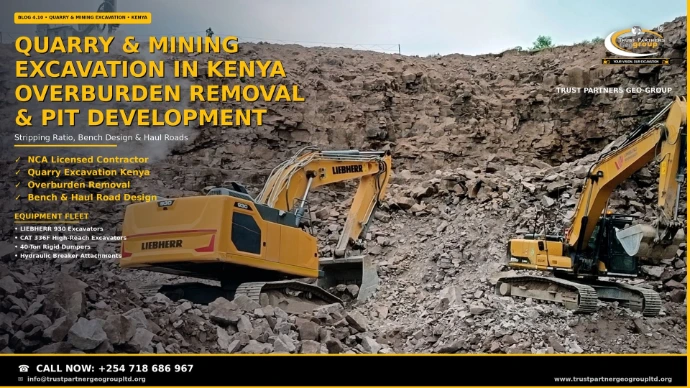
Quarry & Mining Excavation in Kenya: Overburden Removal & Pit Development
A quarry is a business disguised as a hole: every bench, road and stripping pass is set by the ratio of waste moved to product sold. The complete economics, engineering and compliance guide for 2026.

1. The Quarry Economics: Stripping Ratio Rules
Strip away the machinery and the quarry reduces to one ratio: bank cubic metres of waste moved per saleable tonne of rock. The arithmetic that governs: product sells at KES 800–1,500 per tonne for common aggregates; stripping costs KES 150–900 per bcm depending on rippability and haul. At a 1:1 ratio, stripping eats 15–30% of revenue — a healthy business. At 3:1 it consumes half — viable only with premium stone or captive demand. Past 5:1, most Kenyan deposits are uneconomic no matter how good the rock. The planner's response: drill the deposit before anything moves, map overburden thickness across the lease, and let the ratio choose the pit's opening position, its direction of expansion and its floor levels. Quarries do not fail because the machines were small; they fail because the ratio was guessed. Open-pit method selection is this decision in detail.
2. Overburden Removal: Methods & Cost per bcm
| Material | Method | 2026 Rate (KES/bcm) | Fleet |
|---|---|---|---|
| Free soil | Dozer push / excavator load | 150–350 | D8 + tippers |
| Rippable | Dozer ripper, then load | 250–500 | D9 + ripper + ADTs |
| Broken rock | Breaker or blasting, then load | 500–900 | 50t + breakers / drill-blast |
| Long-haul variant | Any of the above | +50–150 per 100m beyond 300m | Haul distance dominates |
The enabling works priced separately: topsoil stripped and stockpiled first — it is the rehabilitation asset NEMA expects returned; pit dewatering where the floor meets groundwater; and the haul road built before the first bcm moves. Worked example: 5 hectares under 3 metres of mixed cover is 150,000 bcm — a two-to-four-month programme at KES 30M–60M for a dozer-excavator-tipper fleet. Stripping methods in detail covers the fleet selection.
3. Bench Design: The Geometry of a Safe Pit
Benches are the pit's structural grammar, and their dimensions follow the machines that work them:
- Height — never more than the working excavator can safely clean from a stable standing level: 5–8m on 30-ton machines, 10–15m on 50-ton and front shovels; higher faces in multiple benches.
- Width — at least twice the widest machine on the floor, so a face failure cannot reach across the working room.
- Face angle — competent blasted faces at 70–80 degrees; weathered or jointed ground flattened or benched down.
- Catch benches — on high faces, intercepting falling material before the haul road.
The method statement that ignores these is writing accidents; the pit that observes them works for decades. Bench design in the open-pit guide ties the geometry to equipment classes.
4. Haul Roads: The Quarry's Arteries
Designed, not improvised: width at 3–4 times the widest vehicle — 12–20 metres on mains for two-way ADT traffic; gradients held at 8–10% sustained, short pitches to 12% where the dig forces them; 300–500mm of compacted crushed stone on the surface, watered and graded daily; cambered to side drains with culvert crossings, because water destroys roads faster than trucks do; and curvature radii sized for the longest vehicle. Construction at KES 300,000–800,000 per kilometre — trivial against what it protects: an hour of fleet-wide truck delay costs more than a kilometre of good road. The maintenance rhythm — grader pass daily, water bowser behind it — is the cheapest production insurance in the pit.
5. Production Fleet: Matching Machines to Material
| Role | Machine | Productive Role |
|---|---|---|
| Stripping | D8–D9 dozers with rippers | Push and rip overburden to loading faces |
| Loading | 30t–50t excavators (1.8–3.5 m³ buckets) | Face loading at 600–2,500 bcm/day equivalent |
| Breaking | Heavy breakers on 50t carriers; drill-blast spread | Secondary oversize; primary where blasting |
| Haulage | ADTs (30–40t) in-pit; rigid tippers on good roads | Cycle-matched to the loading bucket |
| Roads & finishing | Motor grader, water bowser, roller | The daily artery maintenance |
The matching principle from every other article in this series applies at quarry scale: bucket-to-truck in 3–6 passes, road speed multiplied by truck count equals excavation rate, and owned fleets with standby machines keep the pit producing when breakdowns land. Crusher pad preparation completes the production chain from face to stockpile.
6. Permits & Compliance: The Full Stack
- Mining licence — Ministry of Mining; the controlling document, graded by mineral and scale.
- County consents — business permits and land-use approvals where the county governs.
- NEMA EIA licence — quarries are scheduled undertakings; conditions govern dust, noise, blasting windows, rehabilitation bonding and water management.
- Blasting licences — under the Explosives Act: licensed magazines, certified shot-firers, blast records — standing obligations, not one-offs.
- Public participation — EIA process records where communities are near.
The timeline honesty: 6–18 months for the full stack depending on county and complexity — budget it in the business plan, because operating ahead of permits converts profit into penalties. Quarry permits and blasting compliance walks every step.
7. Real Numbers 2026
| Item | Basis | 2026 Band (KES) |
|---|---|---|
| Overburden strip, free soil | per bcm | 150–350 |
| Overburden strip, rippable | per bcm | 250–500 |
| Overburden strip, broken | per bcm | 500–900 |
| Rock breaking (secondary) | per m³ | 1,200–2,500 |
| Haul road construction | per km, two-lane standard | 300,000–800,000 |
| Aggregate selling price (common) | per tonne | 800–1,500 |
| Mining licence & EIA programme | per project | Per consultancy; 6–18 months |
| 30t excavator + operator | per day | 15,000–25,000 |
| ADT 30–40t + driver | per day | 18,000–30,000 |
8. Frequently Asked Questions
The stripping ratio is the deal the ground offers: how much waste must be moved for each unit of saleable rock. Expressed as bank cubic metres of overburden per tonne of product — or m³:m³ where products are measured in volume — it is the single number that decides whether a deposit is a business or a hole. The economics, stated plainly: every tonne of aggregate sells at perhaps KES 800–1,500, while every bank cubic metre of stripping costs KES 150–800 depending on rippability and haul. Ratios of 1:1 to 3:1 (waste to product) keep Kenyan quarries comfortably alive; past 5:1 the margin thins to the point where only premium stone or captive demand justifies the dig. The quarry planner's craft is reading the deposit — drill holes and trial pits mapping the overburden thickness across the lease — because the ratio varies metre by metre, and the pit's opening position, its expansion direction and its floor levels all follow where the ratio is kind. Open-pit method selection starts from this number.
Overburden stripping prices by the bank cubic metre — the in-ground volume, before loosening swell inflates it — at 2026 rates: free-digging soil at KES 150–350 per bcm where a dozer or excavator loads and pushes short distances; rippable material at KES 250–500 where the dozer's ripper opens it first; broken rock overburden at KES 500–900 where breakers work; and everything increases with haul distance — the same bcm at 500 metres of haul can double the rate. Add the enabling works most budgets forget: topsoil strip and stockpile separately (it is the rehabilitation asset, and NEMA expects it back); pit dewatering where the floor intercepts groundwater; and the haul road itself, built before stripping begins, at KES 300,000–800,000 per kilometre of two-lane quarry standard. A worked picture: a 5-hectare opening with 3 metres of mixed overburden is 150,000 bcm — a two-to-four-month stripping programme for a dozer-excavator-tippet fleet at KES 30M–60M. Cost-effective stripping methods detail the fleet choices.
Bench height is set by the machine that works it — the rule is that no bench face may exceed what the excavator can dig safely from a stable standing level, and never more than the machine's ability to clean the face without undercutting. Practical Kenyan figures: with 30-ton excavators, single benches run 5–8 metres; with 50-ton and heavy front shovels, 10–15 metres; anything above that is worked in multiple benches or with specialised high-reach plant. The companion rules: bench width at least twice the widest machine working the floor — so a face collapse never reaches across the working room; face angles matched to the rock — competent blasted faces at 70–80 degrees, weathered or jointed ground flattened to safe angles or benched down; and catch benches on high faces where falling material must be intercepted before the haul road. Benches are not cosmetic steps — they are the pit's structural grammar, and the method statement that ignores them is writing accidents. Bench design in practice covers the geometry.
The haul road is the quarry's artery, and its design is as engineered as the benches. The specification: width — 3 to 4 times the widest vehicle for two-way traffic, typically 12–20 metres on Kenyan quarry mains; gradient — 8–10% sustained maximum, with short pitches to 12% where the dig forces it; surface — 300–500mm of compacted crushed stone, watered and graded daily, because a rutted road halves truck speed and doubles tyre cost; crossfall and drains — cambered to shed water into side drains with regular culvert crossings, since water is the road's destroyer; and curvature radii sized for the longest truck, because an ADT that cannot turn is a production stopper. Construction cost runs KES 300,000–800,000 per kilometre of two-lane standard — trivial against the production it protects: a single hour of truck delay across a fleet costs more than a kilometre of good road. Maintenance is the ongoing discipline: a grader pass daily, water bowser behind it, and the road repays the pit every shift.
The quarry permit stack, in sequence: a mining licence or permit from the Ministry of Mining — the controlling document, graded by mineral and scale, and the one everything else references; county business permits and land-use consents where the county governs the area; NEMA EIA licence — quarries are scheduled undertakings, and the licence conditions govern dust, noise, blasting windows, rehabilitation bonding and water management; blasting licences and storage permits where explosives are used, under the Explosives Act administered through the Chief Inspector of Explosives — with licensed magazines, certified shot-firers and blast records as standing obligations; and where the site is near communities, public participation records under the EIA process. The timeline honesty: the full stack takes 6–18 months depending on county and complexity — budget it in the business plan, because operating before it completes converts profit into penalties. Quarry permits and blasting compliance walks the stack step by step.
Open the Pit Right the First Time.
Trust Partners Geo-Group Ltd delivers quarry and mining earthworks across Kenya — stripping programmes, bench and haul-road construction, production fleet hire with operators, and compliance-ready method statements — from first bcm to full production. Request a programme quotation.
Get a Quarry Earthworks Quote📞 +254 718 68 69 67
Quarry & Mining Excavation in Kenya: Overburden Removal & Pit Development
A quarry is a business disguised as a hole: every bench, road and stripping pass is set by the ratio of waste moved to product sold. The complete economics, engineering and compliance guide for 2026.
1. The Quarry Economics: Stripping Ratio Rules
Strip away the machinery and the quarry reduces to one ratio: bank cubic metres of waste moved per saleable tonne of rock. The arithmetic that governs: product sells at KES 800–1,500 per tonne for common aggregates; stripping costs KES 150–900 per bcm depending on rippability and haul. At a 1:1 ratio, stripping eats 15–30% of revenue — a healthy business. At 3:1 it consumes half — viable only with premium stone or captive demand. Past 5:1, most Kenyan deposits are uneconomic no matter how good the rock. The planner's response: drill the deposit before anything moves, map overburden thickness across the lease, and let the ratio choose the pit's opening position, its direction of expansion and its floor levels. Quarries do not fail because the machines were small; they fail because the ratio was guessed. Open-pit method selection is this decision in detail.
2. Overburden Removal: Methods & Cost per bcm
| Material | Method | 2026 Rate (KES/bcm) | Fleet |
|---|---|---|---|
| Free soil | Dozer push / excavator load | 150–350 | D8 + tippers |
| Rippable | Dozer ripper, then load | 250–500 | D9 + ripper + ADTs |
| Broken rock | Breaker or blasting, then load | 500–900 | 50t + breakers / drill-blast |
| Long-haul variant | Any of the above | +50–150 per 100m beyond 300m | Haul distance dominates |
The enabling works priced separately: topsoil stripped and stockpiled first — it is the rehabilitation asset NEMA expects returned; pit dewatering where the floor meets groundwater; and the haul road built before the first bcm moves. Worked example: 5 hectares under 3 metres of mixed cover is 150,000 bcm — a two-to-four-month programme at KES 30M–60M for a dozer-excavator-tipper fleet. Stripping methods in detail covers the fleet selection.
3. Bench Design: The Geometry of a Safe Pit
Benches are the pit's structural grammar, and their dimensions follow the machines that work them:
- Height — never more than the working excavator can safely clean from a stable standing level: 5–8m on 30-ton machines, 10–15m on 50-ton and front shovels; higher faces in multiple benches.
- Width — at least twice the widest machine on the floor, so a face failure cannot reach across the working room.
- Face angle — competent blasted faces at 70–80 degrees; weathered or jointed ground flattened or benched down.
- Catch benches — on high faces, intercepting falling material before the haul road.
The method statement that ignores these is writing accidents; the pit that observes them works for decades. Bench design in the open-pit guide ties the geometry to equipment classes.
4. Haul Roads: The Quarry's Arteries
Designed, not improvised: width at 3–4 times the widest vehicle — 12–20 metres on mains for two-way ADT traffic; gradients held at 8–10% sustained, short pitches to 12% where the dig forces them; 300–500mm of compacted crushed stone on the surface, watered and graded daily; cambered to side drains with culvert crossings, because water destroys roads faster than trucks do; and curvature radii sized for the longest vehicle. Construction at KES 300,000–800,000 per kilometre — trivial against what it protects: an hour of fleet-wide truck delay costs more than a kilometre of good road. The maintenance rhythm — grader pass daily, water bowser behind it — is the cheapest production insurance in the pit.
5. Production Fleet: Matching Machines to Material
| Role | Machine | Productive Role |
|---|---|---|
| Stripping | D8–D9 dozers with rippers | Push and rip overburden to loading faces |
| Loading | 30t–50t excavators (1.8–3.5 m³ buckets) | Face loading at 600–2,500 bcm/day equivalent |
| Breaking | Heavy breakers on 50t carriers; drill-blast spread | Secondary oversize; primary where blasting |
| Haulage | ADTs (30–40t) in-pit; rigid tippers on good roads | Cycle-matched to the loading bucket |
| Roads & finishing | Motor grader, water bowser, roller | The daily artery maintenance |
The matching principle from every other article in this series applies at quarry scale: bucket-to-truck in 3–6 passes, road speed multiplied by truck count equals excavation rate, and owned fleets with standby machines keep the pit producing when breakdowns land. Crusher pad preparation completes the production chain from face to stockpile.
6. Permits & Compliance: The Full Stack
- Mining licence — Ministry of Mining; the controlling document, graded by mineral and scale.
- County consents — business permits and land-use approvals where the county governs.
- NEMA EIA licence — quarries are scheduled undertakings; conditions govern dust, noise, blasting windows, rehabilitation bonding and water management.
- Blasting licences — under the Explosives Act: licensed magazines, certified shot-firers, blast records — standing obligations, not one-offs.
- Public participation — EIA process records where communities are near.
The timeline honesty: 6–18 months for the full stack depending on county and complexity — budget it in the business plan, because operating ahead of permits converts profit into penalties. Quarry permits and blasting compliance walks every step.
7. Real Numbers 2026
| Item | Basis | 2026 Band (KES) |
|---|---|---|
| Overburden strip, free soil | per bcm | 150–350 |
| Overburden strip, rippable | per bcm | 250–500 |
| Overburden strip, broken | per bcm | 500–900 |
| Rock breaking (secondary) | per m³ | 1,200–2,500 |
| Haul road construction | per km, two-lane standard | 300,000–800,000 |
| Aggregate selling price (common) | per tonne | 800–1,500 |
| Mining licence & EIA programme | per project | Per consultancy; 6–18 months |
| 30t excavator + operator | per day | 15,000–25,000 |
| ADT 30–40t + driver | per day | 18,000–30,000 |
8. Frequently Asked Questions
The stripping ratio is the deal the ground offers: how much waste must be moved for each unit of saleable rock. Expressed as bank cubic metres of overburden per tonne of product — or m³:m³ where products are measured in volume — it is the single number that decides whether a deposit is a business or a hole. The economics, stated plainly: every tonne of aggregate sells at perhaps KES 800–1,500, while every bank cubic metre of stripping costs KES 150–800 depending on rippability and haul. Ratios of 1:1 to 3:1 (waste to product) keep Kenyan quarries comfortably alive; past 5:1 the margin thins to the point where only premium stone or captive demand justifies the dig. The quarry planner's craft is reading the deposit — drill holes and trial pits mapping the overburden thickness across the lease — because the ratio varies metre by metre, and the pit's opening position, its expansion direction and its floor levels all follow where the ratio is kind. Open-pit method selection starts from this number.
Overburden stripping prices by the bank cubic metre — the in-ground volume, before loosening swell inflates it — at 2026 rates: free-digging soil at KES 150–350 per bcm where a dozer or excavator loads and pushes short distances; rippable material at KES 250–500 where the dozer's ripper opens it first; broken rock overburden at KES 500–900 where breakers work; and everything increases with haul distance — the same bcm at 500 metres of haul can double the rate. Add the enabling works most budgets forget: topsoil strip and stockpile separately (it is the rehabilitation asset, and NEMA expects it back); pit dewatering where the floor intercepts groundwater; and the haul road itself, built before stripping begins, at KES 300,000–800,000 per kilometre of two-lane quarry standard. A worked picture: a 5-hectare opening with 3 metres of mixed overburden is 150,000 bcm — a two-to-four-month stripping programme for a dozer-excavator-tippet fleet at KES 30M–60M. Cost-effective stripping methods detail the fleet choices.
Bench height is set by the machine that works it — the rule is that no bench face may exceed what the excavator can dig safely from a stable standing level, and never more than the machine's ability to clean the face without undercutting. Practical Kenyan figures: with 30-ton excavators, single benches run 5–8 metres; with 50-ton and heavy front shovels, 10–15 metres; anything above that is worked in multiple benches or with specialised high-reach plant. The companion rules: bench width at least twice the widest machine working the floor — so a face collapse never reaches across the working room; face angles matched to the rock — competent blasted faces at 70–80 degrees, weathered or jointed ground flattened to safe angles or benched down; and catch benches on high faces where falling material must be intercepted before the haul road. Benches are not cosmetic steps — they are the pit's structural grammar, and the method statement that ignores them is writing accidents. Bench design in practice covers the geometry.
The haul road is the quarry's artery, and its design is as engineered as the benches. The specification: width — 3 to 4 times the widest vehicle for two-way traffic, typically 12–20 metres on Kenyan quarry mains; gradient — 8–10% sustained maximum, with short pitches to 12% where the dig forces it; surface — 300–500mm of compacted crushed stone, watered and graded daily, because a rutted road halves truck speed and doubles tyre cost; crossfall and drains — cambered to shed water into side drains with regular culvert crossings, since water is the road's destroyer; and curvature radii sized for the longest truck, because an ADT that cannot turn is a production stopper. Construction cost runs KES 300,000–800,000 per kilometre of two-lane standard — trivial against the production it protects: a single hour of truck delay across a fleet costs more than a kilometre of good road. Maintenance is the ongoing discipline: a grader pass daily, water bowser behind it, and the road repays the pit every shift.
The quarry permit stack, in sequence: a mining licence or permit from the Ministry of Mining — the controlling document, graded by mineral and scale, and the one everything else references; county business permits and land-use consents where the county governs the area; NEMA EIA licence — quarries are scheduled undertakings, and the licence conditions govern dust, noise, blasting windows, rehabilitation bonding and water management; blasting licences and storage permits where explosives are used, under the Explosives Act administered through the Chief Inspector of Explosives — with licensed magazines, certified shot-firers and blast records as standing obligations; and where the site is near communities, public participation records under the EIA process. The timeline honesty: the full stack takes 6–18 months depending on county and complexity — budget it in the business plan, because operating before it completes converts profit into penalties. Quarry permits and blasting compliance walks the stack step by step.
Open the Pit Right the First Time.
Trust Partners Geo-Group Ltd delivers quarry and mining earthworks across Kenya — stripping programmes, bench and haul-road construction, production fleet hire with operators, and compliance-ready method statements — from first bcm to full production. Request a programme quotation.
Get a Quarry Earthworks Quote📞 +254 718 68 69 67