
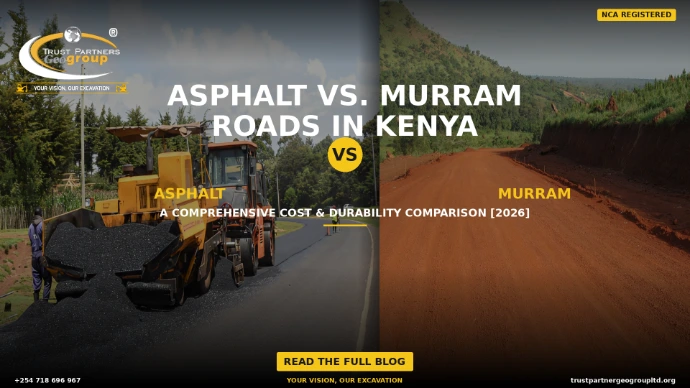
Asphalt vs. Murram Roads in Kenya: Which is Better for Your Project?
Choosing between asphalt (tarmac) roads and murram (gravel) roads is one of the most critical decisions in any Kenyan road construction project. With construction costs ranging from KES 26 million to over KES 900 million per kilometer depending on the surface type, terrain, and design, making the wrong choice can cost millions in premature repairs or unnecessary upfront expenditure. This comprehensive 2026 guide breaks down the real costs, durability, maintenance requirements, and ideal use cases for each road surface type in Kenya.
📋 Table of Contents
- Overview: Asphalt vs. Murram Roads
- Cost Comparison Per Kilometer (2026)
- Durability & Lifespan Analysis
- Maintenance Requirements & Long-Term Costs
- Performance in Kenyan Climate Conditions
- Ideal Use Cases & Project Recommendations
- Decision Matrix: Which Surface Should You Choose?
- Frequently Asked Questions
1. Overview: Asphalt vs. Murram Roads in Kenya
Kenya's road network spans approximately 177,800 kilometers, with only about 17,000 km paved and the remainder comprising murram, earth, and gravel surfaces. The choice between asphalt and murram is not simply about budget—it involves traffic volume projections, soil conditions, climate exposure, maintenance capacity, and long-term economic value.
🛣️ Asphalt (Tarmac) Roads
- ✓ Smooth, all-weather surface
- ✓ 15–25 year design lifespan
- ✓ Low rolling resistance (fuel savings)
- ✓ High load-bearing capacity
- ✓ Minimal dust generation
- ✗ High initial capital cost
- ✗ Requires bitumen importation
- ✗ Vulnerable to thermal cracking
🪨 Murram (Gravel) Roads
- ✓ Significantly lower initial cost
- ✓ Uses locally available materials
- ✓ Easier and faster to construct
- ✓ Good for low-traffic rural areas
- ✓ Lower environmental footprint
- ✗ Requires frequent maintenance
- ✗ Dust and erosion issues
- ✗ Poor performance in heavy rain
2. Cost Comparison Per Kilometer (2026 Estimates)
Based on data from the Kenya Roads Board (KRB), Kenya National Highways Authority (KeNHA), and recent project tenders, here are the realistic 2026 construction costs per kilometer for both road types in Kenya:
2.1 Asphalt Road Construction Costs in Kenya (2026)
| Road Type / Project | Width | Cost per Km (KES) | Cost per Km (USD) |
|---|---|---|---|
| Basic Access Road (Single Carriageway) | 6–7m | 26M – 60M | $200K – $460K |
| Standard Rural Tarmac Road | 7–8m | 60M – 120M | $460K – $920K |
| Urban Collector Road | 10–12m | 120M – 250M | $920K – $1.9M |
| Major Highway / Bypass | 14–18m | 200M – 500M | $1.5M – $3.8M |
| Dual Carriageway (Nairobi Standard) | 24–30m | 500M – 900M+ | $3.8M – $6.9M+ |
Source: Kenya Roads Board project data, KeNHA tender records, and Integrum Construction Cost Database 2021–2025, adjusted for 2026 inflation.
2.2 Murram Road Construction Costs in Kenya (2026)
| Road Type / Standard | Width | Cost per Km (KES) | Cost per Km (USD) |
|---|---|---|---|
| Basic Gravel Road (Earth + Gravel) | 6m | 15M – 25M | $115K – $190K |
| Standard Murram Road (Improved) | 6–7m | 25M – 35M | $190K – $270K |
| High-Standard Murram (Capped + Drained) | 7–8m | 35M – 50M | $270K – $380K |
| Murram Road with Spot Improvements | 6–7m | 20M – 40M | $150K – $300K |
💡 Key Cost Insight
An asphalt road typically costs 3 to 5 times more than a murram road of equivalent width. However, when calculated over a 20-year lifecycle including maintenance, the gap narrows significantly—especially for high-traffic corridors where murram roads require constant grading, re-gravelling, and dust suppression.
3. Durability & Lifespan Analysis
3.1 Asphalt Road Durability in Kenya
Properly designed and constructed asphalt roads in Kenya can achieve a design lifespan of 15–25 years before requiring major rehabilitation. Key factors affecting asphalt durability include:
- Bitumen quality and grade: Kenya primarily uses 60/70 penetration grade bitumen. Using polymer-modified bitumen (PMB) in high-stress areas can extend lifespan by 30–40%.
- Subgrade preparation: Inadequate compaction or poor drainage beneath the pavement is the leading cause of premature asphalt failure in Kenya.
- Traffic loading: Heavy commercial vehicles (especially those exceeding axle load limits) significantly reduce asphalt pavement life through rutting and fatigue cracking.
- Thermal stress: Kenya's high-altitude regions (e.g., Nakuru, Kericho, Nanyuki) experience greater thermal variation, increasing the risk of thermal cracking in asphalt surfaces.
3.2 Murram Road Durability in Kenya
Murram roads, when well-constructed with proper camber, drainage, and gravel quality, can last 5–10 years between major interventions. However, their lifespan is highly dependent on:
- Gravel quality (CBR value): Murram with a California Bearing Ratio (CBR) of 30+ performs significantly better than lower-grade material. Kenya's murram quality varies widely by region.
- Traffic volume: Murram roads deteriorate rapidly under traffic exceeding 300 vehicles per day (vpd), particularly if heavy trucks are involved.
- Rainfall intensity: In high-rainfall areas (Western Kenya, Coast), murram roads can become impassable during wet seasons without proper drainage and regular grading.
- Maintenance frequency: Without grading every 3–6 months and re-gravelling every 2–3 years, murram roads can degrade to earth road standard within 2–3 years.
4. Maintenance Requirements & Long-Term Costs
One of the most overlooked factors in road surface selection is the lifecycle maintenance cost. While murram roads are cheaper to build, their ongoing maintenance can erode those savings over time.
| Maintenance Activity | Asphalt Road | Murram Road | Frequency |
|---|---|---|---|
| Routine Maintenance | Pothole patching, crack sealing KES 2M–5M/km/year |
Grading, pothole filling KES 1.5M–3M/km/year |
Quarterly (Murram) As needed (Asphalt) |
| Periodic Maintenance | Overlay (50mm AC) KES 25M–50M/km |
Re-gravelling (150mm) KES 8M–15M/km |
Every 8–12 years Every 3–5 years |
| Rehabilitation | Structural overlay / reconstruction KES 60M–150M/km |
Full reconstruction KES 15M–30M/km |
Every 15–25 years Every 8–12 years |
| 20-Year Lifecycle Cost | KES 120M–250M/km (excluding initial construction) |
KES 80M–150M/km (excluding initial construction) |
— |
Important: For roads carrying over 500 vehicles per day, asphalt becomes more economical over a 20-year period due to the high frequency of murram maintenance interventions and the economic cost of road closures.
5. Performance in Kenyan Climate Conditions
5.1 High-Rainfall Regions (Western Kenya, Coast, Highlands)
In areas receiving over 1,000mm of rainfall annually, murram roads face severe challenges. Without adequate drainage (cambers, side drains, culverts), murram surfaces can be washed away during heavy rains. Asphalt performs better in wet conditions but requires proper sub-surface drainage to prevent water infiltration and stripping of the bitumen binder.
5.2 Arid and Semi-Arid Regions (Northern Kenya, Eastern, Rift Valley)
In arid zones, murram roads suffer from excessive dust generation, which creates health hazards for nearby communities and increases vehicle maintenance costs. Dust suppression (using calcium chloride or lignosulfonate) adds KES 500,000–1M per km annually. Asphalt roads are ideal for these regions but require careful mix design to withstand high surface temperatures (up to 60°C in some areas).
5.3 High-Altitude / Cold Regions (Nyahururu, Nanyuki, Timau)
Thermal cracking is a concern for asphalt in high-altitude areas where night temperatures can drop below 5°C. Using softer bitumen grades or adding rejuvenators can mitigate this. Murram roads in these areas generally perform well but can become muddy during the rainy season.
6. Ideal Use Cases & Project Recommendations
✅ Choose Asphalt When:
- ✓ Daily traffic exceeds 300–500 vehicles
- ✓ Heavy trucks / commercial vehicles use the road
- ✓ Road serves an urban or peri-urban area
- ✓ All-weather accessibility is essential (hospitals, schools, markets)
- ✓ Long-term budget allows for higher upfront investment
- ✓ Road is part of a national trunk or primary road network
- ✓ Dust suppression is critical (near residential areas, schools, hospitals)
✅ Choose Murram When:
- ✓ Daily traffic is below 300 vehicles
- ✓ Predominantly light vehicles (motorcycles, cars, pickups)
- ✓ Rural or remote area with limited construction budget
- ✓ Maintenance capacity (grader, water bowser) is available locally
- ✓ Road serves as a temporary or feeder route
- ✓ Local murram material is abundant and high-quality
- ✓ Project is part of a phased upgrade strategy (murram first, asphalt later)
7. Decision Matrix: Asphalt vs. Murram Road Calculator
Use this simple scoring matrix to guide your road surface decision. Score each factor from 1 (low importance / unfavorable) to 5 (high importance / favorable), then tally the totals:
| Decision Factor | Asphalt Score | Murram Score | Weight |
|---|---|---|---|
| Initial Budget Availability | 2/5 (High cost) | 5/5 (Low cost) | High |
| Traffic Volume (>300 vpd) | 5/5 (Excellent) | 2/5 (Poor) | High |
| Heavy Vehicle Loading | 5/5 (Excellent) | 1/5 (Very Poor) | High |
| All-Weather Reliability | 5/5 (Excellent) | 2/5 (Seasonal issues) | High |
| Maintenance Budget (Long-term) | 4/5 (Lower frequency) | 2/5 (High frequency) | Medium |
| Material Availability | 2/5 (Bitumen imported) | 5/5 (Local murram) | Medium |
| Construction Speed | 3/5 (Moderate) | 4/5 (Faster) | Low |
| Environmental Impact | 3/5 (Bitumen carbon footprint) | 4/5 (Lower embodied energy) | Low |
| TOTAL SCORE | 29/40 | 25/40 | — |
🎯 Decision Rule
If your project scores 3 or higher on traffic volume, heavy loading, or all-weather reliability, asphalt is strongly recommended despite the higher initial cost. If budget is the overriding constraint and traffic is light, murram is the pragmatic choice—but plan for a phased upgrade to asphalt as traffic grows.
8. Frequently Asked Questions
The cheapest road surface is an earth or gravel road, costing approximately KES 15–25 million per kilometer. However, a well-constructed murram road (KES 25–35M/km) offers much better value as it lasts longer and requires less frequent maintenance than a basic earth road.
The cost of constructing 1 km of tarmac (asphalt) road in Kenya ranges from KES 26.12 million for basic single-carriageway access roads to as much as KES 903.37 million per km for complex urban dual-carriageway projects. The average cost for a standard rural or peri-urban asphalt road is approximately KES 60–120 million per km.
Yes, and this is a common strategy in Kenya. A well-constructed murram road with proper drainage and subgrade preparation can serve as the base for a future asphalt overlay. This phased approach allows counties and developers to spread costs over time while still providing immediate access improvements. The key is ensuring the murram road has adequate camber and drainage from day one.
A properly designed and constructed asphalt road in Kenya typically lasts 15–25 years before requiring major rehabilitation. Routine maintenance (patching, crack sealing) should be performed as needed. The lifespan is heavily influenced by traffic loading, subgrade quality, drainage effectiveness, and the quality of bitumen used.
The main disadvantages of murram roads include: (1) Dust generation—a significant health and environmental concern; (2) Seasonal impassability—during heavy rains, murram roads can become muddy and slippery; (3) High maintenance frequency—requiring grading every 3–6 months; (4) Poor performance under heavy loads—trucks cause rapid rutting and deformation; (5) Gravel loss—material is gradually lost to traffic and erosion, requiring periodic re-gravelling.
It depends on the specific context. For rural roads with light traffic (under 300 vehicles/day) and limited budgets, murram is the practical and cost-effective choice. However, for rural roads serving as market access routes, connecting to health facilities or schools, or carrying commercial agricultural traffic, asphalt provides superior all-weather reliability and lower long-term economic costs. Many Kenyan counties are now adopting a "murram now, asphalt later" strategy for rural road networks.
The Kenya Roads Board recommends a minimum California Bearing Ratio (CBR) of 30% for murram used in road construction. Higher CBR values (40%+) are preferred for roads carrying heavier traffic. Murram sourced from different regions in Kenya varies significantly in quality—materials from the Rift Valley and parts of Central Kenya typically have better CBR values than coastal or western region materials.
Need a Detailed Road Construction Cost Estimate?
Trust Partner Geo Group Ltd provides professional road construction consultancy, feasibility studies, and detailed cost estimates for asphalt and murram road projects across Kenya. Our team of registered engineers and quantity surveyors will help you make the right surface choice for your budget and traffic needs.
Get a Free Project Consultation →Related Articles
Road Construction Cost Per Kilometer in Kenya: 2026 Estimate
Read Article →Construction Materials Prices in Kenya 2026
Read Article →How to Get a Road Construction Permit in Kenya
Read Article →About the Author: Trust Partner Geo Group Ltd is a leading engineering and construction consultancy firm in Kenya, specializing in road construction, geotechnical investigations, and project management. We serve clients across East Africa with data-driven, cost-effective infrastructure solutions.
Published: July 14, 2026 | Last Updated: July 14, 2026 | Categories: Road Construction, Kenya Infrastructure, Cost Estimation
Asphalt vs. Murram Roads in Kenya: Which is Better for Your Project?
Choosing between asphalt (tarmac) roads and murram (gravel) roads is one of the most critical decisions in any Kenyan road construction project. With construction costs ranging from KES 26 million to over KES 900 million per kilometer depending on the surface type, terrain, and design, making the wrong choice can cost millions in premature repairs or unnecessary upfront expenditure. This comprehensive 2026 guide breaks down the real costs, durability, maintenance requirements, and ideal use cases for each road surface type in Kenya.
📋 Table of Contents
- Overview: Asphalt vs. Murram Roads
- Cost Comparison Per Kilometer (2026)
- Durability & Lifespan Analysis
- Maintenance Requirements & Long-Term Costs
- Performance in Kenyan Climate Conditions
- Ideal Use Cases & Project Recommendations
- Decision Matrix: Which Surface Should You Choose?
- Frequently Asked Questions
1. Overview: Asphalt vs. Murram Roads in Kenya
Kenya's road network spans approximately 177,800 kilometers, with only about 17,000 km paved and the remainder comprising murram, earth, and gravel surfaces. The choice between asphalt and murram is not simply about budget—it involves traffic volume projections, soil conditions, climate exposure, maintenance capacity, and long-term economic value.
🛣️ Asphalt (Tarmac) Roads
- ✓ Smooth, all-weather surface
- ✓ 15–25 year design lifespan
- ✓ Low rolling resistance (fuel savings)
- ✓ High load-bearing capacity
- ✓ Minimal dust generation
- ✗ High initial capital cost
- ✗ Requires bitumen importation
- ✗ Vulnerable to thermal cracking
🪨 Murram (Gravel) Roads
- ✓ Significantly lower initial cost
- ✓ Uses locally available materials
- ✓ Easier and faster to construct
- ✓ Good for low-traffic rural areas
- ✓ Lower environmental footprint
- ✗ Requires frequent maintenance
- ✗ Dust and erosion issues
- ✗ Poor performance in heavy rain
2. Cost Comparison Per Kilometer (2026 Estimates)
Based on data from the Kenya Roads Board (KRB), Kenya National Highways Authority (KeNHA), and recent project tenders, here are the realistic 2026 construction costs per kilometer for both road types in Kenya:
2.1 Asphalt Road Construction Costs in Kenya (2026)
| Road Type / Project | Width | Cost per Km (KES) | Cost per Km (USD) |
|---|---|---|---|
| Basic Access Road (Single Carriageway) | 6–7m | 26M – 60M | $200K – $460K |
| Standard Rural Tarmac Road | 7–8m | 60M – 120M | $460K – $920K |
| Urban Collector Road | 10–12m | 120M – 250M | $920K – $1.9M |
| Major Highway / Bypass | 14–18m | 200M – 500M | $1.5M – $3.8M |
| Dual Carriageway (Nairobi Standard) | 24–30m | 500M – 900M+ | $3.8M – $6.9M+ |
Source: Kenya Roads Board project data, KeNHA tender records, and Integrum Construction Cost Database 2021–2025, adjusted for 2026 inflation.
2.2 Murram Road Construction Costs in Kenya (2026)
| Road Type / Standard | Width | Cost per Km (KES) | Cost per Km (USD) |
|---|---|---|---|
| Basic Gravel Road (Earth + Gravel) | 6m | 15M – 25M | $115K – $190K |
| Standard Murram Road (Improved) | 6–7m | 25M – 35M | $190K – $270K |
| High-Standard Murram (Capped + Drained) | 7–8m | 35M – 50M | $270K – $380K |
| Murram Road with Spot Improvements | 6–7m | 20M – 40M | $150K – $300K |
💡 Key Cost Insight
An asphalt road typically costs 3 to 5 times more than a murram road of equivalent width. However, when calculated over a 20-year lifecycle including maintenance, the gap narrows significantly—especially for high-traffic corridors where murram roads require constant grading, re-gravelling, and dust suppression.
3. Durability & Lifespan Analysis
3.1 Asphalt Road Durability in Kenya
Properly designed and constructed asphalt roads in Kenya can achieve a design lifespan of 15–25 years before requiring major rehabilitation. Key factors affecting asphalt durability include:
- Bitumen quality and grade: Kenya primarily uses 60/70 penetration grade bitumen. Using polymer-modified bitumen (PMB) in high-stress areas can extend lifespan by 30–40%.
- Subgrade preparation: Inadequate compaction or poor drainage beneath the pavement is the leading cause of premature asphalt failure in Kenya.
- Traffic loading: Heavy commercial vehicles (especially those exceeding axle load limits) significantly reduce asphalt pavement life through rutting and fatigue cracking.
- Thermal stress: Kenya's high-altitude regions (e.g., Nakuru, Kericho, Nanyuki) experience greater thermal variation, increasing the risk of thermal cracking in asphalt surfaces.
3.2 Murram Road Durability in Kenya
Murram roads, when well-constructed with proper camber, drainage, and gravel quality, can last 5–10 years between major interventions. However, their lifespan is highly dependent on:
- Gravel quality (CBR value): Murram with a California Bearing Ratio (CBR) of 30+ performs significantly better than lower-grade material. Kenya's murram quality varies widely by region.
- Traffic volume: Murram roads deteriorate rapidly under traffic exceeding 300 vehicles per day (vpd), particularly if heavy trucks are involved.
- Rainfall intensity: In high-rainfall areas (Western Kenya, Coast), murram roads can become impassable during wet seasons without proper drainage and regular grading.
- Maintenance frequency: Without grading every 3–6 months and re-gravelling every 2–3 years, murram roads can degrade to earth road standard within 2–3 years.
4. Maintenance Requirements & Long-Term Costs
One of the most overlooked factors in road surface selection is the lifecycle maintenance cost. While murram roads are cheaper to build, their ongoing maintenance can erode those savings over time.
| Maintenance Activity | Asphalt Road | Murram Road | Frequency |
|---|---|---|---|
| Routine Maintenance | Pothole patching, crack sealing KES 2M–5M/km/year |
Grading, pothole filling KES 1.5M–3M/km/year |
Quarterly (Murram) As needed (Asphalt) |
| Periodic Maintenance | Overlay (50mm AC) KES 25M–50M/km |
Re-gravelling (150mm) KES 8M–15M/km |
Every 8–12 years Every 3–5 years |
| Rehabilitation | Structural overlay / reconstruction KES 60M–150M/km |
Full reconstruction KES 15M–30M/km |
Every 15–25 years Every 8–12 years |
| 20-Year Lifecycle Cost | KES 120M–250M/km (excluding initial construction) |
KES 80M–150M/km (excluding initial construction) |
— |
Important: For roads carrying over 500 vehicles per day, asphalt becomes more economical over a 20-year period due to the high frequency of murram maintenance interventions and the economic cost of road closures.
5. Performance in Kenyan Climate Conditions
5.1 High-Rainfall Regions (Western Kenya, Coast, Highlands)
In areas receiving over 1,000mm of rainfall annually, murram roads face severe challenges. Without adequate drainage (cambers, side drains, culverts), murram surfaces can be washed away during heavy rains. Asphalt performs better in wet conditions but requires proper sub-surface drainage to prevent water infiltration and stripping of the bitumen binder.
5.2 Arid and Semi-Arid Regions (Northern Kenya, Eastern, Rift Valley)
In arid zones, murram roads suffer from excessive dust generation, which creates health hazards for nearby communities and increases vehicle maintenance costs. Dust suppression (using calcium chloride or lignosulfonate) adds KES 500,000–1M per km annually. Asphalt roads are ideal for these regions but require careful mix design to withstand high surface temperatures (up to 60°C in some areas).
5.3 High-Altitude / Cold Regions (Nyahururu, Nanyuki, Timau)
Thermal cracking is a concern for asphalt in high-altitude areas where night temperatures can drop below 5°C. Using softer bitumen grades or adding rejuvenators can mitigate this. Murram roads in these areas generally perform well but can become muddy during the rainy season.
6. Ideal Use Cases & Project Recommendations
✅ Choose Asphalt When:
- ✓ Daily traffic exceeds 300–500 vehicles
- ✓ Heavy trucks / commercial vehicles use the road
- ✓ Road serves an urban or peri-urban area
- ✓ All-weather accessibility is essential (hospitals, schools, markets)
- ✓ Long-term budget allows for higher upfront investment
- ✓ Road is part of a national trunk or primary road network
- ✓ Dust suppression is critical (near residential areas, schools, hospitals)
✅ Choose Murram When:
- ✓ Daily traffic is below 300 vehicles
- ✓ Predominantly light vehicles (motorcycles, cars, pickups)
- ✓ Rural or remote area with limited construction budget
- ✓ Maintenance capacity (grader, water bowser) is available locally
- ✓ Road serves as a temporary or feeder route
- ✓ Local murram material is abundant and high-quality
- ✓ Project is part of a phased upgrade strategy (murram first, asphalt later)
7. Decision Matrix: Asphalt vs. Murram Road Calculator
Use this simple scoring matrix to guide your road surface decision. Score each factor from 1 (low importance / unfavorable) to 5 (high importance / favorable), then tally the totals:
| Decision Factor | Asphalt Score | Murram Score | Weight |
|---|---|---|---|
| Initial Budget Availability | 2/5 (High cost) | 5/5 (Low cost) | High |
| Traffic Volume (>300 vpd) | 5/5 (Excellent) | 2/5 (Poor) | High |
| Heavy Vehicle Loading | 5/5 (Excellent) | 1/5 (Very Poor) | High |
| All-Weather Reliability | 5/5 (Excellent) | 2/5 (Seasonal issues) | High |
| Maintenance Budget (Long-term) | 4/5 (Lower frequency) | 2/5 (High frequency) | Medium |
| Material Availability | 2/5 (Bitumen imported) | 5/5 (Local murram) | Medium |
| Construction Speed | 3/5 (Moderate) | 4/5 (Faster) | Low |
| Environmental Impact | 3/5 (Bitumen carbon footprint) | 4/5 (Lower embodied energy) | Low |
| TOTAL SCORE | 29/40 | 25/40 | — |
🎯 Decision Rule
If your project scores 3 or higher on traffic volume, heavy loading, or all-weather reliability, asphalt is strongly recommended despite the higher initial cost. If budget is the overriding constraint and traffic is light, murram is the pragmatic choice—but plan for a phased upgrade to asphalt as traffic grows.
8. Frequently Asked Questions
The cheapest road surface is an earth or gravel road, costing approximately KES 15–25 million per kilometer. However, a well-constructed murram road (KES 25–35M/km) offers much better value as it lasts longer and requires less frequent maintenance than a basic earth road.
The cost of constructing 1 km of tarmac (asphalt) road in Kenya ranges from KES 26.12 million for basic single-carriageway access roads to as much as KES 903.37 million per km for complex urban dual-carriageway projects. The average cost for a standard rural or peri-urban asphalt road is approximately KES 60–120 million per km.
Yes, and this is a common strategy in Kenya. A well-constructed murram road with proper drainage and subgrade preparation can serve as the base for a future asphalt overlay. This phased approach allows counties and developers to spread costs over time while still providing immediate access improvements. The key is ensuring the murram road has adequate camber and drainage from day one.
A properly designed and constructed asphalt road in Kenya typically lasts 15–25 years before requiring major rehabilitation. Routine maintenance (patching, crack sealing) should be performed as needed. The lifespan is heavily influenced by traffic loading, subgrade quality, drainage effectiveness, and the quality of bitumen used.
The main disadvantages of murram roads include: (1) Dust generation—a significant health and environmental concern; (2) Seasonal impassability—during heavy rains, murram roads can become muddy and slippery; (3) High maintenance frequency—requiring grading every 3–6 months; (4) Poor performance under heavy loads—trucks cause rapid rutting and deformation; (5) Gravel loss—material is gradually lost to traffic and erosion, requiring periodic re-gravelling.
It depends on the specific context. For rural roads with light traffic (under 300 vehicles/day) and limited budgets, murram is the practical and cost-effective choice. However, for rural roads serving as market access routes, connecting to health facilities or schools, or carrying commercial agricultural traffic, asphalt provides superior all-weather reliability and lower long-term economic costs. Many Kenyan counties are now adopting a "murram now, asphalt later" strategy for rural road networks.
The Kenya Roads Board recommends a minimum California Bearing Ratio (CBR) of 30% for murram used in road construction. Higher CBR values (40%+) are preferred for roads carrying heavier traffic. Murram sourced from different regions in Kenya varies significantly in quality—materials from the Rift Valley and parts of Central Kenya typically have better CBR values than coastal or western region materials.
Need a Detailed Road Construction Cost Estimate?
Trust Partner Geo Group Ltd provides professional road construction consultancy, feasibility studies, and detailed cost estimates for asphalt and murram road projects across Kenya. Our team of registered engineers and quantity surveyors will help you make the right surface choice for your budget and traffic needs.
Get a Free Project Consultation →Related Articles
Road Construction Cost Per Kilometer in Kenya: 2026 Estimate
Read Article →Construction Materials Prices in Kenya 2026
Read Article →How to Get a Road Construction Permit in Kenya
Read Article →About the Author: Trust Partner Geo Group Ltd is a leading engineering and construction consultancy firm in Kenya, specializing in road construction, geotechnical investigations, and project management. We serve clients across East Africa with data-driven, cost-effective infrastructure solutions.
Published: July 14, 2026 | Last Updated: July 14, 2026 | Categories: Road Construction, Kenya Infrastructure, Cost Estimation