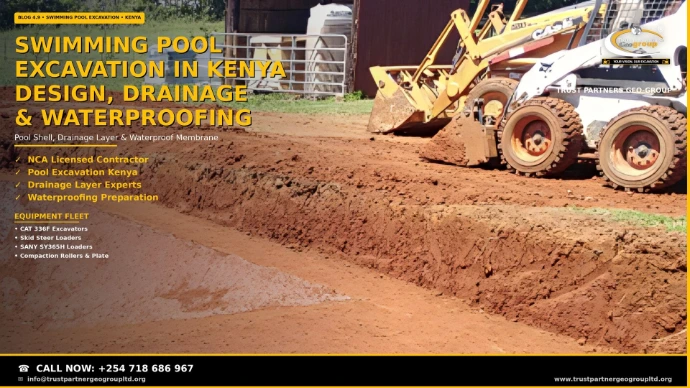
Swimming Pool Excavation in Kenya: Design, Drainage & Waterproofing Considerations
The smallest dig on most estates carries the tightest tolerances. Pool shell profiles, the drainage layer that stops shells floating, waterproofing preparation — and what pool earthworks honestly cost in 2026.

1. The Pool Earthworks: Small Dig, Tight Spec
A residential pool moves 40–100 m³ of earth — the volume a production excavator shifts in an hour — yet it occupies skilled plant for days. The paradox resolves when you see what the dig must be: a formed vessel, ±25mm across floors and walls, with radiused transitions, drainage provision and a blinding bed for the membrane, all in a hole the size of a large room. Every visible element of the finished pool — the waterline, the coping, the tiles — is measured against the excavation. Compared against a basement, the pool is a fraction of the volume and a multiple of the fuss; pricing it like bulk earthwork is the first mistake in the budget.
2. Design First: Depths & the Excavation Profile
The excavation profile is drawn backwards from the waterline. Standard residential profiles: shallow shelf at 0.9–1.2m for lounging, main floor sloping to 1.5–1.8m, deep end at 1.8–2.0m where diving is not planned; dedicated diving pools run 2.7–3.0m at the plunge point with the profile shaped to the diving envelope. The excavation adds what the shell will consume: shell thickness — 150–250mm of reinforced concrete — plus blinding at 50–75mm, plus the drainage layer at 150–300mm where specified, so the dig profile sits 350–600mm outside the finished water profile. Every one of those additions is set by design, not site convenience: steal depth from the drainage layer and the shell floats in a wet season; skip blinding depth and the membrane beds on rock. The pool designer's drawings — not the excavator's experience — define the hole.
3. Digging the Shell: Machines & Tolerances
The plant follows the precision: mini excavators of 1.5–5 tons doing the profile, skid steers hauling the spoil and placing blinding, midis assisting on open sites where access allows. The tolerances that govern: formation at ±25mm floors and walls, held with laser or string-level reference and checked on a grid before handover; over-break controlled to near zero — a 100mm pocket under the design profile becomes either a thicker, unplanned concrete section or an uneven waterline that the tiling exposes; and the profile formed to the designer's geometry, including the radius transitions that prefabricated pools and liners can forgive but concrete shells cannot. Programmes: a residential shell dig runs 2–4 days with trimming and haul; commercial pools with plant rooms, steps and beach entries stretch to weeks. The cost logic mirrors the care: pool excavation prices like precision work, because it is.
4. The Drainage Layer: Why Pools Need It
An empty pool shell on a wet site is a boat that must not float — and groundwater is stronger than concrete. The failure is documented and expensive: shells lifted, cracked and displaced by uplift pressure during their first emptied maintenance, with repairs exceeding the original build. The engineered defence: a free-draining envelope around and beneath the shell — 150–300mm of pea gravel or clean drainage stone, wrapped in geotextile so fines cannot migrate in and clog it — tied to sub-soil drains leading to a sump where water can be seen and pumped. On genuinely high water tables, hydrostatic relief valves through the pool floor admit groundwater into the shell when pressure builds, equalising instead of resisting. In the dry season the same layer serves quietly, routing rainwater away from the membrane's back face. Skipping it is the classic invisible saving with a catastrophic invoice attached.
5. Waterproofing Preparation
Waterproofing is a system, and the excavation delivers its first two layers. The sequence: formation — trimmed to tolerance, free of protrusions; blinding — 50–75mm of lean concrete or compacted sand giving the membrane a smooth, puncture-free bed; membrane — cementitious coatings in multiple coats, bonded sheet membranes, or the combination serious builders specify; shell — reinforced concrete whose own crack discipline (mix design, curing, waterstops at every joint) is part of the waterproofing, because membranes die at cracks. The excavator's obligations sit at the bottom of the stack: a membrane laid over an untrimmed rocky formation is a leak scheduled for its first season, and no coating specification can rescue a bad bed. Excavation discipline is where waterproofing begins.
6. Rock, Water Table & Coastal Pools
- Rock — Karen ridges, parts of Runda, the coral coast: breaking in a tight hole at 10–25 m³/day, at KES 1,500–2,800 per m³ broken; site probes before quoting decide whether the pool budget doubles.
- High water table — Westlands, Upper Hill, lakeside and coastal strips: the drainage layer becomes a designed system with sums and pumps, and pool-emptying procedures get written into the owner's manual.
- Coastal pools — resort pool work on coastal soil adds salt-air corrosion to the shell spec and coral-sand behaviour to the profile: fast digging, poor compaction, and a membrane bed that must be imported where the sand cannot provide it.
For eco-resort natural pools, the earthworks expand to planted filtration zones — bio-pond construction is pool excavation's organic cousin.
7. Real Costs 2026
| Item | Basis | 2026 Band (KES) |
|---|---|---|
| Pool excavation & cart (ordinary ground) | per m³ | 350–800 |
| Residential pool, 8×4m, shell dig + trim | per pool | 60,000–150,000 |
| Large villa pool (10×5 to 15×8m) | per pool | 120,000–350,000 |
| Commercial/resort formation | per m² | 500–1,000 |
| Rock breaking in pool dig | per m³ | 1,500–2,800 |
| Mini excavator (pool class) | per day | 8,000–15,000 |
| Skid steer + haul | per day | 10,000–18,000 |
| Drainage layer material & placement | per m³ placed | 1,200–2,000 |
| Blinding bed | per m² | 150–300 |
The budgeting insight: excavation is a minority of the finished pool's cost, but it is the layer every following trade inherits — the dig sets the waterline, the membrane and the shell's concrete quantity all at once.
8. Frequently Asked Questions
Pool earthworks price two ways, and the 2026 bands for both: by volume — KES 350–800 per m³ of dig and cart, like any excavation, with rock doubling it; and by pool — the more useful budgeting unit. A standard residential pool, 8×4 metres with a 1.5m average depth, holds roughly 45–60 m³: its excavation, trimmed and carted, runs KES 60,000–150,000 in ordinary ground. Larger residential and villa pools — 10×5 to 15×8 metres — run KES 120,000–350,000. Commercial and resort pools, with their tighter tolerances, complex profiles and plant-room footprints, carry per-m² formation rates of KES 500–1,000 and totals that scale with ambition. The lines that move any of these: rock (breaking at 15–40 m³/day changes both cost and calendar), water table (dewatering a pool dig is disproportionately expensive because the hole is small), and access (a machine that must work over a finished garden prices differently than one that drives straight in). Our pool-versus-basement comparison puts the small dig in context against its bigger cousin.
Pool shells demand the tightest tolerances of any residential excavation because everything visible — waterline, coping, tiles — is measured against the dig. The specification: formation to ±25mm across the full shell profile, floors and walls; over-break controlled to nearly zero, because every pocket of over-dig becomes either a thicker concrete section or an uneven waterline; corners and radius transitions formed to the pool designer's geometry, not approximated; and the drainage layer depth — usually 150–300mm of granular material around and beneath the shell — excavated as part of the profile, so the shell sits at its design level without shimming. The practical consequence: pool digs run compact machines at careful pace, with laser or string-level control and a surveyor's check before the shell trade takes over. A ±50mm tolerance that would pass a house foundation fails a pool — the waterline exposes everything. This is why pool excavation is priced as precision work even though the volumes are small.
Because a pool shell in wet ground is a boat that must not float. Groundwater pressing up on an empty pool shell can lift it out of the ground — literally: empty pools on high water tables have cracked, shifted and floated on their backfill, with repairs that exceed the original build cost. The defence is a drainage system around and beneath the shell: a layer of free-draining granular material — pea gravel or similar, 150–300mm — placed around the shell's exterior, wrapped in geotextile to keep fines out, and connected to sub-soil drains that lead to a sump where groundwater can be inspected and pumped if it accumulates. On genuinely high water tables, hydrostatic relief valves in the pool floor let groundwater enter the pool when it rises, equalising pressure instead of fighting it. The drainage layer also serves the dry-season purpose: it drains rainwater that lands around the shell away from the waterproofing, protecting the membrane from the ground side. Skipping the drainage layer is the classic invisible saving that surfaces — at catastrophic scale — the first time the pool is emptied for maintenance in a wet season.
Waterproofing is a system, not a product, and it starts with the excavation the membrane will sit against. The layers, in order: the formation, trimmed to tolerance and free of protrusions that could puncture what follows; a blinding layer of lean concrete or compacted sand — 50–75mm — giving the membrane a smooth, puncture-free bed; the waterproofing membrane itself — cementitious coatings applied in two or more coats, or sheet membranes bonded to the shell, sometimes both in combination; and the shell structure — reinforced concrete, either poured or shotcreted, whose own crack control (mix design, curing, waterstops at construction joints) is part of the waterproofing because membranes fail at cracks. For excavation, the obligations are the first two: the tolerance and the blinding bed. A membrane applied over an untrimmed, rocky formation is a leak scheduled for its first season; the excavation discipline is where waterproofing actually begins. Coastal and high-water-table sites add the drainage-layer partnership from the previous answer — membrane on the shell, drainage on the ground, and the two systems never meet because the shell stands between them.
Compact precision plant, almost always. The standard: a 1.5–5 ton mini excavator — narrow enough to work over finished gardens, precise enough to hold the ±25mm shell tolerance, and light enough to track across lawns and paving without destroying them. Skid steer loaders handle the haul-out and the blinding placement where the excavator cannot. On open sites with room, a midi excavator speeds the bulk but hands the final profile back to the compact unit. Rock, where it appears — and it appears on Karen ridges, parts of Runda, the coast — brings the breaker on a compact carrier, with the slow, careful production that breaking demands in a tight hole. The hiring rates: minis at KES 8,000–15,000 per day, skid steers KES 10,000–18,000, breakers adding KES 3,000–6,000 where needed. The selection principle for pools is the reverse of bulk work: the smallest machine that fits the profile wins, because in a pool dig, precision is production. Our hire fleet carries the compact classes for exactly these scopes.
Dig the Pool Right Before Anyone Sees Water.
Trust Partners Geo-Group Ltd excavates pool shells across Kenya — profile digging at ±25mm, drainage-layer placement, blinding beds and waterproofing preparation — for residential, resort and commercial pools. Send the pool design for a scoped quote.
Get a Pool Excavation Quote📞 +254 718 68 69 67
Swimming Pool Excavation in Kenya: Design, Drainage & Waterproofing Considerations
The smallest dig on most estates carries the tightest tolerances. Pool shell profiles, the drainage layer that stops shells floating, waterproofing preparation — and what pool earthworks honestly cost in 2026.
1. The Pool Earthworks: Small Dig, Tight Spec
A residential pool moves 40–100 m³ of earth — the volume a production excavator shifts in an hour — yet it occupies skilled plant for days. The paradox resolves when you see what the dig must be: a formed vessel, ±25mm across floors and walls, with radiused transitions, drainage provision and a blinding bed for the membrane, all in a hole the size of a large room. Every visible element of the finished pool — the waterline, the coping, the tiles — is measured against the excavation. Compared against a basement, the pool is a fraction of the volume and a multiple of the fuss; pricing it like bulk earthwork is the first mistake in the budget.
2. Design First: Depths & the Excavation Profile
The excavation profile is drawn backwards from the waterline. Standard residential profiles: shallow shelf at 0.9–1.2m for lounging, main floor sloping to 1.5–1.8m, deep end at 1.8–2.0m where diving is not planned; dedicated diving pools run 2.7–3.0m at the plunge point with the profile shaped to the diving envelope. The excavation adds what the shell will consume: shell thickness — 150–250mm of reinforced concrete — plus blinding at 50–75mm, plus the drainage layer at 150–300mm where specified, so the dig profile sits 350–600mm outside the finished water profile. Every one of those additions is set by design, not site convenience: steal depth from the drainage layer and the shell floats in a wet season; skip blinding depth and the membrane beds on rock. The pool designer's drawings — not the excavator's experience — define the hole.
3. Digging the Shell: Machines & Tolerances
The plant follows the precision: mini excavators of 1.5–5 tons doing the profile, skid steers hauling the spoil and placing blinding, midis assisting on open sites where access allows. The tolerances that govern: formation at ±25mm floors and walls, held with laser or string-level reference and checked on a grid before handover; over-break controlled to near zero — a 100mm pocket under the design profile becomes either a thicker, unplanned concrete section or an uneven waterline that the tiling exposes; and the profile formed to the designer's geometry, including the radius transitions that prefabricated pools and liners can forgive but concrete shells cannot. Programmes: a residential shell dig runs 2–4 days with trimming and haul; commercial pools with plant rooms, steps and beach entries stretch to weeks. The cost logic mirrors the care: pool excavation prices like precision work, because it is.
4. The Drainage Layer: Why Pools Need It
An empty pool shell on a wet site is a boat that must not float — and groundwater is stronger than concrete. The failure is documented and expensive: shells lifted, cracked and displaced by uplift pressure during their first emptied maintenance, with repairs exceeding the original build. The engineered defence: a free-draining envelope around and beneath the shell — 150–300mm of pea gravel or clean drainage stone, wrapped in geotextile so fines cannot migrate in and clog it — tied to sub-soil drains leading to a sump where water can be seen and pumped. On genuinely high water tables, hydrostatic relief valves through the pool floor admit groundwater into the shell when pressure builds, equalising instead of resisting. In the dry season the same layer serves quietly, routing rainwater away from the membrane's back face. Skipping it is the classic invisible saving with a catastrophic invoice attached.
5. Waterproofing Preparation
Waterproofing is a system, and the excavation delivers its first two layers. The sequence: formation — trimmed to tolerance, free of protrusions; blinding — 50–75mm of lean concrete or compacted sand giving the membrane a smooth, puncture-free bed; membrane — cementitious coatings in multiple coats, bonded sheet membranes, or the combination serious builders specify; shell — reinforced concrete whose own crack discipline (mix design, curing, waterstops at every joint) is part of the waterproofing, because membranes die at cracks. The excavator's obligations sit at the bottom of the stack: a membrane laid over an untrimmed rocky formation is a leak scheduled for its first season, and no coating specification can rescue a bad bed. Excavation discipline is where waterproofing begins.
6. Rock, Water Table & Coastal Pools
- Rock — Karen ridges, parts of Runda, the coral coast: breaking in a tight hole at 10–25 m³/day, at KES 1,500–2,800 per m³ broken; site probes before quoting decide whether the pool budget doubles.
- High water table — Westlands, Upper Hill, lakeside and coastal strips: the drainage layer becomes a designed system with sums and pumps, and pool-emptying procedures get written into the owner's manual.
- Coastal pools — resort pool work on coastal soil adds salt-air corrosion to the shell spec and coral-sand behaviour to the profile: fast digging, poor compaction, and a membrane bed that must be imported where the sand cannot provide it.
For eco-resort natural pools, the earthworks expand to planted filtration zones — bio-pond construction is pool excavation's organic cousin.
7. Real Costs 2026
| Item | Basis | 2026 Band (KES) |
|---|---|---|
| Pool excavation & cart (ordinary ground) | per m³ | 350–800 |
| Residential pool, 8×4m, shell dig + trim | per pool | 60,000–150,000 |
| Large villa pool (10×5 to 15×8m) | per pool | 120,000–350,000 |
| Commercial/resort formation | per m² | 500–1,000 |
| Rock breaking in pool dig | per m³ | 1,500–2,800 |
| Mini excavator (pool class) | per day | 8,000–15,000 |
| Skid steer + haul | per day | 10,000–18,000 |
| Drainage layer material & placement | per m³ placed | 1,200–2,000 |
| Blinding bed | per m² | 150–300 |
The budgeting insight: excavation is a minority of the finished pool's cost, but it is the layer every following trade inherits — the dig sets the waterline, the membrane and the shell's concrete quantity all at once.
8. Frequently Asked Questions
Pool earthworks price two ways, and the 2026 bands for both: by volume — KES 350–800 per m³ of dig and cart, like any excavation, with rock doubling it; and by pool — the more useful budgeting unit. A standard residential pool, 8×4 metres with a 1.5m average depth, holds roughly 45–60 m³: its excavation, trimmed and carted, runs KES 60,000–150,000 in ordinary ground. Larger residential and villa pools — 10×5 to 15×8 metres — run KES 120,000–350,000. Commercial and resort pools, with their tighter tolerances, complex profiles and plant-room footprints, carry per-m² formation rates of KES 500–1,000 and totals that scale with ambition. The lines that move any of these: rock (breaking at 15–40 m³/day changes both cost and calendar), water table (dewatering a pool dig is disproportionately expensive because the hole is small), and access (a machine that must work over a finished garden prices differently than one that drives straight in). Our pool-versus-basement comparison puts the small dig in context against its bigger cousin.
Pool shells demand the tightest tolerances of any residential excavation because everything visible — waterline, coping, tiles — is measured against the dig. The specification: formation to ±25mm across the full shell profile, floors and walls; over-break controlled to nearly zero, because every pocket of over-dig becomes either a thicker concrete section or an uneven waterline; corners and radius transitions formed to the pool designer's geometry, not approximated; and the drainage layer depth — usually 150–300mm of granular material around and beneath the shell — excavated as part of the profile, so the shell sits at its design level without shimming. The practical consequence: pool digs run compact machines at careful pace, with laser or string-level control and a surveyor's check before the shell trade takes over. A ±50mm tolerance that would pass a house foundation fails a pool — the waterline exposes everything. This is why pool excavation is priced as precision work even though the volumes are small.
Because a pool shell in wet ground is a boat that must not float. Groundwater pressing up on an empty pool shell can lift it out of the ground — literally: empty pools on high water tables have cracked, shifted and floated on their backfill, with repairs that exceed the original build cost. The defence is a drainage system around and beneath the shell: a layer of free-draining granular material — pea gravel or similar, 150–300mm — placed around the shell's exterior, wrapped in geotextile to keep fines out, and connected to sub-soil drains that lead to a sump where groundwater can be inspected and pumped if it accumulates. On genuinely high water tables, hydrostatic relief valves in the pool floor let groundwater enter the pool when it rises, equalising pressure instead of fighting it. The drainage layer also serves the dry-season purpose: it drains rainwater that lands around the shell away from the waterproofing, protecting the membrane from the ground side. Skipping the drainage layer is the classic invisible saving that surfaces — at catastrophic scale — the first time the pool is emptied for maintenance in a wet season.
Waterproofing is a system, not a product, and it starts with the excavation the membrane will sit against. The layers, in order: the formation, trimmed to tolerance and free of protrusions that could puncture what follows; a blinding layer of lean concrete or compacted sand — 50–75mm — giving the membrane a smooth, puncture-free bed; the waterproofing membrane itself — cementitious coatings applied in two or more coats, or sheet membranes bonded to the shell, sometimes both in combination; and the shell structure — reinforced concrete, either poured or shotcreted, whose own crack control (mix design, curing, waterstops at construction joints) is part of the waterproofing because membranes fail at cracks. For excavation, the obligations are the first two: the tolerance and the blinding bed. A membrane applied over an untrimmed, rocky formation is a leak scheduled for its first season; the excavation discipline is where waterproofing actually begins. Coastal and high-water-table sites add the drainage-layer partnership from the previous answer — membrane on the shell, drainage on the ground, and the two systems never meet because the shell stands between them.
Compact precision plant, almost always. The standard: a 1.5–5 ton mini excavator — narrow enough to work over finished gardens, precise enough to hold the ±25mm shell tolerance, and light enough to track across lawns and paving without destroying them. Skid steer loaders handle the haul-out and the blinding placement where the excavator cannot. On open sites with room, a midi excavator speeds the bulk but hands the final profile back to the compact unit. Rock, where it appears — and it appears on Karen ridges, parts of Runda, the coast — brings the breaker on a compact carrier, with the slow, careful production that breaking demands in a tight hole. The hiring rates: minis at KES 8,000–15,000 per day, skid steers KES 10,000–18,000, breakers adding KES 3,000–6,000 where needed. The selection principle for pools is the reverse of bulk work: the smallest machine that fits the profile wins, because in a pool dig, precision is production. Our hire fleet carries the compact classes for exactly these scopes.
Dig the Pool Right Before Anyone Sees Water.
Trust Partners Geo-Group Ltd excavates pool shells across Kenya — profile digging at ±25mm, drainage-layer placement, blinding beds and waterproofing preparation — for residential, resort and commercial pools. Send the pool design for a scoped quote.
Get a Pool Excavation Quote📞 +254 718 68 69 67