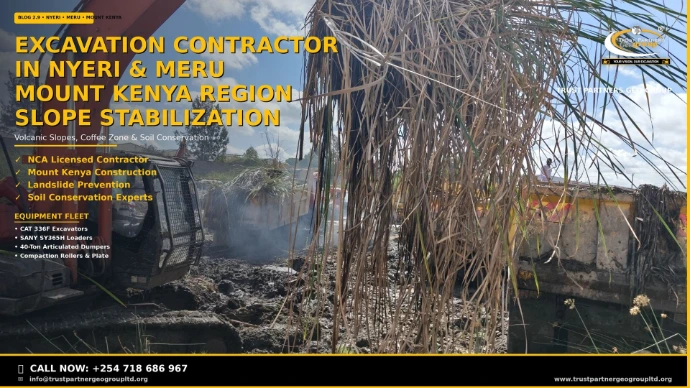
Excavation Contractor in Nyeri & Meru: Mount Kenya Region Slope Stabilization
Volcanic slopes, coffee estates and highland towns — building around Mount Kenya means holding the ground in place. Here is how excavation and slope stabilization work across Nyeri and Meru.

1. Building on the Mountain's Shoulders
The counties ringing Mount Kenya — Nyeri, Kirinyaga, Meru, Laikipia's fringes — build on some of the most productive and most demanding land in the country. Deep volcanic soils feed a dense agricultural economy anchored on coffee, tea and horticulture; the slopes that grow it also shed it when the rains come hard. Add a fast-growing urban belt — Nyeri town, Nanyuki's tourism economy, Meru's regional-city growth — and the excavation market splits into two disciplines that share one ground rule: hold the slope first, build second. Our regional overview of excavation across Nyeri, Nanyuki and Meru maps where each discipline dominates.
2. Volcanic Slopes & Landslide Risk
Mount Kenya's volcanic slopes fail in predictable patterns when pushed: road cuts left unbenched saturate and slide; building platforms cut into hillsides without retaining works creep downhill through their first wet seasons; and degraded farmland on steep gradients sheds topsoil every storm. The highlands' answer is systematic: assess the slope before cutting, bench what must be cut, retain what cannot be benched, and intercept every drop of runoff before it reaches the face. Landslide stabilization across the Kenyan highlands — bench cutting, soil nailing and debris removal — is a standing scope in these counties, not an emergency one.
3. Stabilization Methods: Benches, Walls, Drains
The toolbox, and where each tool earns its keep:
- Bench cutting — the default: slopes stepped into terraces with drained back-edges, used on road cuts, platforms and remediation. Cheap, robust, and it improves with vegetation.
- Retaining walls — gravity walls where space and ground allow, anchored walls where urban plots demand near-vertical faces — both live or die on the drainage behind them.
- Cut-off drains — the quiet heroes: intercepting runoff above a slope so it never saturates the face. Most failed slopes trace back to missing drains, not missing concrete.
- Re-vegetation & terracing — the long game: grassed risers, planted terraces and agroforestry that turn engineered works into permanent ground cover.
💡 Water is the villain, gravity the accomplice
Every highland slope failure investigation reaches the same conclusion: water got in. Design the drainage first — where it falls, where it flows, where it leaves — and the structural works that follow are smaller, cheaper and permanent. Contractors who sequence it in that order build slopes that outlast their warranties.
4. The Coffee Zone: Estate Roads & Farm Earthworks
The coffee belt is a construction economy of its own. Estate roads carry the harvest through two rainy seasons — coffee and tea estate road construction is precision work timed to the picking calendar, when a failed culvert is a failed harvest. Around the roads run the contour terraces that keep the red volcanic soil on the farm, the water tanks and channels that feed pulping stations, and the new-planting earthworks as estates renew. The region's farm contractors speak two languages — engineering and agriculture — and the best speak both fluently.
5. Nyeri & Nanyuki: Urban Highlands Construction
The towns build on the same slopes with urban constraints. Nyeri's expansion presses onto hillside plots where platforms, retaining walls and drainage come as a package; institutional campuses — schools, hospitals, colleges — add large cut-and-fill platforms engineered to hold; and Nanyuki's tourism economy brings lodges, camps and conservancy infrastructure where the road and platform works must serve both guests and the land's limits. Highland urban excavation is surgical: tight plots, live neighbours upslope and downslope, and a drainage failure that becomes a legal dispute within a season.
6. Meru: Irrigation, Agriculture & Growth
Meru's growth runs on water and agriculture: irrigation schemes and water pans feeding horticulture across the central and northern zones, the miraa economy's distinctive farm infrastructure, and a regional city expanding on ground that alternates fertile volcanic soil with black cotton pockets in the lower belts. The earthworks mirror the economy — canals and pans, market centres, farm platforms and the county roads that stitch them together — all of it on terrain where bench cutting and drainage are the default, not the exception.
7. Highlands Excavation Costs at a Glance
| Scope | Typical Range (KES) | Highlands Note |
|---|---|---|
| Soil excavation (per m³) | 350–750 | Slopes slow production |
| Rock breaking (per m³) | 1,200–2,500 | Volcanic bands |
| Hillside platform cut (per plot) | 60,000–150,000 | Plus retention & drains |
| Bench cutting (per metre of bench) | 800–2,000 | Width & access dependent |
| Estate road formation (per km) | 1.5M–4M | Slope & drainage heavy |
| Landslide remediation (per site) | 500K–5M | Scale dependent |
Ranges assume regional mobilisation; isolated Nairobi mobilisation adds to one-off jobs. Compare itemised quotes covering breaking plant, drainage materials and testing.
8. Frequently Asked Questions
The Mount Kenya region builds on volcanic slopes that are fertile, beautiful and periodically unstable. Steep gradients, deep volcanic soils and intense highland rains combine to make landslides the region's recurring infrastructure disaster — blocking roads, burying farms and, in the worst seasons, taking lives. Slope stabilization earthworks — bench cutting, retaining structures, drainage interception and re-vegetation — are therefore not niche services here; they are a standing line of regional construction. The works are well proven: cut slopes benched to stable angles, anchored or gravity retaining walls where space is tight, cut-off drains intercepting runoff before it saturates a face, and the degraded slopes re-grassed or terraced to hold the soil long-term.
Bench cutting steps a steep slope into horizontal terraces, reducing the effective gradient so soil and water stay put. Benches are the default for road cuts, building platforms on hillside plots and landslide remediation — typically cut at 1.5–3 metre widths depending on slope height, with a slight inwards fall and a drain along the back edge to stop water pooling. On deep volcanic soils benches work with vegetation, not against it: grassed risers and planted terraces convert the engineered steps into permanent soil-holding structures. On very steep or constrained urban sites, benches give way to anchored retaining walls, which hold near-vertical faces where there is no room to step.
Highlands earthworks typically price at KES 350–750 per m³ for soil, with the regional premium sitting on mobilisation to slope sites and on any rock — the mountain's volcanic formations carry hard bands that breaking plant handles. Slope stabilization scopes price by method: bench cutting per metre of bench or per m³ moved; retaining walls per m² of face; drainage per metre. A residential platform cut on a Nyeri hillside commonly runs KES 60K–150K; estate road formation KES 1.5M–4M per kilometre on sloping ground; and serious landslide remediation from KES 500K upward depending on scale. Regional fleets working the mountain's circuits keep mobilisation honest; isolated Nairobi mobilisation adds to one-off jobs.
The coffee zone — Nyeri, Kirinyaga's fringes, Meru's central belt — runs on a cycle of farm earthworks: estate roads graded and drained to carry cherry deliveries through two rainy seasons; terracing and contour works that hold the precious top-soil on steep blocks; water infrastructure — tanks, channels and small dams for irrigation and pulping; and new planting earthworks as estates renew or expand. Timing follows the coffee calendar: major works land between seasons, when labour and roads are free. Contractors who understand the calendar keep estates delivering on schedule; those who do not, park machines during harvest.
Highland roads are alignment-first engineering: the route is chosen to hold gradients the terrain can live with — switchbacks and traverses replacing the direct line — then cut into the slope with benched faces and armoured drainage. The drainage is everything: highland storms deliver enormous runoff onto a narrow corridor, and cross-culverts, lined side drains and check structures carry it safely across and away. Subgrades are compacted to specification and surfaced with gravel or asphalt per the traffic; on coffee estate roads, formation and graveling often stage over seasons as budgets allow. The roads that survive the mountain's rains share one signature — drainage designed for the worst storm, not the average one.
Building on Mount Kenya's Slopes? Hire Stabilization-First Crews.
Trust Partners Geo-Group Ltd excavates across the Mount Kenya region — bench cutting, retaining walls, estate roads, coffee zone earthworks and highland platforms — with fleets that respect the mountain's water. Book a free site assessment.
Get a Free Highlands Site Assessment📞 +254 718 68 69 67
Excavation Contractor in Nyeri & Meru: Mount Kenya Region Slope Stabilization
Volcanic slopes, coffee estates and highland towns — building around Mount Kenya means holding the ground in place. Here is how excavation and slope stabilization work across Nyeri and Meru.
1. Building on the Mountain's Shoulders
The counties ringing Mount Kenya — Nyeri, Kirinyaga, Meru, Laikipia's fringes — build on some of the most productive and most demanding land in the country. Deep volcanic soils feed a dense agricultural economy anchored on coffee, tea and horticulture; the slopes that grow it also shed it when the rains come hard. Add a fast-growing urban belt — Nyeri town, Nanyuki's tourism economy, Meru's regional-city growth — and the excavation market splits into two disciplines that share one ground rule: hold the slope first, build second. Our regional overview of excavation across Nyeri, Nanyuki and Meru maps where each discipline dominates.
2. Volcanic Slopes & Landslide Risk
Mount Kenya's volcanic slopes fail in predictable patterns when pushed: road cuts left unbenched saturate and slide; building platforms cut into hillsides without retaining works creep downhill through their first wet seasons; and degraded farmland on steep gradients sheds topsoil every storm. The highlands' answer is systematic: assess the slope before cutting, bench what must be cut, retain what cannot be benched, and intercept every drop of runoff before it reaches the face. Landslide stabilization across the Kenyan highlands — bench cutting, soil nailing and debris removal — is a standing scope in these counties, not an emergency one.
3. Stabilization Methods: Benches, Walls, Drains
The toolbox, and where each tool earns its keep:
- Bench cutting — the default: slopes stepped into terraces with drained back-edges, used on road cuts, platforms and remediation. Cheap, robust, and it improves with vegetation.
- Retaining walls — gravity walls where space and ground allow, anchored walls where urban plots demand near-vertical faces — both live or die on the drainage behind them.
- Cut-off drains — the quiet heroes: intercepting runoff above a slope so it never saturates the face. Most failed slopes trace back to missing drains, not missing concrete.
- Re-vegetation & terracing — the long game: grassed risers, planted terraces and agroforestry that turn engineered works into permanent ground cover.
💡 Water is the villain, gravity the accomplice
Every highland slope failure investigation reaches the same conclusion: water got in. Design the drainage first — where it falls, where it flows, where it leaves — and the structural works that follow are smaller, cheaper and permanent. Contractors who sequence it in that order build slopes that outlast their warranties.
4. The Coffee Zone: Estate Roads & Farm Earthworks
The coffee belt is a construction economy of its own. Estate roads carry the harvest through two rainy seasons — coffee and tea estate road construction is precision work timed to the picking calendar, when a failed culvert is a failed harvest. Around the roads run the contour terraces that keep the red volcanic soil on the farm, the water tanks and channels that feed pulping stations, and the new-planting earthworks as estates renew. The region's farm contractors speak two languages — engineering and agriculture — and the best speak both fluently.
5. Nyeri & Nanyuki: Urban Highlands Construction
The towns build on the same slopes with urban constraints. Nyeri's expansion presses onto hillside plots where platforms, retaining walls and drainage come as a package; institutional campuses — schools, hospitals, colleges — add large cut-and-fill platforms engineered to hold; and Nanyuki's tourism economy brings lodges, camps and conservancy infrastructure where the road and platform works must serve both guests and the land's limits. Highland urban excavation is surgical: tight plots, live neighbours upslope and downslope, and a drainage failure that becomes a legal dispute within a season.
6. Meru: Irrigation, Agriculture & Growth
Meru's growth runs on water and agriculture: irrigation schemes and water pans feeding horticulture across the central and northern zones, the miraa economy's distinctive farm infrastructure, and a regional city expanding on ground that alternates fertile volcanic soil with black cotton pockets in the lower belts. The earthworks mirror the economy — canals and pans, market centres, farm platforms and the county roads that stitch them together — all of it on terrain where bench cutting and drainage are the default, not the exception.
7. Highlands Excavation Costs at a Glance
| Scope | Typical Range (KES) | Highlands Note |
|---|---|---|
| Soil excavation (per m³) | 350–750 | Slopes slow production |
| Rock breaking (per m³) | 1,200–2,500 | Volcanic bands |
| Hillside platform cut (per plot) | 60,000–150,000 | Plus retention & drains |
| Bench cutting (per metre of bench) | 800–2,000 | Width & access dependent |
| Estate road formation (per km) | 1.5M–4M | Slope & drainage heavy |
| Landslide remediation (per site) | 500K–5M | Scale dependent |
Ranges assume regional mobilisation; isolated Nairobi mobilisation adds to one-off jobs. Compare itemised quotes covering breaking plant, drainage materials and testing.
8. Frequently Asked Questions
The Mount Kenya region builds on volcanic slopes that are fertile, beautiful and periodically unstable. Steep gradients, deep volcanic soils and intense highland rains combine to make landslides the region's recurring infrastructure disaster — blocking roads, burying farms and, in the worst seasons, taking lives. Slope stabilization earthworks — bench cutting, retaining structures, drainage interception and re-vegetation — are therefore not niche services here; they are a standing line of regional construction. The works are well proven: cut slopes benched to stable angles, anchored or gravity retaining walls where space is tight, cut-off drains intercepting runoff before it saturates a face, and the degraded slopes re-grassed or terraced to hold the soil long-term.
Bench cutting steps a steep slope into horizontal terraces, reducing the effective gradient so soil and water stay put. Benches are the default for road cuts, building platforms on hillside plots and landslide remediation — typically cut at 1.5–3 metre widths depending on slope height, with a slight inwards fall and a drain along the back edge to stop water pooling. On deep volcanic soils benches work with vegetation, not against it: grassed risers and planted terraces convert the engineered steps into permanent soil-holding structures. On very steep or constrained urban sites, benches give way to anchored retaining walls, which hold near-vertical faces where there is no room to step.
Highlands earthworks typically price at KES 350–750 per m³ for soil, with the regional premium sitting on mobilisation to slope sites and on any rock — the mountain's volcanic formations carry hard bands that breaking plant handles. Slope stabilization scopes price by method: bench cutting per metre of bench or per m³ moved; retaining walls per m² of face; drainage per metre. A residential platform cut on a Nyeri hillside commonly runs KES 60K–150K; estate road formation KES 1.5M–4M per kilometre on sloping ground; and serious landslide remediation from KES 500K upward depending on scale. Regional fleets working the mountain's circuits keep mobilisation honest; isolated Nairobi mobilisation adds to one-off jobs.
The coffee zone — Nyeri, Kirinyaga's fringes, Meru's central belt — runs on a cycle of farm earthworks: estate roads graded and drained to carry cherry deliveries through two rainy seasons; terracing and contour works that hold the precious top-soil on steep blocks; water infrastructure — tanks, channels and small dams for irrigation and pulping; and new planting earthworks as estates renew or expand. Timing follows the coffee calendar: major works land between seasons, when labour and roads are free. Contractors who understand the calendar keep estates delivering on schedule; those who do not, park machines during harvest.
Highland roads are alignment-first engineering: the route is chosen to hold gradients the terrain can live with — switchbacks and traverses replacing the direct line — then cut into the slope with benched faces and armoured drainage. The drainage is everything: highland storms deliver enormous runoff onto a narrow corridor, and cross-culverts, lined side drains and check structures carry it safely across and away. Subgrades are compacted to specification and surfaced with gravel or asphalt per the traffic; on coffee estate roads, formation and graveling often stage over seasons as budgets allow. The roads that survive the mountain's rains share one signature — drainage designed for the worst storm, not the average one.
Building on Mount Kenya's Slopes? Hire Stabilization-First Crews.
Trust Partners Geo-Group Ltd excavates across the Mount Kenya region — bench cutting, retaining walls, estate roads, coffee zone earthworks and highland platforms — with fleets that respect the mountain's water. Book a free site assessment.
Get a Free Highlands Site Assessment📞 +254 718 68 69 67