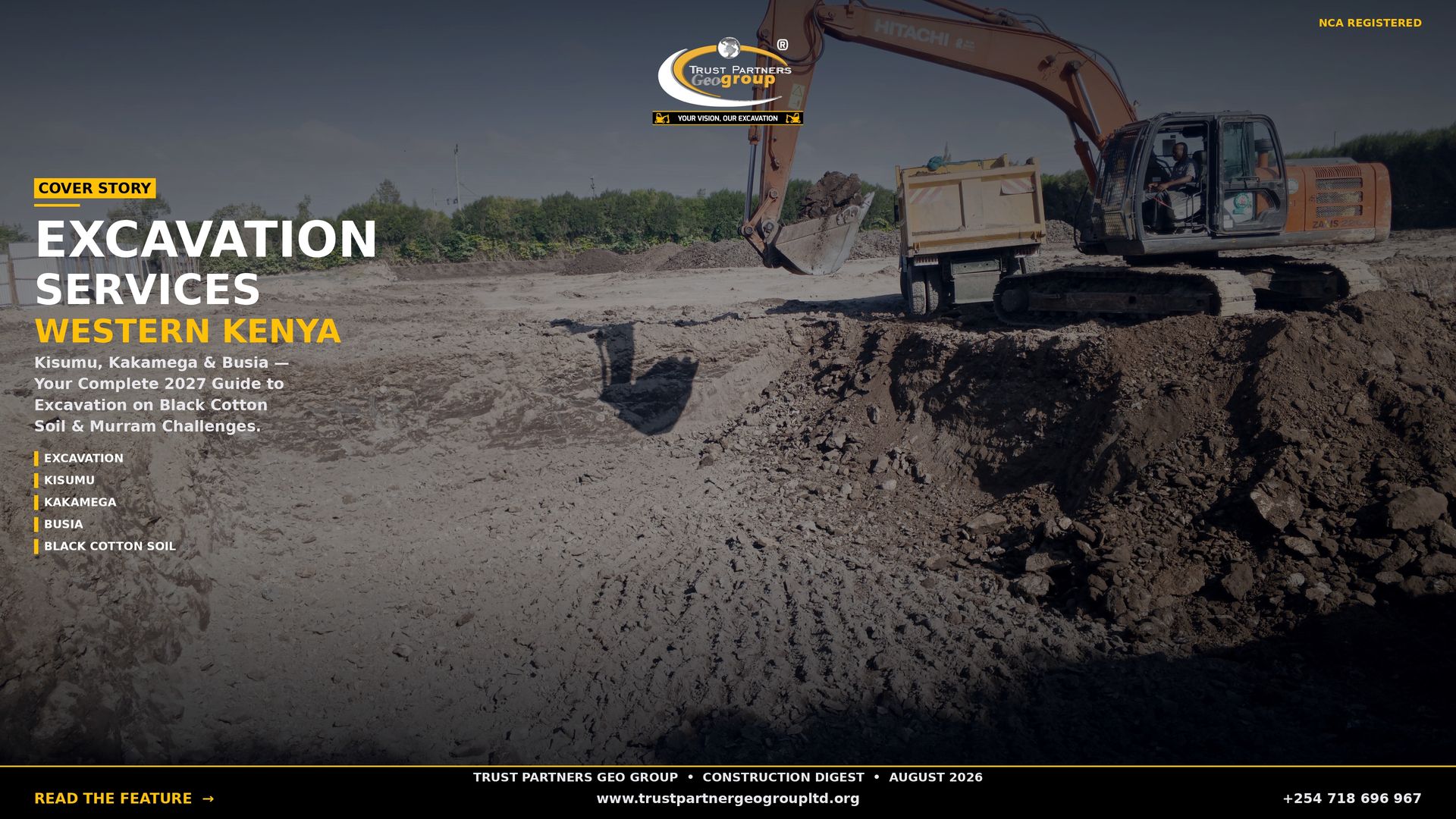
Excavation Services in Kisumu, Kakamega and Busia: Western Kenya Black Cotton Soil and Murram Challenges [2027]
Foundation Excavation, Soil Stabilization & Earthworks for the Lake Victoria Trade Corridor
On the shores of Lake Victoria and the rolling hills of western Kenya, a construction surge is transforming the region's urban landscape. Kisumu, Kakamega and Busia — once colonial outposts, sugar towns and border trading centres — now form one of East Africa's most dynamic cross-border growth corridors. But beneath the maize fields and sugar cane plantations lies a soil profile that has defeated many contractors from Nairobi: vast expanses of black cotton clay that swell and shrink with the seasons, iron-hard murram ridges that resist bucket excavation, and a Lake Victoria water table that sits barely below the surface. This guide covers everything developers need to know about western Kenya excavation — from soil testing and murram breaking to county permits and 2027 hire rates.

NCA-registered excavation and heavy equipment hire contractor with 15+ years operating across Kenya. We provide black cotton soil stabilization, murram ridge breaking and earthworks for Kisumu, Kakamega, Busia and all western Kenya projects.
Why Kisumu, Kakamega and Busia Are Expanding
Western Kenya's Lake Victoria corridor is experiencing accelerated growth driven by seven key factors:
- Kisumu port revival: The refurbished Kisumu port on Lake Victoria now handles cargo to Uganda, Tanzania and the DRC via the lake transport network. New warehouses, container yards, cold storage and docking facilities are under continuous construction.
- Kakamega county capital investment: Since devolution in 2013, Kakamega has seen massive county government investment in offices, modern markets, referral hospitals and tarmac roads. The town is the undisputed political and commercial hub of western Kenya with a metropolitan population exceeding 500,000.
- Busia border trade boom: The Busia border post is one of Kenya's busiest, with 24-hour cross-border trade to Uganda driving demand for warehousing, petrol stations, shopping complexes, cold storage and truck staging yards.
- Affordable western land: A 50×100 ft plot in Kisumu's Milimani or Riat areas costs KES 2–4.5 million, Kakamega plots range KES 1.5–3.5 million, and Busia offers land at KES 1–2.5 million. Comparable plots in Nairobi cost 3–5× more.
- Sugar and agricultural processing: The Mumias, Butere, Busia and Nzoia sugar zones, plus the broader western agricultural belt (maize, beans, dairy), drive continuous demand for factory expansion, storage silos, transport depots and processing plant foundations.
- Devolution infrastructure: County governments in Kisumu, Kakamega, Busia, Vihiga and Bungoma have invested heavily in urban roads, water supply, markets and health facilities — opening new residential and commercial zones.
- Lake Victoria Basin transport: The Kisumu-Kakamega-Busia highway upgrades, the planned lake ferry network and improved feeder roads have cut travel times and unlocked previously remote areas for development.
The Western Kenya Soil Challenge: Black Cotton and Murram Ridges
The Lake Victoria basin presents a geological patchwork that creates distinct excavation conditions across short distances:
- Extensive black cotton soil (vertisols): The Lake Victoria basin has Kenya's largest concentration of black cotton soil, covering vast flat areas around Kisumu (Kajulu, Nyando, Ahero), Busia and the lower Yala River basin. This expansive clay swells 20–30% when wet, shrinks dramatically in dry spells, and has safe bearing capacity of only 50–100 kN/m² — insufficient for multi-storey buildings without treatment.
- Murram-capped ridges: Between the black cotton valleys, ironstone ridges and laterite-capped hills (such as the Kakamega ridge system) provide excellent bearing soil (200–300 kN/m²). However, these ridges often require breaking through a hard iron-pan crust before reaching workable material.
- Lake sediment deposits: Areas within 3–5 km of Lake Victoria shore — including Kibos, Dunga, Kajulu and parts of Busia — sit on lacustrine silts and clays with high compressibility, low shear strength and organic content that produces methane gas in deep excavations.
- Seasonal river flooding: The Yala, Nzoia, Sio and Kuja rivers flood seasonally, depositing fresh silt and creating waterlogged construction conditions that persist for weeks after rains subside.
- High water table: The Lake Victoria basin has a naturally high water table, often within 1–2 metres of surface in low-lying areas. Even shallow foundation excavations encounter water, requiring dewatering or elevated foundation designs.
- Termite activity: Western Kenya's warm, humid climate supports aggressive subterranean termites that attack timber formwork and untreated wooden structures — a secondary consideration for foundation protection.
Excavation Services for Western Kenya Soils
Geotechnical Site Investigation
Before breaking ground on any western Kenya project, Trust Partners Geo-Group coordinates borehole drilling, soil sampling and laboratory testing. We identify black cotton soil depth, swelling potential, murram ridge location and water table level — critical data for foundation design in this variable terrain.
Over-Excavation and Soil Replacement
The most common solution for black cotton soil is removing the problematic layer to 1.0–1.5 m depth and replacing with compacted murram from nearby ridges or imported hardcore. Our teams excavate to geotechnical specifications, haul unsuitable clay to approved disposal sites, and import and compact replacement material in 200 mm layers.
Murram Ridge Breaking
Building on Kakamega's ironstone ridges or Kisumu's higher ground often requires breaking through hard laterite crusts and murram hardpan. We use hydraulic breakers, ripper-equipped bulldozers and controlled blasting to create level building platforms on ridge-top sites.
Foundation Excavation
We excavate to precise levels for strip footings, raft slabs, pile caps and ground beams. In black cotton soil zones, we over-excavate to stable strata or specified replacement depth. On lake sediments, we dewater continuously and place blinding concrete immediately.
Market and School Compound Earthworks
Kakamega and Busia's county governments are building modern markets, stadiums and school complexes that require large-area cut-and-fill, soil stabilization and precision grading. We construct stabilized earth pads for markets, sports fields and assembly grounds.
Sugar Factory and Processing Plant Foundations
Western Kenya's sugar industry requires heavy-duty foundations for milling equipment, boiler houses and storage facilities. These structures need vibration-resistant floors on stabilized soil that won't settle under heavy machinery loads.
Foundation Solutions for Lake Basin Soils
| Foundation Type | Best For | Construction Method | Relative Cost |
|---|---|---|---|
| Raft (mat) foundation | Light structures on moderate black cotton soil; bungalows, markets, light commercial | Continuous reinforced concrete slab; 200–300 mm thick with mesh reinforcement | Moderate — KES 4,200–6,200/m² |
| Strip footing on replaced soil | Standard bungalows and maisonettes where black cotton is shallow | Over-excavate to 1.0–1.5 m, backfill with murram/hardcore, construct conventional strips | Low — KES 2,200–3,800/linear m |
| Pile foundation | Multi-storey buildings, hotels, hospitals on deep black cotton or lake sediment | Bored cast-in-situ piles through clay/sediment into firm murram or weathered rock | High — KES 7,500–14,000/pile |
| Pier and beam | Medium-load structures on variable soil; hillside sites in Kakamega | Isolated piers on stable ridge soil, connected by ground beams spanning weak zones | Moderate — KES 5,500–9,500/pier |
| Stabilized earth pad | Large market yards, school compounds, church sites on expansive clay | Mix black cotton soil with 3–8% cement/lime, compact in layers to 95% density | Low — KES 300–550/m² treated |
Foundation selection depends on soil test results, building load, budget and proximity to Lake Victoria or seasonal rivers. Trust Partners Geo-Group excavates to structural engineer specifications for all foundation types.
Excavation Rates in Kisumu, Kakamega and Busia 2027
| Service | Rate (KES) | Notes |
|---|---|---|
| Plot cutting and clearing (per m²) | 180 – 320 | Upper end for dense bush, sugar cane stubble or rocky ground |
| Topsoil stripping (per m²) | 80 – 140 | Includes preservation of topsoil for landscaping reuse |
| Bulk excavation — firm murram ridge (per m³) | 750 – 1,200 | Stable ground; may require breaker for hardpan |
| Bulk excavation — black cotton soil (per m³) | 1,100 – 1,800 | Includes over-excavation and disposal of unsuitable clay |
| Foundation excavation — lake sediment with dewatering (per m³) | 1,600 – 2,500 | Includes sump pumps and organic soil removal |
| Basement excavation — Kisumu city centre (per m³) | 2,200 – 3,500 | Trimmed excavation; shoring if adjacent buildings |
| Soil stabilization — cement on black cotton (per m²) | 350 – 600 | In-situ mixing, 200–300 mm depth, compaction to 95% Mod AASHTO |
| Murram hardpan breaking (per m³) | 1,800 – 2,800 | Breaker work through ironstone crust on ridge tops |
| Market yard grading (per m²) | 250 – 420 | Cut-and-fill, subgrade preparation, drainage falls |
| Estate road subgrade (per m²) | 280 – 480 | Cut to level, compaction, camber and drainage |
| Spoil disposal — black cotton soil (per 20-ton truck) | 4,000 – 7,000 | Haul to county approved dumping sites |
| 30-ton excavator wet hire (daily) | 40,000 – 55,000 | Operator, fuel, maintenance; western mobilization premium included |
| Vibratory roller 10-ton wet hire (daily) | 18,000 – 28,000 | Operator, fuel; essential for compaction proofing |
Key Development Zones
Kisumu City: Lake Port and Urban Expansion
Kisumu — Kenya's third-largest city — is expanding rapidly around the lake port, the CBD and the Milimani, Riat and Mamboleo areas. The Kisumu Port revival has triggered warehouse, logistics yard and cold storage construction. The Nairobi-Kisumu highway frontage is becoming a showroom and industrial corridor. Excavation in Kisumu varies from firm murram on ridges to deep black cotton in the Nyando and Kajulu plains — soil testing is essential on every plot.
Kakamega: County Capital and Commercial Hub
Kakamega is western Kenya's fastest-growing town, with county government offices, modern markets, referral hospitals and universities driving construction. The town sits on a ridge system with firm murram on higher ground and black cotton soil in valleys. New residential estates, shopping centres and schools are spreading across both soil types. The Kakamega-Webuye highway upgrade has opened new industrial zones.
Busia: Border Trade and Logistics
Busia thrives on cross-border trade with Uganda. The town is seeing warehouse, petrol station, shopping complex and truck staging yard construction. The border area requires heavy-duty pavements and loading bays on stabilized soil. Busia's flat terrain sits predominantly on black cotton soil, requiring ground improvement for most commercial developments.
Sugar Belt Towns: Mumias, Butere and Malava
The sugar-growing zone around Mumias, Butere and Malava is seeing agri-processing expansion, worker housing and rural market construction. These areas have deep black cotton soil and seasonal waterlogging, requiring careful foundation design and drainage engineering.
Agricultural and Market Earthworks
Western Kenya's economy is built on agriculture, trade and county government services — all requiring specialized earthworks:
- Market yard construction: County governments across western Kenya are building modern markets with concrete slabs, drainage and waste management. These require large-area soil stabilization, cut-and-fill balancing and precision grading for surface water drainage.
- School and stadium compounds: Kakamega and Kisumu counties are investing in school infrastructure and sports facilities. We construct level playing fields, assembly grounds and building platforms on stabilized black cotton soil.
- Sugar factory foundations: Milling equipment, boiler houses and cane handling facilities require heavy-duty foundations on vibration-resistant soil. We construct thick raft slabs on stabilized earth pads with perimeter drainage.
- Cold storage and dairy facilities: Western Kenya's dairy and horticulture sectors need cold rooms, milk cooling plants and packhouses. These facilities need level, stable floors that won't settle under refrigeration equipment.
- Water pan and farm dam excavation: The region's seasonal rainfall makes water storage critical. We excavate farm dams and water pans, often lining black cotton soil basins with clay or geomembrane to prevent seepage.
Permits for Western Kenya Counties
Excavation in western Kenya involves a structured compliance framework across multiple counties:
- County building permits: Kisumu County, Kakamega County and Busia County each have building control departments. Submissions must include soil test reports, foundation type specifications, drainage designs and environmental management plans. Processing takes 2–5 weeks.
- NEMA Environmental Impact Assessment: Mandatory for projects over 1 hectare, developments within 500 metres of Lake Victoria, the Yala River or seasonal wetlands, or work in ecologically sensitive areas.
- WARMA (Water Authority) permits: Required for dewatering operations that discharge into Lake Victoria, the Yala River or seasonal streams. Lake Victoria is an international water body with strict quality controls.
- Physical Planning compliance: Setback requirements from roads, rivers and public land vary between Kisumu, Kakamega and Busia counties. Lake Victoria shoreline developments face additional setback rules.
- NCA registration: All structural excavation must be carried out by NCA-registered contractors. Trust Partners Geo-Group holds full western Kenya registration.
- Soil disposal permits: County governments require documentation for hauling black cotton soil and unsuitable fill to approved dumping sites. Unauthorized dumping attracts penalties.
Trust Partners Geo-Group Western Fleet
Our western Kenya fleet is mobilised from Nairobi to Kisumu, Kakamega and Busia, with extended-stay crews for multi-week projects:
- Hyundai HX300SL 30-ton Excavators (4 units): Primary excavation machines for bulk earthworks, foundation trenches and murram ridge breaking. Fitted with buckets, rippers and hydraulic breakers.
- Komatsu D65 Bulldozers with Ripper (2 units): Site clearing, rough grading and ripping ironstone hardpan on Kakamega ridge sites.
- Shacman 30-ton Tippers (10 units): Spoil removal and murram/hardcore delivery. Black cotton soil is heavy when wet, reducing payloads.
- Sany Motor Grader (1 unit): Precision grading for estate roads, market yards and school compounds.
- Vibratory Rollers 10-ton (2 units): Compaction proofing of replaced soil and stabilized black cotton pads to 95% Mod AASHTO density.
- Plate Compactors (4 units): Trench backfill compaction and confined-area work.
- Water Bowser 15,000 litres (2 units): Dust suppression on dry sites and moisture conditioning for cement stabilization.
- Dewatering Pump Sets (3 units): Well-point and submersible pumps for Lake Victoria shoreline and river valley sites.
- Mini-Excavators 5-ton (3 units): Restricted-access work on narrow urban plots in Kisumu and precision trenching near existing buildings.
- Soil Pulverizer/Stabilizer (1 unit): Tractor-mounted rotavator for in-situ cement mixing on large market yard and school projects.
All western Kenya operators receive training in black cotton soil handling, compaction standards and seasonal water management. Projects receive dedicated supervisors, daily progress reports and photographic documentation.
Start Your Western Kenya Project in Kisumu, Kakamega or Busia
Trust Partners Geo-Group is western Kenya's leading black cotton soil and murram excavation contractor. Free site assessment, soil type identification, itemised quote and rapid mobilisation.
Call +254 718 686 967 Email for QuoteFrequently Asked Questions
Why are Kisumu, Kakamega and Busia growing so fast?
Kisumu, Kakamega and Busia are western Kenya's fastest-growing urban centres due to: (1) Kisumu port revival — the refurbished Kisumu port on Lake Victoria now handles cargo to Uganda, Tanzania and the DRC, driving warehouse, logistics and docking facility construction. (2) Kakamega county capital status — since devolution in 2013, Kakamega has seen massive county government investment in offices, markets, hospitals and roads. The town is the political and commercial hub of western Kenya. (3) Busia border trade — the Busia border post is one of Kenya's busiest, with cross-border trade to Uganda driving warehousing, cold storage, petrol stations and shopping complex construction. (4) Affordable western land — a 50×100 ft plot in Kisumu's outskirts costs KES 2–4.5 million, Kakamega plots range KES 1.5–3.5 million, and Busia offers land at KES 1–2.5 million. Comparable plots in Nairobi cost 3–5x more. (5) Sugar and agriculture processing — Mumias, Butere and Busia sugar zones and the broader western agricultural belt drive factory, storage and transport infrastructure demand. (6) Devolution dividends — county governments in Kisumu, Kakamega and Busia have invested heavily in urban infrastructure, opening new residential and commercial zones. (7) Lake Victoria Basin transport — the Kisumu-Kakamega-Busia highway upgrades and the planned lake transport network have improved accessibility and reduced travel times.
What makes western Kenya soil different from other parts of Kenya?
Western Kenya sits on the Lake Victoria basin, a geological depression filled with sediments and overlain by some of Kenya's most distinctive soils: (1) Extensive black cotton soil — the Lake Victoria basin has Kenya's largest concentration of black cotton soil (vertisols), covering vast flat areas around Kisumu, Busia and the lower Yala River basin. This expansive clay swells when wet, shrinks when dry, and has low bearing capacity (50–100 kN/m²). (2) Murram-capped ridges — between the black cotton valleys, ironstone ridges and laterite-capped hills provide excellent bearing soil (200–300 kN/m²) but require breaking through hardpan. (3) Lake sediment deposits — areas within 3–5 km of Lake Victoria shore sit on lacustrine silts and clays with high compressibility and low shear strength. (4) Seasonal flooding — the Yala, Nzoia and Sio rivers flood seasonally, depositing fresh silt and creating waterlogged construction conditions. (5) High water table — the Lake Victoria basin has a naturally high water table, often within 1–2 metres of surface in low-lying areas, requiring dewatering for even shallow foundations. (6) Termite activity — western Kenya's warm, humid climate supports aggressive subterranean termites that attack timber formwork and untreated wooden structures. Together, these conditions make western Kenya one of the most technically challenging regions for foundation construction outside the Rift Valley.
How much does excavation cost in Kisumu and Kakamega?
Western Kenya excavation costs vary by soil type and distance from major centres: Bulk excavation in firm murram ridges costs KES 750–1,200 per m³. Bulk excavation in black cotton soil costs KES 1,100–1,800 per m³ due to over-excavation and disposal requirements. Foundation excavation on lake sediments with dewatering costs KES 1,600–2,500 per m³. Soil stabilization with cement on black cotton soil costs KES 350–600 per m² treated. Basement excavation in Kisumu city centre costs KES 2,200–3,500 per m³. Plot cutting and clearing costs KES 180–320 per m². Key cost drivers include: soil type (black cotton adds 40–60% premium), distance from Nairobi equipment depots (Kisumu is 6 hours; Kakamega 7 hours; Busia 8 hours — adding significant mobilization costs), local equipment availability (western Kenya has fewer heavy equipment hire firms than Nairobi), haul distance to disposal sites, and seasonal rain access (March–May and October–December make black cotton soil unworkable). A typical 3-bedroom bungalow foundation on black cotton soil in Kakamega costs KES 400,000–700,000 including soil replacement and compaction. Trust Partners Geo-Group provides fixed-price quotes after western Kenya-specific site investigation.
What foundation types work best on western Kenya's black cotton soil?
Five foundation systems are proven for western Kenya's black cotton soil and lake sediment conditions: (1) Raft (mat) foundation — a continuous reinforced concrete slab distributing loads across the entire footprint. Best for light structures on moderate expansive soil in Kisumu and Kakamega. Cost: KES 4,200–6,200 per m². (2) Strip footing on replaced soil — excavating black cotton soil to 1.0–1.5 m depth, backfilling with hardcore or murram from nearby ridges, then constructing conventional strip footings. Cost: KES 2,200–3,800 per linear metre. (3) Pile foundation — bored cast-in-situ piles extending through black cotton soil into firm murram or weathered rock below. Essential for multi-storey buildings in Kisumu city centre. Cost: KES 7,500–14,000 per pile (300–450 mm diameter, 6–12 m depth). (4) Pier and beam — isolated piers on stable ridge soil, connected by ground beams spanning over expansive clay. Suitable for hillside sites in Kakamega and Busia. (5) Mechanically stabilized earth pad — mixing black cotton soil with 3–8% cement or lime, compacting in layers to create a stable platform. Cost-effective for large market yards, school compounds and church sites. Trust Partners Geo-Group excavates to geotechnical specifications for all foundation types and manages spoil disposal.
Do I need a soil test before excavating in Kisumu or Kakamega?
Yes — a geotechnical investigation is essential before foundation excavation in Kisumu, Kakamega and Busia due to extreme soil variability across short distances. Kisumu County and Kakamega County building control require soil test reports for all structures over 2 storeys and any building on flat, visibly cracked ground. A standard western Kenya geotechnical investigation includes: (1) Boreholes — 2–4 boreholes per plot to 6–10 m depth, logging soil strata and collecting samples. Cost: KES 25,000–45,000 per plot. (2) Laboratory testing — Atterberg limits, moisture content, particle size distribution, swelling potential, and bearing capacity tests. (3) Foundation recommendation report — structural engineers use this to specify foundation type, depth and any soil treatment required. (4) NEMA may require wetland assessment for sites within 500 metres of Lake Victoria, the Yala River or seasonal wetlands. (5) County physical planning compliance — setback requirements from roads, rivers and public land vary between Kisumu, Kakamega and Busia counties. Trust Partners Geo-Group works with NCA-registered geotechnical firms to coordinate site investigations before excavation begins. Skipping soil testing in western Kenya risks foundation failure, wall cracking and repair costs exceeding KES 1.5 million.
How long does foundation excavation take in western Kenya?
Foundation excavation in western Kenya takes 25–40% longer than in stable murram due to black cotton soil and seasonal waterlogging. A standard bungalow foundation (150 m² footprint) on replaced black cotton soil requires 2–3 weeks: 3–4 days for over-excavation to 1.0–1.5 m depth, 2–3 days for spoil removal and disposal, 3–4 days for backfilling with hardcore in 200 mm layers with compaction, and 3–4 days for footing excavation in the stabilized pad. By comparison, the same foundation on a firm murram ridge takes 5–8 days. Multi-storey building foundations with piles add 3–5 weeks for boring and casting. Basement excavation in Kisumu city centre takes 4–6 weeks for a 2-level basement on 1,000 m². Rainy season work (March–May, October–December) extends timelines by 30–45% as black cotton soil becomes saturated and unworkable — equipment sinks, haul roads degrade and compaction standards cannot be achieved. The long rains are particularly severe in western Kenya due to Lake Victoria's influence. Trust Partners Geo-Group schedules western Kenya excavation in dry-season windows where possible.
What equipment is needed for western Kenya excavation?
Western Kenya excavation requires fleet adapted to black cotton soil, murram ridges and long-distance mobilization: (1) 30-ton excavators with hydraulic breakers — primary tool for murram ridge breaking and black cotton soil over-excavation. Breaker output of 1,500–2,500 joules handles western Kenya's ironstone hardpan. (2) Bulldozers with ripper attachments — for clearing sugar cane stubble, breaking murram hardpan and rough grading on large agricultural sites. (3) 20–30 ton tippers — spoil removal and hardcore delivery. Black cotton soil is heavy when wet, reducing payloads by 15–20%. (4) Vibratory rollers 10-ton — essential for compaction proofing of replaced soil and stabilized earth pads. (5) Plate compactors — trench backfill compaction in confined areas. (6) Motor graders — for estate road profiling and market yard grading through variable soil. (7) Water bowsers — dust suppression on murram roads and moisture conditioning for cement stabilization. (8) Dewatering pumps — submersible and well-point pumps for Lake Victoria shoreline and river valley sites. (9) Mini-excavators 5-ton — for restricted-access urban plots in Kisumu and precision trenching near existing buildings. All equipment is available wet hire with NITA-certified operators from Trust Partners Geo-Group, mobilised to Kisumu, Kakamega and Busia.
Where does excavated black cotton soil from Kisumu and Busia go?
Excavated black cotton soil from western Kenya sites is managed through: (1) Approved county dumping sites — Kisumu County, Kakamega County and Busia County designate specific disposal areas for unsuitable spoil. Transport costs range KES 400–700 per 20-ton truck depending on distance. (2) On-site re-use — lightly expansive black cotton soil can be mixed with 3–8% cement or lime and recompacted as engineered fill within the same development, reducing haul costs by 60–80%. (3) Brick and block manufacturing — Kakamega and Busia have active fired brick industries that use black cotton soil as raw material, provided plasticity index is suitable. (4) Road subgrade — after stabilization with cement, black cotton soil can be used for estate road sub-base and shoulder fill. (5) Agricultural terracing — surplus soil is used for contour bunds and gully control on hillside farms in Kakamega and Vihiga. (6) Landfill capping — approved sanitary landfills use black cotton soil as daily cover material. Trust Partners Geo-Group manages disposal logistics including county transport permits, weighbridge documentation and on-site stabilization where economically justified. Note that dumping black cotton soil into Lake Victoria, the Yala River or unapproved sites carries severe NEMA and county penalties.
Related Resources
Planning a Project in Kisumu, Kakamega or Busia?
Contact Trust Partners Geo-Group at +254 718 686 967 for a free western Kenya site assessment and itemised excavation quote. Serving Kisumu, Kakamega, Busia and all 47 counties.
Call +254 718 686 967 Request QuoteExcavation Services in Kisumu, Kakamega and Busia: Western Kenya Black Cotton Soil and Murram Challenges [2027]
Foundation Excavation, Soil Stabilization & Earthworks for the Lake Victoria Trade Corridor
On the shores of Lake Victoria and the rolling hills of western Kenya, a construction surge is transforming the region's urban landscape. Kisumu, Kakamega and Busia — once colonial outposts, sugar towns and border trading centres — now form one of East Africa's most dynamic cross-border growth corridors. But beneath the maize fields and sugar cane plantations lies a soil profile that has defeated many contractors from Nairobi: vast expanses of black cotton clay that swell and shrink with the seasons, iron-hard murram ridges that resist bucket excavation, and a Lake Victoria water table that sits barely below the surface. This guide covers everything developers need to know about western Kenya excavation — from soil testing and murram breaking to county permits and 2027 hire rates.
NCA-registered excavation and heavy equipment hire contractor with 15+ years operating across Kenya. We provide black cotton soil stabilization, murram ridge breaking and earthworks for Kisumu, Kakamega, Busia and all western Kenya projects.
Why Kisumu, Kakamega and Busia Are Expanding
Western Kenya's Lake Victoria corridor is experiencing accelerated growth driven by seven key factors:
- Kisumu port revival: The refurbished Kisumu port on Lake Victoria now handles cargo to Uganda, Tanzania and the DRC via the lake transport network. New warehouses, container yards, cold storage and docking facilities are under continuous construction.
- Kakamega county capital investment: Since devolution in 2013, Kakamega has seen massive county government investment in offices, modern markets, referral hospitals and tarmac roads. The town is the undisputed political and commercial hub of western Kenya with a metropolitan population exceeding 500,000.
- Busia border trade boom: The Busia border post is one of Kenya's busiest, with 24-hour cross-border trade to Uganda driving demand for warehousing, petrol stations, shopping complexes, cold storage and truck staging yards.
- Affordable western land: A 50×100 ft plot in Kisumu's Milimani or Riat areas costs KES 2–4.5 million, Kakamega plots range KES 1.5–3.5 million, and Busia offers land at KES 1–2.5 million. Comparable plots in Nairobi cost 3–5× more.
- Sugar and agricultural processing: The Mumias, Butere, Busia and Nzoia sugar zones, plus the broader western agricultural belt (maize, beans, dairy), drive continuous demand for factory expansion, storage silos, transport depots and processing plant foundations.
- Devolution infrastructure: County governments in Kisumu, Kakamega, Busia, Vihiga and Bungoma have invested heavily in urban roads, water supply, markets and health facilities — opening new residential and commercial zones.
- Lake Victoria Basin transport: The Kisumu-Kakamega-Busia highway upgrades, the planned lake ferry network and improved feeder roads have cut travel times and unlocked previously remote areas for development.
The Western Kenya Soil Challenge: Black Cotton and Murram Ridges
The Lake Victoria basin presents a geological patchwork that creates distinct excavation conditions across short distances:
- Extensive black cotton soil (vertisols): The Lake Victoria basin has Kenya's largest concentration of black cotton soil, covering vast flat areas around Kisumu (Kajulu, Nyando, Ahero), Busia and the lower Yala River basin. This expansive clay swells 20–30% when wet, shrinks dramatically in dry spells, and has safe bearing capacity of only 50–100 kN/m² — insufficient for multi-storey buildings without treatment.
- Murram-capped ridges: Between the black cotton valleys, ironstone ridges and laterite-capped hills (such as the Kakamega ridge system) provide excellent bearing soil (200–300 kN/m²). However, these ridges often require breaking through a hard iron-pan crust before reaching workable material.
- Lake sediment deposits: Areas within 3–5 km of Lake Victoria shore — including Kibos, Dunga, Kajulu and parts of Busia — sit on lacustrine silts and clays with high compressibility, low shear strength and organic content that produces methane gas in deep excavations.
- Seasonal river flooding: The Yala, Nzoia, Sio and Kuja rivers flood seasonally, depositing fresh silt and creating waterlogged construction conditions that persist for weeks after rains subside.
- High water table: The Lake Victoria basin has a naturally high water table, often within 1–2 metres of surface in low-lying areas. Even shallow foundation excavations encounter water, requiring dewatering or elevated foundation designs.
- Termite activity: Western Kenya's warm, humid climate supports aggressive subterranean termites that attack timber formwork and untreated wooden structures — a secondary consideration for foundation protection.
Excavation Services for Western Kenya Soils
Geotechnical Site Investigation
Before breaking ground on any western Kenya project, Trust Partners Geo-Group coordinates borehole drilling, soil sampling and laboratory testing. We identify black cotton soil depth, swelling potential, murram ridge location and water table level — critical data for foundation design in this variable terrain.
Over-Excavation and Soil Replacement
The most common solution for black cotton soil is removing the problematic layer to 1.0–1.5 m depth and replacing with compacted murram from nearby ridges or imported hardcore. Our teams excavate to geotechnical specifications, haul unsuitable clay to approved disposal sites, and import and compact replacement material in 200 mm layers.
Murram Ridge Breaking
Building on Kakamega's ironstone ridges or Kisumu's higher ground often requires breaking through hard laterite crusts and murram hardpan. We use hydraulic breakers, ripper-equipped bulldozers and controlled blasting to create level building platforms on ridge-top sites.
Foundation Excavation
We excavate to precise levels for strip footings, raft slabs, pile caps and ground beams. In black cotton soil zones, we over-excavate to stable strata or specified replacement depth. On lake sediments, we dewater continuously and place blinding concrete immediately.
Market and School Compound Earthworks
Kakamega and Busia's county governments are building modern markets, stadiums and school complexes that require large-area cut-and-fill, soil stabilization and precision grading. We construct stabilized earth pads for markets, sports fields and assembly grounds.
Sugar Factory and Processing Plant Foundations
Western Kenya's sugar industry requires heavy-duty foundations for milling equipment, boiler houses and storage facilities. These structures need vibration-resistant floors on stabilized soil that won't settle under heavy machinery loads.
Foundation Solutions for Lake Basin Soils
| Foundation Type | Best For | Construction Method | Relative Cost |
|---|---|---|---|
| Raft (mat) foundation | Light structures on moderate black cotton soil; bungalows, markets, light commercial | Continuous reinforced concrete slab; 200–300 mm thick with mesh reinforcement | Moderate — KES 4,200–6,200/m² |
| Strip footing on replaced soil | Standard bungalows and maisonettes where black cotton is shallow | Over-excavate to 1.0–1.5 m, backfill with murram/hardcore, construct conventional strips | Low — KES 2,200–3,800/linear m |
| Pile foundation | Multi-storey buildings, hotels, hospitals on deep black cotton or lake sediment | Bored cast-in-situ piles through clay/sediment into firm murram or weathered rock | High — KES 7,500–14,000/pile |
| Pier and beam | Medium-load structures on variable soil; hillside sites in Kakamega | Isolated piers on stable ridge soil, connected by ground beams spanning weak zones | Moderate — KES 5,500–9,500/pier |
| Stabilized earth pad | Large market yards, school compounds, church sites on expansive clay | Mix black cotton soil with 3–8% cement/lime, compact in layers to 95% density | Low — KES 300–550/m² treated |
Foundation selection depends on soil test results, building load, budget and proximity to Lake Victoria or seasonal rivers. Trust Partners Geo-Group excavates to structural engineer specifications for all foundation types.
Excavation Rates in Kisumu, Kakamega and Busia 2027
| Service | Rate (KES) | Notes |
|---|---|---|
| Plot cutting and clearing (per m²) | 180 – 320 | Upper end for dense bush, sugar cane stubble or rocky ground |
| Topsoil stripping (per m²) | 80 – 140 | Includes preservation of topsoil for landscaping reuse |
| Bulk excavation — firm murram ridge (per m³) | 750 – 1,200 | Stable ground; may require breaker for hardpan |
| Bulk excavation — black cotton soil (per m³) | 1,100 – 1,800 | Includes over-excavation and disposal of unsuitable clay |
| Foundation excavation — lake sediment with dewatering (per m³) | 1,600 – 2,500 | Includes sump pumps and organic soil removal |
| Basement excavation — Kisumu city centre (per m³) | 2,200 – 3,500 | Trimmed excavation; shoring if adjacent buildings |
| Soil stabilization — cement on black cotton (per m²) | 350 – 600 | In-situ mixing, 200–300 mm depth, compaction to 95% Mod AASHTO |
| Murram hardpan breaking (per m³) | 1,800 – 2,800 | Breaker work through ironstone crust on ridge tops |
| Market yard grading (per m²) | 250 – 420 | Cut-and-fill, subgrade preparation, drainage falls |
| Estate road subgrade (per m²) | 280 – 480 | Cut to level, compaction, camber and drainage |
| Spoil disposal — black cotton soil (per 20-ton truck) | 4,000 – 7,000 | Haul to county approved dumping sites |
| 30-ton excavator wet hire (daily) | 40,000 – 55,000 | Operator, fuel, maintenance; western mobilization premium included |
| Vibratory roller 10-ton wet hire (daily) | 18,000 – 28,000 | Operator, fuel; essential for compaction proofing |
Key Development Zones
Kisumu City: Lake Port and Urban Expansion
Kisumu — Kenya's third-largest city — is expanding rapidly around the lake port, the CBD and the Milimani, Riat and Mamboleo areas. The Kisumu Port revival has triggered warehouse, logistics yard and cold storage construction. The Nairobi-Kisumu highway frontage is becoming a showroom and industrial corridor. Excavation in Kisumu varies from firm murram on ridges to deep black cotton in the Nyando and Kajulu plains — soil testing is essential on every plot.
Kakamega: County Capital and Commercial Hub
Kakamega is western Kenya's fastest-growing town, with county government offices, modern markets, referral hospitals and universities driving construction. The town sits on a ridge system with firm murram on higher ground and black cotton soil in valleys. New residential estates, shopping centres and schools are spreading across both soil types. The Kakamega-Webuye highway upgrade has opened new industrial zones.
Busia: Border Trade and Logistics
Busia thrives on cross-border trade with Uganda. The town is seeing warehouse, petrol station, shopping complex and truck staging yard construction. The border area requires heavy-duty pavements and loading bays on stabilized soil. Busia's flat terrain sits predominantly on black cotton soil, requiring ground improvement for most commercial developments.
Sugar Belt Towns: Mumias, Butere and Malava
The sugar-growing zone around Mumias, Butere and Malava is seeing agri-processing expansion, worker housing and rural market construction. These areas have deep black cotton soil and seasonal waterlogging, requiring careful foundation design and drainage engineering.
Agricultural and Market Earthworks
Western Kenya's economy is built on agriculture, trade and county government services — all requiring specialized earthworks:
- Market yard construction: County governments across western Kenya are building modern markets with concrete slabs, drainage and waste management. These require large-area soil stabilization, cut-and-fill balancing and precision grading for surface water drainage.
- School and stadium compounds: Kakamega and Kisumu counties are investing in school infrastructure and sports facilities. We construct level playing fields, assembly grounds and building platforms on stabilized black cotton soil.
- Sugar factory foundations: Milling equipment, boiler houses and cane handling facilities require heavy-duty foundations on vibration-resistant soil. We construct thick raft slabs on stabilized earth pads with perimeter drainage.
- Cold storage and dairy facilities: Western Kenya's dairy and horticulture sectors need cold rooms, milk cooling plants and packhouses. These facilities need level, stable floors that won't settle under refrigeration equipment.
- Water pan and farm dam excavation: The region's seasonal rainfall makes water storage critical. We excavate farm dams and water pans, often lining black cotton soil basins with clay or geomembrane to prevent seepage.
Permits for Western Kenya Counties
Excavation in western Kenya involves a structured compliance framework across multiple counties:
- County building permits: Kisumu County, Kakamega County and Busia County each have building control departments. Submissions must include soil test reports, foundation type specifications, drainage designs and environmental management plans. Processing takes 2–5 weeks.
- NEMA Environmental Impact Assessment: Mandatory for projects over 1 hectare, developments within 500 metres of Lake Victoria, the Yala River or seasonal wetlands, or work in ecologically sensitive areas.
- WARMA (Water Authority) permits: Required for dewatering operations that discharge into Lake Victoria, the Yala River or seasonal streams. Lake Victoria is an international water body with strict quality controls.
- Physical Planning compliance: Setback requirements from roads, rivers and public land vary between Kisumu, Kakamega and Busia counties. Lake Victoria shoreline developments face additional setback rules.
- NCA registration: All structural excavation must be carried out by NCA-registered contractors. Trust Partners Geo-Group holds full western Kenya registration.
- Soil disposal permits: County governments require documentation for hauling black cotton soil and unsuitable fill to approved dumping sites. Unauthorized dumping attracts penalties.
Trust Partners Geo-Group Western Fleet
Our western Kenya fleet is mobilised from Nairobi to Kisumu, Kakamega and Busia, with extended-stay crews for multi-week projects:
- Hyundai HX300SL 30-ton Excavators (4 units): Primary excavation machines for bulk earthworks, foundation trenches and murram ridge breaking. Fitted with buckets, rippers and hydraulic breakers.
- Komatsu D65 Bulldozers with Ripper (2 units): Site clearing, rough grading and ripping ironstone hardpan on Kakamega ridge sites.
- Shacman 30-ton Tippers (10 units): Spoil removal and murram/hardcore delivery. Black cotton soil is heavy when wet, reducing payloads.
- Sany Motor Grader (1 unit): Precision grading for estate roads, market yards and school compounds.
- Vibratory Rollers 10-ton (2 units): Compaction proofing of replaced soil and stabilized black cotton pads to 95% Mod AASHTO density.
- Plate Compactors (4 units): Trench backfill compaction and confined-area work.
- Water Bowser 15,000 litres (2 units): Dust suppression on dry sites and moisture conditioning for cement stabilization.
- Dewatering Pump Sets (3 units): Well-point and submersible pumps for Lake Victoria shoreline and river valley sites.
- Mini-Excavators 5-ton (3 units): Restricted-access work on narrow urban plots in Kisumu and precision trenching near existing buildings.
- Soil Pulverizer/Stabilizer (1 unit): Tractor-mounted rotavator for in-situ cement mixing on large market yard and school projects.
All western Kenya operators receive training in black cotton soil handling, compaction standards and seasonal water management. Projects receive dedicated supervisors, daily progress reports and photographic documentation.
Start Your Western Kenya Project in Kisumu, Kakamega or Busia
Trust Partners Geo-Group is western Kenya's leading black cotton soil and murram excavation contractor. Free site assessment, soil type identification, itemised quote and rapid mobilisation.
Call +254 718 686 967 Email for QuoteFrequently Asked Questions
Why are Kisumu, Kakamega and Busia growing so fast?
Kisumu, Kakamega and Busia are western Kenya's fastest-growing urban centres due to: (1) Kisumu port revival — the refurbished Kisumu port on Lake Victoria now handles cargo to Uganda, Tanzania and the DRC, driving warehouse, logistics and docking facility construction. (2) Kakamega county capital status — since devolution in 2013, Kakamega has seen massive county government investment in offices, markets, hospitals and roads. The town is the political and commercial hub of western Kenya. (3) Busia border trade — the Busia border post is one of Kenya's busiest, with cross-border trade to Uganda driving warehousing, cold storage, petrol stations and shopping complex construction. (4) Affordable western land — a 50×100 ft plot in Kisumu's outskirts costs KES 2–4.5 million, Kakamega plots range KES 1.5–3.5 million, and Busia offers land at KES 1–2.5 million. Comparable plots in Nairobi cost 3–5x more. (5) Sugar and agriculture processing — Mumias, Butere and Busia sugar zones and the broader western agricultural belt drive factory, storage and transport infrastructure demand. (6) Devolution dividends — county governments in Kisumu, Kakamega and Busia have invested heavily in urban infrastructure, opening new residential and commercial zones. (7) Lake Victoria Basin transport — the Kisumu-Kakamega-Busia highway upgrades and the planned lake transport network have improved accessibility and reduced travel times.
What makes western Kenya soil different from other parts of Kenya?
Western Kenya sits on the Lake Victoria basin, a geological depression filled with sediments and overlain by some of Kenya's most distinctive soils: (1) Extensive black cotton soil — the Lake Victoria basin has Kenya's largest concentration of black cotton soil (vertisols), covering vast flat areas around Kisumu, Busia and the lower Yala River basin. This expansive clay swells when wet, shrinks when dry, and has low bearing capacity (50–100 kN/m²). (2) Murram-capped ridges — between the black cotton valleys, ironstone ridges and laterite-capped hills provide excellent bearing soil (200–300 kN/m²) but require breaking through hardpan. (3) Lake sediment deposits — areas within 3–5 km of Lake Victoria shore sit on lacustrine silts and clays with high compressibility and low shear strength. (4) Seasonal flooding — the Yala, Nzoia and Sio rivers flood seasonally, depositing fresh silt and creating waterlogged construction conditions. (5) High water table — the Lake Victoria basin has a naturally high water table, often within 1–2 metres of surface in low-lying areas, requiring dewatering for even shallow foundations. (6) Termite activity — western Kenya's warm, humid climate supports aggressive subterranean termites that attack timber formwork and untreated wooden structures. Together, these conditions make western Kenya one of the most technically challenging regions for foundation construction outside the Rift Valley.
How much does excavation cost in Kisumu and Kakamega?
Western Kenya excavation costs vary by soil type and distance from major centres: Bulk excavation in firm murram ridges costs KES 750–1,200 per m³. Bulk excavation in black cotton soil costs KES 1,100–1,800 per m³ due to over-excavation and disposal requirements. Foundation excavation on lake sediments with dewatering costs KES 1,600–2,500 per m³. Soil stabilization with cement on black cotton soil costs KES 350–600 per m² treated. Basement excavation in Kisumu city centre costs KES 2,200–3,500 per m³. Plot cutting and clearing costs KES 180–320 per m². Key cost drivers include: soil type (black cotton adds 40–60% premium), distance from Nairobi equipment depots (Kisumu is 6 hours; Kakamega 7 hours; Busia 8 hours — adding significant mobilization costs), local equipment availability (western Kenya has fewer heavy equipment hire firms than Nairobi), haul distance to disposal sites, and seasonal rain access (March–May and October–December make black cotton soil unworkable). A typical 3-bedroom bungalow foundation on black cotton soil in Kakamega costs KES 400,000–700,000 including soil replacement and compaction. Trust Partners Geo-Group provides fixed-price quotes after western Kenya-specific site investigation.
What foundation types work best on western Kenya's black cotton soil?
Five foundation systems are proven for western Kenya's black cotton soil and lake sediment conditions: (1) Raft (mat) foundation — a continuous reinforced concrete slab distributing loads across the entire footprint. Best for light structures on moderate expansive soil in Kisumu and Kakamega. Cost: KES 4,200–6,200 per m². (2) Strip footing on replaced soil — excavating black cotton soil to 1.0–1.5 m depth, backfilling with hardcore or murram from nearby ridges, then constructing conventional strip footings. Cost: KES 2,200–3,800 per linear metre. (3) Pile foundation — bored cast-in-situ piles extending through black cotton soil into firm murram or weathered rock below. Essential for multi-storey buildings in Kisumu city centre. Cost: KES 7,500–14,000 per pile (300–450 mm diameter, 6–12 m depth). (4) Pier and beam — isolated piers on stable ridge soil, connected by ground beams spanning over expansive clay. Suitable for hillside sites in Kakamega and Busia. (5) Mechanically stabilized earth pad — mixing black cotton soil with 3–8% cement or lime, compacting in layers to create a stable platform. Cost-effective for large market yards, school compounds and church sites. Trust Partners Geo-Group excavates to geotechnical specifications for all foundation types and manages spoil disposal.
Do I need a soil test before excavating in Kisumu or Kakamega?
Yes — a geotechnical investigation is essential before foundation excavation in Kisumu, Kakamega and Busia due to extreme soil variability across short distances. Kisumu County and Kakamega County building control require soil test reports for all structures over 2 storeys and any building on flat, visibly cracked ground. A standard western Kenya geotechnical investigation includes: (1) Boreholes — 2–4 boreholes per plot to 6–10 m depth, logging soil strata and collecting samples. Cost: KES 25,000–45,000 per plot. (2) Laboratory testing — Atterberg limits, moisture content, particle size distribution, swelling potential, and bearing capacity tests. (3) Foundation recommendation report — structural engineers use this to specify foundation type, depth and any soil treatment required. (4) NEMA may require wetland assessment for sites within 500 metres of Lake Victoria, the Yala River or seasonal wetlands. (5) County physical planning compliance — setback requirements from roads, rivers and public land vary between Kisumu, Kakamega and Busia counties. Trust Partners Geo-Group works with NCA-registered geotechnical firms to coordinate site investigations before excavation begins. Skipping soil testing in western Kenya risks foundation failure, wall cracking and repair costs exceeding KES 1.5 million.
How long does foundation excavation take in western Kenya?
Foundation excavation in western Kenya takes 25–40% longer than in stable murram due to black cotton soil and seasonal waterlogging. A standard bungalow foundation (150 m² footprint) on replaced black cotton soil requires 2–3 weeks: 3–4 days for over-excavation to 1.0–1.5 m depth, 2–3 days for spoil removal and disposal, 3–4 days for backfilling with hardcore in 200 mm layers with compaction, and 3–4 days for footing excavation in the stabilized pad. By comparison, the same foundation on a firm murram ridge takes 5–8 days. Multi-storey building foundations with piles add 3–5 weeks for boring and casting. Basement excavation in Kisumu city centre takes 4–6 weeks for a 2-level basement on 1,000 m². Rainy season work (March–May, October–December) extends timelines by 30–45% as black cotton soil becomes saturated and unworkable — equipment sinks, haul roads degrade and compaction standards cannot be achieved. The long rains are particularly severe in western Kenya due to Lake Victoria's influence. Trust Partners Geo-Group schedules western Kenya excavation in dry-season windows where possible.
What equipment is needed for western Kenya excavation?
Western Kenya excavation requires fleet adapted to black cotton soil, murram ridges and long-distance mobilization: (1) 30-ton excavators with hydraulic breakers — primary tool for murram ridge breaking and black cotton soil over-excavation. Breaker output of 1,500–2,500 joules handles western Kenya's ironstone hardpan. (2) Bulldozers with ripper attachments — for clearing sugar cane stubble, breaking murram hardpan and rough grading on large agricultural sites. (3) 20–30 ton tippers — spoil removal and hardcore delivery. Black cotton soil is heavy when wet, reducing payloads by 15–20%. (4) Vibratory rollers 10-ton — essential for compaction proofing of replaced soil and stabilized earth pads. (5) Plate compactors — trench backfill compaction in confined areas. (6) Motor graders — for estate road profiling and market yard grading through variable soil. (7) Water bowsers — dust suppression on murram roads and moisture conditioning for cement stabilization. (8) Dewatering pumps — submersible and well-point pumps for Lake Victoria shoreline and river valley sites. (9) Mini-excavators 5-ton — for restricted-access urban plots in Kisumu and precision trenching near existing buildings. All equipment is available wet hire with NITA-certified operators from Trust Partners Geo-Group, mobilised to Kisumu, Kakamega and Busia.
Where does excavated black cotton soil from Kisumu and Busia go?
Excavated black cotton soil from western Kenya sites is managed through: (1) Approved county dumping sites — Kisumu County, Kakamega County and Busia County designate specific disposal areas for unsuitable spoil. Transport costs range KES 400–700 per 20-ton truck depending on distance. (2) On-site re-use — lightly expansive black cotton soil can be mixed with 3–8% cement or lime and recompacted as engineered fill within the same development, reducing haul costs by 60–80%. (3) Brick and block manufacturing — Kakamega and Busia have active fired brick industries that use black cotton soil as raw material, provided plasticity index is suitable. (4) Road subgrade — after stabilization with cement, black cotton soil can be used for estate road sub-base and shoulder fill. (5) Agricultural terracing — surplus soil is used for contour bunds and gully control on hillside farms in Kakamega and Vihiga. (6) Landfill capping — approved sanitary landfills use black cotton soil as daily cover material. Trust Partners Geo-Group manages disposal logistics including county transport permits, weighbridge documentation and on-site stabilization where economically justified. Note that dumping black cotton soil into Lake Victoria, the Yala River or unapproved sites carries severe NEMA and county penalties.
Related Resources
Planning a Project in Kisumu, Kakamega or Busia?
Contact Trust Partners Geo-Group at +254 718 686 967 for a free western Kenya site assessment and itemised excavation quote. Serving Kisumu, Kakamega, Busia and all 47 counties.
Call +254 718 686 967 Request Quote