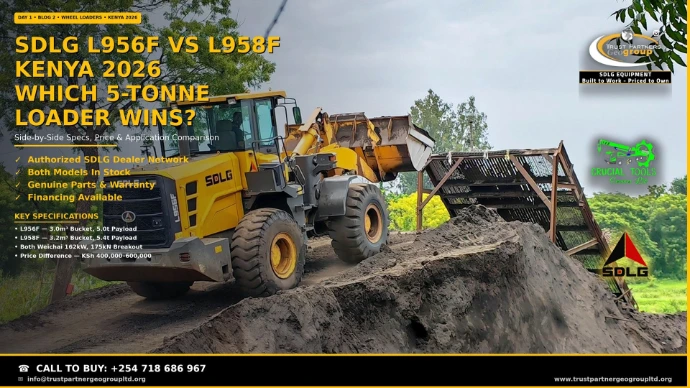
SDLG L956F vs L958F Kenya 2026: Which 5-Tonne Loader Wins?
Same Weichai heart, different muscle. The side-by-side specifications, the KSh 400,000–600,000 price gap, and the honest application logic that picks the winner for your site.

1. Two Machines, One Engine
The L956F and L958F are SDLG's twin 5-tonne-class loaders — same Weichai WD10 power plant at 162 kW, same 175 kN breakout force, same transmission family, same parts book. What separates them is the working end and the frame: the L956F runs a 3.0 m³ bucket at 5.0 tonnes rated payload on a lighter chassis; the L958F runs 3.2 m³ at 5.4 tonnes on the heavier frame. This comparison, from the services portfolio of Trust Partners Geo-Group — authorized SDLG dealers with both models in stock — decodes which machine your application actually earns.
2. The Side-by-Side Table
| Parameter | SDLG L956F | SDLG L958F |
|---|---|---|
| Bucket capacity | 3.0 m³ | 3.2 m³ |
| Rated payload | 5,000 kg | 5,400 kg |
| Engine | Weichai WD10, 162 kW | Weichai WD10, 162 kW |
| Breakout force | 175 kN | 175 kN |
| Operating weight | ~16,400 kg | 17,130 kg |
| Character | Nimble generalist | Production specialist |
| Indicative price | L958F premium: KSh 400,000–600,000 | |
The full L958F deep-dive sits in the Day 1 flagship showcase; the selection logic that lands buyers in this class at all is covered in our wheel loader versus backhoe loader comparison.
3. Quarry & Crusher: The L958F Wins
Volume work is tonnes per hour, and every pass counts. The L958F's 6–7% per-pass advantage — 3.2 m³ against 3.0, 5.4 tonnes against 5.0 — compounds across a shift: at 25–35 second cycles over ten hours, that is roughly 10–15% more material moved, the difference between feeding the crusher and throttling it. The heavier frame pays at the face: more stability digging into shot rock, less bounce on rough floors, a machine that stays planted when the bucket is full and the pile is high. On quarry arithmetic, the KSh 400,000–600,000 premium typically returns inside the first year of hard production.
4. Construction Sites: The L956F Makes Its Case
Construction rewards agility and ground manners. The L956F's lighter frame turns tighter between stockpiles and formwork; its lower ground pressure is kinder to compacted fill and finished surfaces; and the 3.0 m³ bucket is ample for the mixed loading, stockpiling and material-handling duty that dominates site work. Fuel arithmetic favours it on part-load cycles — when the bucket rarely fills to rated payload, the L958F's extra capacity is carried weight, not working capacity. For general construction, agriculture and yard work, the L956F is the rational choice.
5. The Price Gap Decoded
KSh 400,000–600,000 separates the pair — buying exactly the larger bucket, the higher payload rating, the heavier frame and the stability that comes with them, and nothing else: engine, transmission, hydraulics and support structure are shared. The payback question is therefore pure application: volume work recovers the premium in a year; general duty never exercises it. Both machines carry the same warranty, the same parts stock and the same finance structures through the authorized network.
6. Shared Platform, Shared Parts
The shared-platform logic is a fleet-planning gift: one parts stock serves both machines, one service manual covers both, and operators trained on either transition to the other in hours. The components that differ — bucket, linkage, frame sections, counterweight — are the working-end hardware that defines character, not the systems that define uptime. Through the authorized dealer network, genuine parts for both models are stocked in Kenya.
7. The Verdict Matrix
| Your Work | The Winner | Why |
|---|---|---|
| Quarry, crusher, batching plant | L958F | Volume per pass; stability at the pile |
| General construction, mixed sites | L956F | Agility, ground pressure, fuel on part-load |
| Agriculture, feedlots, yards | L956F | Versatility without carrying unused capacity |
| High-volume fleet standard | L958F | Hourly tonnage governs |
| First loader, operator learning curve | L956F | Lighter steering, quicker response |
8. Frequently Asked Questions
Two machines, one engine, different jobs. Both run the Weichai WD10 at 162 kW with 175 kN breakout force — the power and digging ends are effectively identical. The difference is the working end and the frame around it: the L956F carries a 3.0 m³ bucket on a slightly lighter frame at 5.0 tonnes rated payload, while the L958F carries a 3.2 m³ bucket at 5.4 tonnes payload on the heavier chassis — roughly 700 kg more operating weight, which translates to stability under load and slightly more aggressive bucket-fill character in dense material. The practical translation for Kenyan buyers: the L956F is the nimble generalist — quicker cycles, lower fuel burn per pass, kinder to softer ground; the L958F is the production specialist — more material per pass, more stability at the pile, better matched to high-volume loading where the extra 0.2 m³ and 400 kg per cycle compound into real hourly tonnage. The price gap of KSh 400,000–600,000 between them buys exactly that difference and nothing else — same engine, same transmission family, same parts book, same support structure.
Quarry and crusher loading is volume work — trucks waiting, cycles counted, tonnes per hour the only metric that matters. The L958F wins that contest: the 3.2 m³ bucket against the L956F's 3.0 m³ is a 6–7% volume advantage per pass, and the 5.4-tonne payload against 5.0 tonnes keeps 20–25 tonne trucks loaded in 3–4 passes instead of 4–5. Across a 10-hour shift at 25–35 second cycles, that compounds to roughly 10–15% more material moved — the difference between meeting the crusher's appetite and throttling it. The heavier frame also pays off at the face: more stability when digging into shot rock, less bounce over rough quarry floors, and a machine that stays planted when the bucket is full and the pile is high. The L956F's advantages — quicker handling, lower ground pressure — matter more on construction sites and soft yards than at a rock face. For pure quarry production, the KSh 400,000–600,000 premium for the L958F typically returns in the first year of volume work.
Construction sites reward versatility, manoeuvrability and ground manners — and here the L956F makes its case. The lighter frame and slightly shorter wheelbase make it more agile in tight sites, between stockpiles and around formwork; the lower operating weight is kinder to compacted fill and finished surfaces that a heavier machine would rut; and the 3.0 m³ bucket is ample for the mixed loading, stockpiling and material-handling duty that dominates site work — feeding batchers, loading tippers, moving aggregates, handling pallets with forks. The fuel arithmetic also favours the smaller machine on part-load duty cycles: when the bucket is rarely filled to rated payload, the L958F's extra capacity is carried weight, not working capacity. The L956F is also the easier machine for operators stepping up from smaller loaders — its lighter steering and quicker response forgive the learning curve. For general construction, agriculture and yard work, the L956F is the rational choice; the L958F's premium buys capability that construction duty rarely exercises.
The price gap runs KSh 400,000–600,000 in the current Kenyan market — the L956F landing in the lower band of the 5-tonne class and the L958F at the upper, with both sitting comfortably below comparable premium-brand machines. What the gap buys: the larger 3.2 m³ bucket, the 5.4-tonne payload rating, the heavier frame and the stability that comes with it — and nothing else, since engine, transmission, hydraulics and the parts book are shared. The payback arithmetic: on volume work — quarry, crusher, batching plant — the L958F's 6–7% per-pass advantage typically recovers the premium within the first year of hard use; on general construction duty, the L956F's lower purchase price and fuel burn per cycle is the better investment. Both machines are in stock through the authorized dealer network with the same warranty, parts support and finance structures — the comparison is about application, not about which machine is 'better' in the abstract.
Yes — and this is one of the quietest advantages of staying within a model family. The L956F and L958F share the Weichai WD10 engine, the same transmission family, the same hydraulic architecture and the same electrical system; the parts that differ are the bucket and linkage components, the frame sections and the counterweight — the working-end hardware that defines each machine's character. For owners the consequence is practical: one parts stock serves both machines, one service manual covers both, and a fleet running one of each simplifies maintenance, training and spares holding to a degree that mixed-brand fleets cannot match. Through the authorized dealer network, genuine parts for both models are stocked in Kenya with the supply chain behind them — the grey-market alternative of sourcing parts machine-by-machine dissolves exactly this advantage. For fleet planning, the shared-platform logic extends further: operators trained on one transition to the other in hours, not weeks.
Both In Stock. One Conversation Decides.
Trust Partners Geo-Group Ltd — authorized SDLG dealers with L956F and L958F in stock, demonstration available, firm quotations and finance structures on both. Tell us your application; we will tell you which machine earns it.
Visit the SDLG Equipment Desk🧮 Price on Calculator ✉️ Contact Us
📞 +254 718 68 69 67
SDLG L956F vs L958F Kenya 2026: Which 5-Tonne Loader Wins?
Same Weichai heart, different muscle. The side-by-side specifications, the KSh 400,000–600,000 price gap, and the honest application logic that picks the winner for your site.
1. Two Machines, One Engine
The L956F and L958F are SDLG's twin 5-tonne-class loaders — same Weichai WD10 power plant at 162 kW, same 175 kN breakout force, same transmission family, same parts book. What separates them is the working end and the frame: the L956F runs a 3.0 m³ bucket at 5.0 tonnes rated payload on a lighter chassis; the L958F runs 3.2 m³ at 5.4 tonnes on the heavier frame. This comparison, from the services portfolio of Trust Partners Geo-Group — authorized SDLG dealers with both models in stock — decodes which machine your application actually earns.
2. The Side-by-Side Table
| Parameter | SDLG L956F | SDLG L958F |
|---|---|---|
| Bucket capacity | 3.0 m³ | 3.2 m³ |
| Rated payload | 5,000 kg | 5,400 kg |
| Engine | Weichai WD10, 162 kW | Weichai WD10, 162 kW |
| Breakout force | 175 kN | 175 kN |
| Operating weight | ~16,400 kg | 17,130 kg |
| Character | Nimble generalist | Production specialist |
| Indicative price | L958F premium: KSh 400,000–600,000 | |
The full L958F deep-dive sits in the Day 1 flagship showcase; the selection logic that lands buyers in this class at all is covered in our wheel loader versus backhoe loader comparison.
3. Quarry & Crusher: The L958F Wins
Volume work is tonnes per hour, and every pass counts. The L958F's 6–7% per-pass advantage — 3.2 m³ against 3.0, 5.4 tonnes against 5.0 — compounds across a shift: at 25–35 second cycles over ten hours, that is roughly 10–15% more material moved, the difference between feeding the crusher and throttling it. The heavier frame pays at the face: more stability digging into shot rock, less bounce on rough floors, a machine that stays planted when the bucket is full and the pile is high. On quarry arithmetic, the KSh 400,000–600,000 premium typically returns inside the first year of hard production.
4. Construction Sites: The L956F Makes Its Case
Construction rewards agility and ground manners. The L956F's lighter frame turns tighter between stockpiles and formwork; its lower ground pressure is kinder to compacted fill and finished surfaces; and the 3.0 m³ bucket is ample for the mixed loading, stockpiling and material-handling duty that dominates site work. Fuel arithmetic favours it on part-load cycles — when the bucket rarely fills to rated payload, the L958F's extra capacity is carried weight, not working capacity. For general construction, agriculture and yard work, the L956F is the rational choice.
5. The Price Gap Decoded
KSh 400,000–600,000 separates the pair — buying exactly the larger bucket, the higher payload rating, the heavier frame and the stability that comes with them, and nothing else: engine, transmission, hydraulics and support structure are shared. The payback question is therefore pure application: volume work recovers the premium in a year; general duty never exercises it. Both machines carry the same warranty, the same parts stock and the same finance structures through the authorized network.
6. Shared Platform, Shared Parts
The shared-platform logic is a fleet-planning gift: one parts stock serves both machines, one service manual covers both, and operators trained on either transition to the other in hours. The components that differ — bucket, linkage, frame sections, counterweight — are the working-end hardware that defines character, not the systems that define uptime. Through the authorized dealer network, genuine parts for both models are stocked in Kenya.
7. The Verdict Matrix
| Your Work | The Winner | Why |
|---|---|---|
| Quarry, crusher, batching plant | L958F | Volume per pass; stability at the pile |
| General construction, mixed sites | L956F | Agility, ground pressure, fuel on part-load |
| Agriculture, feedlots, yards | L956F | Versatility without carrying unused capacity |
| High-volume fleet standard | L958F | Hourly tonnage governs |
| First loader, operator learning curve | L956F | Lighter steering, quicker response |
8. Frequently Asked Questions
Two machines, one engine, different jobs. Both run the Weichai WD10 at 162 kW with 175 kN breakout force — the power and digging ends are effectively identical. The difference is the working end and the frame around it: the L956F carries a 3.0 m³ bucket on a slightly lighter frame at 5.0 tonnes rated payload, while the L958F carries a 3.2 m³ bucket at 5.4 tonnes payload on the heavier chassis — roughly 700 kg more operating weight, which translates to stability under load and slightly more aggressive bucket-fill character in dense material. The practical translation for Kenyan buyers: the L956F is the nimble generalist — quicker cycles, lower fuel burn per pass, kinder to softer ground; the L958F is the production specialist — more material per pass, more stability at the pile, better matched to high-volume loading where the extra 0.2 m³ and 400 kg per cycle compound into real hourly tonnage. The price gap of KSh 400,000–600,000 between them buys exactly that difference and nothing else — same engine, same transmission family, same parts book, same support structure.
Quarry and crusher loading is volume work — trucks waiting, cycles counted, tonnes per hour the only metric that matters. The L958F wins that contest: the 3.2 m³ bucket against the L956F's 3.0 m³ is a 6–7% volume advantage per pass, and the 5.4-tonne payload against 5.0 tonnes keeps 20–25 tonne trucks loaded in 3–4 passes instead of 4–5. Across a 10-hour shift at 25–35 second cycles, that compounds to roughly 10–15% more material moved — the difference between meeting the crusher's appetite and throttling it. The heavier frame also pays off at the face: more stability when digging into shot rock, less bounce over rough quarry floors, and a machine that stays planted when the bucket is full and the pile is high. The L956F's advantages — quicker handling, lower ground pressure — matter more on construction sites and soft yards than at a rock face. For pure quarry production, the KSh 400,000–600,000 premium for the L958F typically returns in the first year of volume work.
Construction sites reward versatility, manoeuvrability and ground manners — and here the L956F makes its case. The lighter frame and slightly shorter wheelbase make it more agile in tight sites, between stockpiles and around formwork; the lower operating weight is kinder to compacted fill and finished surfaces that a heavier machine would rut; and the 3.0 m³ bucket is ample for the mixed loading, stockpiling and material-handling duty that dominates site work — feeding batchers, loading tippers, moving aggregates, handling pallets with forks. The fuel arithmetic also favours the smaller machine on part-load duty cycles: when the bucket is rarely filled to rated payload, the L958F's extra capacity is carried weight, not working capacity. The L956F is also the easier machine for operators stepping up from smaller loaders — its lighter steering and quicker response forgive the learning curve. For general construction, agriculture and yard work, the L956F is the rational choice; the L958F's premium buys capability that construction duty rarely exercises.
The price gap runs KSh 400,000–600,000 in the current Kenyan market — the L956F landing in the lower band of the 5-tonne class and the L958F at the upper, with both sitting comfortably below comparable premium-brand machines. What the gap buys: the larger 3.2 m³ bucket, the 5.4-tonne payload rating, the heavier frame and the stability that comes with it — and nothing else, since engine, transmission, hydraulics and the parts book are shared. The payback arithmetic: on volume work — quarry, crusher, batching plant — the L958F's 6–7% per-pass advantage typically recovers the premium within the first year of hard use; on general construction duty, the L956F's lower purchase price and fuel burn per cycle is the better investment. Both machines are in stock through the authorized dealer network with the same warranty, parts support and finance structures — the comparison is about application, not about which machine is 'better' in the abstract.
Yes — and this is one of the quietest advantages of staying within a model family. The L956F and L958F share the Weichai WD10 engine, the same transmission family, the same hydraulic architecture and the same electrical system; the parts that differ are the bucket and linkage components, the frame sections and the counterweight — the working-end hardware that defines each machine's character. For owners the consequence is practical: one parts stock serves both machines, one service manual covers both, and a fleet running one of each simplifies maintenance, training and spares holding to a degree that mixed-brand fleets cannot match. Through the authorized dealer network, genuine parts for both models are stocked in Kenya with the supply chain behind them — the grey-market alternative of sourcing parts machine-by-machine dissolves exactly this advantage. For fleet planning, the shared-platform logic extends further: operators trained on one transition to the other in hours, not weeks.
Both In Stock. One Conversation Decides.
Trust Partners Geo-Group Ltd — authorized SDLG dealers with L956F and L958F in stock, demonstration available, firm quotations and finance structures on both. Tell us your application; we will tell you which machine earns it.
Visit the SDLG Equipment Desk🧮 Price on Calculator ✉️ Contact Us
📞 +254 718 68 69 67