
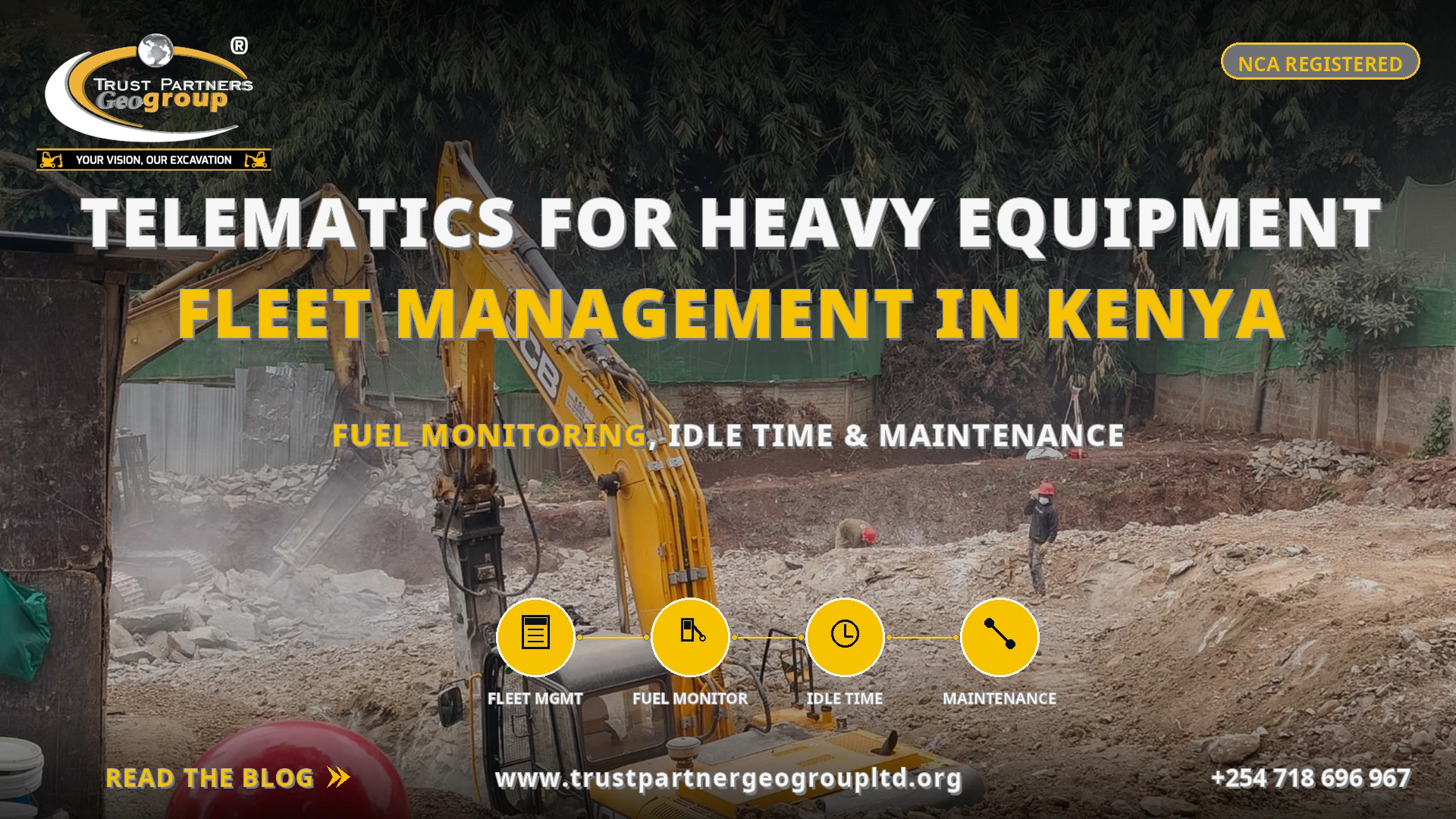
Telematics for Heavy Equipment Fleet Management in Kenya: Fuel Monitoring, Idle Time & Maintenance [2026]
How fleet management telematics, equipment fuel monitoring and construction fleet tracking cut costs, prevent theft and transform heavy equipment for hire productivity across excavation in Kenya
Table of Contents
- 1. Why Telematics is Transforming Heavy Equipment for Hire in Kenya
- 2. How Telematics Works: Sensors, Connectivity and Cloud Dashboards
- 3. Equipment Fuel Monitoring and Theft Prevention
- 4. Idle Time Reduction: The Hidden Cost Killer in Basement Excavation
- 5. Predictive Maintenance and Machine Health Monitoring
- 6. Construction Fleet Tracking, Utilisation and Productivity Analytics
- 7. Telematics for NEMA Compliance, Safety and Reporting
- 8. Implementation Costs and ROI for Kenyan Contractors [2026]
- 9. Frequently Asked Questions
- 10. Conclusion
At 06:45 on a Monday morning, the fleet manager for a Nairobi earthworks contractor opens his laptop and sees that Excavator EX-07 at a basement excavation site in Kilimani has been idling for 23 minutes before the first truck arrived. The fuel level on Grader GR-03 at a road project in Ruaka dropped 18 litres overnight with no engine hours logged - a siphoning event caught before the shift begins. Bulldozer BD-02 in Mombasa has an engine coolant temperature trending 8 degrees above normal, triggering a maintenance alert that prevents a breakdown during the critical afternoon push. This is heavy equipment telematics in action - the digital nervous system of a modern construction fleet - and it is transforming how excavation in Kenya is managed, billed and optimised. For contractors offering heavy equipment for hire, telematics is no longer a luxury; it is the difference between a fleet that bleeds diesel and idle-time profits, and a fleet that delivers transparent, accountable, data-driven earthworks. Trust Partners Geo-Group Ltd has deployed fleet management telematics across our entire heavy equipment for hire fleet, giving clients real-time visibility into every hour, every litre and every location. This guide explains how equipment fuel monitoring, idle time tracking and predictive maintenance work, what they cost, and why they matter for your next basement excavation or infrastructure project in Kenya.
Trust Partners Geo-Group Ltd - Fleet Operations & Technology Team
NCA-registered excavation contractor with 15+ years of fleet management experience and certified telematics system deployment across East African construction projects.
1. Why Telematics is Transforming Heavy Equipment for Hire in Kenya
Kenya's construction sector is equipment-intensive and margin-thin. A typical mid-size contractor running 10-15 machines for heavy equipment for hire faces three intractable cost drains: fuel theft and misappropriation that consumes 8-15% of diesel budgets; idle time that bills clients for non-productive hours while wearing engines and burning fuel; and reactive maintenance that turns minor faults into major breakdowns on programme-critical basement excavation sites. Before telematics, these costs were invisible - buried in monthly fuel invoices, smoothed over in timesheets, and blamed on "bad luck" when machines failed.
Fleet management telematics makes them visible, measurable and actionable. By installing connected sensors on every excavator, grader, bulldozer and dump truck, contractors gain a real-time view of:
- Exact fuel consumption and tank levels: detecting theft, leakage and abnormal consumption by machine and operator;
- Engine-on productive time versus idle time: separating billable excavation hours from waiting, warming up and unauthorised use;
- Machine location and movement history: preventing theft, verifying site attendance and optimising machine deployment between projects;
- Engine health and fault codes: predicting failures before they happen and scheduling maintenance during downtime rather than during production.
For excavation in Kenya, where clients increasingly demand transparent billing and proof of productivity, telematics is becoming a competitive differentiator. The contractor who can show a client that their hired excavator achieved 78% utilisation with 12% idle time and zero fuel anomalies wins the repeat contract. The contractor who bills based on handwritten timesheets and rough fuel estimates loses it.
2. How Telematics Works: Sensors, Connectivity and Cloud Dashboards
Understanding the technology stack explains why telematics delivers reliable data even on remote Kenyan construction sites.
The Onboard Device and Sensors
A telematics control unit (TCU) is installed in each machine's cab or engine compartment. It connects to: the engine control module (ECM) via the CAN bus to read fault codes, temperatures, pressures and RPM; fuel level sensors in the tank to measure volume with ±2% accuracy; GPS/GNSS antennas for location tracking; and accelerometers to detect movement, vibration and harsh operation. The TCU collects data every 1-10 seconds and stores it locally if cellular signal is lost, uploading automatically when connectivity returns.
Connectivity: 4G, Satellite and Store-and-Forward
In Nairobi, Kiambu and Mombasa, 4G coverage is sufficient for real-time streaming. On remote dam construction or rural road projects in Machakos, Kitui or Turkana, satellite modems or store-and-forward logging ensure no data is lost. The system is designed for intermittent connectivity - the machine never stops logging, and the cloud never stops receiving once the link is restored.
The Cloud Dashboard and Mobile Apps
Fleet managers access data through a web dashboard or mobile app showing: a map view of all machine locations with geofence boundaries; fuel level graphs and refuelling event logs; daily utilisation reports (engine hours, idle hours, working hours); maintenance calendars with upcoming service intervals; and alert logs for theft, idling, geofence breaches and fault codes. For clients hiring heavy equipment for hire, Trust Partners Geo-Group Ltd provides read-only dashboard access so they can verify machine activity and fuel consumption in real time.
3. Equipment Fuel Monitoring and Theft Prevention
Diesel is the single largest operating cost for earthworks contractors in Kenya, often exceeding 35% of total project costs. At 2026 prices of KES 180-200 per litre, a 30-tonne excavator consuming 150 litres per day costs KES 27,000-30,000 daily in fuel alone. When 10-15% of that fuel is stolen or misappropriated, the financial damage is severe and the operational impact is disruptive - machines run dry mid-shift, schedules slip, and client trust erodes.
How Telematics Detects Fuel Anomalies
Equipment fuel monitoring uses ultrasonic or capacitive sensors in the tank to measure volume continuously. The system learns normal consumption patterns for each machine type and workload: a 30-tonne excavator in hard rock basement excavation should consume 140-160 litres per 10-hour shift; a motor grader doing finish work should consume 40-60 litres. Deviations trigger alerts: sudden level drops indicate siphoning; consumption above normal rates indicates possible leakage, inefficient operation or fuel dilution; and refuelling events are logged with before/after volumes and GPS location, matching fuel delivery dockets to actual tank increases.
Theft Prevention in Practice
On an unmonitored site, fuel theft typically occurs at night or during shift changes. With telematics, any level drop outside a logged refuelling event generates an immediate SMS alert. Geofencing adds a second layer: if a machine moves outside the site boundary, the manager knows instantly. On a recent excavation in Kenya project in Nakuru, telematics detected a 45-litre drop on a 20-tonne excavator at 02:30. Security review of gate logs identified an unauthorised fuel truck. The theft was stopped, the supplier blacklisted, and KES 8,100 of diesel saved - but more importantly, the pattern was broken before it became habitual.
| Fuel Metric | Unmonitored Fleet | Telematics-Monitored Fleet |
|---|---|---|
| Theft / shrinkage | 8-15% | 1-3% |
| Consumption variance | Unknown | ±5% predictable |
| Refuelling fraud | Common | Eliminated |
| Run-dry incidents | 2-4 per month | Near zero |
4. Idle Time Reduction: The Hidden Cost Killer in Basement Excavation
Idle time is the most expensive non-activity in construction. When an excavator sits with the engine running - waiting for a truck, waiting for a surveyor, waiting for instructions, or simply because the operator prefers air conditioning to Nairobi heat - the client is billed, the fuel burns, the engine hours accumulate, and zero earth is moved. Industry studies and Trust Partners Geo-Group Ltd's own data show that idle time on Kenyan construction sites averages 25-40% of total engine hours.
The Cost of Idling
A 30-tonne excavator idling consumes 8-12 litres of diesel per hour. At KES 190 per litre, one hour of idling costs KES 1,520-2,280 in fuel alone. Add the hire rate of KES 10,000-14,000 per hour, and a single idle hour costs the project KES 11,500-16,000 with zero production. On a basement excavation project where an excavator idles 3 hours per day over 20 days, the waste is KES 690,000-960,000 - enough to hire an additional machine for a week.
Telematics Idle Tracking and Enforcement
Telematics distinguishes between working hours (engine on + hydraulic pressure / PTO engaged), idle hours (engine on + no hydraulic activity), and off hours (engine off). Daily reports show idle percentage by machine and operator. Managers set thresholds: after 10 minutes of idling, the operator receives a cab alert; after 15 minutes, the site manager receives an SMS; repeated violations trigger disciplinary review. Trust Partners Geo-Group Ltd implemented an idle reduction programme across our heavy equipment for hire fleet in 2025. Within 90 days, average idle time dropped from 31% to 14%, saving an estimated KES 2.8 million per month in fuel and hire cost recovery.
Operational Causes and Solutions
Telematics data reveals that idle time is rarely the operator's fault alone. Common causes include: truck mismatch - excavators waiting because tipper trucks are too few or too slow; surveying bottlenecks - machines idle while grade checkers set stakes; and poor shift scheduling - machines started before support crews arrive. By analysing idle time patterns, fleet managers can optimise truck fleet size, deploy GPS machine guidance to eliminate survey delays, and enforce strict start-time discipline. On a Westlands basement excavation project, adding two tipper trucks based on idle-time analytics reduced excavator waiting by 60% and accelerated the programme by 4 days.
5. Predictive Maintenance and Machine Health Monitoring
Breakdowns on critical-path earthworks activities are catastrophic. A failed hydraulic pump on a basement excavation project can halt foundation work for 2-3 days, costing KES 300,000-600,000 in delays, emergency repairs and standby labour. Reactive maintenance - fixing things after they break - is expensive. Preventive maintenance - servicing at fixed intervals - is better but often replaces parts too early or misses emerging faults between services. Predictive maintenance - using real-time data to forecast failures - is the optimal approach, and telematics makes it accessible to Kenyan contractors for the first time.
Engine Diagnostics and Fault Codes
The telematics device reads engine fault codes (DTCs) directly from the ECM. These codes indicate specific problems: P0118 for coolant temperature sensor failure; P0087 for fuel rail pressure low; and U0100 for lost communication with ECM. Instead of waiting for the check-engine light or the operator's complaint, the fleet manager sees the code within seconds of its occurrence, often before performance degradation is noticeable.
Temperature and Pressure Trending
Telematics logs coolant temperature, hydraulic oil temperature, engine oil pressure and boost pressure continuously. Gradual trends - coolant temperature rising 3 degrees per week, hydraulic pressure dropping 5% per month - indicate developing problems. On a recent project, telematics showed coolant temperature on a 35-tonne excavator climbing from 92°C to 101°C over two weeks. A thermostat replacement during a scheduled weekend service prevented the head gasket failure that would have followed within days.
Service Interval Optimisation
Traditional maintenance uses calendar intervals (every 250 hours or every 3 months). Telematics enables condition-based servicing: oil changes when oil quality sensors indicate degradation, not when the calendar says so; filter replacements when differential pressure indicates clogging; and hydraulic oil changes based on contamination sensors rather than fixed hours. This extends component life, reduces waste oil disposal, and ensures machines are not over-serviced or under-serviced.
Case Study: Predictive Maintenance on a Nairobi High-Rise Basement Excavation
A 30-tonne excavator on a 14-metre deep basement excavation in Upper Hill began showing hydraulic oil temperature 12°C above baseline. The telematics alert triggered an inspection that revealed a failing relief valve. The valve was replaced during the next scheduled shift change. Without telematics, the valve would have failed catastrophically during the afternoon production push, dumping 200 litres of hydraulic oil into the excavation and stopping work for 36 hours. The avoided cost was estimated at KES 420,000 in downtime, oil replacement and environmental cleanup.
6. Construction Fleet Tracking, Utilisation and Productivity Analytics
Beyond fuel and maintenance, telematics provides strategic fleet management intelligence that transforms how contractors deploy heavy equipment for hire across multiple projects.
Real-Time Location and Geofencing
Every machine's GPS position updates every 30-60 seconds on the fleet map. Geofences - virtual boundaries around each construction site, depot or restricted area - trigger alerts when machines enter or exit. This prevents theft, verifies that hired machines are on the correct site, and deters unauthorised weekend use. For a contractor with machines on five simultaneous excavation in Kenya projects across Nairobi, Kiambu and Machakos, the map view replaces daily phone calls and site visits.
Utilisation Rate Analytics
Utilisation rate is the percentage of available hours that a machine spends in productive work. Industry benchmarks for excavators are 65-75% in developed markets; Kenyan contractors often achieve 45-60% due to logistical inefficiencies. Telematics calculates utilisation automatically: productive hours divided by shift hours. Low utilisation triggers investigation: is the machine under-deployed? Is it waiting for trucks? Is the operator under-skilled? By optimising utilisation, contractors can take on more work with the same fleet or reduce fleet size without reducing revenue.
Operator Behaviour Scoring
Telematics captures harsh acceleration, hard braking, excessive RPM and hydraulic shock loads. These behaviours increase fuel consumption by 10-20% and accelerate wear on pumps, tracks and undercarriages. Operator scorecards create accountability and identify training needs. Trust Partners Geo-Group Ltd uses telematics-derived behaviour scores in operator incentive programmes, rewarding smooth, efficient operation with bonuses and prioritising high-scoring operators for premium basement excavation assignments.
7. Telematics for NEMA Compliance, Safety and Reporting
Regulatory compliance and safety management are increasingly data-driven in Kenya's construction sector. Telematics provides the audit trails that NEMA inspectors, insurance assessors and green building auditors demand.
NEMA Environmental Reporting
NEMA requires construction projects to document fuel consumption, emissions estimates and environmental management practices. Telematics automates this: fuel consumption logs provide accurate diesel volumes; engine hours and load profiles enable carbon emission estimates using standard conversion factors; and idle time reports demonstrate efforts to minimise unnecessary emissions. For green building projects requiring LEED or EDGE certification, telematics data supports the sustainable operations credit category.
Safety and Curfew Enforcement
Telematics enforces safety policies through technology: speed limits on site roads trigger alerts if exceeded; curfew geofences prevent unauthorised night operation; and seatbelt monitoring (on equipped machines) logs compliance. In the event of an incident, historical data shows machine speed, location and operator identity - critical for insurance claims and legal defence.
Automated Billing and Dispute Resolution
For heavy equipment for hire, billing disputes often arise over hours worked versus hours billed. Telematics provides indisputable records: engine start/stop times with GPS verification; productive versus idle hour breakdowns; and fuel consumption tied to specific shifts. Trust Partners Geo-Group Ltd includes telematics reports with every invoice, giving clients complete transparency and eliminating the disputes that damage contractor-client relationships.
8. Implementation Costs and ROI for Kenyan Contractors [2026]
Telematics is affordable for fleets of any size in Kenya's construction market. The key is matching system complexity to monitoring needs.
| Component | Basic GPS Tracking | Full Telematics (Fuel + Diagnostics) |
|---|---|---|
| Hardware per machine | KES 8,000-15,000 | KES 25,000-45,000 |
| Installation per machine | KES 2,000-3,000 | KES 5,000-8,000 |
| Monthly subscription | KES 1,000-2,000 | KES 3,000-5,000 |
| Dashboard setup (once) | KES 20,000 | KES 50,000-100,000 |
| Training | KES 10,000 | KES 30,000-50,000 |
Return on Investment Calculation
For a 10-machine fleet with full telematics (total first-year cost KES 550,000-850,000): fuel theft reduction saves KES 1.0-1.5 million per year; idle time reduction saves KES 1.5-2.5 million per year in recovered hire rates and fuel; predictive maintenance avoids KES 500,000-1.0 million in emergency breakdown costs; and utilisation optimisation increases revenue capacity by KES 800,000-1.2 million per year. Total annual benefit: KES 3.8-6.2 million. ROI is achieved in 3-5 months, with ongoing savings compounding annually.
Trust Partners Geo-Group Ltd Telematics Integration
Trust Partners Geo-Group Ltd includes telematics monitoring as standard on all long-term heavy equipment for hire contracts. Clients do not pay hardware or subscription costs separately - the technology is embedded in our service. This means every excavator, grader, bulldozer and dump truck you hire from us comes with real-time fuel tracking, idle monitoring, maintenance alerts and location verification at no additional cost. It is our commitment to transparency and accountability in excavation in Kenya.
9. Frequently Asked Questions: Heavy Equipment Telematics & Fleet Management in Kenya
What is heavy equipment telematics and how does it work in Kenya?
Heavy equipment telematics is a fleet management technology that combines GPS tracking, cellular connectivity and onboard sensors to monitor machine location, fuel consumption, engine diagnostics, idle time and operator behaviour in real time. A telematics device is installed on each excavator, grader, bulldozer or truck, collecting data from the engine control module (ECM), fuel level sensors and hydraulic pressure sensors. This data is transmitted via 4G or satellite to a cloud dashboard accessible on desktop or mobile. For excavation in Kenya, where fleets of heavy equipment for hire are often spread across multiple sites in Nairobi, Kiambu and Machakos, telematics gives fleet managers a single view of every machine's productivity, location and health without visiting each site daily.
How does telematics prevent fuel theft on construction sites in Kenya?
Fuel theft is one of the largest hidden costs in Kenyan construction, with industry estimates suggesting 8-15% of diesel is siphoned or misappropriated on unmonitored sites. Equipment fuel monitoring via telematics prevents theft through three mechanisms: real-time fuel level sensors that detect sudden drops outside refuelling events; refuelling event logging that matches fuel deliveries to tank level increases; and geofenced fuel alerts that notify managers if a machine moves outside the designated depot area. On a fleet of ten 30-tonne excavators consuming 150 litres per day each, a 10% fuel theft rate costs KES 45,000 per day at 2026 diesel prices. Telematics typically reduces fuel losses to under 2%, saving KES 1.0-1.2 million per month on a mid-size fleet.
Can telematics reduce idle time on basement excavation projects?
Yes. Idle time is the silent profit killer in basement excavation and bulk earthworks. Industry data from Kenyan construction sites shows that excavators and graders idle 25-40% of their operating hours - waiting for trucks, waiting for surveyors, or running during breaks to keep air conditioning active. At standard heavy equipment for hire rates of KES 8,000-14,000 per hour, every hour of idle time is a billed hour with zero production. Telematics tracks engine-on, PTO-off time automatically and generates daily idle reports by machine and operator. Fleet managers can set idle alerts (e.g., notify after 10 minutes of idling) and enforce shutdown policies. Trust Partners Geo-Group Ltd reduced fleet idle time from 32% to 14% within three months of telematics deployment, cutting equivalent hire costs by KES 2.8 million per month across a 15-machine fleet.
What maintenance alerts does fleet management telematics provide?
Predictive maintenance is one of the most valuable features of modern fleet management telematics. The system monitors engine fault codes, coolant temperature, hydraulic oil temperature, battery voltage, brake pressure and filter status in real time. Alerts are generated before failure occurs: engine overheating warnings at 5 degrees below critical; hydraulic filter clogging alerts at 80% restriction; battery drain warnings before starting failure; and service interval reminders based on engine hours, not calendar dates. For basement excavation projects where a breakdown can delay a critical path activity by days, predictive maintenance allows repairs during scheduled downtime rather than emergency breakdowns. On a recent Nairobi high-rise project, a telematics coolant temperature alert allowed us to replace a water pump during a planned lunch break, avoiding a 36-hour breakdown that would have cost KES 350,000 in delays and emergency repairs.
How much does telematics cost for heavy equipment in Kenya?
In Kenya's heavy equipment for hire market, telematics implementation costs are: hardware and installation KES 15,000-45,000 per machine depending on sensor complexity (basic GPS tracking is cheaper; full engine diagnostics and fuel monitoring are premium); monthly data and platform subscription KES 2,000-5,000 per machine; and training and dashboard setup KES 50,000-100,000 for the entire fleet. For a 10-machine fleet, total first-year cost is KES 400,000-700,000. The return on investment is typically 3-6 months through fuel savings, idle time reduction, theft prevention and avoided breakdowns. Trust Partners Geo-Group Ltd includes telematics monitoring as standard on all long-term heavy equipment for hire contracts, giving clients real-time visibility into machine utilisation and productivity.
Does construction fleet tracking improve equipment security in Kenya?
Yes. Construction equipment theft and unauthorised use are significant risks in Kenya, particularly for machines left on remote sites overnight. Telematics provides real-time GPS location tracking with geofencing: if a machine moves outside a predefined boundary outside working hours, the system sends instant SMS and email alerts to the fleet manager and security team. Historical track logs show every route taken, every stop made, and every hour of operation - invaluable for police reports and insurance claims. Immobilisation features allow remote engine disable for stolen machines. On a road construction project in Nakuru, a telematics geofence alert at 02:00 allowed security to intercept a stolen excavator before it left the site perimeter, preventing a KES 12 million loss.
Can telematics data support NEMA compliance and green building reporting?
Yes. NEMA and green building certification schemes (LEED, EDGE, Green Star) increasingly require documented evidence of fuel consumption, emissions and environmental management. Telematics automatically logs fuel consumption per machine and per project, enabling accurate carbon footprint calculations. Idle time reports demonstrate efforts to minimise unnecessary emissions. Equipment utilisation data proves that machines were not over-deployed or under-utilised. For basement excavation and green building projects in Kenya, Trust Partners Geo-Group Ltd exports telematics data into NEMA-compliant environmental reports that document fuel use, emissions estimates and equipment efficiency - supporting both regulatory compliance and green certification submissions.
Where can I get telematics-enabled heavy equipment for hire in Kenya?
Trust Partners Geo-Group Ltd is a leading provider of telematics-enabled heavy equipment for hire in Kenya. Every machine in our fleet - from 20-tonne excavators to motor graders, bulldozers and dump trucks - is equipped with real-time telematics monitoring. Clients receive dashboard access showing fuel levels, idle time, location, engine health and production hours for every machine on their project. This transparency eliminates billing disputes, prevents fuel theft, and ensures that every hour you pay for is a productive hour. We serve basement excavation, road construction, bulk earthworks and mining projects in Nairobi, Mombasa, Kisumu, Nakuru, Eldoret and nationwide. Contact us at +254 718 68 69 67 or info@trustpartnergeogroupltd.org to hire telematics-equipped machines for your next excavation in Kenya.
10. Conclusion: Data is the New Diesel
The contractors who will dominate excavation in Kenya over the next decade are not necessarily those with the newest machines or the lowest rates. They are the contractors who know exactly where every machine is, how much fuel it is consuming, how many hours it is idling, and what fault code is about to trigger a breakdown. Heavy equipment telematics converts fleet management from an art of guesswork into a science of data - and the science is unforgiving to competitors who refuse to adopt it.
For developers hiring heavy equipment for hire, telematics is the transparency you deserve. You should never pay for an hour your excavator spent idling. You should never wonder whether the fuel bill matches the work done. You should never discover a machine breakdown only when the operator calls to say work has stopped. With telematics-enabled basement excavation and earthworks equipment, you see what you are paying for in real time.
Trust Partners Geo-Group Ltd has invested in fleet management telematics across our entire fleet because we believe our clients deserve accountability, not ambiguity. Every machine we hire comes with real-time monitoring, automated reporting, and the data integrity that modern construction demands. Whether you are managing a single basement excavation in Nairobi or a multi-site infrastructure programme across Kenya, our telematics-equipped heavy equipment for hire gives you the visibility, control and confidence to keep your project on budget and on programme.
Fleet Management Telematics & Heavy Equipment For Hire
Hire telematics-monitored excavators, graders, bulldozers and trucks for basement excavation, road works and bulk earthworks in Nairobi, Mombasa, Kisumu and across Kenya.
Free lead magnet: ask for our Fleet Telematics Implementation Checklist (PDF) - device selection, sensor calibration, alert configuration and ROI measurement guide for Kenyan construction fleets.
Related Resources
GPS Machine Control for Excavators in Kenya: Grade Control Systems & Precision Earthmoving
The companion technology to telematics - 3D machine guidance that eliminates rework and accelerates basement excavation production.
READ MOREExcavator Hire Prices in Kenya: Hourly, Daily & Monthly Rates [2026]
Transparent 2026 pricing for all excavator sizes, including telematics-equipped and GPS-guided machine options.
READ MORE11-20 Ton vs 30 Ton vs 50 Ton Excavator: Which Size Do You Need?
Match excavator tonnage to your project type and understand how telematics utilisation data validates the right machine choice.
READ MOREDump Trucks & Tippers Hire in Kenya: How to Calculate Fleet Size for Your Excavation Project
Optimise truck fleet sizing using telematics idle-time data to eliminate excavator waiting and maximise earthworks productivity.
READ MORETrust Partners Geo-Group Unleashes the Hyundai HX300SL: Four 30-Ton Excavators Join Our Fleet
Meet the latest additions to our telematics-enabled fleet - Tier 3 compliant, low-emission excavators with full monitoring capability.
READ MOREBulk Excavation Cost Per Cubic Meter in Kenya [2026 Updated Rates]
Understand how telematics-driven efficiency improvements translate into lower per-m3 earthworks costs for your project.
READ MORETRUST PARTNERS GEO-GROUP LTD | YOUR VISION, OUR EXCAVATION
WEBSITE: WWW.TRUSTPARTNERGEOGROUPLTD.ORG | EMAIL: INFO@TRUSTPARTNERGEOGROUPLTD.ORG | PHONE: +254 718 68 69 67
FOLLOW US: FACEBOOK | TIKTOK | INSTAGRAM | LINKEDIN
© 2026 TRUST PARTNERS GEO-GROUP LTD. ALL RIGHTS RESERVED.
Telematics for Heavy Equipment Fleet Management in Kenya: Fuel Monitoring, Idle Time & Maintenance [2026]
How fleet management telematics, equipment fuel monitoring and construction fleet tracking cut costs, prevent theft and transform heavy equipment for hire productivity across excavation in Kenya
Table of Contents
- 1. Why Telematics is Transforming Heavy Equipment for Hire in Kenya
- 2. How Telematics Works: Sensors, Connectivity and Cloud Dashboards
- 3. Equipment Fuel Monitoring and Theft Prevention
- 4. Idle Time Reduction: The Hidden Cost Killer in Basement Excavation
- 5. Predictive Maintenance and Machine Health Monitoring
- 6. Construction Fleet Tracking, Utilisation and Productivity Analytics
- 7. Telematics for NEMA Compliance, Safety and Reporting
- 8. Implementation Costs and ROI for Kenyan Contractors [2026]
- 9. Frequently Asked Questions
- 10. Conclusion
At 06:45 on a Monday morning, the fleet manager for a Nairobi earthworks contractor opens his laptop and sees that Excavator EX-07 at a basement excavation site in Kilimani has been idling for 23 minutes before the first truck arrived. The fuel level on Grader GR-03 at a road project in Ruaka dropped 18 litres overnight with no engine hours logged - a siphoning event caught before the shift begins. Bulldozer BD-02 in Mombasa has an engine coolant temperature trending 8 degrees above normal, triggering a maintenance alert that prevents a breakdown during the critical afternoon push. This is heavy equipment telematics in action - the digital nervous system of a modern construction fleet - and it is transforming how excavation in Kenya is managed, billed and optimised. For contractors offering heavy equipment for hire, telematics is no longer a luxury; it is the difference between a fleet that bleeds diesel and idle-time profits, and a fleet that delivers transparent, accountable, data-driven earthworks. Trust Partners Geo-Group Ltd has deployed fleet management telematics across our entire heavy equipment for hire fleet, giving clients real-time visibility into every hour, every litre and every location. This guide explains how equipment fuel monitoring, idle time tracking and predictive maintenance work, what they cost, and why they matter for your next basement excavation or infrastructure project in Kenya.
Trust Partners Geo-Group Ltd - Fleet Operations & Technology Team
NCA-registered excavation contractor with 15+ years of fleet management experience and certified telematics system deployment across East African construction projects.
1. Why Telematics is Transforming Heavy Equipment for Hire in Kenya
Kenya's construction sector is equipment-intensive and margin-thin. A typical mid-size contractor running 10-15 machines for heavy equipment for hire faces three intractable cost drains: fuel theft and misappropriation that consumes 8-15% of diesel budgets; idle time that bills clients for non-productive hours while wearing engines and burning fuel; and reactive maintenance that turns minor faults into major breakdowns on programme-critical basement excavation sites. Before telematics, these costs were invisible - buried in monthly fuel invoices, smoothed over in timesheets, and blamed on "bad luck" when machines failed.
Fleet management telematics makes them visible, measurable and actionable. By installing connected sensors on every excavator, grader, bulldozer and dump truck, contractors gain a real-time view of:
- Exact fuel consumption and tank levels: detecting theft, leakage and abnormal consumption by machine and operator;
- Engine-on productive time versus idle time: separating billable excavation hours from waiting, warming up and unauthorised use;
- Machine location and movement history: preventing theft, verifying site attendance and optimising machine deployment between projects;
- Engine health and fault codes: predicting failures before they happen and scheduling maintenance during downtime rather than during production.
For excavation in Kenya, where clients increasingly demand transparent billing and proof of productivity, telematics is becoming a competitive differentiator. The contractor who can show a client that their hired excavator achieved 78% utilisation with 12% idle time and zero fuel anomalies wins the repeat contract. The contractor who bills based on handwritten timesheets and rough fuel estimates loses it.
2. How Telematics Works: Sensors, Connectivity and Cloud Dashboards
Understanding the technology stack explains why telematics delivers reliable data even on remote Kenyan construction sites.
The Onboard Device and Sensors
A telematics control unit (TCU) is installed in each machine's cab or engine compartment. It connects to: the engine control module (ECM) via the CAN bus to read fault codes, temperatures, pressures and RPM; fuel level sensors in the tank to measure volume with ±2% accuracy; GPS/GNSS antennas for location tracking; and accelerometers to detect movement, vibration and harsh operation. The TCU collects data every 1-10 seconds and stores it locally if cellular signal is lost, uploading automatically when connectivity returns.
Connectivity: 4G, Satellite and Store-and-Forward
In Nairobi, Kiambu and Mombasa, 4G coverage is sufficient for real-time streaming. On remote dam construction or rural road projects in Machakos, Kitui or Turkana, satellite modems or store-and-forward logging ensure no data is lost. The system is designed for intermittent connectivity - the machine never stops logging, and the cloud never stops receiving once the link is restored.
The Cloud Dashboard and Mobile Apps
Fleet managers access data through a web dashboard or mobile app showing: a map view of all machine locations with geofence boundaries; fuel level graphs and refuelling event logs; daily utilisation reports (engine hours, idle hours, working hours); maintenance calendars with upcoming service intervals; and alert logs for theft, idling, geofence breaches and fault codes. For clients hiring heavy equipment for hire, Trust Partners Geo-Group Ltd provides read-only dashboard access so they can verify machine activity and fuel consumption in real time.
3. Equipment Fuel Monitoring and Theft Prevention
Diesel is the single largest operating cost for earthworks contractors in Kenya, often exceeding 35% of total project costs. At 2026 prices of KES 180-200 per litre, a 30-tonne excavator consuming 150 litres per day costs KES 27,000-30,000 daily in fuel alone. When 10-15% of that fuel is stolen or misappropriated, the financial damage is severe and the operational impact is disruptive - machines run dry mid-shift, schedules slip, and client trust erodes.
How Telematics Detects Fuel Anomalies
Equipment fuel monitoring uses ultrasonic or capacitive sensors in the tank to measure volume continuously. The system learns normal consumption patterns for each machine type and workload: a 30-tonne excavator in hard rock basement excavation should consume 140-160 litres per 10-hour shift; a motor grader doing finish work should consume 40-60 litres. Deviations trigger alerts: sudden level drops indicate siphoning; consumption above normal rates indicates possible leakage, inefficient operation or fuel dilution; and refuelling events are logged with before/after volumes and GPS location, matching fuel delivery dockets to actual tank increases.
Theft Prevention in Practice
On an unmonitored site, fuel theft typically occurs at night or during shift changes. With telematics, any level drop outside a logged refuelling event generates an immediate SMS alert. Geofencing adds a second layer: if a machine moves outside the site boundary, the manager knows instantly. On a recent excavation in Kenya project in Nakuru, telematics detected a 45-litre drop on a 20-tonne excavator at 02:30. Security review of gate logs identified an unauthorised fuel truck. The theft was stopped, the supplier blacklisted, and KES 8,100 of diesel saved - but more importantly, the pattern was broken before it became habitual.
| Fuel Metric | Unmonitored Fleet | Telematics-Monitored Fleet |
|---|---|---|
| Theft / shrinkage | 8-15% | 1-3% |
| Consumption variance | Unknown | ±5% predictable |
| Refuelling fraud | Common | Eliminated |
| Run-dry incidents | 2-4 per month | Near zero |
4. Idle Time Reduction: The Hidden Cost Killer in Basement Excavation
Idle time is the most expensive non-activity in construction. When an excavator sits with the engine running - waiting for a truck, waiting for a surveyor, waiting for instructions, or simply because the operator prefers air conditioning to Nairobi heat - the client is billed, the fuel burns, the engine hours accumulate, and zero earth is moved. Industry studies and Trust Partners Geo-Group Ltd's own data show that idle time on Kenyan construction sites averages 25-40% of total engine hours.
The Cost of Idling
A 30-tonne excavator idling consumes 8-12 litres of diesel per hour. At KES 190 per litre, one hour of idling costs KES 1,520-2,280 in fuel alone. Add the hire rate of KES 10,000-14,000 per hour, and a single idle hour costs the project KES 11,500-16,000 with zero production. On a basement excavation project where an excavator idles 3 hours per day over 20 days, the waste is KES 690,000-960,000 - enough to hire an additional machine for a week.
Telematics Idle Tracking and Enforcement
Telematics distinguishes between working hours (engine on + hydraulic pressure / PTO engaged), idle hours (engine on + no hydraulic activity), and off hours (engine off). Daily reports show idle percentage by machine and operator. Managers set thresholds: after 10 minutes of idling, the operator receives a cab alert; after 15 minutes, the site manager receives an SMS; repeated violations trigger disciplinary review. Trust Partners Geo-Group Ltd implemented an idle reduction programme across our heavy equipment for hire fleet in 2025. Within 90 days, average idle time dropped from 31% to 14%, saving an estimated KES 2.8 million per month in fuel and hire cost recovery.
Operational Causes and Solutions
Telematics data reveals that idle time is rarely the operator's fault alone. Common causes include: truck mismatch - excavators waiting because tipper trucks are too few or too slow; surveying bottlenecks - machines idle while grade checkers set stakes; and poor shift scheduling - machines started before support crews arrive. By analysing idle time patterns, fleet managers can optimise truck fleet size, deploy GPS machine guidance to eliminate survey delays, and enforce strict start-time discipline. On a Westlands basement excavation project, adding two tipper trucks based on idle-time analytics reduced excavator waiting by 60% and accelerated the programme by 4 days.
5. Predictive Maintenance and Machine Health Monitoring
Breakdowns on critical-path earthworks activities are catastrophic. A failed hydraulic pump on a basement excavation project can halt foundation work for 2-3 days, costing KES 300,000-600,000 in delays, emergency repairs and standby labour. Reactive maintenance - fixing things after they break - is expensive. Preventive maintenance - servicing at fixed intervals - is better but often replaces parts too early or misses emerging faults between services. Predictive maintenance - using real-time data to forecast failures - is the optimal approach, and telematics makes it accessible to Kenyan contractors for the first time.
Engine Diagnostics and Fault Codes
The telematics device reads engine fault codes (DTCs) directly from the ECM. These codes indicate specific problems: P0118 for coolant temperature sensor failure; P0087 for fuel rail pressure low; and U0100 for lost communication with ECM. Instead of waiting for the check-engine light or the operator's complaint, the fleet manager sees the code within seconds of its occurrence, often before performance degradation is noticeable.
Temperature and Pressure Trending
Telematics logs coolant temperature, hydraulic oil temperature, engine oil pressure and boost pressure continuously. Gradual trends - coolant temperature rising 3 degrees per week, hydraulic pressure dropping 5% per month - indicate developing problems. On a recent project, telematics showed coolant temperature on a 35-tonne excavator climbing from 92°C to 101°C over two weeks. A thermostat replacement during a scheduled weekend service prevented the head gasket failure that would have followed within days.
Service Interval Optimisation
Traditional maintenance uses calendar intervals (every 250 hours or every 3 months). Telematics enables condition-based servicing: oil changes when oil quality sensors indicate degradation, not when the calendar says so; filter replacements when differential pressure indicates clogging; and hydraulic oil changes based on contamination sensors rather than fixed hours. This extends component life, reduces waste oil disposal, and ensures machines are not over-serviced or under-serviced.
Case Study: Predictive Maintenance on a Nairobi High-Rise Basement Excavation
A 30-tonne excavator on a 14-metre deep basement excavation in Upper Hill began showing hydraulic oil temperature 12°C above baseline. The telematics alert triggered an inspection that revealed a failing relief valve. The valve was replaced during the next scheduled shift change. Without telematics, the valve would have failed catastrophically during the afternoon production push, dumping 200 litres of hydraulic oil into the excavation and stopping work for 36 hours. The avoided cost was estimated at KES 420,000 in downtime, oil replacement and environmental cleanup.
6. Construction Fleet Tracking, Utilisation and Productivity Analytics
Beyond fuel and maintenance, telematics provides strategic fleet management intelligence that transforms how contractors deploy heavy equipment for hire across multiple projects.
Real-Time Location and Geofencing
Every machine's GPS position updates every 30-60 seconds on the fleet map. Geofences - virtual boundaries around each construction site, depot or restricted area - trigger alerts when machines enter or exit. This prevents theft, verifies that hired machines are on the correct site, and deters unauthorised weekend use. For a contractor with machines on five simultaneous excavation in Kenya projects across Nairobi, Kiambu and Machakos, the map view replaces daily phone calls and site visits.
Utilisation Rate Analytics
Utilisation rate is the percentage of available hours that a machine spends in productive work. Industry benchmarks for excavators are 65-75% in developed markets; Kenyan contractors often achieve 45-60% due to logistical inefficiencies. Telematics calculates utilisation automatically: productive hours divided by shift hours. Low utilisation triggers investigation: is the machine under-deployed? Is it waiting for trucks? Is the operator under-skilled? By optimising utilisation, contractors can take on more work with the same fleet or reduce fleet size without reducing revenue.
Operator Behaviour Scoring
Telematics captures harsh acceleration, hard braking, excessive RPM and hydraulic shock loads. These behaviours increase fuel consumption by 10-20% and accelerate wear on pumps, tracks and undercarriages. Operator scorecards create accountability and identify training needs. Trust Partners Geo-Group Ltd uses telematics-derived behaviour scores in operator incentive programmes, rewarding smooth, efficient operation with bonuses and prioritising high-scoring operators for premium basement excavation assignments.
7. Telematics for NEMA Compliance, Safety and Reporting
Regulatory compliance and safety management are increasingly data-driven in Kenya's construction sector. Telematics provides the audit trails that NEMA inspectors, insurance assessors and green building auditors demand.
NEMA Environmental Reporting
NEMA requires construction projects to document fuel consumption, emissions estimates and environmental management practices. Telematics automates this: fuel consumption logs provide accurate diesel volumes; engine hours and load profiles enable carbon emission estimates using standard conversion factors; and idle time reports demonstrate efforts to minimise unnecessary emissions. For green building projects requiring LEED or EDGE certification, telematics data supports the sustainable operations credit category.
Safety and Curfew Enforcement
Telematics enforces safety policies through technology: speed limits on site roads trigger alerts if exceeded; curfew geofences prevent unauthorised night operation; and seatbelt monitoring (on equipped machines) logs compliance. In the event of an incident, historical data shows machine speed, location and operator identity - critical for insurance claims and legal defence.
Automated Billing and Dispute Resolution
For heavy equipment for hire, billing disputes often arise over hours worked versus hours billed. Telematics provides indisputable records: engine start/stop times with GPS verification; productive versus idle hour breakdowns; and fuel consumption tied to specific shifts. Trust Partners Geo-Group Ltd includes telematics reports with every invoice, giving clients complete transparency and eliminating the disputes that damage contractor-client relationships.
8. Implementation Costs and ROI for Kenyan Contractors [2026]
Telematics is affordable for fleets of any size in Kenya's construction market. The key is matching system complexity to monitoring needs.
| Component | Basic GPS Tracking | Full Telematics (Fuel + Diagnostics) |
|---|---|---|
| Hardware per machine | KES 8,000-15,000 | KES 25,000-45,000 |
| Installation per machine | KES 2,000-3,000 | KES 5,000-8,000 |
| Monthly subscription | KES 1,000-2,000 | KES 3,000-5,000 |
| Dashboard setup (once) | KES 20,000 | KES 50,000-100,000 |
| Training | KES 10,000 | KES 30,000-50,000 |
Return on Investment Calculation
For a 10-machine fleet with full telematics (total first-year cost KES 550,000-850,000): fuel theft reduction saves KES 1.0-1.5 million per year; idle time reduction saves KES 1.5-2.5 million per year in recovered hire rates and fuel; predictive maintenance avoids KES 500,000-1.0 million in emergency breakdown costs; and utilisation optimisation increases revenue capacity by KES 800,000-1.2 million per year. Total annual benefit: KES 3.8-6.2 million. ROI is achieved in 3-5 months, with ongoing savings compounding annually.
Trust Partners Geo-Group Ltd Telematics Integration
Trust Partners Geo-Group Ltd includes telematics monitoring as standard on all long-term heavy equipment for hire contracts. Clients do not pay hardware or subscription costs separately - the technology is embedded in our service. This means every excavator, grader, bulldozer and dump truck you hire from us comes with real-time fuel tracking, idle monitoring, maintenance alerts and location verification at no additional cost. It is our commitment to transparency and accountability in excavation in Kenya.
9. Frequently Asked Questions: Heavy Equipment Telematics & Fleet Management in Kenya
What is heavy equipment telematics and how does it work in Kenya?
Heavy equipment telematics is a fleet management technology that combines GPS tracking, cellular connectivity and onboard sensors to monitor machine location, fuel consumption, engine diagnostics, idle time and operator behaviour in real time. A telematics device is installed on each excavator, grader, bulldozer or truck, collecting data from the engine control module (ECM), fuel level sensors and hydraulic pressure sensors. This data is transmitted via 4G or satellite to a cloud dashboard accessible on desktop or mobile. For excavation in Kenya, where fleets of heavy equipment for hire are often spread across multiple sites in Nairobi, Kiambu and Machakos, telematics gives fleet managers a single view of every machine's productivity, location and health without visiting each site daily.
How does telematics prevent fuel theft on construction sites in Kenya?
Fuel theft is one of the largest hidden costs in Kenyan construction, with industry estimates suggesting 8-15% of diesel is siphoned or misappropriated on unmonitored sites. Equipment fuel monitoring via telematics prevents theft through three mechanisms: real-time fuel level sensors that detect sudden drops outside refuelling events; refuelling event logging that matches fuel deliveries to tank level increases; and geofenced fuel alerts that notify managers if a machine moves outside the designated depot area. On a fleet of ten 30-tonne excavators consuming 150 litres per day each, a 10% fuel theft rate costs KES 45,000 per day at 2026 diesel prices. Telematics typically reduces fuel losses to under 2%, saving KES 1.0-1.2 million per month on a mid-size fleet.
Can telematics reduce idle time on basement excavation projects?
Yes. Idle time is the silent profit killer in basement excavation and bulk earthworks. Industry data from Kenyan construction sites shows that excavators and graders idle 25-40% of their operating hours - waiting for trucks, waiting for surveyors, or running during breaks to keep air conditioning active. At standard heavy equipment for hire rates of KES 8,000-14,000 per hour, every hour of idle time is a billed hour with zero production. Telematics tracks engine-on, PTO-off time automatically and generates daily idle reports by machine and operator. Fleet managers can set idle alerts (e.g., notify after 10 minutes of idling) and enforce shutdown policies. Trust Partners Geo-Group Ltd reduced fleet idle time from 32% to 14% within three months of telematics deployment, cutting equivalent hire costs by KES 2.8 million per month across a 15-machine fleet.
What maintenance alerts does fleet management telematics provide?
Predictive maintenance is one of the most valuable features of modern fleet management telematics. The system monitors engine fault codes, coolant temperature, hydraulic oil temperature, battery voltage, brake pressure and filter status in real time. Alerts are generated before failure occurs: engine overheating warnings at 5 degrees below critical; hydraulic filter clogging alerts at 80% restriction; battery drain warnings before starting failure; and service interval reminders based on engine hours, not calendar dates. For basement excavation projects where a breakdown can delay a critical path activity by days, predictive maintenance allows repairs during scheduled downtime rather than emergency breakdowns. On a recent Nairobi high-rise project, a telematics coolant temperature alert allowed us to replace a water pump during a planned lunch break, avoiding a 36-hour breakdown that would have cost KES 350,000 in delays and emergency repairs.
How much does telematics cost for heavy equipment in Kenya?
In Kenya's heavy equipment for hire market, telematics implementation costs are: hardware and installation KES 15,000-45,000 per machine depending on sensor complexity (basic GPS tracking is cheaper; full engine diagnostics and fuel monitoring are premium); monthly data and platform subscription KES 2,000-5,000 per machine; and training and dashboard setup KES 50,000-100,000 for the entire fleet. For a 10-machine fleet, total first-year cost is KES 400,000-700,000. The return on investment is typically 3-6 months through fuel savings, idle time reduction, theft prevention and avoided breakdowns. Trust Partners Geo-Group Ltd includes telematics monitoring as standard on all long-term heavy equipment for hire contracts, giving clients real-time visibility into machine utilisation and productivity.
Does construction fleet tracking improve equipment security in Kenya?
Yes. Construction equipment theft and unauthorised use are significant risks in Kenya, particularly for machines left on remote sites overnight. Telematics provides real-time GPS location tracking with geofencing: if a machine moves outside a predefined boundary outside working hours, the system sends instant SMS and email alerts to the fleet manager and security team. Historical track logs show every route taken, every stop made, and every hour of operation - invaluable for police reports and insurance claims. Immobilisation features allow remote engine disable for stolen machines. On a road construction project in Nakuru, a telematics geofence alert at 02:00 allowed security to intercept a stolen excavator before it left the site perimeter, preventing a KES 12 million loss.
Can telematics data support NEMA compliance and green building reporting?
Yes. NEMA and green building certification schemes (LEED, EDGE, Green Star) increasingly require documented evidence of fuel consumption, emissions and environmental management. Telematics automatically logs fuel consumption per machine and per project, enabling accurate carbon footprint calculations. Idle time reports demonstrate efforts to minimise unnecessary emissions. Equipment utilisation data proves that machines were not over-deployed or under-utilised. For basement excavation and green building projects in Kenya, Trust Partners Geo-Group Ltd exports telematics data into NEMA-compliant environmental reports that document fuel use, emissions estimates and equipment efficiency - supporting both regulatory compliance and green certification submissions.
Where can I get telematics-enabled heavy equipment for hire in Kenya?
Trust Partners Geo-Group Ltd is a leading provider of telematics-enabled heavy equipment for hire in Kenya. Every machine in our fleet - from 20-tonne excavators to motor graders, bulldozers and dump trucks - is equipped with real-time telematics monitoring. Clients receive dashboard access showing fuel levels, idle time, location, engine health and production hours for every machine on their project. This transparency eliminates billing disputes, prevents fuel theft, and ensures that every hour you pay for is a productive hour. We serve basement excavation, road construction, bulk earthworks and mining projects in Nairobi, Mombasa, Kisumu, Nakuru, Eldoret and nationwide. Contact us at +254 718 68 69 67 or info@trustpartnergeogroupltd.org to hire telematics-equipped machines for your next excavation in Kenya.
10. Conclusion: Data is the New Diesel
The contractors who will dominate excavation in Kenya over the next decade are not necessarily those with the newest machines or the lowest rates. They are the contractors who know exactly where every machine is, how much fuel it is consuming, how many hours it is idling, and what fault code is about to trigger a breakdown. Heavy equipment telematics converts fleet management from an art of guesswork into a science of data - and the science is unforgiving to competitors who refuse to adopt it.
For developers hiring heavy equipment for hire, telematics is the transparency you deserve. You should never pay for an hour your excavator spent idling. You should never wonder whether the fuel bill matches the work done. You should never discover a machine breakdown only when the operator calls to say work has stopped. With telematics-enabled basement excavation and earthworks equipment, you see what you are paying for in real time.
Trust Partners Geo-Group Ltd has invested in fleet management telematics across our entire fleet because we believe our clients deserve accountability, not ambiguity. Every machine we hire comes with real-time monitoring, automated reporting, and the data integrity that modern construction demands. Whether you are managing a single basement excavation in Nairobi or a multi-site infrastructure programme across Kenya, our telematics-equipped heavy equipment for hire gives you the visibility, control and confidence to keep your project on budget and on programme.
Fleet Management Telematics & Heavy Equipment For Hire
Hire telematics-monitored excavators, graders, bulldozers and trucks for basement excavation, road works and bulk earthworks in Nairobi, Mombasa, Kisumu and across Kenya.
Free lead magnet: ask for our Fleet Telematics Implementation Checklist (PDF) - device selection, sensor calibration, alert configuration and ROI measurement guide for Kenyan construction fleets.
Related Resources
GPS Machine Control for Excavators in Kenya: Grade Control Systems & Precision Earthmoving
The companion technology to telematics - 3D machine guidance that eliminates rework and accelerates basement excavation production.
READ MOREExcavator Hire Prices in Kenya: Hourly, Daily & Monthly Rates [2026]
Transparent 2026 pricing for all excavator sizes, including telematics-equipped and GPS-guided machine options.
READ MORE11-20 Ton vs 30 Ton vs 50 Ton Excavator: Which Size Do You Need?
Match excavator tonnage to your project type and understand how telematics utilisation data validates the right machine choice.
READ MOREDump Trucks & Tippers Hire in Kenya: How to Calculate Fleet Size for Your Excavation Project
Optimise truck fleet sizing using telematics idle-time data to eliminate excavator waiting and maximise earthworks productivity.
READ MORETrust Partners Geo-Group Unleashes the Hyundai HX300SL: Four 30-Ton Excavators Join Our Fleet
Meet the latest additions to our telematics-enabled fleet - Tier 3 compliant, low-emission excavators with full monitoring capability.
READ MOREBulk Excavation Cost Per Cubic Meter in Kenya [2026 Updated Rates]
Understand how telematics-driven efficiency improvements translate into lower per-m3 earthworks costs for your project.
READ MORETRUST PARTNERS GEO-GROUP LTD | YOUR VISION, OUR EXCAVATION
WEBSITE: WWW.TRUSTPARTNERGEOGROUPLTD.ORG | EMAIL: INFO@TRUSTPARTNERGEOGROUPLTD.ORG | PHONE: +254 718 68 69 67
FOLLOW US: FACEBOOK | TIKTOK | INSTAGRAM | LINKEDIN
© 2026 TRUST PARTNERS GEO-GROUP LTD. ALL RIGHTS RESERVED.