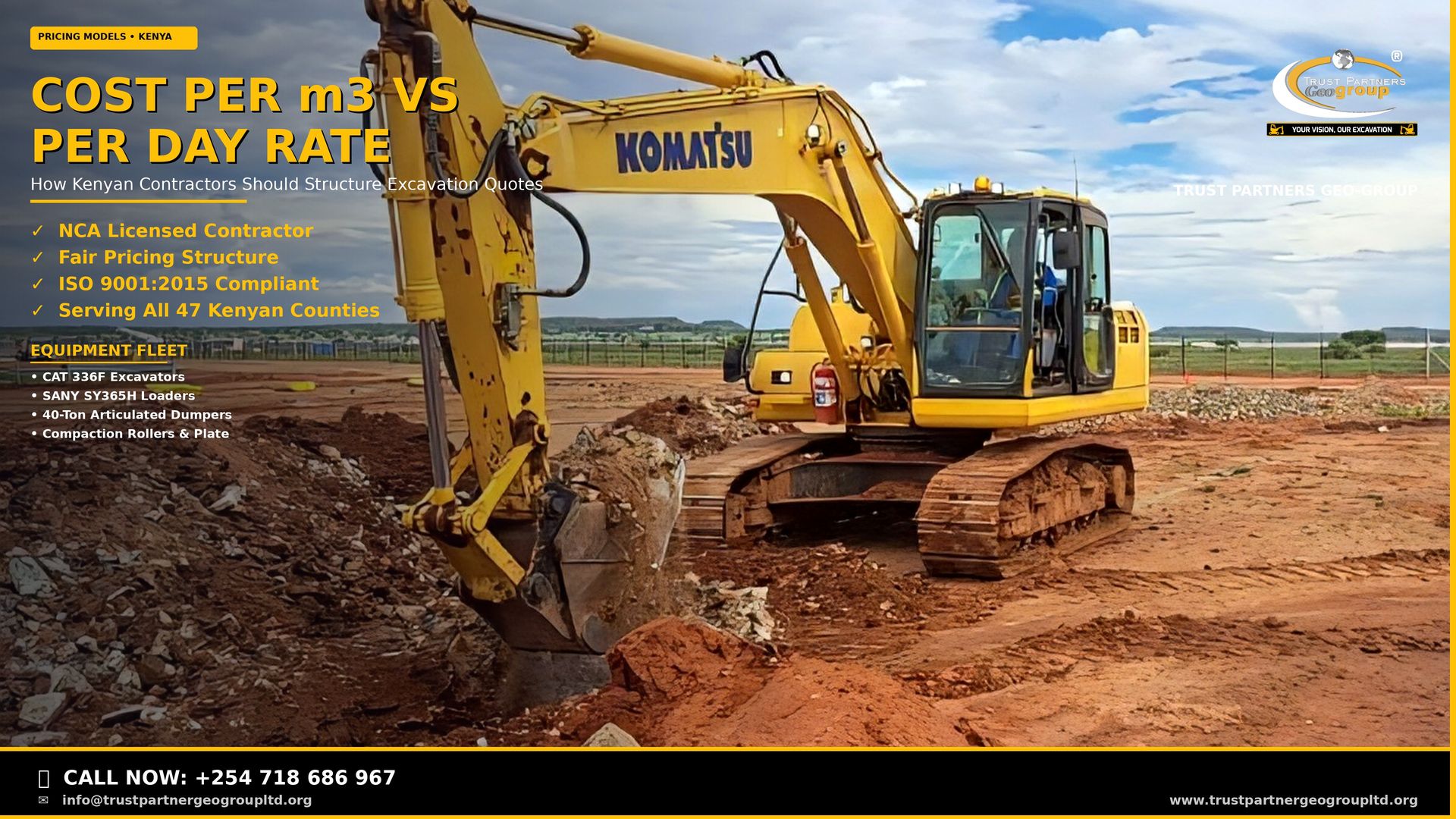
Excavation Cost Per Cubic Meter VS. Per Day: How Kenyan Contractors Should Structure Quotes
Should you price excavation per m3 or per day in Kenya? Compare pricing models, risk allocation and contractor quote structures for fairer earthworks contracts.

📋 Table of Contents
The Pricing Model Dilemma in Kenyan Excavation
Every excavation project in Kenya begins with a fundamental question: how should the work be priced? For contractors, the choice between excavation cost per cubic meter Kenya and excavation daily rate Nairobi pricing is not merely a matter of preference — it is a strategic decision that determines risk allocation, cash flow, profitability and client relationships. For clients, understanding these models is equally critical, because the pricing structure you accept directly affects your budget certainty, dispute exposure and overall project cost.
The Kenyan construction market has traditionally favoured per-day (daywork) pricing for earthworks, particularly on smaller projects and private developments. This reflects the uncertainty of ground conditions, the informality of many contractor-client relationships, and a historical lack of pre-tender geotechnical investigation. However, as the market matures — with larger developers, institutional investors, and county governments demanding greater cost predictability — per-cubic-metre and lump-sum pricing are gaining traction.
This guide examines both models in depth, compares their advantages and risks, introduces hybrid approaches that blend the best of each, and provides practical advice for both contractors structuring quotes and clients evaluating them. Whether you are a contractor deciding how to price your next tender or a developer comparing three different quote formats, the framework below will help you make an informed decision.
⚠️ The Cost of Choosing Wrong
A contractor who prices per m3 on a site with unmapped rock can lose 30-50% of their margin. A client who accepts per-day pricing for a well-defined basement excavation can overpay by 20-35% if the contractor is inefficient. The right pricing model aligns risk with information — the more you know about the ground before work begins, the more you can fix the price.
Per Cubic Metre (m³) Pricing Model
Per cubic metre pricing — also known as unit rate or measure-and-value pricing — charges the client a fixed rate for every cubic metre of material excavated, measured and verified on site. This is the standard pricing model for road earthworks, bulk excavations, and many basement projects in Kenya where quantities can be reasonably determined before work begins.
How m³ Pricing Works
The contractor calculates a rate per m³ that covers all costs associated with excavating, loading, and disposing of one cubic metre of material. This includes:
- Equipment hire or ownership cost (depreciation, maintenance, insurance)
- Operator wages and allowances
- Fuel consumption for the specific soil type
- Spoil disposal or cart-away
- Contractor overheads and profit margin
The total project cost is then: Total Volume × Rate per m³. Payment is typically made monthly based on measured quantities, with the contractor submitting quantity surveys supported by site records, photographs, and engineer verification.
Advantages of m³ Pricing
- Budget certainty for clients: If quantities are accurate, the client knows the total cost before work begins. This is essential for financed projects where lenders require fixed budgets.
- Fairness through measurement: The client pays only for what is actually excavated. If the drawings overstate quantities, the client benefits from the reduction.
- Contractor efficiency incentive: Because the rate is fixed, the contractor profits by completing work faster and more efficiently. This aligns contractor and client interests.
- Easy bid comparison: Clients can compare multiple contractor bids on a like-for-like basis — KSh 450/m³ vs KSh 520/m³ is a straightforward comparison.
- Payment milestone clarity: Progress payments are tied to measurable physical achievement, reducing payment disputes.
Risks and Disadvantages
- Quantity risk for contractors: If the client's drawings understate volumes — or if over-excavation is required for safety or compaction — the contractor absorbs the additional cost unless a variation order is approved.
- Soil condition risk: A rate based on soil excavation becomes unprofitable if rock is encountered. Contractors often add a rock-breaking rate as a separate schedule item, but disputes arise over what constitutes "rock" versus "boulder" or "hardpan."
- Measurement disputes: Clients and contractors frequently disagree on how volumes are calculated — net vs gross, before vs after bulking, with or without working space. Clear measurement rules must be defined in the contract.
- Cash flow pressure: Contractors must finance equipment and labour upfront, then wait for monthly measurement and certification before receiving payment. This can strain working capital on large projects.
Best Projects for m³ Pricing
Per cubic metre pricing works best for:
- Road earthworks with accurate topographical surveys
- Standard basement excavations (1-3 levels) with geotechnical reports
- Bulk site grading and plot cutting
- Dam and reservoir excavations with defined cut lines
- Any project where the ground profile is well understood and quantities are calculable
✅ m³ Pricing Success Tip
Always include a separate rate schedule for different material types — soil, soft rock, hard rock, and black cotton soil. This protects both parties from the most common source of m³ pricing disputes: unforeseen ground conditions.
Per Day (Daywork) Pricing Model
Per day pricing — also called daywork or time-and-materials pricing — charges the client a fixed daily rate for each piece of equipment and crew on site, regardless of how much material is moved. This model is common in Kenya for emergency works, complex urban basements, sites with unknown conditions, and projects where the client wants maximum flexibility to change scope.
How Daily Rate Pricing Works
The contractor quotes a daily rate for each machine-operator combination. A typical quote might look like:
- 30-ton excavator + operator: KSh 75,000 per day
- 40-ton dump truck + driver: KSh 55,000 per day
- Motor grader + operator: KSh 40,000 per day
The client pays for each day the equipment is on site and available for work, whether or not full production is achieved. Rates typically include the machine, operator, basic maintenance, and insurance, but exclude fuel, which is billed separately or via a surcharge.
Advantages of Daily Rate Pricing
- Risk transfer to client: The contractor is protected against quantity underestimation, rock encounters, and weather delays. The client bears these risks in exchange for flexibility.
- Flexibility for scope changes: If the client decides to dig deeper, add a basement level, or extend a trench, no contract amendment is needed — the equipment simply works additional days.
- Simplicity for small projects: For short-duration works (under 2 weeks), daily pricing avoids the administrative burden of quantity surveying and measurement.
- Contractor cash flow: Daily or weekly payment is often negotiable, improving the contractor's working capital position.
- Emergency responsiveness: When a sewer collapses, a landslide blocks a road, or a foundation fails, daily pricing allows contractors to mobilise immediately without waiting for detailed scope definition.
Risks and Disadvantages
- Budget uncertainty for clients: Without a fixed scope, total cost is unknown until work is complete. A 4-week project can stretch to 8 weeks if conditions are worse than expected.
- Productivity risk: The contractor has no financial incentive to work efficiently. A slow operator, poorly maintained machine, or deliberate under-crewing increases days at the client's expense.
- Disputes over chargeable time: Disagreements arise over whether breakdown days, rain days, mobilisation days, and standby time are chargeable. Contracts must define "a day" precisely.
- Higher total cost: Because the contractor builds risk premiums into daily rates, per-day pricing is typically 15-25% more expensive than per-m³ pricing for the same scope on a predictable site.
Best Projects for Daily Rate Pricing
Per day pricing works best for:
- Emergency excavation and repair works
- Sites with no geotechnical data or unreliable records
- Deep basements (4+ levels) in high water-table areas
- Projects with high utility congestion where hand digging and careful excavation are required
- Rock-breaking and demolition work where progress is inherently unpredictable
- Client-managed projects where the client wants direct control over daily operations
Comparison Table: m³ vs Day vs Lump Sum
The following table provides a side-by-side comparison of the three main pricing models used in Kenyan excavation, highlighting where each performs best and where it falls short.
| Criteria | Per m³ (Unit Rate) | Per Day (Daywork) | Lump Sum (Fixed Price) |
|---|---|---|---|
| Cost certainty for client | High (if quantities accurate) | Low | Highest |
| Profit certainty for contractor | Moderate | High | Moderate (risk premium built in) |
| Administrative burden | Medium (measurement required) | Low (time sheets) | Low (minimal post-tender admin) |
| Flexibility for scope changes | Low (variations needed) | Highest | Lowest |
| Efficiency incentive | High | Low | Highest |
| Best for predictable sites | ✅ Excellent | ⚠️ Overpriced | ✅ Excellent |
| Best for uncertain sites | ❌ Risky | ✅ Excellent | ❌ Very risky |
| Typical margin premium | 15-20% | 20-30% | 25-35% |
| Payment basis | Monthly on measured qty | Weekly or monthly on time | Milestones or monthly |
| Dispute likelihood | Medium (measurement) | High (productive time) | Low (if scope clear) |
Hybrid Pricing Models
In practice, the most sophisticated Kenyan contractors and experienced clients rarely use pure m³ or pure daily pricing. Instead, they adopt hybrid models that allocate risk to the party best able to manage it. The following hybrid structures have proven effective on complex projects:
Hybrid Model 1: m³ + Daywork Split
The known-scope portion is priced per m³, while high-risk elements are priced per day. For example:
- Soil excavation: KSh 450/m³ (fixed unit rate)
- Rock breaking (if encountered): KSh 65,000/day for breaker-equipped excavator
- Dewatering: KSh 5,500/day for wellpoint system
- Mobilisation/demobilisation: KSh 150,000 lump sum
This model gives the client cost certainty for the predictable majority of the work while protecting the contractor against the genuinely unforeseeable minority.
Hybrid Model 2: Target Cost with Gainshare/Painshare
The contractor and client agree a target cost based on estimated quantities and conditions. If the actual cost is below target, the savings are shared (e.g., 60% client, 40% contractor). If actual cost exceeds target, the overrun is shared (e.g., 70% contractor, 30% client). This aligns incentives and encourages collaboration rather than adversarial claims.
Hybrid Model 3: Lump Sum with Defined Contingencies
The contractor provides a fixed lump sum for the entire scope, but with clearly defined contingencies that trigger additional payment:
- Rock encountered below 2.0 m depth: additional KSh 1,500/m³
- Groundwater requiring dewatering beyond 2 weeks: additional KSh 5,000/day
- Utility diversion required: cost plus 15% margin
This gives the client a fixed budget for the base case while providing fair compensation for genuinely unforeseen conditions.
💡 Trust Partners Geo-Group Approach
We offer all three models — m³, daily, and hybrid — and recommend the structure that best fits each project's risk profile. For standard basements in Parklands, Kilimani and Upper Hill, we typically propose per-m³ pricing with separate rock and dewatering schedules. For complex deep basements or emergency works, we recommend hybrid or daily pricing with transparent rate cards.
How Clients Should Evaluate Different Quote Structures
When you receive three excavation quotes — one per m³, one per day, and one lump sum — how do you compare them fairly? The following framework helps clients cut through pricing model differences to identify the best value proposition.
Step 1: Normalise to a Common Basis
Convert all quotes to an estimated total project cost using your best estimate of quantities and duration. For the per-day quote, estimate how many days the work should take based on productivity benchmarks (e.g., 400-700 m³/day for bulk soil excavation with a 30-ton excavator). For the lump sum, the total is already fixed — but verify what is included.
Step 2: Verify Inclusions and Exclusions
Create a checklist of every cost item and mark whether each quote includes it:
- Spoil cart-away (to what distance?)
- Dewatering (for how long?)
- Compaction testing (how many tests?)
- Traffic management (if roadside)
- Night-shift premiums (if applicable)
- Fuel (included or excluded?)
- Mobilisation/demobilisation
A per-m³ quote of KSh 450 that excludes cart-away is not cheaper than a per-m³ quote of KSh 550 that includes it — if cart-away costs KSh 400/m³ separately.
Step 3: Assess Risk Allocation
Ask yourself: who is better placed to manage each risk? If you have reliable borehole data, you should push for per-m³ pricing and keep the efficiency gains. If the site is a geological mystery, accept that daily pricing may be fairer — but negotiate productivity guarantees and maximum duration caps.
Step 4: Check Contractor Credentials
Pricing model choice is irrelevant if the contractor lacks the equipment, experience, and financial stability to deliver. Verify NCA registration, inspect the equipment fleet, check references from similar projects, and confirm insurance coverage before evaluating the quote itself.
Step 5: Negotiate Transparency
The best quote is not the cheapest — it is the most transparent. Demand itemised breakdowns, clear variation procedures, and agreed measurement rules. A contractor who refuses to provide detail is a contractor planning to recover margin through extras.
Get a Fair, Transparent Quote from Trust Partners
Unsure which pricing model suits your project? Trust Partners Geo-Group explains every line item and recommends the structure that delivers best value. Contact us for a fully itemised, zero-surprise excavation quote.
Call +254 718 68 69 67📧 info@trustpartnergeogroupltd.org
Frequently Asked Questions
The choice between per m3 and per day pricing depends on project certainty and risk allocation. Per m3 pricing is better when quantities are accurately known from drawings, soil conditions are predictable, and the client wants cost certainty tied to measurable output. Per day pricing is better when quantities are uncertain, ground conditions are unknown, or the project requires flexibility. For most basement excavations in Nairobi with reliable geotechnical data, per m3 pricing offers better value. For emergency works, rock-breaking, or sites with unmapped utilities, per day pricing protects the contractor from losses while ensuring the client pays only for time actually worked.
Daily rate contracts transfer quantity risk to the client but introduce productivity risk. The main risks include: (1) Contractor inefficiency — a slow operator or poorly maintained machine increases days without increasing output. (2) Weather delays — rain, flooding, or muddy conditions extend the programme at the client's cost. (3) Scope creep — without a fixed quantity, clients may request additional work without formal variation orders. (4) Dispute over productive time — disagreements arise over whether standby time, breakdown time, or mobilisation days are chargeable. (5) Budget uncertainty — clients cannot fix total cost upfront, making financing and cash flow planning difficult.
Unit rate (per m3) pricing is ideal for earthworks when: (1) Quantities can be accurately calculated from topographical surveys and design drawings. (2) Soil conditions have been verified through boreholes or trial pits. (3) The project has a clear scope with minimal risk of unforeseen conditions. (4) The client wants budget certainty and the ability to compare contractor bids on a like-for-like basis. (5) Payment milestones can be tied to measurable progress. Unit rate pricing works best for bulk excavations, road earthworks, and standard basement projects where the ground profile is well understood. It is less suitable for deep basements in high water-table areas or sites with known rock or contamination issues.
To calculate excavation cost per cubic meter in Kenya, follow this framework: (1) Determine net excavation volume from drawings — length × width × depth, adjusting for slopes if unshored. (2) Add working space — typically 0.6-1.0 m beyond structural footprint for basements. (3) Classify soil type — common soil (KSh 450-650/m3), black cotton soil (KSh 550-750/m3), soft rock (KSh 1,200-1,800/m3), or hard rock (KSh 800-1,200/m3). (4) Add ancillary costs — dewatering, cart-away, testing, and traffic management — expressed as a per-m3 equivalent by dividing total ancillary cost by total volume. (5) Apply contractor margin — typically 15-25% for competitive tenders, 20-30% for negotiated work. Example: 3,500 m3 basement in red loam with dewatering and cart-away = (KSh 2,200 base + KSh 350 cart-away + KSh 200 dewatering) × 1.20 margin = KSh 3,420/m3.
The fairest pricing model depends on the information available at tender stage and the risk appetite of both parties. For well-documented projects with reliable geotechnical data, per m3 pricing with a defined provisional sum for unforeseen conditions offers the best balance — the client gets cost certainty for the known scope, while the contractor is protected against surprises. For uncertain sites, a hybrid model works best: per m3 for the known soil portion, per day for rock breaking or dewatering, and a fixed lump sum for mobilisation and demobilisation. The key to fairness is transparency — every line item must be clearly defined, and variation order procedures must be agreed before work begins. Trust Partners Geo-Group provides fully itemised quotes with optional fixed-price or unit-rate structures, allowing clients to choose the model that best fits their risk profile.
Excavation Cost Per Cubic Meter VS. Per Day: How Kenyan Contractors Should Structure Quotes
Should you price excavation per m3 or per day in Kenya? Compare pricing models, risk allocation and contractor quote structures for fairer earthworks contracts.
📋 Table of Contents
The Pricing Model Dilemma in Kenyan Excavation
Every excavation project in Kenya begins with a fundamental question: how should the work be priced? For contractors, the choice between excavation cost per cubic meter Kenya and excavation daily rate Nairobi pricing is not merely a matter of preference — it is a strategic decision that determines risk allocation, cash flow, profitability and client relationships. For clients, understanding these models is equally critical, because the pricing structure you accept directly affects your budget certainty, dispute exposure and overall project cost.
The Kenyan construction market has traditionally favoured per-day (daywork) pricing for earthworks, particularly on smaller projects and private developments. This reflects the uncertainty of ground conditions, the informality of many contractor-client relationships, and a historical lack of pre-tender geotechnical investigation. However, as the market matures — with larger developers, institutional investors, and county governments demanding greater cost predictability — per-cubic-metre and lump-sum pricing are gaining traction.
This guide examines both models in depth, compares their advantages and risks, introduces hybrid approaches that blend the best of each, and provides practical advice for both contractors structuring quotes and clients evaluating them. Whether you are a contractor deciding how to price your next tender or a developer comparing three different quote formats, the framework below will help you make an informed decision.
⚠️ The Cost of Choosing Wrong
A contractor who prices per m3 on a site with unmapped rock can lose 30-50% of their margin. A client who accepts per-day pricing for a well-defined basement excavation can overpay by 20-35% if the contractor is inefficient. The right pricing model aligns risk with information — the more you know about the ground before work begins, the more you can fix the price.
Per Cubic Metre (m³) Pricing Model
Per cubic metre pricing — also known as unit rate or measure-and-value pricing — charges the client a fixed rate for every cubic metre of material excavated, measured and verified on site. This is the standard pricing model for road earthworks, bulk excavations, and many basement projects in Kenya where quantities can be reasonably determined before work begins.
How m³ Pricing Works
The contractor calculates a rate per m³ that covers all costs associated with excavating, loading, and disposing of one cubic metre of material. This includes:
- Equipment hire or ownership cost (depreciation, maintenance, insurance)
- Operator wages and allowances
- Fuel consumption for the specific soil type
- Spoil disposal or cart-away
- Contractor overheads and profit margin
The total project cost is then: Total Volume × Rate per m³. Payment is typically made monthly based on measured quantities, with the contractor submitting quantity surveys supported by site records, photographs, and engineer verification.
Advantages of m³ Pricing
- Budget certainty for clients: If quantities are accurate, the client knows the total cost before work begins. This is essential for financed projects where lenders require fixed budgets.
- Fairness through measurement: The client pays only for what is actually excavated. If the drawings overstate quantities, the client benefits from the reduction.
- Contractor efficiency incentive: Because the rate is fixed, the contractor profits by completing work faster and more efficiently. This aligns contractor and client interests.
- Easy bid comparison: Clients can compare multiple contractor bids on a like-for-like basis — KSh 450/m³ vs KSh 520/m³ is a straightforward comparison.
- Payment milestone clarity: Progress payments are tied to measurable physical achievement, reducing payment disputes.
Risks and Disadvantages
- Quantity risk for contractors: If the client's drawings understate volumes — or if over-excavation is required for safety or compaction — the contractor absorbs the additional cost unless a variation order is approved.
- Soil condition risk: A rate based on soil excavation becomes unprofitable if rock is encountered. Contractors often add a rock-breaking rate as a separate schedule item, but disputes arise over what constitutes "rock" versus "boulder" or "hardpan."
- Measurement disputes: Clients and contractors frequently disagree on how volumes are calculated — net vs gross, before vs after bulking, with or without working space. Clear measurement rules must be defined in the contract.
- Cash flow pressure: Contractors must finance equipment and labour upfront, then wait for monthly measurement and certification before receiving payment. This can strain working capital on large projects.
Best Projects for m³ Pricing
Per cubic metre pricing works best for:
- Road earthworks with accurate topographical surveys
- Standard basement excavations (1-3 levels) with geotechnical reports
- Bulk site grading and plot cutting
- Dam and reservoir excavations with defined cut lines
- Any project where the ground profile is well understood and quantities are calculable
✅ m³ Pricing Success Tip
Always include a separate rate schedule for different material types — soil, soft rock, hard rock, and black cotton soil. This protects both parties from the most common source of m³ pricing disputes: unforeseen ground conditions.
Per Day (Daywork) Pricing Model
Per day pricing — also called daywork or time-and-materials pricing — charges the client a fixed daily rate for each piece of equipment and crew on site, regardless of how much material is moved. This model is common in Kenya for emergency works, complex urban basements, sites with unknown conditions, and projects where the client wants maximum flexibility to change scope.
How Daily Rate Pricing Works
The contractor quotes a daily rate for each machine-operator combination. A typical quote might look like:
- 30-ton excavator + operator: KSh 75,000 per day
- 40-ton dump truck + driver: KSh 55,000 per day
- Motor grader + operator: KSh 40,000 per day
The client pays for each day the equipment is on site and available for work, whether or not full production is achieved. Rates typically include the machine, operator, basic maintenance, and insurance, but exclude fuel, which is billed separately or via a surcharge.
Advantages of Daily Rate Pricing
- Risk transfer to client: The contractor is protected against quantity underestimation, rock encounters, and weather delays. The client bears these risks in exchange for flexibility.
- Flexibility for scope changes: If the client decides to dig deeper, add a basement level, or extend a trench, no contract amendment is needed — the equipment simply works additional days.
- Simplicity for small projects: For short-duration works (under 2 weeks), daily pricing avoids the administrative burden of quantity surveying and measurement.
- Contractor cash flow: Daily or weekly payment is often negotiable, improving the contractor's working capital position.
- Emergency responsiveness: When a sewer collapses, a landslide blocks a road, or a foundation fails, daily pricing allows contractors to mobilise immediately without waiting for detailed scope definition.
Risks and Disadvantages
- Budget uncertainty for clients: Without a fixed scope, total cost is unknown until work is complete. A 4-week project can stretch to 8 weeks if conditions are worse than expected.
- Productivity risk: The contractor has no financial incentive to work efficiently. A slow operator, poorly maintained machine, or deliberate under-crewing increases days at the client's expense.
- Disputes over chargeable time: Disagreements arise over whether breakdown days, rain days, mobilisation days, and standby time are chargeable. Contracts must define "a day" precisely.
- Higher total cost: Because the contractor builds risk premiums into daily rates, per-day pricing is typically 15-25% more expensive than per-m³ pricing for the same scope on a predictable site.
Best Projects for Daily Rate Pricing
Per day pricing works best for:
- Emergency excavation and repair works
- Sites with no geotechnical data or unreliable records
- Deep basements (4+ levels) in high water-table areas
- Projects with high utility congestion where hand digging and careful excavation are required
- Rock-breaking and demolition work where progress is inherently unpredictable
- Client-managed projects where the client wants direct control over daily operations
Comparison Table: m³ vs Day vs Lump Sum
The following table provides a side-by-side comparison of the three main pricing models used in Kenyan excavation, highlighting where each performs best and where it falls short.
| Criteria | Per m³ (Unit Rate) | Per Day (Daywork) | Lump Sum (Fixed Price) |
|---|---|---|---|
| Cost certainty for client | High (if quantities accurate) | Low | Highest |
| Profit certainty for contractor | Moderate | High | Moderate (risk premium built in) |
| Administrative burden | Medium (measurement required) | Low (time sheets) | Low (minimal post-tender admin) |
| Flexibility for scope changes | Low (variations needed) | Highest | Lowest |
| Efficiency incentive | High | Low | Highest |
| Best for predictable sites | ✅ Excellent | ⚠️ Overpriced | ✅ Excellent |
| Best for uncertain sites | ❌ Risky | ✅ Excellent | ❌ Very risky |
| Typical margin premium | 15-20% | 20-30% | 25-35% |
| Payment basis | Monthly on measured qty | Weekly or monthly on time | Milestones or monthly |
| Dispute likelihood | Medium (measurement) | High (productive time) | Low (if scope clear) |
Hybrid Pricing Models
In practice, the most sophisticated Kenyan contractors and experienced clients rarely use pure m³ or pure daily pricing. Instead, they adopt hybrid models that allocate risk to the party best able to manage it. The following hybrid structures have proven effective on complex projects:
Hybrid Model 1: m³ + Daywork Split
The known-scope portion is priced per m³, while high-risk elements are priced per day. For example:
- Soil excavation: KSh 450/m³ (fixed unit rate)
- Rock breaking (if encountered): KSh 65,000/day for breaker-equipped excavator
- Dewatering: KSh 5,500/day for wellpoint system
- Mobilisation/demobilisation: KSh 150,000 lump sum
This model gives the client cost certainty for the predictable majority of the work while protecting the contractor against the genuinely unforeseeable minority.
Hybrid Model 2: Target Cost with Gainshare/Painshare
The contractor and client agree a target cost based on estimated quantities and conditions. If the actual cost is below target, the savings are shared (e.g., 60% client, 40% contractor). If actual cost exceeds target, the overrun is shared (e.g., 70% contractor, 30% client). This aligns incentives and encourages collaboration rather than adversarial claims.
Hybrid Model 3: Lump Sum with Defined Contingencies
The contractor provides a fixed lump sum for the entire scope, but with clearly defined contingencies that trigger additional payment:
- Rock encountered below 2.0 m depth: additional KSh 1,500/m³
- Groundwater requiring dewatering beyond 2 weeks: additional KSh 5,000/day
- Utility diversion required: cost plus 15% margin
This gives the client a fixed budget for the base case while providing fair compensation for genuinely unforeseen conditions.
💡 Trust Partners Geo-Group Approach
We offer all three models — m³, daily, and hybrid — and recommend the structure that best fits each project's risk profile. For standard basements in Parklands, Kilimani and Upper Hill, we typically propose per-m³ pricing with separate rock and dewatering schedules. For complex deep basements or emergency works, we recommend hybrid or daily pricing with transparent rate cards.
How Clients Should Evaluate Different Quote Structures
When you receive three excavation quotes — one per m³, one per day, and one lump sum — how do you compare them fairly? The following framework helps clients cut through pricing model differences to identify the best value proposition.
Step 1: Normalise to a Common Basis
Convert all quotes to an estimated total project cost using your best estimate of quantities and duration. For the per-day quote, estimate how many days the work should take based on productivity benchmarks (e.g., 400-700 m³/day for bulk soil excavation with a 30-ton excavator). For the lump sum, the total is already fixed — but verify what is included.
Step 2: Verify Inclusions and Exclusions
Create a checklist of every cost item and mark whether each quote includes it:
- Spoil cart-away (to what distance?)
- Dewatering (for how long?)
- Compaction testing (how many tests?)
- Traffic management (if roadside)
- Night-shift premiums (if applicable)
- Fuel (included or excluded?)
- Mobilisation/demobilisation
A per-m³ quote of KSh 450 that excludes cart-away is not cheaper than a per-m³ quote of KSh 550 that includes it — if cart-away costs KSh 400/m³ separately.
Step 3: Assess Risk Allocation
Ask yourself: who is better placed to manage each risk? If you have reliable borehole data, you should push for per-m³ pricing and keep the efficiency gains. If the site is a geological mystery, accept that daily pricing may be fairer — but negotiate productivity guarantees and maximum duration caps.
Step 4: Check Contractor Credentials
Pricing model choice is irrelevant if the contractor lacks the equipment, experience, and financial stability to deliver. Verify NCA registration, inspect the equipment fleet, check references from similar projects, and confirm insurance coverage before evaluating the quote itself.
Step 5: Negotiate Transparency
The best quote is not the cheapest — it is the most transparent. Demand itemised breakdowns, clear variation procedures, and agreed measurement rules. A contractor who refuses to provide detail is a contractor planning to recover margin through extras.
Get a Fair, Transparent Quote from Trust Partners
Unsure which pricing model suits your project? Trust Partners Geo-Group explains every line item and recommends the structure that delivers best value. Contact us for a fully itemised, zero-surprise excavation quote.
Call +254 718 68 69 67📧 info@trustpartnergeogroupltd.org
Frequently Asked Questions
The choice between per m3 and per day pricing depends on project certainty and risk allocation. Per m3 pricing is better when quantities are accurately known from drawings, soil conditions are predictable, and the client wants cost certainty tied to measurable output. Per day pricing is better when quantities are uncertain, ground conditions are unknown, or the project requires flexibility. For most basement excavations in Nairobi with reliable geotechnical data, per m3 pricing offers better value. For emergency works, rock-breaking, or sites with unmapped utilities, per day pricing protects the contractor from losses while ensuring the client pays only for time actually worked.
Daily rate contracts transfer quantity risk to the client but introduce productivity risk. The main risks include: (1) Contractor inefficiency — a slow operator or poorly maintained machine increases days without increasing output. (2) Weather delays — rain, flooding, or muddy conditions extend the programme at the client's cost. (3) Scope creep — without a fixed quantity, clients may request additional work without formal variation orders. (4) Dispute over productive time — disagreements arise over whether standby time, breakdown time, or mobilisation days are chargeable. (5) Budget uncertainty — clients cannot fix total cost upfront, making financing and cash flow planning difficult.
Unit rate (per m3) pricing is ideal for earthworks when: (1) Quantities can be accurately calculated from topographical surveys and design drawings. (2) Soil conditions have been verified through boreholes or trial pits. (3) The project has a clear scope with minimal risk of unforeseen conditions. (4) The client wants budget certainty and the ability to compare contractor bids on a like-for-like basis. (5) Payment milestones can be tied to measurable progress. Unit rate pricing works best for bulk excavations, road earthworks, and standard basement projects where the ground profile is well understood. It is less suitable for deep basements in high water-table areas or sites with known rock or contamination issues.
To calculate excavation cost per cubic meter in Kenya, follow this framework: (1) Determine net excavation volume from drawings — length × width × depth, adjusting for slopes if unshored. (2) Add working space — typically 0.6-1.0 m beyond structural footprint for basements. (3) Classify soil type — common soil (KSh 450-650/m3), black cotton soil (KSh 550-750/m3), soft rock (KSh 1,200-1,800/m3), or hard rock (KSh 800-1,200/m3). (4) Add ancillary costs — dewatering, cart-away, testing, and traffic management — expressed as a per-m3 equivalent by dividing total ancillary cost by total volume. (5) Apply contractor margin — typically 15-25% for competitive tenders, 20-30% for negotiated work. Example: 3,500 m3 basement in red loam with dewatering and cart-away = (KSh 2,200 base + KSh 350 cart-away + KSh 200 dewatering) × 1.20 margin = KSh 3,420/m3.
The fairest pricing model depends on the information available at tender stage and the risk appetite of both parties. For well-documented projects with reliable geotechnical data, per m3 pricing with a defined provisional sum for unforeseen conditions offers the best balance — the client gets cost certainty for the known scope, while the contractor is protected against surprises. For uncertain sites, a hybrid model works best: per m3 for the known soil portion, per day for rock breaking or dewatering, and a fixed lump sum for mobilisation and demobilisation. The key to fairness is transparency — every line item must be clearly defined, and variation order procedures must be agreed before work begins. Trust Partners Geo-Group provides fully itemised quotes with optional fixed-price or unit-rate structures, allowing clients to choose the model that best fits their risk profile.