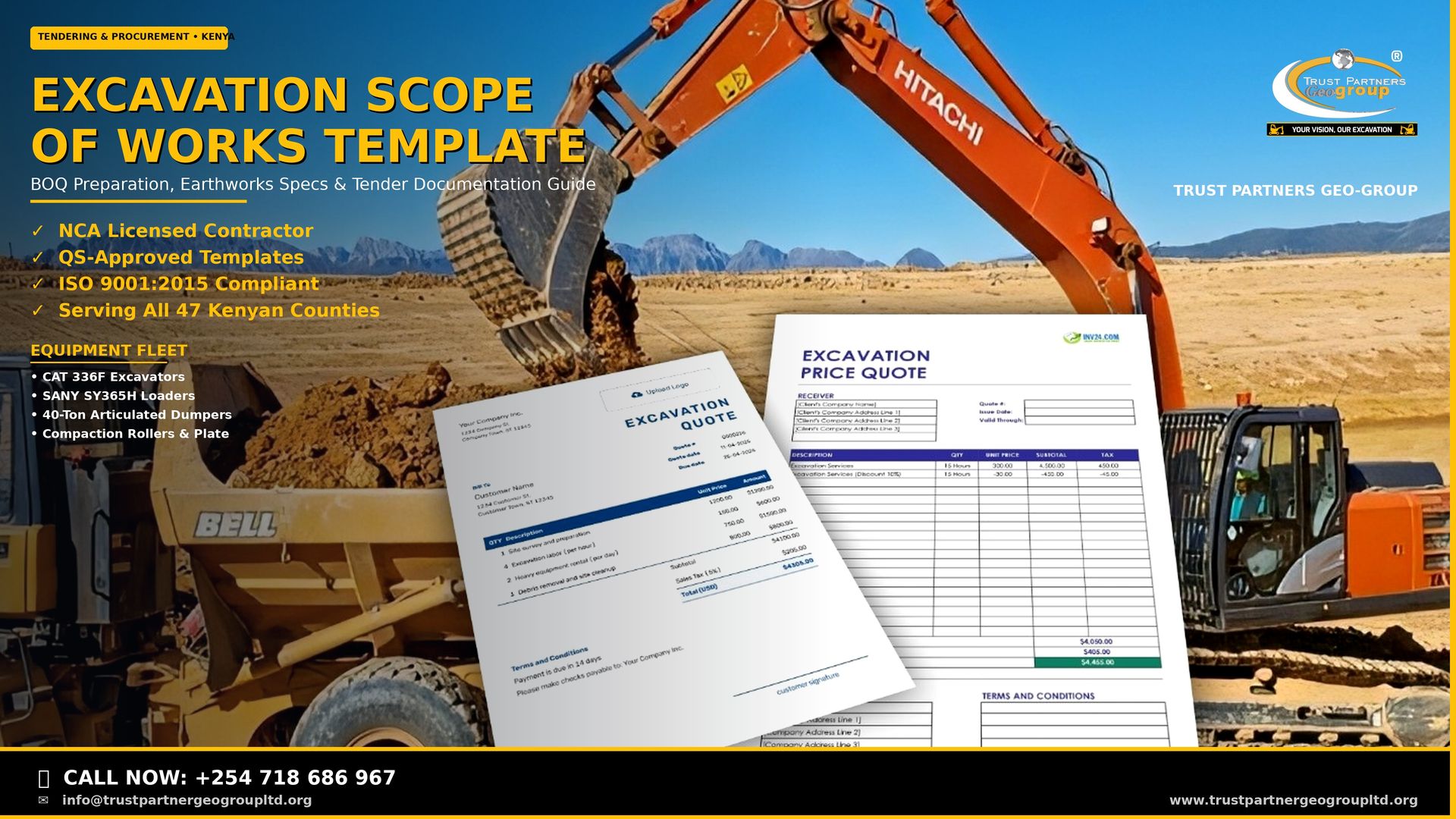
How to Write an Excavation Scope of Works: Template for Kenyan Developers & QS Teams
A professional guide to drafting excavation scope of works documents, BOQ preparation, earthworks specifications and method statements for Kenyan construction projects. Download our free template.

📋 Table of Contents
- Why a Detailed Excavation Scope of Works Matters
- Key Components of an Excavation Scope of Works
- Project Overview and Site Description
- Scope of Earthworks (Cut, Fill, Import, Export)
- Technical Specifications and Standards
- Equipment and Methodology Requirements
- Quality Assurance and Testing Protocols
- Health, Safety and Environmental Requirements
- Programme and Milestone Dates
- Downloadable Excavation Scope of Works Template
- Common Mistakes in Excavation Scope Documents
- How to Evaluate Contractor Responses to Your Scope
- Frequently Asked Questions
- Need Help Drafting Your Excavation Scope?
Every construction project in Kenya — from a high-rise basement in Upper Hill to a road embankment in Nakuru — begins with earthworks. Yet the majority of disputes between developers and contractors trace back to poorly defined excavation scopes. Ambiguous quantities, missing testing protocols, and undefined spoil disposal responsibilities create the perfect storm for variation orders, cost overruns, and project delays.
This guide is written for quantity surveyors, project managers, and developers who need to produce bulletproof excavation scope of works documents that withstand tender scrutiny, contract enforcement, and site reality. At Trust Partners Geo-Group Ltd, we review dozens of excavation scopes every month — from county government BOQs to private sector tender documents. We know what separates a scope that attracts competitive, accurate bids from one that invites disputes.
Why a Detailed Excavation Scope of Works Matters
An excavation scope of works is not merely a formality — it is the contractual foundation upon which pricing, programme, and risk allocation rest. In Kenya's construction market, where earthwork rates vary by 40-60% between contractors, a precise scope ensures apples-to-apples bid comparison.
The consequences of a poorly drafted scope include:
- Provisional sum blowouts — When quantities are estimated rather than calculated from survey data, contractors load risk into their rates. A 20% quantity variance on a KES 5M earthworks package can trigger KES 1M+ in variation orders.
- Methodology conflicts — Without specifying equipment size and sequence, one contractor may price for a 30-ton excavator while another assumes manual methods. The result? Incomparable bids and post-award disputes.
- Testing gaps — If the scope omits compaction testing frequencies, contractors may skip testing entirely, leaving the developer with substandard subgrades and pavement failures within months.
- Spoil disposal surprises — Nairobi's NEMA regulations prohibit dumping within city limits without a waste movement licence. A scope that says "cart away" without specifying disposal site and distance exposes the developer to unbudgeted costs of KES 800-1,500 per m3.
💡 Pro Tip from Trust Partners
The best excavation scopes we see come from QS teams who invest in a detailed topographic survey before tender. Spending KES 50,000-100,000 on survey and geotechnical investigation upfront saves KES 500,000+ in variation orders later. Learn how basement projects are planned for survey best practices.
Key Components of an Excavation Scope of Works
A comprehensive excavation scope of works for Kenyan construction projects should contain seven mandatory sections. Each section below includes explanatory guidance and example wording you can adapt for your project.
1. Project Overview and Site Description
This section orients contractors to the physical and logistical context of the project:
- Site location and access — "The site is located at [Plot No., Road, County], approximately [X] km from [nearest major road]. Site access is via a [X] metre wide existing murram road with [X] metre vertical clearance. No heavy vehicle access restrictions apply."
- Site constraints — Document neighbouring structures, overhead power lines (Kenya Power 33kV line at eastern boundary), existing trees to be retained, archaeological sensitivity, and working hours restrictions (e.g., "No works between 10:00 PM and 6:00 AM per county noise bylaws").
- Existing services — "The site contains an existing 150mm diameter water main at 1.2m depth along the southern boundary (marked by Kenya Water blue pegs). A 33kV overhead line crosses the north-west corner at 8.5m height. The contractor shall verify all services via CAT scan before excavation and obtain Kenya Power safety clearance for works within 10 metres of the overhead line."
- Site datum and benchmarks — Reference the survey datum (e.g., "All levels are referenced to Ardhisasa beacon ABC-123 at RL 1,682.45m"). Provide a site plan showing grid lines, existing levels, and proposed formation levels.
2. Scope of Earthworks (Cut, Fill, Import, Export)
This is the quantitative heart of the scope. Be explicit about what is included and excluded:
| Item | Description | Unit | Qty (Indicative) |
|---|---|---|---|
| 2.1 | Topsoil stripping to 300mm depth and stockpiling for reuse | m² | 2,450 |
| 2.2 | Bulk excavation in soil (ordinary) to formation level | m³ | 5,800 |
| 2.3 | Bulk excavation in rock (medium hardness) to formation level | m³ | 420 |
| 2.4 | Trench excavation for strip footings (max depth 1.5m) | m³ | 850 |
| 2.5 | Backfilling with selected granular material (CBR ≥15%) | m³ | 1,200 |
| 2.6 | Import of approved fill material (lateritic gravel) | m³ | 680 |
| 2.7 | Cart away of surplus spoil to approved dumping site (max 15km) | m³ | 3,200 |
| 2.8 | Subgrade compaction to 95% MDD (Modified Proctor) | m² | 2,450 |
Critical inclusions for this section:
- Formation level definition — "Formation level is defined as the underside of blinding concrete (150mm thick) for raft foundations, or underside of compacted sub-base (200mm thick) for pavement areas."
- Excavation tolerances — "Bulk excavation shall be to within +50mm / -0mm of formation level. Final 150mm shall be excavated by smaller equipment or manually to avoid over-excavation and disturbance of bearing stratum."
- Groundwater — "The contractor shall allow for dewatering by wellpoint or sump pumping to maintain excavation bottoms dry. Groundwater was encountered at 2.8m depth in borehole BH-02."
- Rock definition — "Rock is defined as material requiring hydraulic breaker or blasting for excavation, verified by geotechnical engineer. Rate for rock excavation is provisional and subject to remeasurement."
3. Technical Specifications and Standards
Reference the standards that govern workmanship and materials:
- Soil classification — "Soils shall be classified per BS 1377 and USCS. The contractor shall submit particle size distribution, Atterberg limits, and moisture content for all imported fill materials."
- Compaction standards — "Subgrade beneath foundations: 95% MDD (Modified Proctor, BS 1377:Part 4). Sub-base for pavements: 98% MDD. Trench backfill: 90% MDD in 150mm layers."
- Fill material requirements — "Imported fill shall be free-draining lateritic gravel with maximum particle size 37mm, plasticity index (PI) <12, and organic content <2% by mass."
- Excavation support — "Where excavation depth exceeds 1.5m and adjacent to existing structures, the contractor shall design and install shoring per BS 8002. Shoring design shall be signed by a registered structural engineer."
- Tree protection — "Trees marked for retention on the landscape plan shall be protected by fencing at the drip line. No excavation, storage of materials, or vehicle movement shall occur within the protected zone."
4. Equipment and Methodology Requirements
While contractors propose their own methods, the scope should set minimum capabilities:
- Minimum equipment — "The contractor shall deploy a minimum of one 20-ton hydraulic excavator with GPS grade control capability, one D6 bulldozer, one 10-ton smooth drum vibratory roller, and two 20-ton articulated dump trucks."
- Excavation sequence — "Excavation shall proceed in phases from east to west to maintain positive drainage. No excavation shall commence until dewatering systems are operational."
- Spoil management — "Spoil shall be temporarily stockpiled in designated areas shown on the site plan. Stockpile height shall not exceed 3 metres. Spoil shall be covered with tarpaulin during rainy season to prevent erosion."
- Working hours — "Normal working hours are 07:30 to 17:30, Monday to Saturday. No Sunday or public holiday work without written approval from the Engineer."
5. Quality Assurance and Testing Protocols
Define who tests, how often, and to what standard:
- Compaction testing — "In-situ density tests shall be carried out by a NEMA-accredited geotechnical laboratory at the following frequencies: (a) Subgrade: one test per 500m² per lift, (b) Trench backfill: one test per 50 linear metres per lift, (c) Sub-base: one test per 250m² per lift."
- Material testing — "Imported fill shall be tested for grading, PI, and CBR before placement. One test per 500m³ or per source, whichever is more frequent."
- Concrete testing — "Where blinding concrete is specified, cube tests (3 cubes per set) shall be taken per 20m³ of concrete or per day, per BS 1881."
- As-built survey — "Upon completion, the contractor shall provide an as-built topographic survey showing final excavation levels, drainage invert levels, and utility crossings. Survey shall be by a registered land surveyor."
6. Health, Safety and Environmental Requirements
Kenyan law mandates specific safety and environmental compliance:
- OSHA 2007 compliance — "The contractor shall comply with the Occupational Safety and Health Act 2007, including provision of PPE (hard hats, high-visibility vests, safety boots), trench shoring for depths >1.5m, and confined space entry permits."
- NEMA compliance — "The contractor shall obtain a NEMA Environmental Management Plan approval before site establishment. Dust suppression (water spraying) shall be continuous during dry conditions. Sediment fences shall be installed at site boundaries."
- Traffic management — "Where works affect public roads, the contractor shall submit a Traffic Management Plan to the County Roads Department and KeNHA (for Class A/B roads) for approval."
- Emergency response — "The contractor shall maintain a fully stocked first aid station, trained first aiders on site, and emergency contact numbers displayed at the site office."
7. Programme and Milestone Dates
Link earthworks to the overall construction programme:
- Commencement — "Works shall commence within 7 calendar days of possession of site."
- Key milestones — "(a) Site clearance and topsoil strip: Week 1, (b) Bulk excavation 50% complete: Week 3, (c) Bulk excavation 100% complete: Week 5, (d) Subgrade compaction and testing: Week 6, (e) Handover to foundation contractor: Week 7."
- Liquidated damages — "The contractor shall pay liquidated damages of 0.05% of the contract sum per day for delay beyond the agreed completion date, capped at 10% of contract sum."
- Early completion bonus — "A bonus of KES 50,000 per day shall be paid for completion ahead of programme, capped at 5% of contract sum."
Downloadable Excavation Scope of Works Template [PDF]
To save you time, we have prepared a comprehensive Excavation Scope of Works Template in Microsoft Word format, pre-populated with the sections above, example wording, and a BOQ table. The template is fully editable for your specific project.
📥 Free Download: Excavation Scope of Works Template
Our template includes: (1) Pre-formatted scope document structure, (2) Example BOQ table with 25 standard earthworks items, (3) Method statement checklist, (4) Testing schedule template, (5) HSE plan outline, and (6) Programme milestone tracker. Email info@trustpartnergeogroupltd.org with subject "Scope Template" and we will send it within 24 hours.
Common Mistakes in Excavation Scope Documents
After reviewing hundreds of scopes, these are the most expensive errors we encounter:
Mistake 1: Vague Quantity Descriptions
Bad: "Excavate as required."
Good: "Excavate 5,800m³ of soil to formation level as shown on Drawing C-101. Quantity is approximate and subject to remeasurement from as-built survey."
Mistake 2: Missing Spoil Disposal Details
Bad: "Cart away surplus material."
Good: "Cart away surplus material to an approved dumping site within 15km of site. Contractor to obtain NEMA waste movement licence and provide tipping receipts."
Mistake 3: No Reference to Geotechnical Report
Every scope should reference the geotechnical investigation report by number and date. Without it, contractors cannot assess rock risk, groundwater, or soil suitability for reuse.
Mistake 4: Ignoring Seasonal Constraints
Scopes drafted in January often ignore Kenya's long rains (March-May). Include: "The contractor shall allow for dewatering, soil stabilization, and erosion control during rainy season. No additional payment shall be made for rain-related delays unless the Engineer certifies exceptional weather."
Mistake 5: Omitting Handover Criteria
Define exactly when earthworks are "complete." Is it after the last compaction test? After as-built survey submission? After Engineer sign-off? Without clarity, foundation contractors refuse to accept handover, creating programme gaps.
How to Evaluate Contractor Responses to Your Scope
Once tenders are returned, use this evaluation framework:
| Criteria | Weight | What to Look For |
|---|---|---|
| Rate reasonableness | 30% | Within ±15% of QS estimate; flag low outliers |
| Methodology feasibility | 25% | Equipment matches scope; sequence is logical |
| Programme realism | 20% | Achievable with stated resources; buffer for weather |
| Experience | 15% | 3+ similar projects completed; references check |
| Compliance | 10% | NCA reg, insurance, safety certs all valid |
Red flags in tender returns:
- Rates 30%+ below estimate (indicates missing items or desperation)
- No mention of testing in pricing (contractor plans to skip QA)
- Vague equipment list ("excavators as required" instead of specific tonnage)
- No allowance for dewatering despite groundwater in geotech report
- Programme shorter than 60% of your estimate (unachievable without corner-cutting)
Frequently Asked Questions About Excavation Scope of Works
An excavation scope of works should include: (1) Project overview and site description with access constraints, (2) Detailed earthworks scope defining cut, fill, import and export volumes, (3) Technical specifications referencing Kenyan building codes and BS standards, (4) Equipment and methodology requirements, (5) Quality assurance and testing protocols including compaction frequencies, (6) Health, safety and environmental requirements, (7) Programme and milestone dates with penalties for delay, and (8) Documentation and handover requirements including as-built drawings and test records.
To prepare an earthworks BOQ in Kenya, first conduct a topographic survey to establish existing ground levels. Calculate cut and fill volumes using software or grid methods. Itemize works by: bulk excavation in soil, bulk excavation in rock, trench excavation, backfilling, cart away of surplus spoil, import of fill material, and compaction. Apply unit rates from current market data (KES 1,500-3,500 per m³ for soil excavation). Include preliminaries for site establishment, testing, and environmental compliance. Reference the Standard Method of Measurement (SMM7) or Kenyan Standard Method of Measurement for consistency.
The scope of works defines WHAT work is to be done and the extent of work — it describes the boundaries of the contract, quantities, and deliverables. The specification defines HOW the work is to be done — it details materials, workmanship standards, testing requirements, and compliance with codes. In excavation projects, the scope states "excavate 5,000 m³ of soil to formation level," while the specification states "excavate to ±25mm tolerance, compact subgrade to 95% MDD per BS 1377, and test every 500 m²." Both documents are essential for tender clarity and contract enforcement.
Quantity Surveyor teams evaluate excavation contractors through: (1) Technical capability assessment — reviewing equipment fleet, operator certifications, and past project experience, (2) Financial viability analysis — checking audited accounts, bank references, and turnover capacity, (3) Rate analysis — comparing unit rates against market benchmarks and identifying unrealistically low bids, (4) Methodology review — assessing the feasibility of proposed excavation sequences, phasing, and traffic management, (5) Safety and compliance history — verifying NCA registration, NEMA compliance, and OSHA safety records, and (6) Reference checks — contacting previous clients for performance feedback on timelines, quality, and dispute resolution.
Excavation scope documents in Kenya must reference: (1) Kenyan Building Code 2009 and county by-laws for construction standards, (2) BS 1377 for soil testing and classification, (3) BS 5930 for site investigation, (4) ASTM D1557 or BS 1377 for compaction testing (Modified Proctor), (5) Kenya Road Design Manual for pavement subgrade requirements, (6) NEMA Environmental Management and Coordination Act for environmental compliance, (7) OSHA 2007 for occupational health and safety, and (8) NCA regulations for contractor registration and project oversight. International projects may also reference FIDIC conditions of contract.
Need Expert Input on Your Excavation Scope?
Trust Partners Geo-Group reviews excavation scopes of works for developers and QS teams across Kenya. From BOQ validation to methodology review and contractor prequalification, we ensure your tender documents attract competitive, compliant bids.
📞 +254 718 68 69 67Request Free Scope Template
Serving all 47 counties including Nairobi, Mombasa, Kisumu, Nakuru, and beyond.
How to Write an Excavation Scope of Works: Template for Kenyan Developers & QS Teams
A professional guide to drafting excavation scope of works documents, BOQ preparation, earthworks specifications and method statements for Kenyan construction projects. Download our free template.
📋 Table of Contents
- Why a Detailed Excavation Scope of Works Matters
- Key Components of an Excavation Scope of Works
- Project Overview and Site Description
- Scope of Earthworks (Cut, Fill, Import, Export)
- Technical Specifications and Standards
- Equipment and Methodology Requirements
- Quality Assurance and Testing Protocols
- Health, Safety and Environmental Requirements
- Programme and Milestone Dates
- Downloadable Excavation Scope of Works Template
- Common Mistakes in Excavation Scope Documents
- How to Evaluate Contractor Responses to Your Scope
- Frequently Asked Questions
- Need Help Drafting Your Excavation Scope?
Every construction project in Kenya — from a high-rise basement in Upper Hill to a road embankment in Nakuru — begins with earthworks. Yet the majority of disputes between developers and contractors trace back to poorly defined excavation scopes. Ambiguous quantities, missing testing protocols, and undefined spoil disposal responsibilities create the perfect storm for variation orders, cost overruns, and project delays.
This guide is written for quantity surveyors, project managers, and developers who need to produce bulletproof excavation scope of works documents that withstand tender scrutiny, contract enforcement, and site reality. At Trust Partners Geo-Group Ltd, we review dozens of excavation scopes every month — from county government BOQs to private sector tender documents. We know what separates a scope that attracts competitive, accurate bids from one that invites disputes.
Why a Detailed Excavation Scope of Works Matters
An excavation scope of works is not merely a formality — it is the contractual foundation upon which pricing, programme, and risk allocation rest. In Kenya's construction market, where earthwork rates vary by 40-60% between contractors, a precise scope ensures apples-to-apples bid comparison.
The consequences of a poorly drafted scope include:
- Provisional sum blowouts — When quantities are estimated rather than calculated from survey data, contractors load risk into their rates. A 20% quantity variance on a KES 5M earthworks package can trigger KES 1M+ in variation orders.
- Methodology conflicts — Without specifying equipment size and sequence, one contractor may price for a 30-ton excavator while another assumes manual methods. The result? Incomparable bids and post-award disputes.
- Testing gaps — If the scope omits compaction testing frequencies, contractors may skip testing entirely, leaving the developer with substandard subgrades and pavement failures within months.
- Spoil disposal surprises — Nairobi's NEMA regulations prohibit dumping within city limits without a waste movement licence. A scope that says "cart away" without specifying disposal site and distance exposes the developer to unbudgeted costs of KES 800-1,500 per m3.
💡 Pro Tip from Trust Partners
The best excavation scopes we see come from QS teams who invest in a detailed topographic survey before tender. Spending KES 50,000-100,000 on survey and geotechnical investigation upfront saves KES 500,000+ in variation orders later. Learn how basement projects are planned for survey best practices.
Key Components of an Excavation Scope of Works
A comprehensive excavation scope of works for Kenyan construction projects should contain seven mandatory sections. Each section below includes explanatory guidance and example wording you can adapt for your project.
1. Project Overview and Site Description
This section orients contractors to the physical and logistical context of the project:
- Site location and access — "The site is located at [Plot No., Road, County], approximately [X] km from [nearest major road]. Site access is via a [X] metre wide existing murram road with [X] metre vertical clearance. No heavy vehicle access restrictions apply."
- Site constraints — Document neighbouring structures, overhead power lines (Kenya Power 33kV line at eastern boundary), existing trees to be retained, archaeological sensitivity, and working hours restrictions (e.g., "No works between 10:00 PM and 6:00 AM per county noise bylaws").
- Existing services — "The site contains an existing 150mm diameter water main at 1.2m depth along the southern boundary (marked by Kenya Water blue pegs). A 33kV overhead line crosses the north-west corner at 8.5m height. The contractor shall verify all services via CAT scan before excavation and obtain Kenya Power safety clearance for works within 10 metres of the overhead line."
- Site datum and benchmarks — Reference the survey datum (e.g., "All levels are referenced to Ardhisasa beacon ABC-123 at RL 1,682.45m"). Provide a site plan showing grid lines, existing levels, and proposed formation levels.
2. Scope of Earthworks (Cut, Fill, Import, Export)
This is the quantitative heart of the scope. Be explicit about what is included and excluded:
| Item | Description | Unit | Qty (Indicative) |
|---|---|---|---|
| 2.1 | Topsoil stripping to 300mm depth and stockpiling for reuse | m² | 2,450 |
| 2.2 | Bulk excavation in soil (ordinary) to formation level | m³ | 5,800 |
| 2.3 | Bulk excavation in rock (medium hardness) to formation level | m³ | 420 |
| 2.4 | Trench excavation for strip footings (max depth 1.5m) | m³ | 850 |
| 2.5 | Backfilling with selected granular material (CBR ≥15%) | m³ | 1,200 |
| 2.6 | Import of approved fill material (lateritic gravel) | m³ | 680 |
| 2.7 | Cart away of surplus spoil to approved dumping site (max 15km) | m³ | 3,200 |
| 2.8 | Subgrade compaction to 95% MDD (Modified Proctor) | m² | 2,450 |
Critical inclusions for this section:
- Formation level definition — "Formation level is defined as the underside of blinding concrete (150mm thick) for raft foundations, or underside of compacted sub-base (200mm thick) for pavement areas."
- Excavation tolerances — "Bulk excavation shall be to within +50mm / -0mm of formation level. Final 150mm shall be excavated by smaller equipment or manually to avoid over-excavation and disturbance of bearing stratum."
- Groundwater — "The contractor shall allow for dewatering by wellpoint or sump pumping to maintain excavation bottoms dry. Groundwater was encountered at 2.8m depth in borehole BH-02."
- Rock definition — "Rock is defined as material requiring hydraulic breaker or blasting for excavation, verified by geotechnical engineer. Rate for rock excavation is provisional and subject to remeasurement."
3. Technical Specifications and Standards
Reference the standards that govern workmanship and materials:
- Soil classification — "Soils shall be classified per BS 1377 and USCS. The contractor shall submit particle size distribution, Atterberg limits, and moisture content for all imported fill materials."
- Compaction standards — "Subgrade beneath foundations: 95% MDD (Modified Proctor, BS 1377:Part 4). Sub-base for pavements: 98% MDD. Trench backfill: 90% MDD in 150mm layers."
- Fill material requirements — "Imported fill shall be free-draining lateritic gravel with maximum particle size 37mm, plasticity index (PI) <12, and organic content <2% by mass."
- Excavation support — "Where excavation depth exceeds 1.5m and adjacent to existing structures, the contractor shall design and install shoring per BS 8002. Shoring design shall be signed by a registered structural engineer."
- Tree protection — "Trees marked for retention on the landscape plan shall be protected by fencing at the drip line. No excavation, storage of materials, or vehicle movement shall occur within the protected zone."
4. Equipment and Methodology Requirements
While contractors propose their own methods, the scope should set minimum capabilities:
- Minimum equipment — "The contractor shall deploy a minimum of one 20-ton hydraulic excavator with GPS grade control capability, one D6 bulldozer, one 10-ton smooth drum vibratory roller, and two 20-ton articulated dump trucks."
- Excavation sequence — "Excavation shall proceed in phases from east to west to maintain positive drainage. No excavation shall commence until dewatering systems are operational."
- Spoil management — "Spoil shall be temporarily stockpiled in designated areas shown on the site plan. Stockpile height shall not exceed 3 metres. Spoil shall be covered with tarpaulin during rainy season to prevent erosion."
- Working hours — "Normal working hours are 07:30 to 17:30, Monday to Saturday. No Sunday or public holiday work without written approval from the Engineer."
5. Quality Assurance and Testing Protocols
Define who tests, how often, and to what standard:
- Compaction testing — "In-situ density tests shall be carried out by a NEMA-accredited geotechnical laboratory at the following frequencies: (a) Subgrade: one test per 500m² per lift, (b) Trench backfill: one test per 50 linear metres per lift, (c) Sub-base: one test per 250m² per lift."
- Material testing — "Imported fill shall be tested for grading, PI, and CBR before placement. One test per 500m³ or per source, whichever is more frequent."
- Concrete testing — "Where blinding concrete is specified, cube tests (3 cubes per set) shall be taken per 20m³ of concrete or per day, per BS 1881."
- As-built survey — "Upon completion, the contractor shall provide an as-built topographic survey showing final excavation levels, drainage invert levels, and utility crossings. Survey shall be by a registered land surveyor."
6. Health, Safety and Environmental Requirements
Kenyan law mandates specific safety and environmental compliance:
- OSHA 2007 compliance — "The contractor shall comply with the Occupational Safety and Health Act 2007, including provision of PPE (hard hats, high-visibility vests, safety boots), trench shoring for depths >1.5m, and confined space entry permits."
- NEMA compliance — "The contractor shall obtain a NEMA Environmental Management Plan approval before site establishment. Dust suppression (water spraying) shall be continuous during dry conditions. Sediment fences shall be installed at site boundaries."
- Traffic management — "Where works affect public roads, the contractor shall submit a Traffic Management Plan to the County Roads Department and KeNHA (for Class A/B roads) for approval."
- Emergency response — "The contractor shall maintain a fully stocked first aid station, trained first aiders on site, and emergency contact numbers displayed at the site office."
7. Programme and Milestone Dates
Link earthworks to the overall construction programme:
- Commencement — "Works shall commence within 7 calendar days of possession of site."
- Key milestones — "(a) Site clearance and topsoil strip: Week 1, (b) Bulk excavation 50% complete: Week 3, (c) Bulk excavation 100% complete: Week 5, (d) Subgrade compaction and testing: Week 6, (e) Handover to foundation contractor: Week 7."
- Liquidated damages — "The contractor shall pay liquidated damages of 0.05% of the contract sum per day for delay beyond the agreed completion date, capped at 10% of contract sum."
- Early completion bonus — "A bonus of KES 50,000 per day shall be paid for completion ahead of programme, capped at 5% of contract sum."
Downloadable Excavation Scope of Works Template [PDF]
To save you time, we have prepared a comprehensive Excavation Scope of Works Template in Microsoft Word format, pre-populated with the sections above, example wording, and a BOQ table. The template is fully editable for your specific project.
📥 Free Download: Excavation Scope of Works Template
Our template includes: (1) Pre-formatted scope document structure, (2) Example BOQ table with 25 standard earthworks items, (3) Method statement checklist, (4) Testing schedule template, (5) HSE plan outline, and (6) Programme milestone tracker. Email info@trustpartnergeogroupltd.org with subject "Scope Template" and we will send it within 24 hours.
Common Mistakes in Excavation Scope Documents
After reviewing hundreds of scopes, these are the most expensive errors we encounter:
Mistake 1: Vague Quantity Descriptions
Bad: "Excavate as required."
Good: "Excavate 5,800m³ of soil to formation level as shown on Drawing C-101. Quantity is approximate and subject to remeasurement from as-built survey."
Mistake 2: Missing Spoil Disposal Details
Bad: "Cart away surplus material."
Good: "Cart away surplus material to an approved dumping site within 15km of site. Contractor to obtain NEMA waste movement licence and provide tipping receipts."
Mistake 3: No Reference to Geotechnical Report
Every scope should reference the geotechnical investigation report by number and date. Without it, contractors cannot assess rock risk, groundwater, or soil suitability for reuse.
Mistake 4: Ignoring Seasonal Constraints
Scopes drafted in January often ignore Kenya's long rains (March-May). Include: "The contractor shall allow for dewatering, soil stabilization, and erosion control during rainy season. No additional payment shall be made for rain-related delays unless the Engineer certifies exceptional weather."
Mistake 5: Omitting Handover Criteria
Define exactly when earthworks are "complete." Is it after the last compaction test? After as-built survey submission? After Engineer sign-off? Without clarity, foundation contractors refuse to accept handover, creating programme gaps.
How to Evaluate Contractor Responses to Your Scope
Once tenders are returned, use this evaluation framework:
| Criteria | Weight | What to Look For |
|---|---|---|
| Rate reasonableness | 30% | Within ±15% of QS estimate; flag low outliers |
| Methodology feasibility | 25% | Equipment matches scope; sequence is logical |
| Programme realism | 20% | Achievable with stated resources; buffer for weather |
| Experience | 15% | 3+ similar projects completed; references check |
| Compliance | 10% | NCA reg, insurance, safety certs all valid |
Red flags in tender returns:
- Rates 30%+ below estimate (indicates missing items or desperation)
- No mention of testing in pricing (contractor plans to skip QA)
- Vague equipment list ("excavators as required" instead of specific tonnage)
- No allowance for dewatering despite groundwater in geotech report
- Programme shorter than 60% of your estimate (unachievable without corner-cutting)
Frequently Asked Questions About Excavation Scope of Works
An excavation scope of works should include: (1) Project overview and site description with access constraints, (2) Detailed earthworks scope defining cut, fill, import and export volumes, (3) Technical specifications referencing Kenyan building codes and BS standards, (4) Equipment and methodology requirements, (5) Quality assurance and testing protocols including compaction frequencies, (6) Health, safety and environmental requirements, (7) Programme and milestone dates with penalties for delay, and (8) Documentation and handover requirements including as-built drawings and test records.
To prepare an earthworks BOQ in Kenya, first conduct a topographic survey to establish existing ground levels. Calculate cut and fill volumes using software or grid methods. Itemize works by: bulk excavation in soil, bulk excavation in rock, trench excavation, backfilling, cart away of surplus spoil, import of fill material, and compaction. Apply unit rates from current market data (KES 1,500-3,500 per m³ for soil excavation). Include preliminaries for site establishment, testing, and environmental compliance. Reference the Standard Method of Measurement (SMM7) or Kenyan Standard Method of Measurement for consistency.
The scope of works defines WHAT work is to be done and the extent of work — it describes the boundaries of the contract, quantities, and deliverables. The specification defines HOW the work is to be done — it details materials, workmanship standards, testing requirements, and compliance with codes. In excavation projects, the scope states "excavate 5,000 m³ of soil to formation level," while the specification states "excavate to ±25mm tolerance, compact subgrade to 95% MDD per BS 1377, and test every 500 m²." Both documents are essential for tender clarity and contract enforcement.
Quantity Surveyor teams evaluate excavation contractors through: (1) Technical capability assessment — reviewing equipment fleet, operator certifications, and past project experience, (2) Financial viability analysis — checking audited accounts, bank references, and turnover capacity, (3) Rate analysis — comparing unit rates against market benchmarks and identifying unrealistically low bids, (4) Methodology review — assessing the feasibility of proposed excavation sequences, phasing, and traffic management, (5) Safety and compliance history — verifying NCA registration, NEMA compliance, and OSHA safety records, and (6) Reference checks — contacting previous clients for performance feedback on timelines, quality, and dispute resolution.
Excavation scope documents in Kenya must reference: (1) Kenyan Building Code 2009 and county by-laws for construction standards, (2) BS 1377 for soil testing and classification, (3) BS 5930 for site investigation, (4) ASTM D1557 or BS 1377 for compaction testing (Modified Proctor), (5) Kenya Road Design Manual for pavement subgrade requirements, (6) NEMA Environmental Management and Coordination Act for environmental compliance, (7) OSHA 2007 for occupational health and safety, and (8) NCA regulations for contractor registration and project oversight. International projects may also reference FIDIC conditions of contract.
Need Expert Input on Your Excavation Scope?
Trust Partners Geo-Group reviews excavation scopes of works for developers and QS teams across Kenya. From BOQ validation to methodology review and contractor prequalification, we ensure your tender documents attract competitive, compliant bids.
📞 +254 718 68 69 67Request Free Scope Template
Serving all 47 counties including Nairobi, Mombasa, Kisumu, Nakuru, and beyond.