
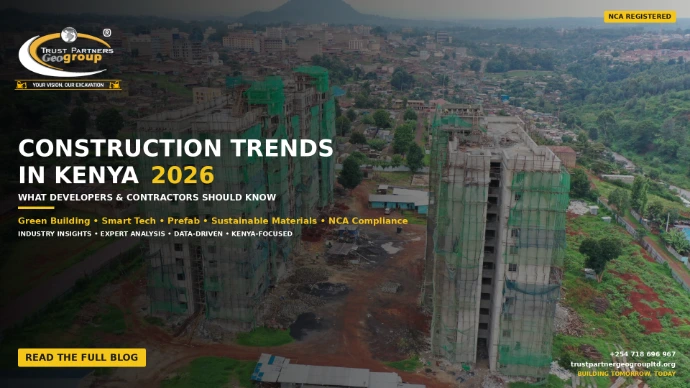
Construction Trends in Kenya 2026: What Developers and Contractors Should Know
Kenya's construction industry is entering a transformative phase in 2026. With the market projected to reach KES 1.02 trillion and grow at 7.5% annually, developers and contractors who understand the emerging trends—from affordable housing mega-projects and green building standards to rising material costs and digital construction technologies—will capture the greatest opportunities. This comprehensive guide breaks down the forces shaping Kenya's built environment, the regulatory landscape, cost dynamics, and strategic insights every construction professional needs to stay competitive in 2026 and beyond.
📋 Table of Contents
- Market Overview: Kenya's Trillion-Shilling Construction Industry
- Affordable Housing: The Defining Megatrend of 2026
- Construction Materials: Prices, Supply & Cost Management
- Green Building & Sustainable Construction
- Digital Transformation: BIM, Drones & Smart Sites
- Infrastructure & Mega-Projects Driving Demand
- Regulatory Landscape: NCA, NEMA & Compliance Updates
- Regional Construction Hotspots in Kenya
- Key Challenges & Risk Factors for 2026
- Frequently Asked Questions
1. Market Overview: Kenya's Trillion-Shilling Construction Industry
Kenya's construction market is one of the most dynamic in East Africa, driven by rapid urbanization, government infrastructure investment, and a growing middle class demanding better housing and commercial spaces. In 2026, the industry is projected to reach KES 1.02 trillion, representing a 7.5% annual growth rate following a robust CAGR of 11.2% during 2021-2025.
The construction sector now accounts for approximately 7% of Kenya's GDP, making it one of the largest contributors to economic growth alongside agriculture and services. The sector employs over 1.5 million Kenyans directly and supports millions more in allied industries including manufacturing, transport, and professional services.
Key growth drivers for 2026 include:
- Government infrastructure spending: KES 749.5 billion allocated for development expenditure in FY 2026/27, with construction as the largest beneficiary
- Affordable Housing Program: 250,000 units annually targeted, with 500,000 units planned for completion by December 2026
- Urbanization: Over 32% of Kenyans now live in urban areas, driving demand for housing, commercial space, and urban infrastructure
- Foreign investment: Chinese, European, and Middle Eastern contractors continue to dominate large infrastructure projects, while local firms capture residential and mid-scale commercial work
- Regional integration: East African Community infrastructure projects (LAPSSET, SGR Phase 2, power interconnections) create cross-border opportunities
💡 Strategic Insight
The construction market is forecast to grow from KES 956.7 billion in 2025 to approximately KES 1.41 trillion by 2030 at a CAGR of 6.4%. Developers and contractors who position themselves in high-growth segments—affordable housing, green building, and tier-2 city developments—will outperform the market average. The key is aligning capabilities with government priorities and emerging consumer preferences.
2. Affordable Housing: The Defining Megatrend of 2026
The Affordable Housing Program (AHP) remains the single most significant force reshaping Kenya's construction landscape in 2026. Under President William Ruto's Bottom-Up Economic Transformation Agenda (BETA), the government aims to deliver 250,000 housing units annually, with an aggregate target of one million units by 2027.
2.1 Program Progress & 2026 Targets
As of early 2026, the Ministry of Housing reports approximately 320,000 units completed across counties, with plans to reach 500,000 units by December 2026. The Boma Yangu housing platform has registered over 1.1 million Kenyans—a significant milestone demonstrating strong demand.
Key 2026 developments include:
- 4,096 units under construction in Starehe, Nairobi, incorporating affordable, market-rate, and social housing categories
- 30,792 units in the national pipeline across 17 flagship projects including Pioneer, Kidiwa, Lumumba, and Jogoo Road estates
- Deposit reduction to 5% under revised regulations, expanding access for low and middle-income buyers
- KMRC refinancing program: Over 4,500 affordable home loans disbursed across 39 counties at average interest rates of 10.0%
2.2 Housing Levy & Funding Dynamics
The Affordable Housing Levy—mandating a 1.5% deduction of gross income from employees matched by 1.5% from employers—has emerged as the primary funding instrument. In FY 2024/2025, KRA collected KES 73.2 billion, surpassing the KES 63.2 billion target by 15.8%. Cumulative collections now exceed KES 170 billion.
However, a critical challenge persists: fund utilization lags behind collection. Nearly half of FY 2024/25 proceeds remained unspent, invested in Treasury bills to preserve value. This "pipeline illusion"—where projects appear under construction but progress stalls—creates execution risk and erodes public confidence. For contractors, this means payment delays and cash flow challenges are endemic in government housing projects.
| Affordable Housing Project | Location | Units | Status (2026) |
|---|---|---|---|
| Stoni-Athi Affordable Housing | Nairobi | 10,500 | Under Construction |
| Starehe Affordable Housing | Nairobi | 4,096 | Construction Started |
| Jogoo Road Affordable Housing | Nairobi | 2,760 | Under Construction |
| Lumumba Affordable Housing | Nairobi | 2,348 | Under Construction |
| Kakamega Affordable Housing | Kakamega | 2,100 | Under Construction |
| Pioneer Affordable Housing | Nairobi | 2,105 | Under Construction |
| Kidiwa Affordable Housing | Nairobi | 1,976 | Under Construction |
| Alego Usonga Affordable Housing | Siaya | 882 | Under Construction |
| Mokowe Affordable Housing | Lamu | 496 | Under Construction |
| Nanyuki Affordable Housing | Laikipia | 200 | Under Construction |
Source: Boma Yangu Platform and Cytonn Research, 2026.
2.3 Opportunities for Private Developers
With an estimated annual financing shortfall of KES 326 billion relative to the KES 400 billion needed for 250,000 units yearly, the government is actively seeking private sector participation. Key incentives include:
- Tax incentives for developers participating in the Affordable Housing Program
- Simplified regulatory processes through the Boma Yangu digital platform
- Access to KMRC refinancing at approximately 5.0% for primary mortgage lenders
- Rent-to-own financing models being piloted to enhance affordability
- Low-cost construction technologies and prefabrication being encouraged
⚠️ Contractor Caution
Government housing projects carry significant payment risk. Budget absorption rates have historically lagged below 35%, and procurement bottlenecks cause extended timelines. Contractors should negotiate milestone-based payments with adequate advance payments, secure performance bonds, and maintain diversified client portfolios to mitigate government payment delays. The Buxton Point Apartment project incurred a KES 450 million loss due to foundation issues and infrastructure deficits that counties failed to provide—illustrating the hidden risks in government-backed developments.
3. Construction Materials: Prices, Supply & Cost Management
Material costs remain the largest variable in construction budgeting, accounting for 50-60% of total project costs in Kenya. After a period of stabilization, 2026 has seen renewed price pressure driven by raw material costs, currency fluctuations, and tax policy changes.
3.1 Cement Prices in Kenya (2026)
Cement prices have stabilized following the 2022 spike caused by global coal cost increases, but new tax pressures are pushing prices upward again. As of January 2026, a 50kg bag averages approximately KES 750 in Nairobi, with significant brand variation:
| Brand / Grade | Type | Price per 50kg Bag (KES) | Price per 50kg Bag (USD) |
|---|---|---|---|
| Simba 32.5R | General Purpose | 735 | $5.65 |
| Simba 42.5N | High Strength | 1,200 | $9.23 |
| Rhino Cement | General Purpose | 750 | $5.77 |
| Bamburi Fundi | General Purpose | 780 | $6.00 |
| Bamburi Tembo | General Purpose | 800 | $6.15 |
| Bamburi Nguvu | High Strength | 855 | $6.58 |
| Bamburi Powermax | Premium | 1,350 | $10.38 |
| E.A. Portland Blue Triangle | General Purpose | 755 | $5.81 |
| Mombasa Cement Nyumba | General Purpose | 750 | $5.77 |
Source: Construction Kenya, January 2026. Note: East Africa Portland Cement announced a 1.39% price increase (KES 10/bag) effective March 2026 due to rising raw material costs.
3.2 Steel & Reinforcement Prices
Steel prices in Kenya are heavily influenced by global iron ore markets, shipping costs, and import duties. In 2026, mild steel reinforcement bars (Y12, Y16, Y20) range from KES 110-140 per kg depending on diameter and grade. High-tensile steel commands a 15-20% premium. Key factors affecting steel costs:
- Import dependency: Kenya imports approximately 60% of its steel, making the sector vulnerable to exchange rate fluctuations and global supply shocks
- Devki Group dominance: Local production by Devki Steel Mills, Tononoka, and Accurate Steel provides price competition but capacity remains below demand
- Scrap metal regulations: Export bans on scrap metal aim to support local steel recycling but have created supply constraints for smaller fabricators
3.3 Other Key Material Costs (2026)
| Material | Unit | Price Range (KES) | Key Trend |
|---|---|---|---|
| Machine-cut stones | per piece (6×9) | 25 – 45 | Stable; quarry licensing affecting supply |
| Hardcore / Ballast | per ton | 2,500 – 4,000 | Rising due to transport costs |
| Sand (river) | per ton | 1,800 – 3,500 | Scarcity driving M-sand adoption |
| M-sand (manufactured) | per ton | 1,500 – 2,800 | Growing acceptance; 20% cheaper than river sand |
| Timber (Cypress) | per foot (2×2) | 35 – 55 | Deforestation controls tightening supply |
| Roofing sheets (mabati) | per meter (G30) | 450 – 700 | Stable; local production dominant |
| HDPE Geomembrane (0.5mm) | per m² | 180 – 350 | Growing demand for dam/pond lining |
| Bitumen (60/70) | per ton | 85,000 – 120,000 | Import-dependent; volatile |
| Ready-mix concrete (C25) | per m³ | 8,500 – 12,000 | Urban concentration; transport limits rural access |
3.4 Cost Management Strategies for 2026
With material costs consuming the majority of project budgets, successful contractors and developers are adopting proactive cost management strategies:
- Bulk purchasing agreements: Lock in prices with suppliers for 3-6 month periods, especially for cement and steel
- Alternative materials: M-sand replacing river sand, pozzolanic cement reducing clinker costs, prefabricated components reducing on-site waste
- Value engineering: Optimizing structural designs to reduce steel and concrete quantities without compromising safety
- Local sourcing: Prioritizing locally manufactured materials to reduce import exposure and transport costs
- Just-in-time delivery: Reducing on-site storage costs and material degradation, particularly for cement
4. Green Building & Sustainable Construction
Sustainability is no longer a niche concern in Kenya's construction industry—it is becoming a competitive necessity. Green building practices are gaining traction driven by environmental regulations, energy cost pressures, and growing consumer awareness.
4.1 Green Building Trends in 2026
- Energy efficiency: Solar water heating is now mandatory for buildings over certain sizes per the Energy Regulatory Commission. Solar PV installations are increasingly common in commercial and residential projects, with payback periods of 4-7 years.
- Water conservation: Rainwater harvesting systems, greywater recycling, and low-flow fixtures are becoming standard in mid-to-high-end developments. NEMA now requires water management plans for large projects.
- Sustainable materials: Bamboo, stabilized soil blocks, recycled steel, and fly ash concrete are gaining acceptance. The Kenya Green Building Society is promoting local certification aligned with international standards.
- Waste management: Construction waste recycling is emerging as a business opportunity, with companies specializing in crushing concrete waste for aggregate reuse. NEMA enforcement of waste disposal regulations is tightening.
- Cool roofs & natural ventilation: Reflective roofing materials and building orientation optimization are reducing cooling loads by 20-30% in tropical climates.
4.2 Regulatory Push for Sustainability
The National Construction Authority (NCA) and NEMA are progressively incorporating sustainability requirements into building approvals:
- Environmental Impact Assessments (ESIA) required for all projects above specified thresholds
- Energy audits mandatory for commercial buildings over 1,000 m²
- Tree replacement requirements for developments affecting green spaces
- Stormwater management plans to reduce urban flooding (especially critical after the March 2026 Nairobi floods)
💡 Competitive Advantage
Developers who embrace green building standards now will capture premium pricing and faster approvals as regulations tighten. Early movers in solar-integrated housing, rainwater harvesting, and sustainable materials will build brand differentiation that becomes harder to replicate as the market matures. Green certification (EDGE, LEED, or local equivalents) can increase property values by 5-15% and reduce operating costs by 20-40%.
5. Digital Transformation: BIM, Drones & Smart Sites
Digital construction technologies are transforming how projects are designed, managed, and delivered in Kenya. While adoption lags behind developed markets, 2026 is seeing accelerated uptake among Tier 1 contractors and progressive developers.
5.1 Building Information Modeling (BIM)
BIM adoption in Kenya is primarily driven by large infrastructure projects and international clients requiring 3D modeling and clash detection. Key applications include:
- 3D design coordination: Reducing design errors and rework by 15-25%
- Quantity takeoffs: Automated material estimation improving accuracy and reducing waste
- 4D/5D BIM: Integrating time (scheduling) and cost data for better project control
- Facility management: Digital handover models supporting post-construction operations
Challenges include high software costs, limited local training, and resistance from traditional practitioners. However, NCA is exploring BIM mandates for large public projects, which would accelerate adoption.
5.2 Drones & Aerial Surveying
Drone technology has become mainstream for:
- Topographic surveys: 5-10x faster than traditional ground surveys, with centimeter accuracy using RTK GPS
- Progress monitoring: Weekly aerial imagery for client reporting and dispute resolution
- Stockpile measurement: Automated volume calculations for earthworks and materials
- Site safety inspection: Accessing hazardous areas without putting personnel at risk
KCAA regulations require licensed drone operators for commercial use, and privacy concerns around aerial photography are emerging considerations.
5.3 Project Management Software & IoT
Cloud-based project management platforms (Procore, Autodesk Construction Cloud, local solutions) are replacing paper-based processes. IoT sensors are being deployed for:
- Concrete curing temperature monitoring
- Equipment fleet tracking and utilization optimization
- Environmental monitoring (dust, noise, vibration) for NEMA compliance
- Smart safety systems (wearable devices, geofencing for hazardous zones)
6. Infrastructure & Mega-Projects Driving Demand
Beyond housing, Kenya's infrastructure pipeline is creating massive construction demand across transport, energy, water, and urban development.
6.1 Road Construction
Kenya's road network spans approximately 177,800 km, with only 17,000 km paved. The Kenya Roads Board and KeNHA are investing heavily in:
- Nairobi Expressway expansion and urban bypasses
- Last-mile rural access roads under the Kenya Rural Roads Authority (KERRA)
- County road programs funded through equitable share allocations
- Standard Gauge Railway (SGR) Phase 2 (Nairobi to Naivasha extension and beyond)
Road construction costs range from KES 26 million to over KES 900 million per kilometer depending on surface type, terrain, and design standards.
6.2 Water & Irrigation Infrastructure
The State Department for Irrigation has earmarked 2 million acres for irrigation development, with at least six mega dams planned for construction in 2026:
- Lowaat Dam (Turkana): 384 million m³ capacity, KES 35 billion
- Radat Dam (Baringo): 124 million m³, KES 96.3 billion
- Thuci Dam (Embu): 17,000-acre irrigation scheme
- Basilinga Dam (Isiolo): ASAL region strategic storage
- High Falls Dam (Kitui & Tharaka Nithi): Multi-purpose
- Galana Dam (Tana River & Kilifi): Food security project
6.3 Energy Projects
Kenya's renewable energy push continues with:
- Geothermal expansion: Olkaria and Menengai fields adding capacity
- Wind power: Lake Turkana Wind Power (310 MW) and planned expansions
- Solar farms: Garissa (55 MW) and distributed commercial rooftop installations
- Grid infrastructure: Transmission line upgrades and rural electrification
7. Regulatory Landscape: NCA, NEMA & Compliance Updates
Navigating Kenya's regulatory environment is critical for project success. In 2026, several regulatory developments are shaping construction practices:
7.1 National Construction Authority (NCA)
The NCA continues to enforce contractor registration, project registration, and compliance with the National Building Code. Key 2026 requirements:
- Contractor registration: All contractors must hold valid NCA registration for their category (NCA 1-8). Renewal requires proof of completed projects and CPD training.
- Project registration: All construction projects must be registered with NCA before commencement. Failure to register can result in project halts and fines.
- Site safety: Method statements, risk assessments, and job safety analyses required for all phases. NCA inspectors conduct spot checks with increasing frequency.
- Quality assurance: Concrete cube testing, steel certification, and material compliance documentation mandatory for structural elements.
7.2 NEMA Environmental Compliance
NEMA enforcement has intensified following high-profile environmental incidents:
- ESIA requirements: Projects above specified thresholds require full Environmental and Social Impact Assessment
- Audits: NEMA conducts compliance audits during and after construction
- Waste management: Proper disposal of construction waste, hazardous materials, and effluent is strictly enforced
- Watercourse protection: Any works impacting rivers, streams, or wetlands require WRA permits in addition to NEMA clearance
7.3 County Government Regulations
County governments have significant authority over construction through:
- Building permits: All construction requires county building permits, with fees varying by county and project value
- Physical planning: County spatial plans dictate land use, zoning, and development standards
- Local infrastructure: Developers often bear costs for roads, water, sewer, and power connections that counties fail to provide
⚠️ Compliance Risk Alert
Skipping permits or cutting corners on compliance is a high-risk strategy. NCA, NEMA, and county enforcement actions—including demolition orders, project halts, and criminal prosecution—are increasing. The cost of retroactive compliance (demolition and reconstruction, legal fees, project delays) far exceeds the cost of doing it right from the start. Budget 5-10% of total project cost for permits, compliance, and professional fees.
8. Regional Construction Hotspots in Kenya
Construction activity is not evenly distributed across Kenya. Understanding regional hotspots helps developers and contractors target their investments and marketing.
| Region / City | Key Drivers | Hot Segments | Cost Level |
|---|---|---|---|
| Nairobi & Kiambu | Affordable housing, commercial, infrastructure | High-rise residential, office parks, roads | High (premium land costs) |
| Mombasa & Coast | Tourism, port expansion, logistics | Hotels, warehouses, residential estates | High (corrosion-resistant materials) |
| Kisumu & Western | Lake port, agriculture, county growth | Residential, commercial, irrigation | Moderate |
| Nakuru & Rift Valley | Industrial, logistics, agriculture | Warehouses, cold storage, farm structures | Moderate |
| Eldoret & North Rift | Agriculture, education, health | Institutional, residential, farm buildings | Moderate-Low |
| Machakos, Kitui, Eastern | ASAL development, dam projects, devolution | Dams, rural housing, roads | Low-Moderate |
| Turkana, Northern Kenya | Oil, mega dams, pastoral development | Infrastructure, institutional, water projects | High (remote access costs) |
9. Key Challenges & Risk Factors for 2026
While the outlook is broadly positive, several challenges require proactive management:
📈 Opportunities
- ✓ Affordable housing pipeline (1M+ units by 2027)
- ✓ Government infrastructure spending (KES 749B)
- ✓ Green building early-mover advantage
- ✓ Digital construction differentiation
- ✓ Tier-2 city expansion (lower competition)
- ✓ Regional EAC infrastructure projects
- ✓ Renewable energy construction boom
⚠️ Risks
- ✗ Government payment delays (35% absorption rate)
- ✗ Material cost volatility (cement, steel, fuel)
- ✗ Currency depreciation affecting imports
- ✗ Regulatory complexity (NCA, NEMA, county, WRA)
- ✗ Skilled labor shortages and wage inflation
- ✗ Land acquisition and titling delays
- ✗ Climate disruption (floods, droughts)
9.1 Mitigation Strategies
Successful contractors and developers in 2026 are implementing these risk mitigation approaches:
- Diversified client base: Balancing government, private, and commercial work to reduce payment concentration risk
- Fixed-price material contracts: Locking in supplier prices for 3-6 months on large projects
- Local currency hedging: For imported materials, using forward contracts or local substitutes where possible
- Regulatory compliance investment: Hiring dedicated compliance officers and engaging professional consultants early
- Skills development: Apprenticeship programs, partnerships with technical colleges, and competitive wages to retain talent
- Climate adaptation: Designing for extreme weather, flood-resistant foundations, and drought-tolerant landscaping
Stay Ahead of Kenya's Construction Trends
Trust Partner Geo Group Ltd provides construction consultancy, project management, and engineering services that keep developers and contractors competitive in Kenya's fast-evolving market. From affordable housing compliance to green building certification, our team delivers the expertise you need to win in 2026.
Get a Free Project Consultation →10. Frequently Asked Questions
Kenya's construction market is projected to reach KES 1.02 trillion in 2026, growing at 7.5% annually. This follows a robust CAGR of 11.2% during 2021-2025. By 2030, the market is forecast to expand to approximately KES 1.41 trillion at a CAGR of 6.4%. The sector accounts for approximately 7% of Kenya's GDP and employs over 1.5 million people directly.
The government targets 250,000 affordable housing units annually under the Affordable Housing Program, with an aggregate goal of 1 million units by 2027. As of early 2026, approximately 320,000 units have been completed across counties, with 500,000 targeted for completion by December 2026. The Boma Yangu platform has registered over 1.1 million interested buyers. However, execution challenges remain—budget absorption rates have historically lagged below 35%, and procurement bottlenecks cause significant delays.
As of January 2026, a 50kg bag of cement in Kenya averages approximately KES 750 in Nairobi. Prices vary by brand and grade: Simba 32.5R at KES 735, Rhino Cement at KES 750, Bamburi Fundi at KES 780, Bamburi Nguvu at KES 855, and premium grades like Bamburi Powermax at KES 1,350. East Africa Portland Cement announced a 1.39% price increase (KES 10/bag) effective March 2026 due to rising raw material costs. Bulk purchases and direct manufacturer relationships can reduce costs by 10-20%.
The primary challenges include: (1) Government payment delays—budget absorption rates below 35% mean contractors face extended payment timelines; (2) Material cost volatility—cement, steel, and fuel prices fluctuate with global markets and currency depreciation; (3) Regulatory complexity—navigating NCA, NEMA, county, and WRA requirements demands dedicated expertise; (4) Skilled labor shortages—wage inflation and competition for experienced workers; (5) Land acquisition delays—titling and compulsory acquisition processes are slow; (6) Climate disruption—floods and droughts affecting project timelines and site conditions. Successful contractors mitigate these through diversified clients, fixed-price material contracts, compliance investment, and skills development programs.
While not yet universally mandatory, green building requirements are progressively tightening. Solar water heating is mandatory for buildings above certain sizes. NEMA requires Environmental Impact Assessments (ESIA) for large projects, energy audits for commercial buildings over 1,000 m², and stormwater management plans. The National Construction Authority is exploring BIM and sustainability mandates for public projects. Developers who adopt green standards early gain competitive advantage through faster approvals, premium pricing (5-15% value increase), and lower operating costs (20-40% reduction). Certification through EDGE, LEED, or the Kenya Green Building Society is increasingly recognized by institutional investors and international tenants.
All contractors must hold valid NCA registration for their category (NCA 1 through NCA 8, based on project value capacity). Registration renewal requires proof of completed projects and Continuing Professional Development (CPD) training. All construction projects must be registered with NCA before commencement—failure to register can result in project halts, fines, and legal action. Additionally, contractors need county building permits, NEMA clearance (for projects above thresholds), and WRA permits for any watercourse works. Trust Partner Geo Group Ltd assists clients with full regulatory compliance documentation.
The highest construction activity is concentrated in: (1) Nairobi & Kiambu—affordable housing, commercial, and infrastructure; (2) Mombasa & Coast—tourism, port expansion, and logistics; (3) Kisumu & Western Kenya—lake port development, agriculture, and county growth; (4) Nakuru & Rift Valley—industrial, logistics, and agricultural processing; (5) Eastern Kenya (Machakos, Kitui)—ASAL development, dam projects, and devolution-driven infrastructure. Emerging hotspots include Turkana (oil and mega dams) and Eldoret (agriculture and institutional development). Tier-2 cities offer lower competition and land costs for early movers.
Construction costs vary significantly by location, finishes, and design. As a general guide for 2026: Basic low-cost housing ranges from KES 25,000-35,000 per m²; Standard middle-class housing from KES 35,000-55,000 per m²; High-end residential from KES 55,000-100,000+ per m²; and Commercial buildings from KES 40,000-80,000 per m². A standard 3-bedroom house (100-150 m²) costs approximately KES 3.5-8 million depending on finishes and location. Affordable housing program units are priced between KES 1.5-3 million for 1-2 bedroom units. Key cost drivers include foundation type (black cotton soils increase costs 15-25%), roofing material, finishes, and compliance costs (5-10% of total).
Related Articles
Road Construction Cost Per Kilometer in Kenya: 2026 Estimate
Read Article →Asphalt vs. Murram Roads in Kenya: Which is Better?
Read Article →Seepage Control and Embankment Stability for Dams in Kenya
Read Article →About the Author: Trust Partner Geo Group Ltd is a leading engineering and construction consultancy firm in Kenya, specializing in construction project management, road construction, dam engineering, geotechnical investigations, and regulatory compliance. We serve developers, contractors, and government clients across East Africa with data-driven, compliant, and sustainable infrastructure solutions.
Published: July 15, 2026 | Last Updated: July 15, 2026 | Categories: Construction Trends, Kenya Building Industry, Market Analysis, Affordable Housing
Construction Trends in Kenya 2026: What Developers and Contractors Should Know
Kenya's construction industry is entering a transformative phase in 2026. With the market projected to reach KES 1.02 trillion and grow at 7.5% annually, developers and contractors who understand the emerging trends—from affordable housing mega-projects and green building standards to rising material costs and digital construction technologies—will capture the greatest opportunities. This comprehensive guide breaks down the forces shaping Kenya's built environment, the regulatory landscape, cost dynamics, and strategic insights every construction professional needs to stay competitive in 2026 and beyond.
📋 Table of Contents
- Market Overview: Kenya's Trillion-Shilling Construction Industry
- Affordable Housing: The Defining Megatrend of 2026
- Construction Materials: Prices, Supply & Cost Management
- Green Building & Sustainable Construction
- Digital Transformation: BIM, Drones & Smart Sites
- Infrastructure & Mega-Projects Driving Demand
- Regulatory Landscape: NCA, NEMA & Compliance Updates
- Regional Construction Hotspots in Kenya
- Key Challenges & Risk Factors for 2026
- Frequently Asked Questions
1. Market Overview: Kenya's Trillion-Shilling Construction Industry
Kenya's construction market is one of the most dynamic in East Africa, driven by rapid urbanization, government infrastructure investment, and a growing middle class demanding better housing and commercial spaces. In 2026, the industry is projected to reach KES 1.02 trillion, representing a 7.5% annual growth rate following a robust CAGR of 11.2% during 2021-2025.
The construction sector now accounts for approximately 7% of Kenya's GDP, making it one of the largest contributors to economic growth alongside agriculture and services. The sector employs over 1.5 million Kenyans directly and supports millions more in allied industries including manufacturing, transport, and professional services.
Key growth drivers for 2026 include:
- Government infrastructure spending: KES 749.5 billion allocated for development expenditure in FY 2026/27, with construction as the largest beneficiary
- Affordable Housing Program: 250,000 units annually targeted, with 500,000 units planned for completion by December 2026
- Urbanization: Over 32% of Kenyans now live in urban areas, driving demand for housing, commercial space, and urban infrastructure
- Foreign investment: Chinese, European, and Middle Eastern contractors continue to dominate large infrastructure projects, while local firms capture residential and mid-scale commercial work
- Regional integration: East African Community infrastructure projects (LAPSSET, SGR Phase 2, power interconnections) create cross-border opportunities
💡 Strategic Insight
The construction market is forecast to grow from KES 956.7 billion in 2025 to approximately KES 1.41 trillion by 2030 at a CAGR of 6.4%. Developers and contractors who position themselves in high-growth segments—affordable housing, green building, and tier-2 city developments—will outperform the market average. The key is aligning capabilities with government priorities and emerging consumer preferences.
2. Affordable Housing: The Defining Megatrend of 2026
The Affordable Housing Program (AHP) remains the single most significant force reshaping Kenya's construction landscape in 2026. Under President William Ruto's Bottom-Up Economic Transformation Agenda (BETA), the government aims to deliver 250,000 housing units annually, with an aggregate target of one million units by 2027.
2.1 Program Progress & 2026 Targets
As of early 2026, the Ministry of Housing reports approximately 320,000 units completed across counties, with plans to reach 500,000 units by December 2026. The Boma Yangu housing platform has registered over 1.1 million Kenyans—a significant milestone demonstrating strong demand.
Key 2026 developments include:
- 4,096 units under construction in Starehe, Nairobi, incorporating affordable, market-rate, and social housing categories
- 30,792 units in the national pipeline across 17 flagship projects including Pioneer, Kidiwa, Lumumba, and Jogoo Road estates
- Deposit reduction to 5% under revised regulations, expanding access for low and middle-income buyers
- KMRC refinancing program: Over 4,500 affordable home loans disbursed across 39 counties at average interest rates of 10.0%
2.2 Housing Levy & Funding Dynamics
The Affordable Housing Levy—mandating a 1.5% deduction of gross income from employees matched by 1.5% from employers—has emerged as the primary funding instrument. In FY 2024/2025, KRA collected KES 73.2 billion, surpassing the KES 63.2 billion target by 15.8%. Cumulative collections now exceed KES 170 billion.
However, a critical challenge persists: fund utilization lags behind collection. Nearly half of FY 2024/25 proceeds remained unspent, invested in Treasury bills to preserve value. This "pipeline illusion"—where projects appear under construction but progress stalls—creates execution risk and erodes public confidence. For contractors, this means payment delays and cash flow challenges are endemic in government housing projects.
| Affordable Housing Project | Location | Units | Status (2026) |
|---|---|---|---|
| Stoni-Athi Affordable Housing | Nairobi | 10,500 | Under Construction |
| Starehe Affordable Housing | Nairobi | 4,096 | Construction Started |
| Jogoo Road Affordable Housing | Nairobi | 2,760 | Under Construction |
| Lumumba Affordable Housing | Nairobi | 2,348 | Under Construction |
| Kakamega Affordable Housing | Kakamega | 2,100 | Under Construction |
| Pioneer Affordable Housing | Nairobi | 2,105 | Under Construction |
| Kidiwa Affordable Housing | Nairobi | 1,976 | Under Construction |
| Alego Usonga Affordable Housing | Siaya | 882 | Under Construction |
| Mokowe Affordable Housing | Lamu | 496 | Under Construction |
| Nanyuki Affordable Housing | Laikipia | 200 | Under Construction |
Source: Boma Yangu Platform and Cytonn Research, 2026.
2.3 Opportunities for Private Developers
With an estimated annual financing shortfall of KES 326 billion relative to the KES 400 billion needed for 250,000 units yearly, the government is actively seeking private sector participation. Key incentives include:
- Tax incentives for developers participating in the Affordable Housing Program
- Simplified regulatory processes through the Boma Yangu digital platform
- Access to KMRC refinancing at approximately 5.0% for primary mortgage lenders
- Rent-to-own financing models being piloted to enhance affordability
- Low-cost construction technologies and prefabrication being encouraged
⚠️ Contractor Caution
Government housing projects carry significant payment risk. Budget absorption rates have historically lagged below 35%, and procurement bottlenecks cause extended timelines. Contractors should negotiate milestone-based payments with adequate advance payments, secure performance bonds, and maintain diversified client portfolios to mitigate government payment delays. The Buxton Point Apartment project incurred a KES 450 million loss due to foundation issues and infrastructure deficits that counties failed to provide—illustrating the hidden risks in government-backed developments.
3. Construction Materials: Prices, Supply & Cost Management
Material costs remain the largest variable in construction budgeting, accounting for 50-60% of total project costs in Kenya. After a period of stabilization, 2026 has seen renewed price pressure driven by raw material costs, currency fluctuations, and tax policy changes.
3.1 Cement Prices in Kenya (2026)
Cement prices have stabilized following the 2022 spike caused by global coal cost increases, but new tax pressures are pushing prices upward again. As of January 2026, a 50kg bag averages approximately KES 750 in Nairobi, with significant brand variation:
| Brand / Grade | Type | Price per 50kg Bag (KES) | Price per 50kg Bag (USD) |
|---|---|---|---|
| Simba 32.5R | General Purpose | 735 | $5.65 |
| Simba 42.5N | High Strength | 1,200 | $9.23 |
| Rhino Cement | General Purpose | 750 | $5.77 |
| Bamburi Fundi | General Purpose | 780 | $6.00 |
| Bamburi Tembo | General Purpose | 800 | $6.15 |
| Bamburi Nguvu | High Strength | 855 | $6.58 |
| Bamburi Powermax | Premium | 1,350 | $10.38 |
| E.A. Portland Blue Triangle | General Purpose | 755 | $5.81 |
| Mombasa Cement Nyumba | General Purpose | 750 | $5.77 |
Source: Construction Kenya, January 2026. Note: East Africa Portland Cement announced a 1.39% price increase (KES 10/bag) effective March 2026 due to rising raw material costs.
3.2 Steel & Reinforcement Prices
Steel prices in Kenya are heavily influenced by global iron ore markets, shipping costs, and import duties. In 2026, mild steel reinforcement bars (Y12, Y16, Y20) range from KES 110-140 per kg depending on diameter and grade. High-tensile steel commands a 15-20% premium. Key factors affecting steel costs:
- Import dependency: Kenya imports approximately 60% of its steel, making the sector vulnerable to exchange rate fluctuations and global supply shocks
- Devki Group dominance: Local production by Devki Steel Mills, Tononoka, and Accurate Steel provides price competition but capacity remains below demand
- Scrap metal regulations: Export bans on scrap metal aim to support local steel recycling but have created supply constraints for smaller fabricators
3.3 Other Key Material Costs (2026)
| Material | Unit | Price Range (KES) | Key Trend |
|---|---|---|---|
| Machine-cut stones | per piece (6×9) | 25 – 45 | Stable; quarry licensing affecting supply |
| Hardcore / Ballast | per ton | 2,500 – 4,000 | Rising due to transport costs |
| Sand (river) | per ton | 1,800 – 3,500 | Scarcity driving M-sand adoption |
| M-sand (manufactured) | per ton | 1,500 – 2,800 | Growing acceptance; 20% cheaper than river sand |
| Timber (Cypress) | per foot (2×2) | 35 – 55 | Deforestation controls tightening supply |
| Roofing sheets (mabati) | per meter (G30) | 450 – 700 | Stable; local production dominant |
| HDPE Geomembrane (0.5mm) | per m² | 180 – 350 | Growing demand for dam/pond lining |
| Bitumen (60/70) | per ton | 85,000 – 120,000 | Import-dependent; volatile |
| Ready-mix concrete (C25) | per m³ | 8,500 – 12,000 | Urban concentration; transport limits rural access |
3.4 Cost Management Strategies for 2026
With material costs consuming the majority of project budgets, successful contractors and developers are adopting proactive cost management strategies:
- Bulk purchasing agreements: Lock in prices with suppliers for 3-6 month periods, especially for cement and steel
- Alternative materials: M-sand replacing river sand, pozzolanic cement reducing clinker costs, prefabricated components reducing on-site waste
- Value engineering: Optimizing structural designs to reduce steel and concrete quantities without compromising safety
- Local sourcing: Prioritizing locally manufactured materials to reduce import exposure and transport costs
- Just-in-time delivery: Reducing on-site storage costs and material degradation, particularly for cement
4. Green Building & Sustainable Construction
Sustainability is no longer a niche concern in Kenya's construction industry—it is becoming a competitive necessity. Green building practices are gaining traction driven by environmental regulations, energy cost pressures, and growing consumer awareness.
4.1 Green Building Trends in 2026
- Energy efficiency: Solar water heating is now mandatory for buildings over certain sizes per the Energy Regulatory Commission. Solar PV installations are increasingly common in commercial and residential projects, with payback periods of 4-7 years.
- Water conservation: Rainwater harvesting systems, greywater recycling, and low-flow fixtures are becoming standard in mid-to-high-end developments. NEMA now requires water management plans for large projects.
- Sustainable materials: Bamboo, stabilized soil blocks, recycled steel, and fly ash concrete are gaining acceptance. The Kenya Green Building Society is promoting local certification aligned with international standards.
- Waste management: Construction waste recycling is emerging as a business opportunity, with companies specializing in crushing concrete waste for aggregate reuse. NEMA enforcement of waste disposal regulations is tightening.
- Cool roofs & natural ventilation: Reflective roofing materials and building orientation optimization are reducing cooling loads by 20-30% in tropical climates.
4.2 Regulatory Push for Sustainability
The National Construction Authority (NCA) and NEMA are progressively incorporating sustainability requirements into building approvals:
- Environmental Impact Assessments (ESIA) required for all projects above specified thresholds
- Energy audits mandatory for commercial buildings over 1,000 m²
- Tree replacement requirements for developments affecting green spaces
- Stormwater management plans to reduce urban flooding (especially critical after the March 2026 Nairobi floods)
💡 Competitive Advantage
Developers who embrace green building standards now will capture premium pricing and faster approvals as regulations tighten. Early movers in solar-integrated housing, rainwater harvesting, and sustainable materials will build brand differentiation that becomes harder to replicate as the market matures. Green certification (EDGE, LEED, or local equivalents) can increase property values by 5-15% and reduce operating costs by 20-40%.
5. Digital Transformation: BIM, Drones & Smart Sites
Digital construction technologies are transforming how projects are designed, managed, and delivered in Kenya. While adoption lags behind developed markets, 2026 is seeing accelerated uptake among Tier 1 contractors and progressive developers.
5.1 Building Information Modeling (BIM)
BIM adoption in Kenya is primarily driven by large infrastructure projects and international clients requiring 3D modeling and clash detection. Key applications include:
- 3D design coordination: Reducing design errors and rework by 15-25%
- Quantity takeoffs: Automated material estimation improving accuracy and reducing waste
- 4D/5D BIM: Integrating time (scheduling) and cost data for better project control
- Facility management: Digital handover models supporting post-construction operations
Challenges include high software costs, limited local training, and resistance from traditional practitioners. However, NCA is exploring BIM mandates for large public projects, which would accelerate adoption.
5.2 Drones & Aerial Surveying
Drone technology has become mainstream for:
- Topographic surveys: 5-10x faster than traditional ground surveys, with centimeter accuracy using RTK GPS
- Progress monitoring: Weekly aerial imagery for client reporting and dispute resolution
- Stockpile measurement: Automated volume calculations for earthworks and materials
- Site safety inspection: Accessing hazardous areas without putting personnel at risk
KCAA regulations require licensed drone operators for commercial use, and privacy concerns around aerial photography are emerging considerations.
5.3 Project Management Software & IoT
Cloud-based project management platforms (Procore, Autodesk Construction Cloud, local solutions) are replacing paper-based processes. IoT sensors are being deployed for:
- Concrete curing temperature monitoring
- Equipment fleet tracking and utilization optimization
- Environmental monitoring (dust, noise, vibration) for NEMA compliance
- Smart safety systems (wearable devices, geofencing for hazardous zones)
6. Infrastructure & Mega-Projects Driving Demand
Beyond housing, Kenya's infrastructure pipeline is creating massive construction demand across transport, energy, water, and urban development.
6.1 Road Construction
Kenya's road network spans approximately 177,800 km, with only 17,000 km paved. The Kenya Roads Board and KeNHA are investing heavily in:
- Nairobi Expressway expansion and urban bypasses
- Last-mile rural access roads under the Kenya Rural Roads Authority (KERRA)
- County road programs funded through equitable share allocations
- Standard Gauge Railway (SGR) Phase 2 (Nairobi to Naivasha extension and beyond)
Road construction costs range from KES 26 million to over KES 900 million per kilometer depending on surface type, terrain, and design standards.
6.2 Water & Irrigation Infrastructure
The State Department for Irrigation has earmarked 2 million acres for irrigation development, with at least six mega dams planned for construction in 2026:
- Lowaat Dam (Turkana): 384 million m³ capacity, KES 35 billion
- Radat Dam (Baringo): 124 million m³, KES 96.3 billion
- Thuci Dam (Embu): 17,000-acre irrigation scheme
- Basilinga Dam (Isiolo): ASAL region strategic storage
- High Falls Dam (Kitui & Tharaka Nithi): Multi-purpose
- Galana Dam (Tana River & Kilifi): Food security project
6.3 Energy Projects
Kenya's renewable energy push continues with:
- Geothermal expansion: Olkaria and Menengai fields adding capacity
- Wind power: Lake Turkana Wind Power (310 MW) and planned expansions
- Solar farms: Garissa (55 MW) and distributed commercial rooftop installations
- Grid infrastructure: Transmission line upgrades and rural electrification
7. Regulatory Landscape: NCA, NEMA & Compliance Updates
Navigating Kenya's regulatory environment is critical for project success. In 2026, several regulatory developments are shaping construction practices:
7.1 National Construction Authority (NCA)
The NCA continues to enforce contractor registration, project registration, and compliance with the National Building Code. Key 2026 requirements:
- Contractor registration: All contractors must hold valid NCA registration for their category (NCA 1-8). Renewal requires proof of completed projects and CPD training.
- Project registration: All construction projects must be registered with NCA before commencement. Failure to register can result in project halts and fines.
- Site safety: Method statements, risk assessments, and job safety analyses required for all phases. NCA inspectors conduct spot checks with increasing frequency.
- Quality assurance: Concrete cube testing, steel certification, and material compliance documentation mandatory for structural elements.
7.2 NEMA Environmental Compliance
NEMA enforcement has intensified following high-profile environmental incidents:
- ESIA requirements: Projects above specified thresholds require full Environmental and Social Impact Assessment
- Audits: NEMA conducts compliance audits during and after construction
- Waste management: Proper disposal of construction waste, hazardous materials, and effluent is strictly enforced
- Watercourse protection: Any works impacting rivers, streams, or wetlands require WRA permits in addition to NEMA clearance
7.3 County Government Regulations
County governments have significant authority over construction through:
- Building permits: All construction requires county building permits, with fees varying by county and project value
- Physical planning: County spatial plans dictate land use, zoning, and development standards
- Local infrastructure: Developers often bear costs for roads, water, sewer, and power connections that counties fail to provide
⚠️ Compliance Risk Alert
Skipping permits or cutting corners on compliance is a high-risk strategy. NCA, NEMA, and county enforcement actions—including demolition orders, project halts, and criminal prosecution—are increasing. The cost of retroactive compliance (demolition and reconstruction, legal fees, project delays) far exceeds the cost of doing it right from the start. Budget 5-10% of total project cost for permits, compliance, and professional fees.
8. Regional Construction Hotspots in Kenya
Construction activity is not evenly distributed across Kenya. Understanding regional hotspots helps developers and contractors target their investments and marketing.
| Region / City | Key Drivers | Hot Segments | Cost Level |
|---|---|---|---|
| Nairobi & Kiambu | Affordable housing, commercial, infrastructure | High-rise residential, office parks, roads | High (premium land costs) |
| Mombasa & Coast | Tourism, port expansion, logistics | Hotels, warehouses, residential estates | High (corrosion-resistant materials) |
| Kisumu & Western | Lake port, agriculture, county growth | Residential, commercial, irrigation | Moderate |
| Nakuru & Rift Valley | Industrial, logistics, agriculture | Warehouses, cold storage, farm structures | Moderate |
| Eldoret & North Rift | Agriculture, education, health | Institutional, residential, farm buildings | Moderate-Low |
| Machakos, Kitui, Eastern | ASAL development, dam projects, devolution | Dams, rural housing, roads | Low-Moderate |
| Turkana, Northern Kenya | Oil, mega dams, pastoral development | Infrastructure, institutional, water projects | High (remote access costs) |
9. Key Challenges & Risk Factors for 2026
While the outlook is broadly positive, several challenges require proactive management:
📈 Opportunities
- ✓ Affordable housing pipeline (1M+ units by 2027)
- ✓ Government infrastructure spending (KES 749B)
- ✓ Green building early-mover advantage
- ✓ Digital construction differentiation
- ✓ Tier-2 city expansion (lower competition)
- ✓ Regional EAC infrastructure projects
- ✓ Renewable energy construction boom
⚠️ Risks
- ✗ Government payment delays (35% absorption rate)
- ✗ Material cost volatility (cement, steel, fuel)
- ✗ Currency depreciation affecting imports
- ✗ Regulatory complexity (NCA, NEMA, county, WRA)
- ✗ Skilled labor shortages and wage inflation
- ✗ Land acquisition and titling delays
- ✗ Climate disruption (floods, droughts)
9.1 Mitigation Strategies
Successful contractors and developers in 2026 are implementing these risk mitigation approaches:
- Diversified client base: Balancing government, private, and commercial work to reduce payment concentration risk
- Fixed-price material contracts: Locking in supplier prices for 3-6 months on large projects
- Local currency hedging: For imported materials, using forward contracts or local substitutes where possible
- Regulatory compliance investment: Hiring dedicated compliance officers and engaging professional consultants early
- Skills development: Apprenticeship programs, partnerships with technical colleges, and competitive wages to retain talent
- Climate adaptation: Designing for extreme weather, flood-resistant foundations, and drought-tolerant landscaping
Stay Ahead of Kenya's Construction Trends
Trust Partner Geo Group Ltd provides construction consultancy, project management, and engineering services that keep developers and contractors competitive in Kenya's fast-evolving market. From affordable housing compliance to green building certification, our team delivers the expertise you need to win in 2026.
Get a Free Project Consultation →10. Frequently Asked Questions
Kenya's construction market is projected to reach KES 1.02 trillion in 2026, growing at 7.5% annually. This follows a robust CAGR of 11.2% during 2021-2025. By 2030, the market is forecast to expand to approximately KES 1.41 trillion at a CAGR of 6.4%. The sector accounts for approximately 7% of Kenya's GDP and employs over 1.5 million people directly.
The government targets 250,000 affordable housing units annually under the Affordable Housing Program, with an aggregate goal of 1 million units by 2027. As of early 2026, approximately 320,000 units have been completed across counties, with 500,000 targeted for completion by December 2026. The Boma Yangu platform has registered over 1.1 million interested buyers. However, execution challenges remain—budget absorption rates have historically lagged below 35%, and procurement bottlenecks cause significant delays.
As of January 2026, a 50kg bag of cement in Kenya averages approximately KES 750 in Nairobi. Prices vary by brand and grade: Simba 32.5R at KES 735, Rhino Cement at KES 750, Bamburi Fundi at KES 780, Bamburi Nguvu at KES 855, and premium grades like Bamburi Powermax at KES 1,350. East Africa Portland Cement announced a 1.39% price increase (KES 10/bag) effective March 2026 due to rising raw material costs. Bulk purchases and direct manufacturer relationships can reduce costs by 10-20%.
The primary challenges include: (1) Government payment delays—budget absorption rates below 35% mean contractors face extended payment timelines; (2) Material cost volatility—cement, steel, and fuel prices fluctuate with global markets and currency depreciation; (3) Regulatory complexity—navigating NCA, NEMA, county, and WRA requirements demands dedicated expertise; (4) Skilled labor shortages—wage inflation and competition for experienced workers; (5) Land acquisition delays—titling and compulsory acquisition processes are slow; (6) Climate disruption—floods and droughts affecting project timelines and site conditions. Successful contractors mitigate these through diversified clients, fixed-price material contracts, compliance investment, and skills development programs.
While not yet universally mandatory, green building requirements are progressively tightening. Solar water heating is mandatory for buildings above certain sizes. NEMA requires Environmental Impact Assessments (ESIA) for large projects, energy audits for commercial buildings over 1,000 m², and stormwater management plans. The National Construction Authority is exploring BIM and sustainability mandates for public projects. Developers who adopt green standards early gain competitive advantage through faster approvals, premium pricing (5-15% value increase), and lower operating costs (20-40% reduction). Certification through EDGE, LEED, or the Kenya Green Building Society is increasingly recognized by institutional investors and international tenants.
All contractors must hold valid NCA registration for their category (NCA 1 through NCA 8, based on project value capacity). Registration renewal requires proof of completed projects and Continuing Professional Development (CPD) training. All construction projects must be registered with NCA before commencement—failure to register can result in project halts, fines, and legal action. Additionally, contractors need county building permits, NEMA clearance (for projects above thresholds), and WRA permits for any watercourse works. Trust Partner Geo Group Ltd assists clients with full regulatory compliance documentation.
The highest construction activity is concentrated in: (1) Nairobi & Kiambu—affordable housing, commercial, and infrastructure; (2) Mombasa & Coast—tourism, port expansion, and logistics; (3) Kisumu & Western Kenya—lake port development, agriculture, and county growth; (4) Nakuru & Rift Valley—industrial, logistics, and agricultural processing; (5) Eastern Kenya (Machakos, Kitui)—ASAL development, dam projects, and devolution-driven infrastructure. Emerging hotspots include Turkana (oil and mega dams) and Eldoret (agriculture and institutional development). Tier-2 cities offer lower competition and land costs for early movers.
Construction costs vary significantly by location, finishes, and design. As a general guide for 2026: Basic low-cost housing ranges from KES 25,000-35,000 per m²; Standard middle-class housing from KES 35,000-55,000 per m²; High-end residential from KES 55,000-100,000+ per m²; and Commercial buildings from KES 40,000-80,000 per m². A standard 3-bedroom house (100-150 m²) costs approximately KES 3.5-8 million depending on finishes and location. Affordable housing program units are priced between KES 1.5-3 million for 1-2 bedroom units. Key cost drivers include foundation type (black cotton soils increase costs 15-25%), roofing material, finishes, and compliance costs (5-10% of total).
Related Articles
Road Construction Cost Per Kilometer in Kenya: 2026 Estimate
Read Article →Asphalt vs. Murram Roads in Kenya: Which is Better?
Read Article →Seepage Control and Embankment Stability for Dams in Kenya
Read Article →About the Author: Trust Partner Geo Group Ltd is a leading engineering and construction consultancy firm in Kenya, specializing in construction project management, road construction, dam engineering, geotechnical investigations, and regulatory compliance. We serve developers, contractors, and government clients across East Africa with data-driven, compliant, and sustainable infrastructure solutions.
Published: July 15, 2026 | Last Updated: July 15, 2026 | Categories: Construction Trends, Kenya Building Industry, Market Analysis, Affordable Housing